

Importo totale (1 articolo articoli):
Destinazione ordine:

9780226528267 - The Restless Clock: A History of the Centuries-Long Argument over What Makes Living Things Tick di Riskin, Jessica (33 risultati)
Vai alla pagina principale dei risultati di ricerca
Filtri di ricerca
Tipo di articolo
- Tutti i tipi di prodotto
- Libri (33)
- Riviste e Giornali (Nessun altro risultato corrispondente a questo perfezionamento)
- Fumetti (Nessun altro risultato corrispondente a questo perfezionamento)
- Spartiti (Nessun altro risultato corrispondente a questo perfezionamento)
- Arte, Stampe e Poster (Nessun altro risultato corrispondente a questo perfezionamento)
- Fotografie (Nessun altro risultato corrispondente a questo perfezionamento)
- Mappe (Nessun altro risultato corrispondente a questo perfezionamento)
- Manoscritti e Collezionismo cartaceo (Nessun altro risultato corrispondente a questo perfezionamento)
Condizioni Maggiori informazioni
- Nuovo (26)
- Come nuovo, Ottimo o Quasi ottimo (4)
- Molto buono o Buono (3)
- Discreto o Mediocre (Nessun altro risultato corrispondente a questo perfezionamento)
- Come descritto (Nessun altro risultato corrispondente a questo perfezionamento)
Legatura
- Tutte
- Rilegato (Nessun altro risultato corrispondente a questo perfezionamento)
- Brossura (33)
Ulteriori caratteristiche
- Prima ed. (Nessun altro risultato corrispondente a questo perfezionamento)
- Copia autograf. (Nessun altro risultato corrispondente a questo perfezionamento)
- Sovracoperta (Nessun altro risultato corrispondente a questo perfezionamento)
- Con foto (10)
- Non Print on Demand (32)
Lingua (1)
Spedizione gratuita
Paese del venditore
Valutazione venditore
-

The Restless Clock : A History of the Centuries-Long Argument over What Makes Living Things Tick
Lingua: Inglese
Editore: University of Chicago Press, 2018
ISBN 10: 022652826X ISBN 13: 9780226528267
Da: Better World Books Ltd, Dunfermline, Regno Unito
Valutazione del venditore 5 su 5 stelle

EUR 20,54
Spedizione EUR 5,78
Spedito da Regno Unito a U.S.A.Quantità: 2 disponibili
Aggiungi al carrelloCondizione: Very Good. Former library copy. Pages intact with possible writing/highlighting. Binding strong with minor wear. Dust jackets/supplements may not be included. Includes library markings. Stock photo provided. Product includes identifying sticker. Better World Books: Buy Books. Do Good.
-
The Restless Clock Format: Paperback
Lingua: Inglese
Editore: University of Chicago press, 2018
ISBN 10: 022652826X ISBN 13: 9780226528267
EUR 27,27
Spedizione gratuita
Spedito in U.S.A.Quantità: Più di 20 disponibili
Aggiungi al carrelloCondizione: New. Brand New.
-

Restless Clock : A History of the Centuries-Long Argument over What Makes Living Things Tick
Lingua: Inglese
Editore: University of Chicago Press, 2018
ISBN 10: 022652826X ISBN 13: 9780226528267
Da: GreatBookPrices, Columbia, MD, U.S.A.
Valutazione del venditore 5 su 5 stelle
Condizione: New.
-
The Restless Clock: A History of the Centuries-Long Argument over What Makes Living Things Tick
Lingua: Inglese
Editore: University of Chicago Press February 2018, 2018
ISBN 10: 022652826X ISBN 13: 9780226528267
Da: Eighth Day Books, LLC, Wichita, KS, U.S.A.
Valutazione del venditore 4 su 5 stelle

Paper Back. Condizione: New.
-
The Restless Clock: A History of the Centuries-Long Argument Over What Makes Living Things Tick.
Lingua: Inglese
Editore: University of Chicago Press,, Chicago:, 2017
ISBN 10: 022652826X ISBN 13: 9780226528267
Da: Grendel Books, ABAA/ILAB, Springfield, MA, U.S.A.
Membro dell'associazione: ABAA ILAB IOBA SNEAB
Valutazione del venditore 5 su 5 stelle
Paperback. Condizione: Near Fine. Fourth paperback printing. About fine in illustrated wraps.
-
The Restless Clock: A History of the Centuries-Long Argument over What Makes Living Things Tick
Lingua: Inglese
Editore: University of Chicago Press, 2018
ISBN 10: 022652826X ISBN 13: 9780226528267
Da: Lucky's Textbooks, Dallas, TX, U.S.A.
Valutazione del venditore 5 su 5 stelle
EUR 34,21
Spedizione EUR 3,44
Spedito in U.S.A.Quantità: Più di 20 disponibili
Aggiungi al carrelloCondizione: New.
-
The Restless Clock ? A History of the Centuries?Long Argument over What Makes Living Things Tick
Lingua: Inglese
Editore: University of Chicago Press, 2018
ISBN 10: 022652826X ISBN 13: 9780226528267
Da: Brit Books, Milton Keynes, Regno Unito
Valutazione del venditore 4 su 5 stelle
EUR 19,90
Spedizione EUR 18,48
Spedito da Regno Unito a U.S.A.Quantità: 1 disponibili
Aggiungi al carrelloPaperback. Condizione: Used; Good. ***Simply Brit*** Welcome to our online used book store, where affordability meets great quality. Dive into a world of captivating reads without breaking the bank. We take pride in offering a wide selection of used books, from classics to hidden gems, ensuring there is something for every literary palate. All orders are shipped within 24 hours and our lightning fast-delivery within 48 hours coupled with our prompt customer service ensures a smooth journey from ordering to delivery. Discover the joy of reading with us, your trusted source for affordable books that do not compromise on quality.
-
The Restless Clock: A History of the CenturiesLong Argument Over What Makes Living Things Tick
Lingua: Inglese
Editore: University Of Chicago Press, 2017
ISBN 10: 022652826X ISBN 13: 9780226528267
EUR 24,42
Spedizione EUR 15,72
Spedito da Regno Unito a U.S.A.Quantità: 1 disponibili
Aggiungi al carrelloCondizione: Good. This is an ex-library book and may have the usual library/used-book markings inside.This book has soft covers. In good all round condition. Please note the Image in this listing is a stock photo and may not match the covers of the actual item,1150grams, ISBN:9780226528267.
-
The Restless Clock
Lingua: Inglese
Editore: University of Chicago Press, 2018
ISBN 10: 022652826X ISBN 13: 9780226528267
Da: PBShop.store UK, Fairford, GLOS, Regno Unito
Valutazione del venditore 5 su 5 stelle
EUR 34,51
Spedizione EUR 7,81
Spedito da Regno Unito a U.S.A.Quantità: 1 disponibili
Aggiungi al carrelloPAP. Condizione: New. New Book. Shipped from UK. Established seller since 2000.
-
The Restless Clock: A History of the Centuries-Long Argument Over What Makes Living Things Tick
Lingua: Inglese
Editore: University of Chicago Press, 2018
ISBN 10: 022652826X ISBN 13: 9780226528267
Da: Kennys Bookshop and Art Galleries Ltd., Galway, GY, Irlanda
Valutazione del venditore 5 su 5 stelle
EUR 31,47
Spedizione EUR 10,50
Spedito da Irlanda a U.S.A.Quantità: 1 disponibili
Aggiungi al carrelloCondizione: New. 2018. Reprint. Paperback. . . . . .
-
RESTLESS CLOCK
Lingua: Inglese
Editore: University of Chicago Press, 2018
ISBN 10: 022652826X ISBN 13: 9780226528267
Da: Speedyhen LLC, Hialeah, FL, U.S.A.
Valutazione del venditore 2 su 5 stelle

Condizione: NEW.
-
The Restless Clock: A History of the Centuries-Long Argument Over What Makes Living Things Tick
Lingua: Inglese
Editore: University of Chicago Press, 2018
ISBN 10: 022652826X ISBN 13: 9780226528267
Da: Kennys Bookstore, Olney, MD, U.S.A.
Valutazione del venditore 5 su 5 stelle
Condizione: New. 2018. Reprint. Paperback. . . . . . Books ship from the US and Ireland.
-

The Restless Clock
Lingua: Inglese
Editore: The University of Chicago Press, US, 2018
ISBN 10: 022652826X ISBN 13: 9780226528267
Da: Rarewaves.com USA, London, LONDO, Regno Unito
Valutazione del venditore 5 su 5 stelle
EUR 47,91
Spedizione gratuita
Spedito da Regno Unito a U.S.A.Quantità: 1 disponibili
Aggiungi al carrelloPaperback. Condizione: New. Today, a scientific explanation is not meant to ascribe agency to natural phenomena: we would not say a rock falls because it seeks the center of the earth. Even for living things, in the natural sciences and often in the social sciences, the same is true. A modern botanist would not say that plants pursue sunlight. This has not always been the case, nor, perhaps, was it inevitable. Since the seventeenth century, many thinkers have made agency, in various forms, central to science. The Restless Clock examines the history of this principle, banning agency, in the life sciences. It also tells the story of dissenters embracing the opposite idea: that agency is essential to nature. The story begins with the automata of early modern Europe, as models for the new science of living things, and traces questions of science and agency through Descartes, Leibniz, Lamarck, and Darwin, among many others. Mechanist science, Jessica Riskin shows, had an associated theology: the argument from design, which found evidence for a designer in the mechanisms of nature.Rejecting such appeals to a supernatural God, the dissenters sought to naturalize agency rather than outsourcing it to a "divine engineer." Their model cast living things not as passive but as active, self-making machines. The conflict between passive- and active-mechanist approaches maintains a subterranean life in current science, shaping debates in fields such as evolutionary biology, cognitive science, and artificial intelligence. This history promises not only to inform such debates, but also our sense of the possibilities for what it means to engage in science and even what it means to be alive.
-
The Restless Clock: A History of the Centuries-long Argument over What Makes Living Things Tick
Lingua: Inglese
Editore: University of Chicago Press, 2018
ISBN 10: 022652826X ISBN 13: 9780226528267
Da: Majestic Books, Hounslow, Regno Unito
Valutazione del venditore 4 su 5 stelle
EUR 40,90
Spedizione EUR 7,51
Spedito da Regno Unito a U.S.A.Quantità: 3 disponibili
Aggiungi al carrelloCondizione: New. pp. 544.
-

The Restless Clock
Lingua: Inglese
Editore: The University of Chicago Press, US, 2018
ISBN 10: 022652826X ISBN 13: 9780226528267
EUR 49,77
Spedizione gratuita
Spedito in U.S.A.Quantità: Più di 20 disponibili
Aggiungi al carrelloPaperback. Condizione: New. Today, a scientific explanation is not meant to ascribe agency to natural phenomena: we would not say a rock falls because it seeks the center of the earth. Even for living things, in the natural sciences and often in the social sciences, the same is true. A modern botanist would not say that plants pursue sunlight. This has not always been the case, nor, perhaps, was it inevitable. Since the seventeenth century, many thinkers have made agency, in various forms, central to science. The Restless Clock examines the history of this principle, banning agency, in the life sciences. It also tells the story of dissenters embracing the opposite idea: that agency is essential to nature. The story begins with the automata of early modern Europe, as models for the new science of living things, and traces questions of science and agency through Descartes, Leibniz, Lamarck, and Darwin, among many others. Mechanist science, Jessica Riskin shows, had an associated theology: the argument from design, which found evidence for a designer in the mechanisms of nature.Rejecting such appeals to a supernatural God, the dissenters sought to naturalize agency rather than outsourcing it to a "divine engineer." Their model cast living things not as passive but as active, self-making machines. The conflict between passive- and active-mechanist approaches maintains a subterranean life in current science, shaping debates in fields such as evolutionary biology, cognitive science, and artificial intelligence. This history promises not only to inform such debates, but also our sense of the possibilities for what it means to engage in science and even what it means to be alive.
-
The Restless Clock - A History of the Centuries-Long Argument over What Makes Living Things Tick
Lingua: Inglese
Editore: University of Chicago Press 2018-01-19, 2018
ISBN 10: 022652826X ISBN 13: 9780226528267
Da: Chiron Media, Wallingford, Regno Unito
Valutazione del venditore 5 su 5 stelle
EUR 32,67
Spedizione EUR 17,90
Spedito da Regno Unito a U.S.A.Quantità: 1 disponibili
Aggiungi al carrelloPaperback. Condizione: New.
-
The Restless Clock: A History of the Centuries-Long Argument over What Makes Living Things Tick
Lingua: Inglese
Editore: University of Chicago Press, 2018
ISBN 10: 022652826X ISBN 13: 9780226528267
Da: Ria Christie Collections, Uxbridge, Regno Unito
Valutazione del venditore 5 su 5 stelle
EUR 37,32
Spedizione EUR 13,85
Spedito da Regno Unito a U.S.A.Quantità: 1 disponibili
Aggiungi al carrelloCondizione: New. In.
-

Restless Clock : A History of the Centuries-Long Argument over What Makes Living Things Tick
Lingua: Inglese
Editore: University of Chicago Press, 2018
ISBN 10: 022652826X ISBN 13: 9780226528267
Da: GreatBookPricesUK, Woodford Green, Regno Unito
Valutazione del venditore 5 su 5 stelle
EUR 34,50
Spedizione EUR 17,34
Spedito da Regno Unito a U.S.A.Quantità: 3 disponibili
Aggiungi al carrelloCondizione: New.
-
The Restless Clock: A History of the Centuries-Long Argument over What Makes Living Things Tick
Lingua: Inglese
Editore: University of Chicago Press, 2018
ISBN 10: 022652826X ISBN 13: 9780226528267
Da: MostlyAcademic, Berrima, NSW, Australia
Valutazione del venditore 5 su 5 stelle
EUR 22,14
Spedizione EUR 30,10
Spedito da Australia a U.S.A.Quantità: 1 disponibili
Aggiungi al carrelloSoft cover. Condizione: As New.
-
Restless Clock : A History of the Centuries-Long Argument over What Makes Living Things Tick
Lingua: Inglese
Editore: University of Chicago Press, 2018
ISBN 10: 022652826X ISBN 13: 9780226528267
Da: GreatBookPrices, Columbia, MD, U.S.A.
Valutazione del venditore 5 su 5 stelle
Condizione: As New. Unread book in perfect condition.
-

The Restless Clock: A History of the Centuries-Long Argument Over What Makes Living Things Tick (Paperback or Softback)
Lingua: Inglese
Editore: University of Chicago Press 10/27/2017, 2017
ISBN 10: 022652826X ISBN 13: 9780226528267
Da: BargainBookStores, Grand Rapids, MI, U.S.A.
Valutazione del venditore 5 su 5 stelle
Paperback or Softback. Condizione: New. The Restless Clock: A History of the Centuries-Long Argument Over What Makes Living Things Tick. Book.
-
The Restless Clock: A History of the Centuries-Long Argument Over What Makes Living Things Tick
Lingua: Inglese
Editore: The University of Chicago Press, 2018
ISBN 10: 022652826X ISBN 13: 9780226528267
Da: THE SAINT BOOKSTORE, Southport, Regno Unito
Valutazione del venditore 5 su 5 stelle
EUR 41,80
Spedizione EUR 23,98
Spedito da Regno Unito a U.S.A.Quantità: 1 disponibili
Aggiungi al carrelloPaperback / softback. Condizione: New. New copy - Usually dispatched within 3 working days.
-
The Restless Clock: A History of the Centuries-long Argument over What Makes Living Things Tick
Lingua: Inglese
Editore: University of Chicago Press, 2018
ISBN 10: 022652826X ISBN 13: 9780226528267
Da: Books Puddle, New York, NY, U.S.A.
Valutazione del venditore 4 su 5 stelle
Condizione: New. pp. 544.
-
The Restless Clock: A History of the Centuries-long Argument over What Makes Living Things Tick
Lingua: Inglese
Editore: University of Chicago Press, 2018
ISBN 10: 022652826X ISBN 13: 9780226528267
Da: Biblios, Frankfurt am main, HESSE, Germania
Valutazione del venditore 4 su 5 stelle
EUR 56,73
Spedizione EUR 9,95
Spedito da Germania a U.S.A.Quantità: 3 disponibili
Aggiungi al carrelloCondizione: New. pp. 544.
-
Restless Clock : A History of the Centuries-Long Argument over What Makes Living Things Tick
Lingua: Inglese
Editore: University of Chicago Press, 2018
ISBN 10: 022652826X ISBN 13: 9780226528267
Da: GreatBookPricesUK, Woodford Green, Regno Unito
Valutazione del venditore 5 su 5 stelle
EUR 53,80
Spedizione EUR 17,34
Spedito da Regno Unito a U.S.A.Quantità: 3 disponibili
Aggiungi al carrelloCondizione: As New. Unread book in perfect condition.
-
The Restless Clock A History of the CenturiesLong Argument over What Makes Living Things Tick
Da: Revaluation Books, Exeter, Regno Unito
Valutazione del venditore 5 su 5 stelle
EUR 57,32
Spedizione EUR 14,45
Spedito da Regno Unito a U.S.A.Quantità: 2 disponibili
Aggiungi al carrelloPaperback. Condizione: Brand New. reprint edition. 544 pages. 8.75x6.00x1.50 inches. In Stock.
-
RESTLESS CLOCK
Lingua: Inglese
Editore: University of Chicago Press, 2018
ISBN 10: 022652826X ISBN 13: 9780226528267
Da: Speedyhen, Hertfordshire, Regno Unito
Valutazione del venditore 5 su 5 stelle
EUR 31,00
Spedizione EUR 47,39
Spedito da Regno Unito a U.S.A.Quantità: 1 disponibili
Aggiungi al carrelloCondizione: NEW.
-
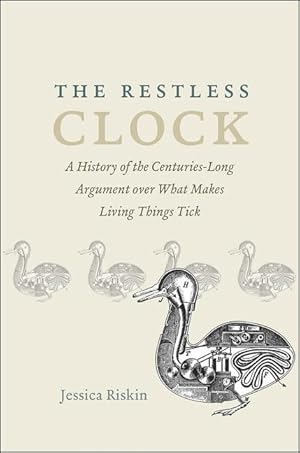
The Restless Clock
Lingua: Inglese
Editore: KNV Besorgung|University of Chicago Press, 2018
ISBN 10: 022652826X ISBN 13: 9780226528267
EUR 39,52
Spedizione EUR 48,99
Spedito da Germania a U.S.A.Quantità: 1 disponibili
Aggiungi al carrelloCondizione: New. Über den AutorJessica Riskin is professor of history at Stanford University and author of Science in the Age of Sensibility: The Sentimental Empiricists of the French Enlightenment, also published by the University of .
-

The Restless Clock
Lingua: Inglese
Editore: The University of Chicago Press, US, 2018
ISBN 10: 022652826X ISBN 13: 9780226528267
Da: Rarewaves USA United, OSWEGO, IL, U.S.A.
Valutazione del venditore 5 su 5 stelle
EUR 51,80
Spedizione EUR 43,06
Spedito in U.S.A.Quantità: Più di 20 disponibili
Aggiungi al carrelloPaperback. Condizione: New. Today, a scientific explanation is not meant to ascribe agency to natural phenomena: we would not say a rock falls because it seeks the center of the earth. Even for living things, in the natural sciences and often in the social sciences, the same is true. A modern botanist would not say that plants pursue sunlight. This has not always been the case, nor, perhaps, was it inevitable. Since the seventeenth century, many thinkers have made agency, in various forms, central to science. The Restless Clock examines the history of this principle, banning agency, in the life sciences. It also tells the story of dissenters embracing the opposite idea: that agency is essential to nature. The story begins with the automata of early modern Europe, as models for the new science of living things, and traces questions of science and agency through Descartes, Leibniz, Lamarck, and Darwin, among many others. Mechanist science, Jessica Riskin shows, had an associated theology: the argument from design, which found evidence for a designer in the mechanisms of nature.Rejecting such appeals to a supernatural God, the dissenters sought to naturalize agency rather than outsourcing it to a "divine engineer." Their model cast living things not as passive but as active, self-making machines. The conflict between passive- and active-mechanist approaches maintains a subterranean life in current science, shaping debates in fields such as evolutionary biology, cognitive science, and artificial intelligence. This history promises not only to inform such debates, but also our sense of the possibilities for what it means to engage in science and even what it means to be alive.
-

The Restless Clock : A History of the Centuries-Long Argument Over What Makes Living Things Tick
Lingua: Inglese
Editore: University Of Chicago Press Feb 2018, 2018
ISBN 10: 022652826X ISBN 13: 9780226528267
EUR 41,84
Spedizione EUR 65,30
Spedito da Germania a U.S.A.Quantità: 1 disponibili
Aggiungi al carrelloTaschenbuch. Condizione: Neu. Neuware - Today, a scientific explanation is not meant to ascribe agency to natural phenomena: we would not say a rock falls because it seeks the center of the earth. Even for living things, in the natural sciences and often in the social sciences, the same is true. A modern botanist would not say that plants pursue sunlight. This has not always been the case, nor, perhaps, was it inevitable. Since the seventeenth century, many thinkers have made agency, in various forms, central to science. The Restless Clock examines the history of this principle, banning agency, in the life sciences. It also tells the story of dissenters embracing the opposite idea: that agency is essential to nature. The story begins with the automata of early modern Europe, as models for the new science of living things, and traces questions of science and agency through Descartes, Leibniz, Lamarck, and Darwin, among many others. Mechanist science, Jessica Riskin shows, had an associated theology: the argument from design, which found evidence for a designer in the mechanisms of nature. Rejecting such appeals to a supernatural God, the dissenters sought to naturalize agency rather than outsourcing it to a 'divine engineer.' Their model cast living things not as passive but as active, self-making machines. The conflict between passive- and active-mechanist approaches maintains a subterranean life in current science, shaping debates in fields such as evolutionary biology, cognitive science, and artificial intelligence. This history promises not only to inform such debates, but also our sense of the possibilities for what it means to engage in science and even what it means to be alive.


