

Importo totale (1 articolo articoli):
Destinazione ordine:

9780300022391 - The Supreme Court and the Idea of Progress di Bickel, Alexander M. (20 risultati)
Vai alla pagina principale dei risultati di ricerca
Filtri di ricerca
Tipo di articolo
- Tutti i tipi di prodotto
- Libri (20)
- Riviste e Giornali (Nessun altro risultato corrispondente a questo perfezionamento)
- Fumetti (Nessun altro risultato corrispondente a questo perfezionamento)
- Spartiti (Nessun altro risultato corrispondente a questo perfezionamento)
- Arte, Stampe e Poster (Nessun altro risultato corrispondente a questo perfezionamento)
- Fotografie (Nessun altro risultato corrispondente a questo perfezionamento)
- Mappe (Nessun altro risultato corrispondente a questo perfezionamento)
- Manoscritti e Collezionismo cartaceo (Nessun altro risultato corrispondente a questo perfezionamento)
Condizioni Maggiori informazioni
- Nuovo (16)
- Come nuovo, Ottimo o Quasi ottimo (2)
- Molto buono o Buono (1)
- Discreto o Mediocre (1)
- Come descritto (Nessun altro risultato corrispondente a questo perfezionamento)
Legatura
- Tutte
- Rilegato (Nessun altro risultato corrispondente a questo perfezionamento)
- Brossura (20)
Ulteriori caratteristiche
- Prima ed. (Nessun altro risultato corrispondente a questo perfezionamento)
- Copia autograf. (Nessun altro risultato corrispondente a questo perfezionamento)
- Sovracoperta (Nessun altro risultato corrispondente a questo perfezionamento)
- Con foto (7)
- Non Print on Demand (16)
Lingua (1)
Spedizione gratuita
Paese del venditore
Valutazione venditore
-

The Supreme Court and the Idea of Progress
Da: -OnTimeBooks-, Phoenix, AZ, U.S.A.
Valutazione del venditore 5 su 5 stelle

Condizione: good. A copy that has been read, remains in good condition. All pages are intact, and the cover is intact. The spine and cover show signs of wear. Pages can include notes and highlighting and show signs of wear, and the copy can include "From the library of" labels or previous owner inscriptions. 100% GUARANTEE! Shipped with delivery confirmation, if you're not satisfied with purchase please return item! Ships via media mail.
-
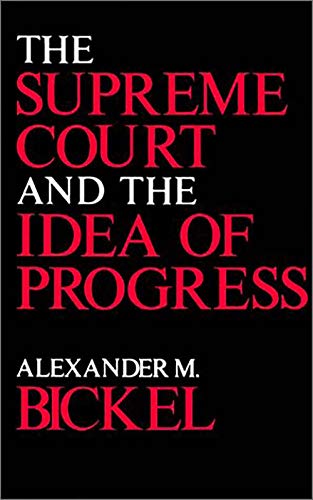
The Supreme Court and the Idea of Progress
Da: Midtown Scholar Bookstore, Harrisburg, PA, U.S.A.
Valutazione del venditore 5 su 5 stelle
paperback. Condizione: Acceptable. Acceptable - This is a significantly damaged book. It should be considered a reading copy only. Please order this book only if you are interested in the content and not the condition. May be ex-library. PAPERBACK Standard-sized.
-

The Supreme Court and the Idea of Progress
Da: Rarewaves.com USA, London, LONDO, Regno Unito
Valutazione del venditore 5 su 5 stelle
EUR 37,63
Spedizione gratuita
Spedito da Regno Unito a U.S.A.Quantità: Più di 20 disponibili
Aggiungi al carrelloPaperback. Condizione: New. Timeless questions about the role of the Supreme Court in the American political and legal system are raised in the late Alexander Bickel's characteristically astute analysis of the work of the Warren Court. He takes issue with the Court's view that its role should be to move the American polity in the direction of perfect equality and expresses his preference for "a more faithful adherence to the method of analytical reason, and a less confident reliance on the intuitive capacity to identify the course of progress." First published in 1970, this book made news with its prediction that the Court's best-known decision, in Brown v. Board of Education, might be headed for "irrelevance." Bickel charged the Court, particularly in its segregation and reapportionment cases, with being irrational, inconsistent, and even incoherent and argued that its decisions would lead to unwise centralization of government. He explored the limitations on the role of the court in stimulating social progress and concluded that the Warren Court had intervened in matters of social policy where the political process, not judicial action, should apply. "Process is what especially concerned him - the relationship between the legal and the political process in a country where the two are uniquely intermixed. If he criticized something done by the courts for the stated purpose of speeding school desegregation, that did not mean that he favored state-imposed racial discrimination; in fact he abhorred it. He was concerned, rather, about trying to solve complicated problems by legal formulas instead of leaving them to the give-and-take of the political process." -- Anthony Lewis.
-
Supreme Court and the Idea of Progress
Da: GreatBookPrices, Columbia, MD, U.S.A.
Valutazione del venditore 5 su 5 stelle
EUR 35,30
Spedizione EUR 2,27
Spedito in U.S.A.Quantità: Più di 20 disponibili
Aggiungi al carrelloCondizione: New.
-
Supreme Court and the Idea of Progress
Da: GreatBookPrices, Columbia, MD, U.S.A.
Valutazione del venditore 5 su 5 stelle
EUR 35,39
Spedizione EUR 2,27
Spedito in U.S.A.Quantità: Più di 20 disponibili
Aggiungi al carrelloCondizione: As New. Unread book in perfect condition.
-
The Supreme Court and the Idea of Progress (Paperback or Softback)
Lingua: Inglese
Editore: Yale University Press 1/1/1978, 1978
ISBN 10: 0300022395 ISBN 13: 9780300022391
Da: BargainBookStores, Grand Rapids, MI, U.S.A.
Valutazione del venditore 5 su 5 stelle
Paperback or Softback. Condizione: New. The Supreme Court and the Idea of Progress. Book.
-
The Supreme Court and the Idea of Progress (Paperback)
Lingua: Inglese
Editore: Yale University Press, New Haven, 1978
ISBN 10: 0300022395 ISBN 13: 9780300022391
Da: Grand Eagle Retail, Bensenville, IL, U.S.A.
Valutazione del venditore 5 su 5 stelle
Paperback. Condizione: new. Paperback. Timeless questions about the role of the Supreme Court in the American political and legal system are raised in the late Alexander Bickels characteristically astute analysis of the work of the Warren Court. He takes issue with the Courts view that its role should be to move the American polity in the direction of perfect equality and expresses his preference for "a more faithful adherence to the method of analytical reason, and a less confident reliance on the intuitive capacity to identify the course of progress." First published in 1970, this book made news with its prediction that the Courts best-known decision, in Brown v. Board of Education, might be headed for "irrelevance." Bickel charged the Court, particularly in its segregation and reapportionment cases, with being irrational, inconsistent, and even incoherent and argued that its decisions would lead to unwise centralization of government. He explored the limitations on the role of the court in stimulating social progress and concluded that the Warren Court had intervened in matters of social policy where the political process, not judicial action, should apply. "Process is what especially concerned him the relationship between the legal and the political process in a country where the two are uniquely intermixed. If he criticized something done by the courts for the stated purpose of speeding school desegregation, that did not mean that he favored state-imposed racial discrimination; in fact he abhorred it. He was concerned, rather, about trying to solve complicated problems by legal formulas instead of leaving them to the give-and-take of the political process." -- Anthony Lewis A history of the Warren Court and its impact on the political and legal system. Best known for its treatment of the Brown v. Board of Education decision, which Bickel believed was headed for obsolescence and abandonment. Based on the Oliver Wendell Holmes Lectures at Harvard Law School in 1969. Shipping may be from multiple locations in the US or from the UK, depending on stock availability.
-
The Supreme Court and the Idea of Progress
Lingua: Inglese
Editore: Yale University Press 2009-09-04, 2009
ISBN 10: 0300022395 ISBN 13: 9780300022391
Da: Chiron Media, Wallingford, Regno Unito
Valutazione del venditore 5 su 5 stelle
EUR 31,46
Spedizione EUR 17,89
Spedito da Regno Unito a U.S.A.Quantità: 10 disponibili
Aggiungi al carrelloPaperback. Condizione: New.
-
The Supreme Court and the Idea of Progress
Da: Ria Christie Collections, Uxbridge, Regno Unito
Valutazione del venditore 5 su 5 stelle
EUR 35,76
Spedizione EUR 13,83
Spedito da Regno Unito a U.S.A.Quantità: Più di 20 disponibili
Aggiungi al carrelloCondizione: New. In.
-
Supreme Court and the Idea of Progress
Da: GreatBookPricesUK, Woodford Green, Regno Unito
Valutazione del venditore 5 su 5 stelle
EUR 33,93
Spedizione EUR 17,32
Spedito da Regno Unito a U.S.A.Quantità: Più di 20 disponibili
Aggiungi al carrelloCondizione: New.
-
The Supreme Court and the Idea of Progress
Da: Kennys Bookshop and Art Galleries Ltd., Galway, GY, Irlanda
Valutazione del venditore 5 su 5 stelle
EUR 40,39
Spedizione EUR 10,50
Spedito da Irlanda a U.S.A.Quantità: Più di 20 disponibili
Aggiungi al carrelloCondizione: New. 2009. Revised ed. paperback. . . . . .
-
Supreme Court and the Idea of Progress
Da: GreatBookPricesUK, Woodford Green, Regno Unito
Valutazione del venditore 5 su 5 stelle
EUR 38,56
Spedizione EUR 17,32
Spedito da Regno Unito a U.S.A.Quantità: Più di 20 disponibili
Aggiungi al carrelloCondizione: As New. Unread book in perfect condition.
-
The Supreme Court and the Idea of Progress
Da: Kennys Bookstore, Olney, MD, U.S.A.
Valutazione del venditore 5 su 5 stelle
EUR 49,65
Spedizione EUR 9,04
Spedito in U.S.A.Quantità: Più di 20 disponibili
Aggiungi al carrelloCondizione: New. 2009. Revised ed. paperback. . . . . . Books ship from the US and Ireland.
-
EUR 43,44
Spedizione EUR 48,99
Spedito da Germania a U.S.A.Quantità: Più di 20 disponibili
Aggiungi al carrelloCondizione: New. KlappentextrnrnA history of the Warren Court and its impact on the political and legal system. Best known for its treatment of the Brown v. Board of Education decision, which Bickel believed was headed for obsolescence and abandonment. Based on .
-

The Supreme Court and the Idea of Progress
Da: Rarewaves.com UK, London, Regno Unito
Valutazione del venditore 5 su 5 stelle
EUR 33,94
Spedizione EUR 75,06
Spedito da Regno Unito a U.S.A.Quantità: Più di 20 disponibili
Aggiungi al carrelloPaperback. Condizione: New. Timeless questions about the role of the Supreme Court in the American political and legal system are raised in the late Alexander Bickel's characteristically astute analysis of the work of the Warren Court. He takes issue with the Court's view that its role should be to move the American polity in the direction of perfect equality and expresses his preference for "a more faithful adherence to the method of analytical reason, and a less confident reliance on the intuitive capacity to identify the course of progress." First published in 1970, this book made news with its prediction that the Court's best-known decision, in Brown v. Board of Education, might be headed for "irrelevance." Bickel charged the Court, particularly in its segregation and reapportionment cases, with being irrational, inconsistent, and even incoherent and argued that its decisions would lead to unwise centralization of government. He explored the limitations on the role of the court in stimulating social progress and concluded that the Warren Court had intervened in matters of social policy where the political process, not judicial action, should apply. "Process is what especially concerned him - the relationship between the legal and the political process in a country where the two are uniquely intermixed. If he criticized something done by the courts for the stated purpose of speeding school desegregation, that did not mean that he favored state-imposed racial discrimination; in fact he abhorred it. He was concerned, rather, about trying to solve complicated problems by legal formulas instead of leaving them to the give-and-take of the political process." -- Anthony Lewis.
-

The Supreme Court and the Idea of Progress
Lingua: Inglese
Editore: Yale University Press Jul 1978, 1978
ISBN 10: 0300022395 ISBN 13: 9780300022391
EUR 55,66
Spedizione EUR 61,27
Spedito da Germania a U.S.A.Quantità: 2 disponibili
Aggiungi al carrelloTaschenbuch. Condizione: Neu. Neuware - A history of the Warren Court and its impact on the political and legal system. Best known for its treatment of the Brown v. Board of Education decision, which Bickel believed was headed for obsolescence and abandonment. Based on the Oliver Wendell Holmes Lectures at Harvard Law School in 1969.
-
The Supreme Court and the Idea of Progress
Da: PBShop.store US, Wood Dale, IL, U.S.A.
Valutazione del venditore 5 su 5 stelle
EUR 37,85
Spedizione gratuita
Spedito in U.S.A.Quantità: Più di 20 disponibili
Aggiungi al carrelloPAP. Condizione: New. New Book. Shipped from UK. THIS BOOK IS PRINTED ON DEMAND. Established seller since 2000.
-
The Supreme Court and the Idea of Progress
Da: PBShop.store UK, Fairford, GLOS, Regno Unito
Valutazione del venditore 4 su 5 stelle

EUR 35,96
Spedizione EUR 4,80
Spedito da Regno Unito a U.S.A.Quantità: Più di 20 disponibili
Aggiungi al carrelloPAP. Condizione: New. New Book. Delivered from our UK warehouse in 4 to 14 business days. THIS BOOK IS PRINTED ON DEMAND. Established seller since 2000.
-
The Supreme Court and the Idea of Progress
Da: THE SAINT BOOKSTORE, Southport, Regno Unito
Valutazione del venditore 5 su 5 stelle
EUR 40,44
Spedizione EUR 15,68
Spedito da Regno Unito a U.S.A.Quantità: Più di 20 disponibili
Aggiungi al carrelloPaperback / softback. Condizione: New. This item is printed on demand. New copy - Usually dispatched within 5-9 working days.
-
The Supreme Court and the Idea of Progress (Paperback)
Lingua: Inglese
Editore: Yale University Press, New Haven, 1978
ISBN 10: 0300022395 ISBN 13: 9780300022391
Da: CitiRetail, Stevenage, Regno Unito
Valutazione del venditore 5 su 5 stelle
EUR 40,43
Spedizione EUR 42,73
Spedito da Regno Unito a U.S.A.Quantità: 1 disponibili
Aggiungi al carrelloPaperback. Condizione: new. Paperback. Timeless questions about the role of the Supreme Court in the American political and legal system are raised in the late Alexander Bickels characteristically astute analysis of the work of the Warren Court. He takes issue with the Courts view that its role should be to move the American polity in the direction of perfect equality and expresses his preference for "a more faithful adherence to the method of analytical reason, and a less confident reliance on the intuitive capacity to identify the course of progress." First published in 1970, this book made news with its prediction that the Courts best-known decision, in Brown v. Board of Education, might be headed for "irrelevance." Bickel charged the Court, particularly in its segregation and reapportionment cases, with being irrational, inconsistent, and even incoherent and argued that its decisions would lead to unwise centralization of government. He explored the limitations on the role of the court in stimulating social progress and concluded that the Warren Court had intervened in matters of social policy where the political process, not judicial action, should apply. "Process is what especially concerned him the relationship between the legal and the political process in a country where the two are uniquely intermixed. If he criticized something done by the courts for the stated purpose of speeding school desegregation, that did not mean that he favored state-imposed racial discrimination; in fact he abhorred it. He was concerned, rather, about trying to solve complicated problems by legal formulas instead of leaving them to the give-and-take of the political process." -- Anthony Lewis A history of the Warren Court and its impact on the political and legal system. Best known for its treatment of the Brown v. Board of Education decision, which Bickel believed was headed for obsolescence and abandonment. Based on the Oliver Wendell Holmes Lectures at Harvard Law School in 1969. This item is printed on demand. Shipping may be from our UK warehouse or from our Australian or US warehouses, depending on stock availability.

