
Importo totale (1 articolo articoli):
Destinazione ordine:

9780309472616 - Modernizing Crime Statistics: Report 2 - New Systems for Measuring Crime (10 risultati)
Vai alla pagina principale dei risultati di ricerca
Filtri di ricerca
Tipo di articolo
- Tutti i tipi di prodotto
- Libri (10)
- Riviste e Giornali (Nessun altro risultato corrispondente a questo perfezionamento)
- Fumetti (Nessun altro risultato corrispondente a questo perfezionamento)
- Spartiti (Nessun altro risultato corrispondente a questo perfezionamento)
- Arte, Stampe e Poster (Nessun altro risultato corrispondente a questo perfezionamento)
- Fotografie (Nessun altro risultato corrispondente a questo perfezionamento)
- Mappe (Nessun altro risultato corrispondente a questo perfezionamento)
- Manoscritti e Collezionismo cartaceo (Nessun altro risultato corrispondente a questo perfezionamento)
Condizioni Maggiori informazioni
- Nuovo (10)
- Come nuovo, Ottimo o Quasi ottimo (Nessun altro risultato corrispondente a questo perfezionamento)
- Molto buono o Buono (Nessun altro risultato corrispondente a questo perfezionamento)
- Discreto o Mediocre (Nessun altro risultato corrispondente a questo perfezionamento)
- Come descritto (Nessun altro risultato corrispondente a questo perfezionamento)
Legatura
- Tutte
- Rilegato (Nessun altro risultato corrispondente a questo perfezionamento)
- Brossura (10)
Ulteriori caratteristiche
- Prima ed. (Nessun altro risultato corrispondente a questo perfezionamento)
- Copia autograf. (Nessun altro risultato corrispondente a questo perfezionamento)
- Sovracoperta (Nessun altro risultato corrispondente a questo perfezionamento)
- Con foto (2)
- Non Print on Demand (10)
Lingua (1)
Prezzo
- Qualsiasi prezzo
- Inferiore a EUR 20 (Nessun altro risultato corrispondente a questo perfezionamento)
- EUR 20 a EUR 45 (Nessun altro risultato corrispondente a questo perfezionamento)
- Superiore a EUR 45
Spedizione gratuita
Paese del venditore
Valutazione venditore
-
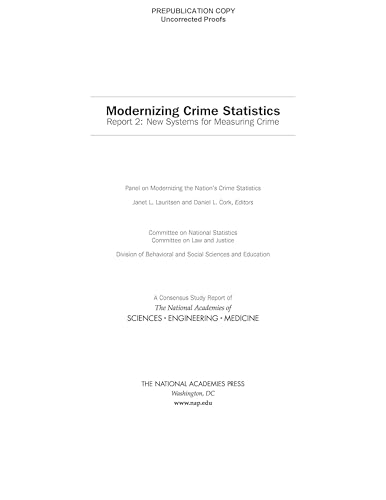
Modernizing Crime Statistics: Report 2: New Systems for Measuring Crime
Da: Ria Christie Collections, Uxbridge, Regno Unito
Valutazione del venditore 5 su 5 stelle

EUR 67,96
EUR 13,84 shipping
Spedito da Regno Unito a U.S.A.Quantità: 2 disponibili
Aggiungi al carrelloCondizione: New. In.
-
Modernizing Crime Statistics: Report 2 (Paperback)
Lingua: Inglese
Editore: National Academies Press, Washington, 2018
ISBN 10: 030947261X ISBN 13: 9780309472616
Da: Grand Eagle Retail, Bensenville, IL, U.S.A.
Valutazione del venditore 5 su 5 stelle
Paperback. Condizione: new. Paperback. To derive statistics about crime to estimate its levels and trends, assess its costs to and impacts on society, and inform law enforcement approaches to prevent it a conceptual framework for defining and thinking about crime is virtually a prerequisite. Developing and maintaining such a framework is no easy task, because the mechanics of crime are ever evolving and shifting: tied to shifts and development in technology, society, and legislation.Interest in understanding crime surged in the 1920s, which proved to be a pivotal decade for the collection of nationwide crime statistics. Now established as a permanent agency, the Census Bureau commissioned the drafting of a manual for preparing crime statisticsintended for use by the police, corrections departments, and courts alike. The new manual sought to solve a perennial problem by suggesting a standard taxonomy of crime. Shortly after the Census Bureau issued its manual, the International Association of Chiefs of Police in convention adopted a resolution to create a Committee on Uniform Crime Records to begin the process of describing what a national system of data on crimes known to the police might look like.Report 1 performed a comprehensive reassessment of what is meant by crime in U.S. crime statistics and recommends a new classification of crime to organize measurement efforts. This second report examines methodological and implementation issues and presents a conceptual blueprint for modernizing crime statistics.Table of ContentsFront MatterSummary1 Introduction2 "Traditional" and "New" Crime: Structuring a Modern Crime Statistics Enterprise3 Coordination and Governance of Modern National Crime StatisticsReferencesAppendixesAppendix A: Charge to the Panel on Modernizing the Nation's Crime StatisticsAppendix B: Historical Themes in the Development of U.S. Nationa lCrime StatisticsAppendix C: Coverage of Recommended Crime Classification in Current Crime StatisticsAppendix D: Remaining Methodology and Implementation Issues for Modern Crime StatisticsAppendix E: Excerpted State Legal Requirements for Crime ReportingAppendix F: Cautionary Tales from International Experience: Police-Report Crime Statistics in the United KingdomAppendix G: Biographical Sketches of Panel Members and StaffCommittee on National Statistics Shipping may be from multiple locations in the US or from the UK, depending on stock availability.
-
Modernizing Crime Statistics Repor
Da: Kennys Bookshop and Art Galleries Ltd., Galway, GY, Irlanda
Valutazione del venditore 5 su 5 stelle
EUR 76,02
EUR 10,50 shipping
Spedito da Irlanda a U.S.A.Quantità: 2 disponibili
Aggiungi al carrelloCondizione: New.
-
Modernizing Crime Statistics: Report 2 - New Systems for Measuring Crime
Da: Revaluation Books, Exeter, Regno Unito
Valutazione del venditore 5 su 5 stelle
EUR 79,08
EUR 11,55 shipping
Spedito da Regno Unito a U.S.A.Quantità: 2 disponibili
Aggiungi al carrelloPaperback. Condizione: Brand New. 280 pages. 9.00x6.00x0.75 inches. In Stock.
-
Modernizing Crime Statistics: Report 2: New Systems for Measuring Crime
Da: THE SAINT BOOKSTORE, Southport, Regno Unito
Valutazione del venditore 5 su 5 stelle
EUR 76,55
EUR 18,49 shipping
Spedito da Regno Unito a U.S.A.Quantità: 2 disponibili
Aggiungi al carrelloPaperback / softback. Condizione: New. New copy - Usually dispatched within 3 working days.
-
Modernizing Crime Statistics Repor
Da: Kennys Bookstore, Olney, MD, U.S.A.
Valutazione del venditore 5 su 5 stelle
Condizione: New.
-
EUR 56,84
EUR 47,36 shipping
Spedito da Regno Unito a U.S.A.Quantità: 2 disponibili
Aggiungi al carrelloCondizione: NEW.
-
Modernizing Crime Statistics: Report 2 (Paperback)
Lingua: Inglese
Editore: National Academies Press, Washington, 2018
ISBN 10: 030947261X ISBN 13: 9780309472616
Da: AussieBookSeller, Truganina, VIC, Australia
Valutazione del venditore 5 su 5 stelle
EUR 88,31
EUR 31,58 shipping
Spedito da Australia a U.S.A.Quantità: 1 disponibili
Aggiungi al carrelloPaperback. Condizione: new. Paperback. To derive statistics about crime to estimate its levels and trends, assess its costs to and impacts on society, and inform law enforcement approaches to prevent it a conceptual framework for defining and thinking about crime is virtually a prerequisite. Developing and maintaining such a framework is no easy task, because the mechanics of crime are ever evolving and shifting: tied to shifts and development in technology, society, and legislation.Interest in understanding crime surged in the 1920s, which proved to be a pivotal decade for the collection of nationwide crime statistics. Now established as a permanent agency, the Census Bureau commissioned the drafting of a manual for preparing crime statisticsintended for use by the police, corrections departments, and courts alike. The new manual sought to solve a perennial problem by suggesting a standard taxonomy of crime. Shortly after the Census Bureau issued its manual, the International Association of Chiefs of Police in convention adopted a resolution to create a Committee on Uniform Crime Records to begin the process of describing what a national system of data on crimes known to the police might look like.Report 1 performed a comprehensive reassessment of what is meant by crime in U.S. crime statistics and recommends a new classification of crime to organize measurement efforts. This second report examines methodological and implementation issues and presents a conceptual blueprint for modernizing crime statistics.Table of ContentsFront MatterSummary1 Introduction2 "Traditional" and "New" Crime: Structuring a Modern Crime Statistics Enterprise3 Coordination and Governance of Modern National Crime StatisticsReferencesAppendixesAppendix A: Charge to the Panel on Modernizing the Nation's Crime StatisticsAppendix B: Historical Themes in the Development of U.S. Nationa lCrime StatisticsAppendix C: Coverage of Recommended Crime Classification in Current Crime StatisticsAppendix D: Remaining Methodology and Implementation Issues for Modern Crime StatisticsAppendix E: Excerpted State Legal Requirements for Crime ReportingAppendix F: Cautionary Tales from International Experience: Police-Report Crime Statistics in the United KingdomAppendix G: Biographical Sketches of Panel Members and StaffCommittee on National Statistics Shipping may be from our Sydney, NSW warehouse or from our UK or US warehouse, depending on stock availability.
-

Modernizing Crime Statistics: Report 2 : New Systems for Measuring Crime
Lingua: Inglese
Editore: National Academies Press Mai 2018, 2018
ISBN 10: 030947261X ISBN 13: 9780309472616
EUR 82,22
EUR 62,40 shipping
Spedito da Germania a U.S.A.Quantità: 2 disponibili
Aggiungi al carrelloTaschenbuch. Condizione: Neu. Neuware - 'To derive statistics about crime - to estimate its levels and trends, assess its costs to and impacts on society, and inform law enforcement approaches to prevent it - a conceptual framework for defining and thinking about crime is virtually a prerequisite. Developing and maintaining such a framework is no easy task, because the mechanics of crime are ever evolving and shifting: tied to shifts and development in technology, society, and legislation. Interest in understanding crime surged in the 1920s, which proved to be a pivotal decade for the collection of nationwide crime statistics. Now established as a permanent agency, the Census Bureau commissioned the drafting of a manual for preparing crime statistics--intended for use by the police, corrections departments, and courts alike. The new manual sought to solve a perennial problem by suggesting a standard taxonomy of crime. Shortly after the Census Bureau issued its manual, the International Association of Chiefs of Police in convention adopted a resolution to create a Committee on Uniform Crime Records --to begin the process of describing what a national system of data on crimes known to the police might look like. Report 1 performed a comprehensive reassessment of what is meant by crime in U.S. crime statistics and recommends a new classification of crime to organize measurement efforts. This second report examines methodological and implementation issues and presents a conceptual blueprint for modernizing crime statistics'--Publisher's description.
-

EUR 82,00
EUR 70,00 shipping
Spedito da Germania a U.S.A.Quantità: 1 disponibili
Aggiungi al carrelloTaschenbuch. Condizione: Neu. Modernizing Crime Statistics: Report 2 | New Systems for Measuring Crime | National Academies of Sciences Engineering and Medicine (u. a.) | Taschenbuch | Kartoniert / Broschiert | Englisch | 2018 | National Academies Press | EAN 9780309472616 | Verantwortliche Person für die EU: Libri GmbH, Europaallee 1, 36244 Bad Hersfeld, gpsr[at]libri[dot]de | Anbieter: preigu.
