
Importo totale (1 articolo articoli):
Destinazione ordine:

9780521403757 - The Reactive Keyboard di Darragh, John J.; Witten, Ian H. (12 risultati)
Vai alla pagina principale dei risultati di ricerca
Filtri di ricerca
Tipo di articolo
- Tutti i tipi di prodotto
- Libri (12)
- Riviste e Giornali (Nessun altro risultato corrispondente a questo perfezionamento)
- Fumetti (Nessun altro risultato corrispondente a questo perfezionamento)
- Spartiti (Nessun altro risultato corrispondente a questo perfezionamento)
- Arte, Stampe e Poster (Nessun altro risultato corrispondente a questo perfezionamento)
- Fotografie (Nessun altro risultato corrispondente a questo perfezionamento)
- Mappe (Nessun altro risultato corrispondente a questo perfezionamento)
- Manoscritti e Collezionismo cartaceo (Nessun altro risultato corrispondente a questo perfezionamento)
Condizioni Maggiori informazioni
- Nuovo (12)
- Come nuovo, Ottimo o Quasi ottimo (Nessun altro risultato corrispondente a questo perfezionamento)
- Molto buono o Buono (Nessun altro risultato corrispondente a questo perfezionamento)
- Discreto o Mediocre (Nessun altro risultato corrispondente a questo perfezionamento)
- Come descritto (Nessun altro risultato corrispondente a questo perfezionamento)
Legatura
- Tutte
- Rilegato (12)
- Brossura (Nessun altro risultato corrispondente a questo perfezionamento)
Ulteriori caratteristiche
- Prima ed. (Nessun altro risultato corrispondente a questo perfezionamento)
- Copia autograf. (Nessun altro risultato corrispondente a questo perfezionamento)
- Sovracoperta (Nessun altro risultato corrispondente a questo perfezionamento)
- Con foto (2)
- Non Print on Demand (5)
Lingua (1)
Prezzo
- Qualsiasi prezzo
- Inferiore a EUR 20 (Nessun altro risultato corrispondente a questo perfezionamento)
- EUR 20 a EUR 40 (Nessun altro risultato corrispondente a questo perfezionamento)
- Superiore a EUR 40
Spedizione gratuita
Paese del venditore
Valutazione venditore
-
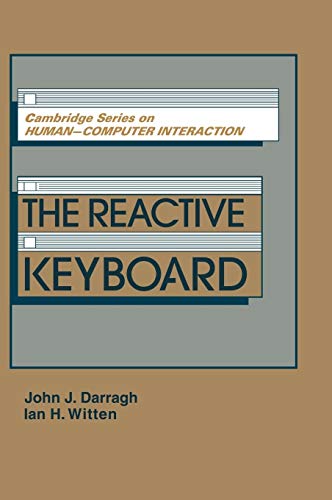
The Reactive Keyboard (Cambridge Series on Human-Computer Interaction, Series Number 5)
Lingua: Inglese
Editore: Cambridge University Press, 1992
ISBN 10: 0521403758 ISBN 13: 9780521403757
Da: Lucky's Textbooks, Dallas, TX, U.S.A.
Valutazione del venditore 5 su 5 stelle

EUR 74,18
Spedizione EUR 3,37
Spedito in U.S.A.Quantità: Più di 20 disponibili
Aggiungi al carrelloCondizione: New.
-
The Reactive Keyboard (Hardcover)
Lingua: Inglese
Editore: Cambridge University Press, Cambridge, 1992
ISBN 10: 0521403758 ISBN 13: 9780521403757
Da: Grand Eagle Retail, Bensenville, IL, U.S.A.
Valutazione del venditore 5 su 5 stelle
Hardcover. Condizione: new. Hardcover. Extremely slow communication is a daily reality for many people with different forms of physical disability. Modern computer interfaces can be designed to enhance expressive communication. This is accomplished first by supplying facilities to tailor them to each particular user's residual physical disabilities, and second by automatically supplying much of the redundancy inherent in natural communication. In the first part of this book a functional architecture for communication aids is discussed and the idea of automatically supplying the intrinsic redundancy contained in natural communication is explained. The distinctions between adaptive and non-adaptive models of communication are shown and details are given of working predictive text generation systems. One such system is the Reactive Keyboard, and in the second part of the book this is described. It greatly speeds communication by predicting the user's next response before it is made, although it does not always predict correctly. The guesses are made on the basis of previous answers and thus can conform to whatever kind of text is entered. Versions of the Reactive Keyboard exist for Unix, IBM PC, and Macintosh systems, free of charge, and can be tailored to individual user needs. This book will be of great value to all involved in helping disabled users interact with computers. This book discusses a functional architecture for communication aids and details are given of working predictive text generation systems, specifically the Reactive Keyboard. Shipping may be from multiple locations in the US or from the UK, depending on stock availability.
-
The Reactive Keyboard (Cambridge Series on Human-Computer Interaction, Series Number 5)
Lingua: Inglese
Editore: Cambridge University Press, 1992
ISBN 10: 0521403758 ISBN 13: 9780521403757
Da: Ria Christie Collections, Uxbridge, Regno Unito
Valutazione del venditore 5 su 5 stelle
EUR 84,52
Spedizione EUR 13,79
Spedito da Regno Unito a U.S.A.Quantità: Più di 20 disponibili
Aggiungi al carrelloCondizione: New. In.
-
The Reactive Keyboard
Lingua: Inglese
Editore: Cambridge University Press CUP, 1992
ISBN 10: 0521403758 ISBN 13: 9780521403757
Da: Books Puddle, New York, NY, U.S.A.
Valutazione del venditore 4 su 5 stelle

Condizione: New. pp. 200.
-

The Reactive Keyboard
Lingua: Inglese
Editore: Cambridge University Press, 1992
ISBN 10: 0521403758 ISBN 13: 9780521403757
EUR 107,06
Spedizione EUR 62,91
Spedito da Germania a U.S.A.Quantità: 1 disponibili
Aggiungi al carrelloBuch. Condizione: Neu. Druck auf Anfrage Neuware - Printed after ordering - This book discusses a functional architecture for communication aids and details are given of working predictive text generation systems, specifically the Reactive Keyboard.
-
The Reactive Keyboard (Cambridge Series on Human-Computer Interaction)
Da: Revaluation Books, Exeter, Regno Unito
Valutazione del venditore 5 su 5 stelle
EUR 87,71
Spedizione EUR 14,38
Spedito da Regno Unito a U.S.A.Quantità: 1 disponibili
Aggiungi al carrelloHardcover. Condizione: Brand New. 198 pages. 10.50x7.50x0.75 inches. In Stock. This item is printed on demand.
-
The Reactive Keyboard
Lingua: Inglese
Editore: Cambridge University Press, 1992
ISBN 10: 0521403758 ISBN 13: 9780521403757
Da: THE SAINT BOOKSTORE, Southport, Regno Unito
Valutazione del venditore 5 su 5 stelle
EUR 91,24
Spedizione EUR 19,76
Spedito da Regno Unito a U.S.A.Quantità: Più di 20 disponibili
Aggiungi al carrelloHardback. Condizione: New. This item is printed on demand. New copy - Usually dispatched within 5-9 working days.
-
The Reactive Keyboard
Lingua: Inglese
Editore: Cambridge University Press, 1992
ISBN 10: 0521403758 ISBN 13: 9780521403757
Da: Majestic Books, Hounslow, Regno Unito
Valutazione del venditore 4 su 5 stelle
EUR 115,32
Spedizione EUR 7,48
Spedito da Regno Unito a U.S.A.Quantità: 4 disponibili
Aggiungi al carrelloCondizione: New. Print on Demand pp. 200 68:B&W 7 x 10 in or 254 x 178 mm Case Laminate on White w/Gloss Lam.
-
The Reactive Keyboard (Hardcover)
Lingua: Inglese
Editore: Cambridge University Press, Cambridge, 1992
ISBN 10: 0521403758 ISBN 13: 9780521403757
Da: AussieBookSeller, Truganina, VIC, Australia
Valutazione del venditore 5 su 5 stelle
EUR 94,47
Spedizione EUR 31,28
Spedito da Australia a U.S.A.Quantità: 1 disponibili
Aggiungi al carrelloHardcover. Condizione: new. Hardcover. Extremely slow communication is a daily reality for many people with different forms of physical disability. Modern computer interfaces can be designed to enhance expressive communication. This is accomplished first by supplying facilities to tailor them to each particular user's residual physical disabilities, and second by automatically supplying much of the redundancy inherent in natural communication. In the first part of this book a functional architecture for communication aids is discussed and the idea of automatically supplying the intrinsic redundancy contained in natural communication is explained. The distinctions between adaptive and non-adaptive models of communication are shown and details are given of working predictive text generation systems. One such system is the Reactive Keyboard, and in the second part of the book this is described. It greatly speeds communication by predicting the user's next response before it is made, although it does not always predict correctly. The guesses are made on the basis of previous answers and thus can conform to whatever kind of text is entered.Versions of the Reactive Keyboard exist for Unix, IBM PC, and Macintosh systems, free of charge, and can be tailored to individual user needs. This book will be of great value to all involved in helping disabled users interact with computers. This book describes the Reactive Keyboard, a device to assist disabled users interaction with computers by predicting the user's next response. This item is printed on demand. Shipping may be from our Sydney, NSW warehouse or from our UK or US warehouse, depending on stock availability.
-
The Reactive Keyboard
Lingua: Inglese
Editore: Cambridge University Press, 1992
ISBN 10: 0521403758 ISBN 13: 9780521403757
Da: Biblios, Frankfurt am main, HESSE, Germania
Valutazione del venditore 4 su 5 stelle
EUR 119,31
Spedizione EUR 9,95
Spedito da Germania a U.S.A.Quantità: 4 disponibili
Aggiungi al carrelloCondizione: New. PRINT ON DEMAND pp. 200.
-
The Reactive Keyboard (Hardcover)
Lingua: Inglese
Editore: Cambridge University Press, Cambridge, 1992
ISBN 10: 0521403758 ISBN 13: 9780521403757
Da: CitiRetail, Stevenage, Regno Unito
Valutazione del venditore 5 su 5 stelle
EUR 94,21
Spedizione EUR 42,58
Spedito da Regno Unito a U.S.A.Quantità: 1 disponibili
Aggiungi al carrelloHardcover. Condizione: new. Hardcover. Extremely slow communication is a daily reality for many people with different forms of physical disability. Modern computer interfaces can be designed to enhance expressive communication. This is accomplished first by supplying facilities to tailor them to each particular user's residual physical disabilities, and second by automatically supplying much of the redundancy inherent in natural communication. In the first part of this book a functional architecture for communication aids is discussed and the idea of automatically supplying the intrinsic redundancy contained in natural communication is explained. The distinctions between adaptive and non-adaptive models of communication are shown and details are given of working predictive text generation systems. One such system is the Reactive Keyboard, and in the second part of the book this is described. It greatly speeds communication by predicting the user's next response before it is made, although it does not always predict correctly. The guesses are made on the basis of previous answers and thus can conform to whatever kind of text is entered. Versions of the Reactive Keyboard exist for Unix, IBM PC, and Macintosh systems, free of charge, and can be tailored to individual user needs. This book will be of great value to all involved in helping disabled users interact with computers. This book discusses a functional architecture for communication aids and details are given of working predictive text generation systems, specifically the Reactive Keyboard. This item is printed on demand. Shipping may be from our UK warehouse or from our Australian or US warehouses, depending on stock availability.
-

The Reactive Keyboard
Lingua: Inglese
Editore: Cambridge University Press, 2012
ISBN 10: 0521403758 ISBN 13: 9780521403757
EUR 86,39
Spedizione EUR 48,99
Spedito da Germania a U.S.A.Quantità: Più di 20 disponibili
Aggiungi al carrelloGebunden. Condizione: New. Dieser Artikel ist ein Print on Demand Artikel und wird nach Ihrer Bestellung fuer Sie gedruckt. This 1992 book discusses a functional architecture for communication aids and the idea of automatically supplying the intrinsic redundancy contained in natural communication. The distinctions between adaptive and non-adaptive models of communication are sho.

