

Importo totale (1 articolo articoli):
Destinazione ordine:

9780567625205 - Word of God in Transition: From Prophet to Exegete in the Second Temple Period: 197 di Schniedewind, William M. (16 risultati)
Vai alla pagina principale dei risultati di ricerca
Filtri di ricerca
Tipo di articolo
- Tutti i tipi di prodotto
- Libri (16)
- Riviste e Giornali (Nessun altro risultato corrispondente a questo perfezionamento)
- Fumetti (Nessun altro risultato corrispondente a questo perfezionamento)
- Spartiti (Nessun altro risultato corrispondente a questo perfezionamento)
- Arte, Stampe e Poster (Nessun altro risultato corrispondente a questo perfezionamento)
- Fotografie (Nessun altro risultato corrispondente a questo perfezionamento)
- Mappe (Nessun altro risultato corrispondente a questo perfezionamento)
- Manoscritti e Collezionismo cartaceo (Nessun altro risultato corrispondente a questo perfezionamento)
Condizioni Maggiori informazioni
- Nuovo (14)
- Come nuovo, Ottimo o Quasi ottimo (2)
- Molto buono o Buono (Nessun altro risultato corrispondente a questo perfezionamento)
- Discreto o Mediocre (Nessun altro risultato corrispondente a questo perfezionamento)
- Come descritto (Nessun altro risultato corrispondente a questo perfezionamento)
Legatura
- Tutte
- Rilegato (Nessun altro risultato corrispondente a questo perfezionamento)
- Brossura (16)
Ulteriori caratteristiche
- Prima ed. (Nessun altro risultato corrispondente a questo perfezionamento)
- Copia autograf. (Nessun altro risultato corrispondente a questo perfezionamento)
- Sovracoperta (Nessun altro risultato corrispondente a questo perfezionamento)
- Con foto (6)
- Non Print on Demand (8)
Lingua (1)
Prezzo
- Qualsiasi prezzo
- Inferiore a EUR 20 (Nessun altro risultato corrispondente a questo perfezionamento)
- EUR 20 a EUR 45 (Nessun altro risultato corrispondente a questo perfezionamento)
- Superiore a EUR 45
Spedizione gratuita
Paese del venditore
Valutazione venditore
-

Word of God in Transition : From Prophet to Exegete in the Second Temple Period
Da: GreatBookPrices, Columbia, MD, U.S.A.
Valutazione del venditore 5 su 5 stelle

EUR 51,28
Spedizione EUR 2,30
Spedito in U.S.A.Quantità: Più di 20 disponibili
Aggiungi al carrelloCondizione: As New. Unread book in perfect condition.
-

Word of God in Transition : From Prophet to Exegete in the Second Temple Period
Da: GreatBookPrices, Columbia, MD, U.S.A.
Valutazione del venditore 5 su 5 stelle
EUR 51,51
Spedizione EUR 2,30
Spedito in U.S.A.Quantità: Più di 20 disponibili
Aggiungi al carrelloCondizione: New.
-

The Word of God in Transition: From Prophet to Exegete in the Second Temple Period (Paperback or Softback)
Da: BargainBookStores, Grand Rapids, MI, U.S.A.
Valutazione del venditore 5 su 5 stelle
Paperback or Softback. Condizione: New. The Word of God in Transition: From Prophet to Exegete in the Second Temple Period. Book.
-
The Word of God in Transition: From Prophet to Exegete in the Second Temple Period (The Library of Hebrew Bible/Old Testament Studies)
Da: Ria Christie Collections, Uxbridge, Regno Unito
Valutazione del venditore 5 su 5 stelle
EUR 49,35
Spedizione EUR 13,80
Spedito da Regno Unito a U.S.A.Quantità: Più di 20 disponibili
Aggiungi al carrelloCondizione: New. In.
-
Word of God in Transition: From Prophet to Exegete in the Second Temple Period: 197 (The Library of Hebrew Bible/Old Testament Studies)
Lingua: Inglese
Editore: T & T Clark International 2009-02-01, 2009
ISBN 10: 0567625206 ISBN 13: 9780567625205
Da: Chiron Media, Wallingford, Regno Unito
Valutazione del venditore 5 su 5 stelle
EUR 45,44
Spedizione EUR 17,85
Spedito da Regno Unito a U.S.A.Quantità: Più di 20 disponibili
Aggiungi al carrelloPaperback. Condizione: New.
-

Word of God in Transition : From Prophet to Exegete in the Second Temple Period
Da: GreatBookPricesUK, Woodford Green, Regno Unito
Valutazione del venditore 5 su 5 stelle
EUR 48,38
Spedizione EUR 17,28
Spedito da Regno Unito a U.S.A.Quantità: Più di 20 disponibili
Aggiungi al carrelloCondizione: New.
-
Word of God in Transition : From Prophet to Exegete in the Second Temple Period
Da: GreatBookPricesUK, Woodford Green, Regno Unito
Valutazione del venditore 5 su 5 stelle
EUR 53,89
Spedizione EUR 17,28
Spedito da Regno Unito a U.S.A.Quantità: Più di 20 disponibili
Aggiungi al carrelloCondizione: As New. Unread book in perfect condition.
-
The Word of God in Transition: From Prophet to Exegete in the Second Temple Period
Da: Revaluation Books, Exeter, Regno Unito
Valutazione del venditore 5 su 5 stelle
EUR 78,55
Spedizione EUR 11,52
Spedito da Regno Unito a U.S.A.Quantità: 2 disponibili
Aggiungi al carrelloPaperback. Condizione: Brand New. 275 pages. 9.00x6.00x0.50 inches. In Stock.
-
The Word of God in Transition
Lingua: Inglese
Editore: Bloomsbury Publishing (UK), 2009
ISBN 10: 0567625206 ISBN 13: 9780567625205
Da: PBShop.store US, Wood Dale, IL, U.S.A.
Valutazione del venditore 5 su 5 stelle
EUR 53,89
Spedizione gratuita
Spedito in U.S.A.Quantità: Più di 20 disponibili
Aggiungi al carrelloPAP. Condizione: New. New Book. Shipped from UK. THIS BOOK IS PRINTED ON DEMAND. Established seller since 2000.
-
The Word of God in Transition
Lingua: Inglese
Editore: Bloomsbury Publishing (UK), 2009
ISBN 10: 0567625206 ISBN 13: 9780567625205
Da: PBShop.store UK, Fairford, GLOS, Regno Unito
Valutazione del venditore 5 su 5 stelle
EUR 49,82
Spedizione EUR 5,78
Spedito da Regno Unito a U.S.A.Quantità: Più di 20 disponibili
Aggiungi al carrelloPAP. Condizione: New. New Book. Delivered from our UK warehouse in 4 to 14 business days. THIS BOOK IS PRINTED ON DEMAND. Established seller since 2000.
-
The Word of God in Transition (Paperback)
Lingua: Inglese
Editore: Bloomsbury Publishing PLC, London, 2009
ISBN 10: 0567625206 ISBN 13: 9780567625205
Da: Grand Eagle Retail, Bensenville, IL, U.S.A.
Valutazione del venditore 5 su 5 stelle
Paperback. Condizione: new. Paperback. The Chronicler distinguishes between "traditional prophets" and "inspired messengers", and thereby highlights a radical transition in the meaning of the "word of God" which takes place in the post-exilic period. The Chronicler summarizes his perspective in 2 Chron. 36.16, saying that Israel rejected "his prophets", "the messengers of God", and "his word" (i.e. Torah). This distinction is reflected in the forms and functions of prophetic speech in the books of Chronicles. Thus, the prophets speak to the king, and the inspired messengers (e.g. priests, levites) speak to the people. The prophets interpret narrative events for the king; they explain how God acts. The inspired messengers exhort the people, admonishing them how they should act. The prophets' speeches usually do not use any kind of inspiration formula, but the inspired messengers' speeches are prefaced with possession formulas. These possession formulas are not typical of classical prophecy and mark the rise of a new kind of prophecy, namely, the inspired interpretation of texts. These inspired messengers are thus forerunners of the inspired interpreters of scripture in Qumran, early Christianity and Judaism. The Chronicler distinguishes between "traditional prophets" and "inspired messengers," and thereby highlights a radical transition in the meaning of the "word of God" which takes place in the post-exilic period. The Chronicler summarizes his perspective in 2 Chron. 36.16, saying that Israel rejected "his prophets," "the messengers of God," and "his word" (i.e. Torah). This distinction is reflected in the forms and functions of prophetic speech in the books of Chronicles. Thus, the prophets speak to the king, and the inspired messengers (e.g. priests, levites) speak to the people. The prophets interpret narrative events for the king; they explain how God acts. The inspired messengers exhort the people, admonishing them how they should act. The prophets' speeches usually do not use any kind of inspiration formula, but the inspired messengers' speeches are prefaced with possession formulas. These possession formulas are not typical of classical prophecy and mark the rise of a new kind of prophecy, namely, the inspired interpretation of texts. These inspired messengers are thus forerunners of the inspired interpreters of scripture in Qumran, early Christianity and Judaism. This item is printed on demand. Shipping may be from multiple locations in the US or from the UK, depending on stock availability.
-
The Word of God in Transition: From Prophet to Exegete in the Second Temple Period
Da: THE SAINT BOOKSTORE, Southport, Regno Unito
Valutazione del venditore 5 su 5 stelle
EUR 55,93
Spedizione EUR 17,46
Spedito da Regno Unito a U.S.A.Quantità: Più di 20 disponibili
Aggiungi al carrelloPaperback / softback. Condizione: New. This item is printed on demand. New copy - Usually dispatched within 5-9 working days.
-
The Word of God in Transition (Paperback)
Lingua: Inglese
Editore: Bloomsbury Publishing PLC, London, 2009
ISBN 10: 0567625206 ISBN 13: 9780567625205
Da: CitiRetail, Stevenage, Regno Unito
Valutazione del venditore 5 su 5 stelle
EUR 54,58
Spedizione EUR 42,63
Spedito da Regno Unito a U.S.A.Quantità: 1 disponibili
Aggiungi al carrelloPaperback. Condizione: new. Paperback. The Chronicler distinguishes between "traditional prophets" and "inspired messengers", and thereby highlights a radical transition in the meaning of the "word of God" which takes place in the post-exilic period. The Chronicler summarizes his perspective in 2 Chron. 36.16, saying that Israel rejected "his prophets", "the messengers of God", and "his word" (i.e. Torah). This distinction is reflected in the forms and functions of prophetic speech in the books of Chronicles. Thus, the prophets speak to the king, and the inspired messengers (e.g. priests, levites) speak to the people. The prophets interpret narrative events for the king; they explain how God acts. The inspired messengers exhort the people, admonishing them how they should act. The prophets' speeches usually do not use any kind of inspiration formula, but the inspired messengers' speeches are prefaced with possession formulas. These possession formulas are not typical of classical prophecy and mark the rise of a new kind of prophecy, namely, the inspired interpretation of texts. These inspired messengers are thus forerunners of the inspired interpreters of scripture in Qumran, early Christianity and Judaism. The Chronicler distinguishes between "traditional prophets" and "inspired messengers," and thereby highlights a radical transition in the meaning of the "word of God" which takes place in the post-exilic period. The Chronicler summarizes his perspective in 2 Chron. 36.16, saying that Israel rejected "his prophets," "the messengers of God," and "his word" (i.e. Torah). This distinction is reflected in the forms and functions of prophetic speech in the books of Chronicles. Thus, the prophets speak to the king, and the inspired messengers (e.g. priests, levites) speak to the people. The prophets interpret narrative events for the king; they explain how God acts. The inspired messengers exhort the people, admonishing them how they should act. The prophets' speeches usually do not use any kind of inspiration formula, but the inspired messengers' speeches are prefaced with possession formulas. These possession formulas are not typical of classical prophecy and mark the rise of a new kind of prophecy, namely, the inspired interpretation of texts. These inspired messengers are thus forerunners of the inspired interpreters of scripture in Qumran, early Christianity and Judaism. This item is printed on demand. Shipping may be from our UK warehouse or from our Australian or US warehouses, depending on stock availability.
-
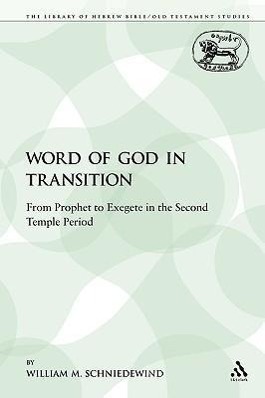
EUR 57,63
Spedizione EUR 48,99
Spedito da Germania a U.S.A.Quantità: Più di 20 disponibili
Aggiungi al carrelloKartoniert / Broschiert. Condizione: New. Dieser Artikel ist ein Print on Demand Artikel und wird nach Ihrer Bestellung fuer Sie gedruckt.
-

EUR 59,85
Spedizione EUR 70,00
Spedito da Germania a U.S.A.Quantità: 5 disponibili
Aggiungi al carrelloTaschenbuch. Condizione: Neu. Word of God in Transition | From Prophet to Exegete in the Second Temple Period | William M. Schniedewind | Taschenbuch | Kartoniert / Broschiert | Englisch | 2009 | Continnuum-3PL | EAN 9780567625205 | Verantwortliche Person für die EU: Libri GmbH, Europaallee 1, 36244 Bad Hersfeld, gpsr[at]libri[dot]de | Anbieter: preigu Print on Demand.
-

EUR 68,79
Spedizione EUR 62,23
Spedito da Germania a U.S.A.Quantità: 2 disponibili
Aggiungi al carrelloTaschenbuch. Condizione: Neu. nach der Bestellung gedruckt Neuware - Printed after ordering - The Chronicler distinguishes between 'traditional prophets' and 'inspired messengers', and thereby highlights a radical transition in the meaning of the 'word of God' which takes place in the post-exilic period. The Chronicler summarizes his perspective in 2 Chron. 36.16, saying that Israel rejected 'his prophets', 'the messengers of God', and 'his word' (i.e. Torah). This distinction is reflected in the forms and functions of prophetic speech in the books of Chronicles. Thus, the prophets speak to the king, and the inspired messengers (e.g. priests, levites) speak to the people. The prophets interpret narrative events for the king; they explain how God acts. The inspired messengers exhort the people, admonishing them how they should act. The prophets' speeches usually do not use any kind of inspiration formula, but the inspired messengers' speeches are prefaced with possession formulas. These possession formulas are not typical of classical prophecy and mark the rise of a new kind of prophecy, namely, the inspired interpretation of texts. These inspired messengers are thus forerunners of the inspired interpreters of scripture in Qumran, early Christianity and Judaism.
