

Importo totale (1 articolo articoli):
Destinazione ordine:

9780674023697 - Capital Rules: The Construction of Global Finance di Abdelal, Rawi (6 risultati)
Vai alla pagina principale dei risultati di ricerca
Filtri di ricerca
Tipo di articolo
- Tutti i tipi di prodotto
- Libri (6)
- Riviste e Giornali (Nessun altro risultato corrispondente a questo perfezionamento)
- Fumetti (Nessun altro risultato corrispondente a questo perfezionamento)
- Spartiti (Nessun altro risultato corrispondente a questo perfezionamento)
- Arte, Stampe e Poster (Nessun altro risultato corrispondente a questo perfezionamento)
- Fotografie (Nessun altro risultato corrispondente a questo perfezionamento)
- Mappe (Nessun altro risultato corrispondente a questo perfezionamento)
- Manoscritti e Collezionismo cartaceo (Nessun altro risultato corrispondente a questo perfezionamento)
Condizioni Maggiori informazioni
- Nuovo (3)
- Come nuovo, Ottimo o Quasi ottimo (1)
- Molto buono o Buono (2)
- Discreto o Mediocre (Nessun altro risultato corrispondente a questo perfezionamento)
- Come descritto (Nessun altro risultato corrispondente a questo perfezionamento)
Legatura
- Tutte
- Rilegato (6)
- Brossura (Nessun altro risultato corrispondente a questo perfezionamento)
Ulteriori caratteristiche
Lingua (1)
Spedizione gratuita
Paese del venditore
Valutazione venditore
-
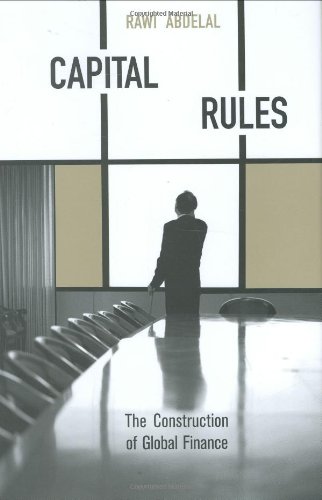
Capital Rules: The Construction of Global Finance
Da: ThriftBooks-Dallas, Dallas, TX, U.S.A.
Valutazione del venditore 5 su 5 stelle

Hardcover. Condizione: Very Good. No Jacket. May have limited writing in cover pages. Pages are unmarked. ~ ThriftBooks: Read More, Spend Less.
-
Capital Rules: The Construction of Global Finance (Signed)
Da: Sequitur Books, Boonsboro, MD, U.S.A.
Membro dell'associazione: IOBA
Valutazione del venditore 5 su 5 stelle
Copia autografata
Hardcover. Condizione: Good. Inscribed by Rawi Abdelal on front end page. Hardcover and dust jacket. Good binding and cover. Scattered underlining and highlighting to a couple of pages. *Autographed by author.*. Signed.
-

Capital Rules: The Construction of Global Finance
Da: Rosario Beach Rare Books, Lake Stevens, WA, U.S.A.
Membro dell'associazione: CBA ESA IOBA
Valutazione del venditore 5 su 5 stelle
Prima edizione
Hardcover. Condizione: Fine. Condizione sovraccoperta: Very Good. 1st Edition. *Veteran-Owned, Family-Run, Small Book Store in the Pacific Northwest* FAST SHIPPING!! Clean text, no markings, tight binding. 304 pp.
-
Capital rules the construction of global finance
Lingua: Inglese
Editore: Harvard University Press, Cambridge (Massachusetts), 2007
ISBN 10: 0674023692 ISBN 13: 9780674023697
Da: MARCIAL PONS LIBRERO, MADRID, M, Spagna
Valutazione del venditore 4 su 5 stelle

EUR 59,65
Spedizione EUR 21,00
Spedito da Spagna a U.S.A.Quantità: 1 disponibili
Aggiungi al carrelloTAPA DURA. Condizione: New.
-
Condizione: New. Satisfaction Guaranteed or your money back.
-

EUR 35,75
Spedizione EUR 65,00
Spedito da Polonia a U.S.A.Quantità: 2 disponibili
Aggiungi al carrelloHardcover. Condizione: New. 8vo (24 cm), XI, 304 pp. Publisher's cloth and dust jacket. From the blurb: "The rise of global financial markets in the last decades of the twentieth century was premised on one fundamental idea: that capital ought to flow across country borders with minimal restriction and regulation. Freedom for capital movements became the new orthodoxy. In an intellectual, legal, and political history of financial globalization, Rawi Abdelal shows that this was not always the case. Transactions routinely executed by bankers, managers, and investors during the 1990s - trading foreign stocks and bonds, borrowing in foreign currencies - had been illegal in many countries only decades, and sometimes just a year or two, earlier. How and why did the world shift from an orthodoxy of free capital movements in 1914 to an orthodoxy of capital controls in 1944 and then back again by 1994? How have such standards of appropriate behavior been codified and transmitted internationally? Contrary to conventional accounts, Abdelal argues that neither the U.S. Treasury nor Wall Street bankers have preferred or promoted multilateral, liberal rules for global finance. Instead, European policy makers conceived and promoted the liberal rules that compose the international financial architecture. Whereas U.S. policy makers have tended to embrace unilateral, ad hoc globalization, French and European policy makers have promoted a rule-based, "managed" globalization. This contest over the character of globalization continues today.".

