

Importo totale (1 articolo articoli):
Destinazione ordine:

9780792371212 - Algebra of Conscience: 30 di Lefebvre, Vladimir A. (10 risultati)
Vai alla pagina principale dei risultati di ricerca
Filtri di ricerca
Tipo di articolo
- Tutti i tipi di prodotto
- Libri (10)
- Riviste e Giornali (Nessun altro risultato corrispondente a questo perfezionamento)
- Fumetti (Nessun altro risultato corrispondente a questo perfezionamento)
- Spartiti (Nessun altro risultato corrispondente a questo perfezionamento)
- Arte, Stampe e Poster (Nessun altro risultato corrispondente a questo perfezionamento)
- Fotografie (Nessun altro risultato corrispondente a questo perfezionamento)
- Mappe (Nessun altro risultato corrispondente a questo perfezionamento)
- Manoscritti e Collezionismo cartaceo (Nessun altro risultato corrispondente a questo perfezionamento)
Condizioni Maggiori informazioni
- Nuovo (8)
- Come nuovo, Ottimo o Quasi ottimo (2)
- Molto buono o Buono (Nessun altro risultato corrispondente a questo perfezionamento)
- Discreto o Mediocre (Nessun altro risultato corrispondente a questo perfezionamento)
- Come descritto (Nessun altro risultato corrispondente a questo perfezionamento)
Legatura
- Tutte
- Rilegato (10)
- Brossura (Nessun altro risultato corrispondente a questo perfezionamento)
Ulteriori caratteristiche
- Prima ed. (1)
- Copia autograf. (Nessun altro risultato corrispondente a questo perfezionamento)
- Sovracoperta (Nessun altro risultato corrispondente a questo perfezionamento)
- Con foto (5)
- Non Print on Demand (7)
Lingua (1)
Prezzo
- Qualsiasi prezzo
- Inferiore a EUR 20 (Nessun altro risultato corrispondente a questo perfezionamento)
- EUR 20 a EUR 45 (Nessun altro risultato corrispondente a questo perfezionamento)
- Superiore a EUR 45
Spedizione gratuita
- Spedizione gratuita in U.S.A. (Nessun altro risultato corrispondente a questo perfezionamento)
Paese del venditore
Valutazione venditore
-

Algebra of Conscience: Second, Revised Edition (Theory and Decision Library, Series A: Philosophy and Methodology of the Social Sciences)
Da: killarneybooks, Inagh, CLARE, Irlanda
Valutazione del venditore 5 su 5 stelle

EUR 85,20
Spedizione EUR 34,26
Spedito da Irlanda a U.S.A.Quantità: 1 disponibili
Aggiungi al carrelloHardcover. Condizione: Near Fine. 2nd Edition. Hardcover, xiv + 358 pages, NOT ex-library. Minor handling wear, book is clean and bright with unmarked text, free of inscriptions and stamps, firmly bound. Issued without a dust jacket. -- This work presents a groundbreaking formal system for modeling human ethical cognition and choice. The core of the analysis is the development of a mathematical "algebra" built on a Boolean foundation to describe two fundamentally different ethical systems. The first system, which prohibits any union of "good" and "evil," models a worldview where compromise with a perceived negative is itself a negative act. The second system models a worldview where compromise and the search for a "golden mean" between good and evil are considered positive acts. This formal structure is then used to analyze the internal calculus of a subject's "reflexion" - the process of self-awareness and of modeling the inner worlds of others. The book provides a powerful and predictive tool for understanding the logic behind confrontation and cooperation, making it a foundational text in mathematical psychology and the theory of reflexive control.
-
Algebra of Conscience (Theory and Decision Library A:, 30)
Da: Ria Christie Collections, Uxbridge, Regno Unito
Valutazione del venditore 5 su 5 stelle
EUR 219,07
Spedizione EUR 13,83
Spedito da Regno Unito a U.S.A.Quantità: Più di 20 disponibili
Aggiungi al carrelloCondizione: New. In.
-
Algebra of Conscience (Theory and Decision Library A: (30))
Da: Mispah books, Redhill, SURRE, Regno Unito
Valutazione del venditore 4 su 5 stelle

EUR 204,45
Spedizione EUR 28,85
Spedito da Regno Unito a U.S.A.Quantità: 1 disponibili
Aggiungi al carrelloHardcover. Condizione: Like New. Like New. book.
-
Algebra of Conscience
Lingua: Inglese
Editore: Kluwer Academic Publishers, 2001
ISBN 10: 0792371216 ISBN 13: 9780792371212
Da: Kennys Bookshop and Art Galleries Ltd., Galway, GY, Irlanda
Valutazione del venditore 5 su 5 stelle
EUR 287,95
Spedizione EUR 10,50
Spedito da Irlanda a U.S.A.Quantità: 15 disponibili
Aggiungi al carrelloCondizione: New. Revised Edition with a Second Part with a new Foreword by Anatol Rapoport Series: Theory and Decision Library A:. Num Pages: 358 pages, biography. BIC Classification: HPQ. Category: (G) General (US: Trade); (P) Professional & Vocational; (UP) Postgraduate, Research & Scholarly; (UU) Undergraduate. Dimension: 234 x 156 x 22. Weight in Grams: 708. . 2001. 2nd ed. 2001. Hardback. . . . .
-

Algebra of Conscience
Lingua: Inglese
Editore: Springer Netherlands, Springer Netherlands Jul 2001, 2001
ISBN 10: 0792371216 ISBN 13: 9780792371212
Da: buchversandmimpf2000, Emtmannsberg, BAYE, Germania
Valutazione del venditore 5 su 5 stelle
Prima edizione
EUR 235,39
Spedizione EUR 60,00
Spedito da Germania a U.S.A.Quantità: 2 disponibili
Aggiungi al carrelloBuch. Condizione: Neu. Neuware -Conscience is an essential human attribute. Nevertheless, in the construction of formal models of the subject it is customarily left outside the framework of theoretical analysis. The Algebra of Conscience, whose first edition appeared in 1982, was the first specialized work modeling the phenomenon of conscience. The method used in this book made it possible to connect moral experience with decision-making procedures on the level of mathematical models. The application of such models allows us to propose the hypothesis of two fundamentally different ethical systems determining the normative patterns of human behavior in situations of conflict. Under the first ethical system the subject's self-esteem is raised if the subject seeks to resolve the conflict; in the second it is raised by seeking to dramatize the conflict.The new edition of The Algebra of Conscience is significantly expanded. The second part of the book, devoted to moral choice, is completely new. Based on the theory presented in the first part, it constructs the model of a subject capable of making an intentional choice. A special variable corresponds to the subject's intention. This development allows us to include within the model freedom of will and freedom of choice, and also to generalize classical 2×2 game theory to the case where outcomes, in addition to having utility measures, are either `positive' or `negative.'In its concluding chapters the book constructs a dynamic model of the intentional subject faced with a choice between two alternatives, neither of which is morally acceptable for the subject. It is shown that in this case the probabilities of choice of the alternatives may change chaotically. From this it follows that one cannot predict which alternative will be chosen or even the probabilities with which they will be chosen.Audience: The book is addressed to a broad readership having elementaryknowledge of mathematical logic and the theory of probability. It can be used in college courses studying the modelling of moral choice. The book's material can also be used in the design of artificial intelligence systems.Springer Verlag GmbH, Tiergartenstr. 17, 69121 Heidelberg 376 pp. Englisch.
-
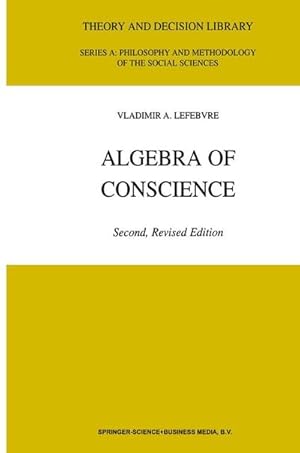
EUR 244,86
Spedizione EUR 63,65
Spedito da Germania a U.S.A.Quantità: 1 disponibili
Aggiungi al carrelloBuch. Condizione: Neu. Druck auf Anfrage Neuware - Printed after ordering - Conscience is an essential human attribute. Nevertheless, in the construction of formal models of the subject it is customarily left outside the framework of theoretical analysis. The Algebra of Conscience, whose first edition appeared in 1982, was the first specialized work modeling the phenomenon of conscience. The method used in this book made it possible to connect moral experience with decision-making procedures on the level of mathematical models. The application of such models allows us to propose the hypothesis of two fundamentally different ethical systems determining the normative patterns of human behavior in situations of conflict. Under the first ethical system the subject's self-esteem is raised if the subject seeks to resolve the conflict; in the second it is raised by seeking to dramatize the conflict. The new edition of The Algebra of Conscience is significantly expanded. The second part of the book, devoted to moral choice, is completely new. Based on the theory presented in the first part, it constructs the model of a subject capable of making an intentional choice. A special variable corresponds to the subject's intention. This development allows us to include within the model freedom of will and freedom of choice, and also to generalize classical 2×2 game theory to the case where outcomes, in addition to having utility measures, are either `positive' or `negative.' In its concluding chapters the book constructs a dynamic model of the intentional subject faced with a choice between two alternatives, neither of which is morally acceptable for the subject. It is shown that in this case the probabilities of choice of the alternatives may change chaotically. From this it follows that one cannot predict which alternative will be chosen or even the probabilities with which they will be chosen. Audience: The book is addressed to a broad readership having elementaryknowledge of mathematical logic and the theory of probability. It can be used in college courses studying the modelling of moral choice. The book's material can also be used in the design of artificial intelligence systems.
-
Algebra of Conscience
Lingua: Inglese
Editore: Kluwer Academic Publishers, 2001
ISBN 10: 0792371216 ISBN 13: 9780792371212
Da: Kennys Bookstore, Olney, MD, U.S.A.
Valutazione del venditore 5 su 5 stelle
Condizione: New. Revised Edition with a Second Part with a new Foreword by Anatol Rapoport Series: Theory and Decision Library A:. Num Pages: 358 pages, biography. BIC Classification: HPQ. Category: (G) General (US: Trade); (P) Professional & Vocational; (UP) Postgraduate, Research & Scholarly; (UU) Undergraduate. Dimension: 234 x 156 x 22. Weight in Grams: 708. . 2001. 2nd ed. 2001. Hardback. . . . . Books ship from the US and Ireland.
-

EUR 197,62
Spedizione EUR 48,99
Spedito da Germania a U.S.A.Quantità: Più di 20 disponibili
Aggiungi al carrelloGebunden. Condizione: New. Dieser Artikel ist ein Print on Demand Artikel und wird nach Ihrer Bestellung fuer Sie gedruckt. Revised Edition with a Second Part with a new Foreword by Anatol RapoportConscience is an essential human attribute. Nevertheless, in the construction of formal models of the subject it is customarily left outside the framework of theoretical ana.
-

Algebra of Conscience
Lingua: Inglese
Editore: Springer Netherlands Jul 2001, 2001
ISBN 10: 0792371216 ISBN 13: 9780792371212
Da: BuchWeltWeit Ludwig Meier e.K., Bergisch Gladbach, Germania
Valutazione del venditore 5 su 5 stelle
EUR 235,39
Spedizione EUR 23,00
Spedito da Germania a U.S.A.Quantità: 2 disponibili
Aggiungi al carrelloBuch. Condizione: Neu. This item is printed on demand - it takes 3-4 days longer - Neuware -Conscience is an essential human attribute. Nevertheless, in the construction of formal models of the subject it is customarily left outside the framework of theoretical analysis. The Algebra of Conscience, whose first edition appeared in 1982, was the first specialized work modeling the phenomenon of conscience. The method used in this book made it possible to connect moral experience with decision-making procedures on the level of mathematical models. The application of such models allows us to propose the hypothesis of two fundamentally different ethical systems determining the normative patterns of human behavior in situations of conflict. Under the first ethical system the subject's self-esteem is raised if the subject seeks to resolve the conflict; in the second it is raised by seeking to dramatize the conflict. The new edition of The Algebra of Conscience is significantly expanded. The second part of the book, devoted to moral choice, is completely new. Based on the theory presented in the first part, it constructs the model of a subject capable of making an intentional choice. A special variable corresponds to the subject's intention. This development allows us to include within the model freedom of will and freedom of choice, and also to generalize classical 2×2 game theory to the case where outcomes, in addition to having utility measures, are either `positive' or `negative.' In its concluding chapters the book constructs a dynamic model of the intentional subject faced with a choice between two alternatives, neither of which is morally acceptable for the subject. It is shown that in this case the probabilities of choice of the alternatives may change chaotically. From this it follows that one cannot predict which alternative will be chosen or even the probabilities with which they will be chosen. Audience: The book is addressed to a broad readership having elementaryknowledge of mathematical logic and the theory of probability. It can be used in college courses studying the modelling of moral choice. The book's material can also be used in the design of artificial intelligence systems. 376 pp. Englisch.
-
EUR 204,85
Spedizione EUR 70,00
Spedito da Germania a U.S.A.Quantità: 5 disponibili
Aggiungi al carrelloBuch. Condizione: Neu. Algebra of Conscience | V. A. Lefebvre | Buch | xiv | Englisch | 2001 | Springer | EAN 9780792371212 | Verantwortliche Person für die EU: Springer Verlag GmbH, Tiergartenstr. 17, 69121 Heidelberg, juergen[dot]hartmann[at]springer[dot]com | Anbieter: preigu Print on Demand.


