
Importo totale (1 articolo articoli):
Destinazione ordine:

9780792395331 - Applications of Logic Databases: 296 (17 risultati)
Vai alla pagina principale dei risultati di ricerca
Filtri di ricerca
Tipo di articolo
- Tutti i tipi di prodotto
- Libri (17)
- Riviste e Giornali (Nessun altro risultato corrispondente a questo perfezionamento)
- Fumetti (Nessun altro risultato corrispondente a questo perfezionamento)
- Spartiti (Nessun altro risultato corrispondente a questo perfezionamento)
- Arte, Stampe e Poster (Nessun altro risultato corrispondente a questo perfezionamento)
- Fotografie (Nessun altro risultato corrispondente a questo perfezionamento)
- Mappe (Nessun altro risultato corrispondente a questo perfezionamento)
- Manoscritti e Collezionismo cartaceo (Nessun altro risultato corrispondente a questo perfezionamento)
Condizioni Maggiori informazioni
- Nuovo (9)
- Come nuovo, Ottimo o Quasi ottimo (6)
- Molto buono o Buono (2)
- Discreto o Mediocre (Nessun altro risultato corrispondente a questo perfezionamento)
- Come descritto (Nessun altro risultato corrispondente a questo perfezionamento)
Legatura
Ulteriori caratteristiche
- Prima ed. (Nessun altro risultato corrispondente a questo perfezionamento)
- Copia autograf. (Nessun altro risultato corrispondente a questo perfezionamento)
- Sovracoperta (Nessun altro risultato corrispondente a questo perfezionamento)
- Con foto (10)
- Non Print on Demand (13)
Lingua (1)
Spedizione gratuita
Paese del venditore
Valutazione venditore
-
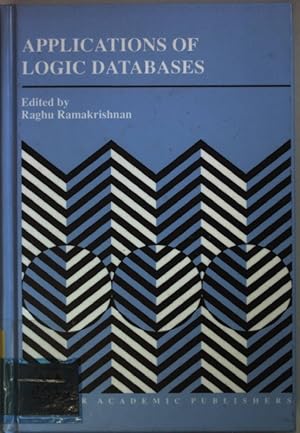
Applications of Logic Databases.
Da: books4less (Versandantiquariat Petra Gros GmbH & Co. KG), Welling, Germania
Valutazione del venditore 5 su 5 stelle

EUR 4,45
Spedizione EUR 12,95
Spedito da Germania a U.S.A.Quantità: 1 disponibili
Aggiungi al carrellogebundene Ausgabe. Condizione: Gut. 280 Seiten; Das hier angebotene Buch stammt aus einer teilaufgelösten wissenschaftlichen Bibliothek und trägt die entsprechenden Kennzeichnungen (Rückenschild, Instituts-Stempel.); Schnitt und Einband sind etwas staubschmutzig; der Buchzustand ist ansonsten ordentlich und dem Alter entsprechend gut. Text in ENGLISCHER Sprache! Sprache: Englisch Gewicht in Gramm: 720.
-

Applications of Logic Databases
Da: Better World Books, Mishawaka, IN, U.S.A.
Valutazione del venditore 5 su 5 stelle
Condizione: Fine. 1995th Edition. Used book that is in almost brand-new condition.
-
Affare
EUR 5,84
Spedizione EUR 20,50
Spedito da Francia a U.S.A.Quantità: 1 disponibili
Aggiungi al carrelloHardcover. Condizione: Très bon. Ancien livre de bibliothèque. Salissures sur la tranche. Edition 1995. Ammareal reverse jusqu'à 15% du prix net de cet article à des organisations caritatives. ENGLISH DESCRIPTION Book Condition: Used, Very good. Former library book. Stains on the edge. Edition 1995. Ammareal gives back up to 15% of this item's net price to charity organizations.
-
EUR 10,48
Spedizione EUR 105,00
Spedito da Germania a U.S.A.Quantità: 1 disponibili
Aggiungi al carrelloCondizione: Gut. Zustand: Gut | Seiten: 308 | Sprache: Englisch | Produktart: Bücher | The premise behind developing powerful declarative database languages is compelling: by enabling users to specify their queries (and their integrity constraints) in a clear, non-operational way, they make the user's task easier, and provide the database system with more opportunities for optimization. Relational database systems offer a striking proof that this premise is indeed valid. The most popular relational query language, SQL, is based upon relational algebra and calculus, i.e., a small fragment of first-order logic, and the ease of writing queries in SQL (in comparison to more navigational languages) has been an important factor in the commercial success of relational databases. It is well-known that SQL has some important limitations, in spite of its success and popUlarity. Notably, the query language is non-recursive, and support for integrity constraints is limited. Indeed, recognizing these problems, the latest standard, SQL-92, provides increased support for integrity constraints, and it is anticipated that the successor to the SQL-92 standard, called SQL3, RECURSIVE UNION operation [1]. Logic database systems have will include a concentrated on these extensions to the relational database paradigm, and some systems (e.g., Bull's DEL prototype) have even incorporated object-oriented features (another extension likely to appear in SQL3).
-
EUR 10,48
Spedizione EUR 105,00
Spedito da Germania a U.S.A.Quantità: 1 disponibili
Aggiungi al carrelloCondizione: Sehr gut. Zustand: Sehr gut | Seiten: 308 | Sprache: Englisch | Produktart: Bücher | The premise behind developing powerful declarative database languages is compelling: by enabling users to specify their queries (and their integrity constraints) in a clear, non-operational way, they make the user's task easier, and provide the database system with more opportunities for optimization. Relational database systems offer a striking proof that this premise is indeed valid. The most popular relational query language, SQL, is based upon relational algebra and calculus, i.e., a small fragment of first-order logic, and the ease of writing queries in SQL (in comparison to more navigational languages) has been an important factor in the commercial success of relational databases. It is well-known that SQL has some important limitations, in spite of its success and popUlarity. Notably, the query language is non-recursive, and support for integrity constraints is limited. Indeed, recognizing these problems, the latest standard, SQL-92, provides increased support for integrity constraints, and it is anticipated that the successor to the SQL-92 standard, called SQL3, RECURSIVE UNION operation [1]. Logic database systems have will include a concentrated on these extensions to the relational database paradigm, and some systems (e.g., Bull's DEL prototype) have even incorporated object-oriented features (another extension likely to appear in SQL3).
-

Applications of Logic Databases
Da: GreatBookPrices, Columbia, MD, U.S.A.
Valutazione del venditore 5 su 5 stelle
EUR 158,65
Spedizione EUR 2,26
Spedito in U.S.A.Quantità: Più di 20 disponibili
Aggiungi al carrelloCondizione: New.
-
Applications of Logic Databases (The Springer International Series in Engineering and Computer Science, 296)
Da: Lucky's Textbooks, Dallas, TX, U.S.A.
Valutazione del venditore 5 su 5 stelle
EUR 157,47
Spedizione EUR 3,42
Spedito in U.S.A.Quantità: Più di 20 disponibili
Aggiungi al carrelloCondizione: New.
-
Applications of Logic Databases (The Springer International Series in Engineering and Computer Science, 296)
Da: Ria Christie Collections, Uxbridge, Regno Unito
Valutazione del venditore 5 su 5 stelle
EUR 159,43
Spedizione EUR 13,81
Spedito da Regno Unito a U.S.A.Quantità: Più di 20 disponibili
Aggiungi al carrelloCondizione: New. In.
-

Applications of Logic Databases
Da: GreatBookPricesUK, Woodford Green, Regno Unito
Valutazione del venditore 5 su 5 stelle
EUR 159,42
Spedizione EUR 17,29
Spedito da Regno Unito a U.S.A.Quantità: Più di 20 disponibili
Aggiungi al carrelloCondizione: New.
-

EUR 168,73
Spedizione EUR 63,15
Spedito da Germania a U.S.A.Quantità: 1 disponibili
Aggiungi al carrelloBuch. Condizione: Neu. Druck auf Anfrage Neuware - Printed after ordering - The premise behind developing powerful declarative database languages is compelling: by enabling users to specify their queries (and their integrity constraints) in a clear, non-operational way, they make the user's task easier, and provide the database system with more opportunities for optimization. Relational database systems offer a striking proof that this premise is indeed valid. The most popular relational query language, SQL, is based upon relational algebra and calculus, i.e., a small fragment of first-order logic, and the ease of writing queries in SQL (in comparison to more navigational languages) has been an important factor in the commercial success of relational databases. It is well-known that SQL has some important limitations, in spite of its success and popUlarity. Notably, the query language is non-recursive, and support for integrity constraints is limited. Indeed, recognizing these problems, the latest standard, SQL-92, provides increased support for integrity constraints, and it is anticipated that the successor to the SQL-92 standard, called SQL3, RECURSIVE UNION operation [1]. Logic database systems have will include a concentrated on these extensions to the relational database paradigm, and some systems (e.g., Bull's DEL prototype) have even incorporated object-oriented features (another extension likely to appear in SQL3).
-

Applications of Logic Databases
Da: GreatBookPricesUK, Woodford Green, Regno Unito
Valutazione del venditore 5 su 5 stelle
EUR 236,23
Spedizione EUR 17,29
Spedito da Regno Unito a U.S.A.Quantità: Più di 20 disponibili
Aggiungi al carrelloCondizione: As New. Unread book in perfect condition.
-
Applications of Logic Databases (The Springer International Series in Engineering and Computer Science (296))
Da: Mispah books, Redhill, SURRE, Regno Unito
Valutazione del venditore 4 su 5 stelle

EUR 226,74
Spedizione EUR 28,81
Spedito da Regno Unito a U.S.A.Quantità: 1 disponibili
Aggiungi al carrelloHardcover. Condizione: Like New. Like New. book.
-

Applications of Logic Databases
Da: GreatBookPrices, Columbia, MD, U.S.A.
Valutazione del venditore 5 su 5 stelle
EUR 261,71
Spedizione EUR 2,26
Spedito in U.S.A.Quantità: Più di 20 disponibili
Aggiungi al carrelloCondizione: As New. Unread book in perfect condition.
-

Applications of Logic Databases
Lingua: Inglese
Editore: Springer US, Springer US Nov 1994, 1994
ISBN 10: 0792395336 ISBN 13: 9780792395331
Da: BuchWeltWeit Ludwig Meier e.K., Bergisch Gladbach, Germania
Valutazione del venditore 5 su 5 stelle
EUR 160,49
Spedizione EUR 23,00
Spedito da Germania a U.S.A.Quantità: 2 disponibili
Aggiungi al carrelloBuch. Condizione: Neu. This item is printed on demand - it takes 3-4 days longer - Neuware -The premise behind developing powerful declarative database languages is compelling: by enabling users to specify their queries (and their integrity constraints) in a clear, non-operational way, they make the user's task easier, and provide the database system with more opportunities for optimization. Relational database systems offer a striking proof that this premise is indeed valid. The most popular relational query language, SQL, is based upon relational algebra and calculus, i.e., a small fragment of first-order logic, and the ease of writing queries in SQL (in comparison to more navigational languages) has been an important factor in the commercial success of relational databases. It is well-known that SQL has some important limitations, in spite of its success and popUlarity. Notably, the query language is non-recursive, and support for integrity constraints is limited. Indeed, recognizing these problems, the latest standard, SQL-92, provides increased support for integrity constraints, and it is anticipated that the successor to the SQL-92 standard, called SQL3, RECURSIVE UNION operation [1]. Logic database systems have will include a concentrated on these extensions to the relational database paradigm, and some systems (e.g., Bull's DEL prototype) have even incorporated object-oriented features (another extension likely to appear in SQL3). 308 pp. Englisch.
-

EUR 136,16
Spedizione EUR 48,99
Spedito da Germania a U.S.A.Quantità: Più di 20 disponibili
Aggiungi al carrelloGebunden. Condizione: New. Dieser Artikel ist ein Print on Demand Artikel und wird nach Ihrer Bestellung fuer Sie gedruckt. The premise behind developing powerful declarative database languages is compelling: by enabling users to specify their queries (and their integrity constraints) in a clear, non-operational way, they make the user s task easier, and provide the database sys.
-
EUR 141,20
Spedizione EUR 70,00
Spedito da Germania a U.S.A.Quantità: 5 disponibili
Aggiungi al carrelloBuch. Condizione: Neu. Applications of Logic Databases | Raghu Ramakrishnan | Buch | xxiii | Englisch | 1994 | Springer | EAN 9780792395331 | Verantwortliche Person für die EU: Springer Verlag GmbH, Tiergartenstr. 17, 69121 Heidelberg, juergen[dot]hartmann[at]springer[dot]com | Anbieter: preigu Print on Demand.
-

Applications of Logic Databases
Lingua: Inglese
Editore: Springer US, Springer US Nov 1994, 1994
ISBN 10: 0792395336 ISBN 13: 9780792395331
Da: buchversandmimpf2000, Emtmannsberg, BAYE, Germania
Valutazione del venditore 5 su 5 stelle
EUR 160,49
Spedizione EUR 60,00
Spedito da Germania a U.S.A.Quantità: 1 disponibili
Aggiungi al carrelloBuch. Condizione: Neu. This item is printed on demand - Print on Demand Titel. Neuware -The premise behind developing powerful declarative database languages is compelling: by enabling users to specify their queries (and their integrity constraints) in a clear, non-operational way, they make the user's task easier, and provide the database system with more opportunities for optimization. Relational database systems offer a striking proof that this premise is indeed valid. The most popular relational query language, SQL, is based upon relational algebra and calculus, i.e., a small fragment of first-order logic, and the ease of writing queries in SQL (in comparison to more navigational languages) has been an important factor in the commercial success of relational databases. It is well-known that SQL has some important limitations, in spite of its success and popUlarity. Notably, the query language is non-recursive, and support for integrity constraints is limited. Indeed, recognizing these problems, the latest standard, SQL-92, provides increased support for integrity constraints, and it is anticipated that the successor to the SQL-92 standard, called SQL3, RECURSIVE UNION operation [1]. Logic database systems have will include a concentrated on these extensions to the relational database paradigm, and some systems (e.g., Bull's DEL prototype) have even incorporated object-oriented features (another extension likely to appear in SQL3).Springer Verlag GmbH, Tiergartenstr. 17, 69121 Heidelberg 308 pp. Englisch.


