
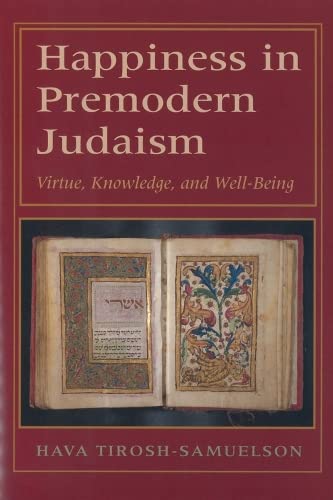
9780822963974 - happiness in premodern judaism: virtue, knowledge, and well-being: 29 di tirosh-samuelson, hava (10 risultati)
Lingua: Inglese
Editore: University of Pittsburgh Press, Pittsburgh PA, 2016
- Brossura
Da: Grand Eagle Retail, Bensenville, IL, U.S.A.Grand Eagle Retail
Contatta il venditoreVenditore con 5 stelleCondizione: Nuovo
EUR 34,24
Spedizione gratuitaSpedito in U.S.A.Quantità: 1 disponibili
Paperback. Condizione: new. Paperback. It is not common to think that Jews were interested in happiness or that Judaism has anything to say about happiness. On the contrary, the concept of happiness was a central concern of Jewish thinkers. Hava Tirosh-Samuelson shows that rabbinic Judaism regarded itself primarily as a prescrip…tion for the attainment of happiness, and that the discourse on happiness captures the evolution of Jewish intellectual history from antiquity to the seventeenth century. These claims make sense if one understands happiness as human flourishing on the basis of Aristotle's thought in the Nichomachean Ethics. Linking virtue, knowledge, and well-being, Aristotle's analysis of happiness can be traced in Jewish understanding of human flourishing as early as the Greco-Roman world, but the fusion of Greek and Judaic perspectives on happiness reached its zenith in in the Middle Ages in the thought of Moses Maimonides and his followers. Even the controversies about Maimonides' ideas could be viewed as discussions about the meaning of happiness and the way to attain it within Judaism. Much of this book, then, concerns the reception of Aristotle's Ethics in medieval Jewish philosophy. This book shows how a certain notion of happiness reflects the intellectual culture of a given period, including cultural exchanges among Judaism, Islam, and Christianity. Demonstrating the discourse on happiness as a dramatic interplay between Wisdom and Torah, between philosophy and religion, between reason and faith, Hava Tirosh-Samuelson presents, to specialists and non-specialists alike, a fascinating tour of Jewish intellectual history. Hava Tirosh-Samuelson shows that rabbinic Judaism regarded itself primarily as a prescription for the attainment of happiness, and that the discourse on happiness captures the evolution of Jewish intellectual history from antiquity to the seventeenth century. Shipping may be from multiple locations in the US or from the UK, depending on stock availability.
- Brossura
- Prima edizione
Da: ISD LLC, Bristol, CT, U.S.A.ISD LLC
Contatta il venditoreVenditore con 5 stelleCondizione: Nuovo
EUR 29,74
EUR 4,37 spedizioneSpedito in U.S.A.Quantità: 14 disponibili
paperback. Condizione: New. 1st.

- Brossura
Da: Rarewaves.com USA, London, LONDO, Regno UnitoRarewaves.com USA
Contatta il venditoreVenditore con 5 stelleCondizione: Nuovo
EUR 48,38
Spedizione gratuitaSpedito da Regno Unito a U.S.A.Quantità: 1 disponibili
Paperback. Condizione: New. It is not common to think that Jews were interested in happiness or that Judaism has anything to say about happiness. On the contrary, the concept of happiness was a central concern of Jewish thinkers. Hava Tirosh-Samuelson shows that rabbinic Judaism regarded itself primarily as a prescription for th…e attainment of happiness, and that the discourse on happiness captures the evolution of Jewish intellectual history from antiquity to the seventeenth century. These claims make sense if one understands happiness as human flourishing on the basis of Aristotle's thought in the Nichomachean Ethics. Linking virtue, knowledge, and well-being, Aristotle's analysis of happiness can be traced in Jewish understanding of human flourishing as early as the Greco-Roman world, but the fusion of Greek and Judaic perspectives on happiness reached its zenith in in the Middle Ages in the thought of Moses Maimonides and his followers. Even the controversies about Maimonides' ideas could be viewed as discussions about the meaning of happiness and the way to attain it within Judaism. Much of this book, then, concerns the reception of Aristotle's Ethics in medieval Jewish philosophy. This book shows how a certain notion of happiness reflects the intellectual culture of a given period, including cultural exchanges among Judaism, Islam, and Christianity. Demonstrating the discourse on happiness as a dramatic interplay between Wisdom and Torah, between philosophy and religion, between reason and faith, Hava Tirosh-Samuelson presents, to specialists and non-specialists alike, a fascinating tour of Jewish intellectual history.
- Brossura
Da: Revaluation Books, Exeter, Regno UnitoRevaluation Books
Contatta il venditoreVenditore con 5 stelleCondizione: Nuovo
EUR 39,46
EUR 14,65 spedizioneSpedito da Regno Unito a U.S.A.Quantità: 2 disponibili
Paperback. Condizione: Brand New. reprint edition. 608 pages. 9.00x6.00x1.46 inches. In Stock.
- Brossura
Da: Ria Christie Collections, Uxbridge, Regno UnitoRia Christie Collections
Contatta il venditoreVenditore con 5 stelleCondizione: Nuovo
EUR 46,04
EUR 14,04 spedizioneSpedito da Regno Unito a U.S.A.Quantità: 4 disponibili
Condizione: New. In.
- Brossura
Da: Kennys Bookshop and Art Galleries Ltd., Galway, GY, IrlandaKennys Bookshop and Art Galleries Ltd.
Contatta il venditoreVenditore con 5 stelleCondizione: Nuovo
EUR 63,74
EUR 9,50 spedizioneSpedito da Irlanda a U.S.A.Quantità: 14 disponibili
Condizione: New. 2016. Reprint. Paperback. . . . . .
- Brossura
Da: Kennys Bookstore, Olney, MD, U.S.A.Kennys Bookstore
Contatta il venditoreVenditore con 5 stelleCondizione: Nuovo
EUR 67,95
EUR 9,20 spedizioneSpedito in U.S.A.Quantità: 14 disponibili
Condizione: New. 2016. Reprint. Paperback. . . . . . Books ship from the US and Ireland.
Lingua: Inglese
Editore: University of Pittsburgh Press, Pittsburgh PA, 2016
- Brossura
Da: AussieBookSeller, Truganina, VIC, AustraliaAussieBookSeller
Contatta il venditoreVenditore con 5 stelleCondizione: Nuovo
EUR 69,80
EUR 32,42 spedizioneSpedito da Australia a U.S.A.Quantità: 1 disponibili
Paperback. Condizione: new. Paperback. It is not common to think that Jews were interested in happiness or that Judaism has anything to say about happiness. On the contrary, the concept of happiness was a central concern of Jewish thinkers. Hava Tirosh-Samuelson shows that rabbinic Judaism regarded itself primarily as a prescrip…tion for the attainment of happiness, and that the discourse on happiness captures the evolution of Jewish intellectual history from antiquity to the seventeenth century. These claims make sense if one understands happiness as human flourishing on the basis of Aristotle's thought in the Nichomachean Ethics. Linking virtue, knowledge, and well-being, Aristotle's analysis of happiness can be traced in Jewish understanding of human flourishing as early as the Greco-Roman world, but the fusion of Greek and Judaic perspectives on happiness reached its zenith in in the Middle Ages in the thought of Moses Maimonides and his followers. Even the controversies about Maimonides' ideas could be viewed as discussions about the meaning of happiness and the way to attain it within Judaism. Much of this book, then, concerns the reception of Aristotle's Ethics in medieval Jewish philosophy. This book shows how a certain notion of happiness reflects the intellectual culture of a given period, including cultural exchanges among Judaism, Islam, and Christianity. Demonstrating the discourse on happiness as a dramatic interplay between Wisdom and Torah, between philosophy and religion, between reason and faith, Hava Tirosh-Samuelson presents, to specialists and non-specialists alike, a fascinating tour of Jewish intellectual history. Hava Tirosh-Samuelson shows that rabbinic Judaism regarded itself primarily as a prescription for the attainment of happiness, and that the discourse on happiness captures the evolution of Jewish intellectual history from antiquity to the seventeenth century. Shipping may be from our Sydney, NSW warehouse or from our UK or US warehouse, depending on stock availability.

- Brossura
Da: AHA-BUCH GmbH, Einbeck, GermaniaAHA-BUCH GmbH
Contatta il venditoreVenditore con 5 stelleCondizione: Nuovo
EUR 56,24
EUR 64,23 spedizioneSpedito da Germania a U.S.A.Quantità: 1 disponibili
Taschenbuch. Condizione: Neu. Neuware - It is not common to think that Jews were interested in happiness or that Judaism has anything to say about happiness. On the contrary, the concept of happiness was a central concern of Jewish thinkers. Hava Tirosh-Samuelson shows that rabbinic Judaism regarded itself primarily as a prescri…ption for the attainment of happiness, and that the discourse on happiness captures the evolution of Jewish intellectual history from antiquity to the seventeenth century. These claims make sense if one understands happiness as human flourishing on the basis of Aristotle's thought in the Nichomachean Ethics. Linking virtue, knowledge, and well-being, Aristotle's analysis of happiness can be traced in Jewish understanding of human flourishing as early as the Greco-Roman world, but the fusion of Greek and Judaic perspectives on happiness reached its zenith in in the Middle Ages in the thought of Moses Maimonides and his followers. Even the controversies about Maimonides' ideas could be viewed as discussions about the meaning of happiness and the way to attain it within Judaism. Much of this book, then, concerns the reception of Aristotle's Ethics in medieval Jewish philosophy. This book shows how a certain notion of happiness reflects the intellectual culture of a given period, including cultural exchanges among Judaism, Islam, and Christianity. Demonstrating the discourse on happiness as a dramatic interplay between Wisdom and Torah, between philosophy and religion, between reason and faith, Hava Tirosh-Samuelson presents, to specialists and non-specialists alike, a fascinating tour of Jewish intellectual history.

- Brossura
Da: Rarewaves.com UK, London, Regno UnitoRarewaves.com UK
Contatta il venditoreVenditore con 5 stelleCondizione: Nuovo
EUR 45,48
EUR 76,19 spedizioneSpedito da Regno Unito a U.S.A.Quantità: 1 disponibili
Paperback. Condizione: New. It is not common to think that Jews were interested in happiness or that Judaism has anything to say about happiness. On the contrary, the concept of happiness was a central concern of Jewish thinkers. Hava Tirosh-Samuelson shows that rabbinic Judaism regarded itself primarily as a prescription for th…e attainment of happiness, and that the discourse on happiness captures the evolution of Jewish intellectual history from antiquity to the seventeenth century. These claims make sense if one understands happiness as human flourishing on the basis of Aristotle's thought in the Nichomachean Ethics. Linking virtue, knowledge, and well-being, Aristotle's analysis of happiness can be traced in Jewish understanding of human flourishing as early as the Greco-Roman world, but the fusion of Greek and Judaic perspectives on happiness reached its zenith in in the Middle Ages in the thought of Moses Maimonides and his followers. Even the controversies about Maimonides' ideas could be viewed as discussions about the meaning of happiness and the way to attain it within Judaism. Much of this book, then, concerns the reception of Aristotle's Ethics in medieval Jewish philosophy. This book shows how a certain notion of happiness reflects the intellectual culture of a given period, including cultural exchanges among Judaism, Islam, and Christianity. Demonstrating the discourse on happiness as a dramatic interplay between Wisdom and Torah, between philosophy and religion, between reason and faith, Hava Tirosh-Samuelson presents, to specialists and non-specialists alike, a fascinating tour of Jewish intellectual history.


