

Importo totale (1 articolo articoli):
Destinazione ordine:

9780865978751 - Essay on the Nature of Trade in General di Cantillon, Richard (24 risultati)
Vai alla pagina principale dei risultati di ricerca
Filtri di ricerca
Tipo di articolo
- Tutti i tipi di prodotto
- Libri (24)
- Riviste e Giornali (Nessun altro risultato corrispondente a questo perfezionamento)
- Fumetti (Nessun altro risultato corrispondente a questo perfezionamento)
- Spartiti (Nessun altro risultato corrispondente a questo perfezionamento)
- Arte, Stampe e Poster (Nessun altro risultato corrispondente a questo perfezionamento)
- Fotografie (Nessun altro risultato corrispondente a questo perfezionamento)
- Mappe (Nessun altro risultato corrispondente a questo perfezionamento)
- Manoscritti e Collezionismo cartaceo (Nessun altro risultato corrispondente a questo perfezionamento)
Condizioni Maggiori informazioni
- Nuovo (21)
- Come nuovo, Ottimo o Quasi ottimo (3)
- Molto buono o Buono (Nessun altro risultato corrispondente a questo perfezionamento)
- Discreto o Mediocre (Nessun altro risultato corrispondente a questo perfezionamento)
- Come descritto (Nessun altro risultato corrispondente a questo perfezionamento)
Legatura
- Tutte
- Rilegato (Nessun altro risultato corrispondente a questo perfezionamento)
- Brossura (24)
Ulteriori caratteristiche
- Prima ed. (Nessun altro risultato corrispondente a questo perfezionamento)
- Copia autograf. (Nessun altro risultato corrispondente a questo perfezionamento)
- Sovracoperta (Nessun altro risultato corrispondente a questo perfezionamento)
- Con foto (10)
- Non Print on Demand (24)
Lingua (1)
Prezzo
- Qualsiasi prezzo
- Inferiore a EUR 20
- EUR 20 a EUR 45
- Superiore a EUR 45 (Nessun altro risultato corrispondente a questo perfezionamento)
Spedizione gratuita
Paese del venditore
Valutazione venditore
-
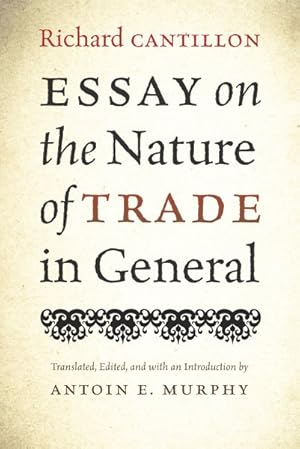
Essay on the Nature of Trade in General
Da: GreatBookPrices, Columbia, MD, U.S.A.
Valutazione del venditore 5 su 5 stelle

Condizione: New.
-

Essay on the Nature of Trade in General
Da: Rarewaves.com USA, London, LONDO, Regno Unito
Valutazione del venditore 5 su 5 stelle
EUR 14,20
Spedizione gratuita
Spedito da Regno Unito a U.S.A.Quantità: 4 disponibili
Aggiungi al carrelloPaperback. Condizione: New. "Richard Cantillon (1680?1734), an Irish economist, has claims to be regarded as one of the most outstanding analytical economists of the eighteenth century. F. A. Hayek wrote that Cantillon was the first to fully articulate economics as a science, and Stanley Jevons called Cantillon's only surviving work, Essai sur la nature du commerce en général, the "cradle of political economy." The Liberty Fund edition is a modernized translation of Cantillon's Essai sur la nature du commerce en général (1755) with a new introduction by economics professor Antoin E. Murphy. In the Essay, Cantillon outlined an extraordinary model-building approach showing how the economy could be built up, through progressive stages, from a command, barter, closed economy to a market economy, which uses money and is open. He produced some outstanding monetary theoryincluding what Mark Blaug called the Cantillon effectwhen demonstrating the effects of monetary expansion on inflation, output, and the balance of payments. He also highlighted the difficulties created by excessive financial innovation for a real economy and outlined the dangers of foreign borrowing by a country. Though written in the eighteenth century, the Essay has a considerable resonance for a twenty-first-century audience. Richard Cantillon (1680?1734), an Irish economist, has claims to be regarded as one of the most outstanding analytical economists of the eighteenth century. F. A. Hayek wrote that Cantillon was the first to fully articulate economics as a science, and Stanley Jevons called Cantillon's only surviving work, Essai sur la nature du commerce en général, the "cradle of political economy." The Liberty Fund edition is a modernized translation of Cantillon's Essai sur la nature du commerce en général (1755) with a new introduction by economics professor Antoin E. Murphy. In the Essay, Cantillon outlined an extraordinary model-building approach showing how the economy could be built up, through progressive stages, from a command, barter, closed economy to a market economy, which uses money and is open. He produced some outstanding monetary theoryincluding what Mark Blaug called the Cantillon effectwhen demonstrating the effects of monetary expansion on inflation, output, and the balance of payments. He also highlighted the difficulties created by excessive financial innovation for a real economy and outlined the dangers of foreign borrowing by a country. Though written in the eighteenth century, the Essay has a considerable resonance for a twenty-first-century audience. Richard Cantillon (1680?1734), an Irish economist, has claims to be regarded as one of the most outstanding analytical economists of the eighteenth century. F. A. Hayek wrote that Cantillon was the first to fully articulate economics as a science, and Stanley Jevons called Cantillon's only surviving work, Essai sur la nature du commerce en général, the "cradle of political economy." The Liberty Fund edition is a modernized translatio.
-

Essay on the Nature of Trade in General
Da: GreatBookPrices, Columbia, MD, U.S.A.
Valutazione del venditore 5 su 5 stelle
Condizione: As New. Unread book in perfect condition.
-

EUR 15,66
Spedizione gratuita
Spedito in U.S.A.Quantità: Più di 20 disponibili
Aggiungi al carrelloCondizione: As New. Unread copy in mint condition.
-
EUR 15,74
Spedizione gratuita
Spedito in U.S.A.Quantità: Più di 20 disponibili
Aggiungi al carrelloCondizione: New. Brand New.
-
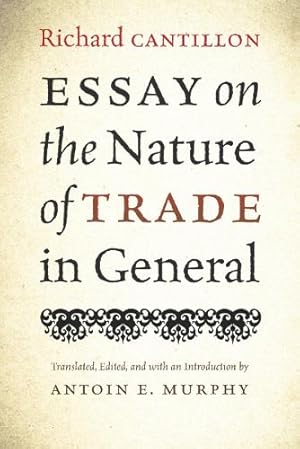
Paperback. Condizione: New. "Richard Cantillon (1680?1734), an Irish economist, has claims to be regarded as one of the most outstanding analytical economists of the eighteenth century. F. A. Hayek wrote that Cantillon was the first to fully articulate economics as a science, and Stanley Jevons called Cantillon's only surviving work, Essai sur la nature du commerce en général, the "cradle of political economy." The Liberty Fund edition is a modernized translation of Cantillon's Essai sur la nature du commerce en général (1755) with a new introduction by economics professor Antoin E. Murphy. In the Essay, Cantillon outlined an extraordinary model-building approach showing how the economy could be built up, through progressive stages, from a command, barter, closed economy to a market economy, which uses money and is open. He produced some outstanding monetary theoryincluding what Mark Blaug called the Cantillon effectwhen demonstrating the effects of monetary expansion on inflation, output, and the balance of payments. He also highlighted the difficulties created by excessive financial innovation for a real economy and outlined the dangers of foreign borrowing by a country. Though written in the eighteenth century, the Essay has a considerable resonance for a twenty-first-century audience. Richard Cantillon (1680?1734), an Irish economist, has claims to be regarded as one of the most outstanding analytical economists of the eighteenth century. F. A. Hayek wrote that Cantillon was the first to fully articulate economics as a science, and Stanley Jevons called Cantillon's only surviving work, Essai sur la nature du commerce en général, the "cradle of political economy." The Liberty Fund edition is a modernized translation of Cantillon's Essai sur la nature du commerce en général (1755) with a new introduction by economics professor Antoin E. Murphy. In the Essay, Cantillon outlined an extraordinary model-building approach showing how the economy could be built up, through progressive stages, from a command, barter, closed economy to a market economy, which uses money and is open. He produced some outstanding monetary theoryincluding what Mark Blaug called the Cantillon effectwhen demonstrating the effects of monetary expansion on inflation, output, and the balance of payments. He also highlighted the difficulties created by excessive financial innovation for a real economy and outlined the dangers of foreign borrowing by a country. Though written in the eighteenth century, the Essay has a considerable resonance for a twenty-first-century audience. Richard Cantillon (1680?1734), an Irish economist, has claims to be regarded as one of the most outstanding analytical economists of the eighteenth century. F. A. Hayek wrote that Cantillon was the first to fully articulate economics as a science, and Stanley Jevons called Cantillon's only surviving work, Essai sur la nature du commerce en général, the "cradle of political economy." The Liberty Fund edition is a modernized translatio.
-
Essay on the Nature of Trade in General (Paperback)
Lingua: Inglese
Editore: Liberty Fund Inc, Indianapolis, IN, 2015
ISBN 10: 0865978751 ISBN 13: 9780865978751
Da: Grand Eagle Retail, Bensenville, IL, U.S.A.
Valutazione del venditore 5 su 5 stelle
Paperback. Condizione: new. Paperback. "Richard Cantillon (1680?1734), an Irish economist, has claims to be regarded as one of the most outstanding analytical economists of the eighteenth century. F. A. Hayek wrote that Cantillon was the first to fully articulate economics as a science, and Stanley Jevons called Cantillon's only surviving work, Essai sur la nature du commerce en general, the cradle of political economy. The Liberty Fund edition is a modernized translation of Cantillons Essai sur la nature du commerce en general (1755) with a new introduction by economics professor Antoin E. Murphy. In the Essay, Cantillon outlined an extraordinary model-building approach showing how the economy could be built up, through progressive stages, from a command, barter, closed economy to a market economy, which uses money and is open. He produced some outstanding monetary theoryincluding what Mark Blaug called the Cantillon effectwhen demonstrating the effects of monetary expansion on inflation, output, and the balance of payments. He also highlighted the difficulties created by excessive financial innovation for a real economy and outlined the dangers of foreign borrowing by a country.Though written in the eighteenth century, the Essay has a considerable resonance for a twenty-first-century audience. Richard Cantillon (1680?1734), an Irish economist, has claims to be regarded as one of the most outstanding analytical economists of the eighteenth century. F. A. Hayek wrote that Cantillon was the first to fully articulate economics as a science, and Stanley Jevons called Cantillon's only surviving work, Essai sur la nature du commerce en general, the cradle of political economy. The Liberty Fund edition is a modernized translation of Cantillons Essai sur la nature du commerce en general (1755) with a new introduction by economics professor Antoin E. Murphy. In the Essay, Cantillon outlined an extraordinary model-building approach showing how the economy could be built up, through progressive stages, from a command, barter, closed economy to a market economy, which uses money and is open. He produced some outstanding monetary theoryincluding what Mark Blaug called the Cantillon effectwhen demonstrating the effects of monetary expansion on inflation, output, and the balance of payments.He also highlighted the difficulties created by excessive financial innovation for a real economy and outlined the dangers of foreign borrowing by a country. Though written in the eighteenth century, the Essay has a considerable resonance for a twenty-first-century audience. Richard Cantillon (1680?1734), an Irish economist, has claims to be regarded as one of the most outstanding analytical economists of the eighteenth century. F. A. Hayek wrote that Cantillon was the first to fully articulate economics as a science, and Stanley Jevons called Cantillon's only surviving work, Essai sur la nature du commerce en general, the cradle of political economy. The Liberty Fund edition is a modernized translation of Cantillons Essai sur la nature du commerce en general (1755) with a new introduction by economics professor Antoin E. Murphy. In the Essay, Cantillon outlined an extraordinary model-building approach showing how the economy could be built up, through progressive stages, from a command, barter, closed economy to a market economy, which uses money and is open.He produced some outstanding monetary theoryincluding what Mark Blaug called the Cantillon effectwhen demonstrating the effects of monetary expansion on inflation, output, and the balance of payments. He also highlighted the difficulties created by excessive financial innovation for a real economy and outlined the dangers of foreign borrowing by a country. Though written in the eighteenth century, the Essay has a considerable resonance for a twenty-first-century audience." Shipping may be from multiple locations in the US or from the UK, depending on stock availability.
-
Essay on the Nature of Trade in General
Da: PBShop.store UK, Fairford, GLOS, Regno Unito
Valutazione del venditore 5 su 5 stelle
EUR 14,72
Spedizione EUR 4,86
Spedito da Regno Unito a U.S.A.Quantità: 7 disponibili
Aggiungi al carrelloPAP. Condizione: New. New Book. Shipped from UK. Established seller since 2000.
-
Essay on the Nature of Trade in General
Da: Majestic Books, Hounslow, Regno Unito
Valutazione del venditore 4 su 5 stelle

EUR 14,77
Spedizione EUR 7,59
Spedito da Regno Unito a U.S.A.Quantità: 3 disponibili
Aggiungi al carrelloCondizione: New. pp. 176.
-
Essay on the Nature of Trade in General
Da: Kennys Bookshop and Art Galleries Ltd., Galway, GY, Irlanda
Valutazione del venditore 5 su 5 stelle
EUR 15,30
Spedizione EUR 10,50
Spedito da Irlanda a U.S.A.Quantità: 2 disponibili
Aggiungi al carrelloCondizione: New. Num Pages: 176 pages. BIC Classification: KC. Category: (G) General (US: Trade). Dimension: 155 x 232 x 16. Weight in Grams: 302. . 2015. Paperback. . . . .
-
Essay on the Nature of Trade in General
Da: Kennys Bookstore, Olney, MD, U.S.A.
Valutazione del venditore 5 su 5 stelle
Condizione: New. Num Pages: 176 pages. BIC Classification: KC. Category: (G) General (US: Trade). Dimension: 155 x 232 x 16. Weight in Grams: 302. . 2015. Paperback. . . . . Books ship from the US and Ireland.
-
Essay on the Nature of Trade in General
Da: Books Puddle, New York, NY, U.S.A.
Valutazione del venditore 4 su 5 stelle
Condizione: New. pp. 176.
-
Essay on the Nature of Trade in General
Da: Revaluation Books, Exeter, Regno Unito
Valutazione del venditore 5 su 5 stelle
EUR 18,77
Spedizione EUR 11,67
Spedito da Regno Unito a U.S.A.Quantità: 2 disponibili
Aggiungi al carrelloPaperback. Condizione: Brand New. 153 pages. 8.75x5.75x0.50 inches. In Stock.
-

Essay on the Nature of Trade in General
Da: GreatBookPricesUK, Woodford Green, Regno Unito
Valutazione del venditore 5 su 5 stelle
EUR 12,98
Spedizione EUR 17,51
Spedito da Regno Unito a U.S.A.Quantità: 4 disponibili
Aggiungi al carrelloCondizione: New.
-
Essay on the Nature of Trade in General
Da: Biblios, Frankfurt am main, HESSE, Germania
Valutazione del venditore 4 su 5 stelle
EUR 20,02
Spedizione EUR 9,95
Spedito da Germania a U.S.A.Quantità: 3 disponibili
Aggiungi al carrelloCondizione: New. pp. 176.
-
Essay on the Nature of Trade in General
Da: Russell Books, Victoria, BC, Canada
Valutazione del venditore 5 su 5 stelle
EUR 13,72
Spedizione EUR 17,47
Spedito da Canada a U.S.A.Quantità: 2 disponibili
Aggiungi al carrelloPaperback. Condizione: New. Special order direct from the distributor.
-
Essay on the Nature of Trade in General
Da: THE SAINT BOOKSTORE, Southport, Regno Unito
Valutazione del venditore 5 su 5 stelle
EUR 15,05
Spedizione EUR 16,45
Spedito da Regno Unito a U.S.A.Quantità: 8 disponibili
Aggiungi al carrelloPaperback / softback. Condizione: New. New copy - Usually dispatched within 4 working days.
-

Essay on the Nature of Trade in General
Da: GreatBookPricesUK, Woodford Green, Regno Unito
Valutazione del venditore 5 su 5 stelle
EUR 15,39
Spedizione EUR 17,51
Spedito da Regno Unito a U.S.A.Quantità: 4 disponibili
Aggiungi al carrelloCondizione: As New. Unread book in perfect condition.
-
Essay on the Nature of Trade in General (Paperback)
Lingua: Inglese
Editore: Liberty Fund Inc, Indianapolis, IN, 2015
ISBN 10: 0865978751 ISBN 13: 9780865978751
Da: AussieBookSeller, Truganina, VIC, Australia
Valutazione del venditore 5 su 5 stelle
EUR 22,23
Spedizione EUR 32,34
Spedito da Australia a U.S.A.Quantità: 1 disponibili
Aggiungi al carrelloPaperback. Condizione: new. Paperback. "Richard Cantillon (1680?1734), an Irish economist, has claims to be regarded as one of the most outstanding analytical economists of the eighteenth century. F. A. Hayek wrote that Cantillon was the first to fully articulate economics as a science, and Stanley Jevons called Cantillon's only surviving work, Essai sur la nature du commerce en general, the cradle of political economy. The Liberty Fund edition is a modernized translation of Cantillons Essai sur la nature du commerce en general (1755) with a new introduction by economics professor Antoin E. Murphy. In the Essay, Cantillon outlined an extraordinary model-building approach showing how the economy could be built up, through progressive stages, from a command, barter, closed economy to a market economy, which uses money and is open. He produced some outstanding monetary theoryincluding what Mark Blaug called the Cantillon effectwhen demonstrating the effects of monetary expansion on inflation, output, and the balance of payments. He also highlighted the difficulties created by excessive financial innovation for a real economy and outlined the dangers of foreign borrowing by a country.Though written in the eighteenth century, the Essay has a considerable resonance for a twenty-first-century audience. Richard Cantillon (1680?1734), an Irish economist, has claims to be regarded as one of the most outstanding analytical economists of the eighteenth century. F. A. Hayek wrote that Cantillon was the first to fully articulate economics as a science, and Stanley Jevons called Cantillon's only surviving work, Essai sur la nature du commerce en general, the cradle of political economy. The Liberty Fund edition is a modernized translation of Cantillons Essai sur la nature du commerce en general (1755) with a new introduction by economics professor Antoin E. Murphy. In the Essay, Cantillon outlined an extraordinary model-building approach showing how the economy could be built up, through progressive stages, from a command, barter, closed economy to a market economy, which uses money and is open. He produced some outstanding monetary theoryincluding what Mark Blaug called the Cantillon effectwhen demonstrating the effects of monetary expansion on inflation, output, and the balance of payments.He also highlighted the difficulties created by excessive financial innovation for a real economy and outlined the dangers of foreign borrowing by a country. Though written in the eighteenth century, the Essay has a considerable resonance for a twenty-first-century audience. Richard Cantillon (1680?1734), an Irish economist, has claims to be regarded as one of the most outstanding analytical economists of the eighteenth century. F. A. Hayek wrote that Cantillon was the first to fully articulate economics as a science, and Stanley Jevons called Cantillon's only surviving work, Essai sur la nature du commerce en general, the cradle of political economy. The Liberty Fund edition is a modernized translation of Cantillons Essai sur la nature du commerce en general (1755) with a new introduction by economics professor Antoin E. Murphy. In the Essay, Cantillon outlined an extraordinary model-building approach showing how the economy could be built up, through progressive stages, from a command, barter, closed economy to a market economy, which uses money and is open.He produced some outstanding monetary theoryincluding what Mark Blaug called the Cantillon effectwhen demonstrating the effects of monetary expansion on inflation, output, and the balance of payments. He also highlighted the difficulties created by excessive financial innovation for a real economy and outlined the dangers of foreign borrowing by a country. Though written in the eighteenth century, the Essay has a considerable resonance for a twenty-first-century audience." Shipping may be from our Sydney, NSW warehouse or from our UK or US warehouse, depending on stock availability.
-

Essay on the Nature of Trade in General
Da: Rarewaves USA United, OSWEGO, IL, U.S.A.
Valutazione del venditore 5 su 5 stelle
Paperback. Condizione: New. "Richard Cantillon (1680?1734), an Irish economist, has claims to be regarded as one of the most outstanding analytical economists of the eighteenth century. F. A. Hayek wrote that Cantillon was the first to fully articulate economics as a science, and Stanley Jevons called Cantillon's only surviving work, Essai sur la nature du commerce en général, the "cradle of political economy." The Liberty Fund edition is a modernized translation of Cantillon's Essai sur la nature du commerce en général (1755) with a new introduction by economics professor Antoin E. Murphy. In the Essay, Cantillon outlined an extraordinary model-building approach showing how the economy could be built up, through progressive stages, from a command, barter, closed economy to a market economy, which uses money and is open. He produced some outstanding monetary theoryincluding what Mark Blaug called the Cantillon effectwhen demonstrating the effects of monetary expansion on inflation, output, and the balance of payments. He also highlighted the difficulties created by excessive financial innovation for a real economy and outlined the dangers of foreign borrowing by a country. Though written in the eighteenth century, the Essay has a considerable resonance for a twenty-first-century audience. Richard Cantillon (1680?1734), an Irish economist, has claims to be regarded as one of the most outstanding analytical economists of the eighteenth century. F. A. Hayek wrote that Cantillon was the first to fully articulate economics as a science, and Stanley Jevons called Cantillon's only surviving work, Essai sur la nature du commerce en général, the "cradle of political economy." The Liberty Fund edition is a modernized translation of Cantillon's Essai sur la nature du commerce en général (1755) with a new introduction by economics professor Antoin E. Murphy. In the Essay, Cantillon outlined an extraordinary model-building approach showing how the economy could be built up, through progressive stages, from a command, barter, closed economy to a market economy, which uses money and is open. He produced some outstanding monetary theoryincluding what Mark Blaug called the Cantillon effectwhen demonstrating the effects of monetary expansion on inflation, output, and the balance of payments. He also highlighted the difficulties created by excessive financial innovation for a real economy and outlined the dangers of foreign borrowing by a country. Though written in the eighteenth century, the Essay has a considerable resonance for a twenty-first-century audience. Richard Cantillon (1680?1734), an Irish economist, has claims to be regarded as one of the most outstanding analytical economists of the eighteenth century. F. A. Hayek wrote that Cantillon was the first to fully articulate economics as a science, and Stanley Jevons called Cantillon's only surviving work, Essai sur la nature du commerce en général, the "cradle of political economy." The Liberty Fund edition is a modernized translatio.
-

EUR 19,44
Spedizione EUR 48,99
Spedito da Germania a U.S.A.Quantità: 5 disponibili
Aggiungi al carrelloCondizione: New. Klappentextrnrn"Richard Cantillon (1680?1734), an Irish economist, has claims to be regarded as one of the most outstanding analytical economists of the eighteenth century. F. A. Hayek wrote that Cantillon was the first to fully articulate .
-
Essay on the Nature of Trade in General
Da: Gazelle Books, Lancaster, LANCA, Regno Unito
Valutazione del venditore 4 su 5 stelle
EUR 9,88
Spedizione EUR 64,20
Spedito da Regno Unito a U.S.A.Quantità: 7 disponibili
Aggiungi al carrelloPaperback. Condizione: New. New Book, Direct from Publisher.
-

EUR 20,58
Spedizione EUR 61,51
Spedito da Germania a U.S.A.Quantità: 2 disponibili
Aggiungi al carrelloTaschenbuch. Condizione: Neu. Neuware - The Liberty Fund edition is a modernized translation of Richard Cantillon's Essai sur la nature du commerce en général (1755) with a new introduction by Antoin E. Murphy. In the Essay, Cantillon outlined an extraordinary model-building approach showing how the economy could be built up, through progressive stages, from a command, barter, closed economy to a market economy, which uses money and is open. Though written in the eighteenth century, the Essay has a considerable resonance for a twenty-first century audience. Antoin E. Murphy is Emeritus Professor of Economics and Fellow of Trinity College Dublin.
-

Essay on the Nature of Trade in General
Da: Rarewaves.com UK, London, Regno Unito
Valutazione del venditore 5 su 5 stelle
EUR 12,99
Spedizione EUR 75,88
Spedito da Regno Unito a U.S.A.Quantità: 4 disponibili
Aggiungi al carrelloPaperback. Condizione: New. "Richard Cantillon (1680?1734), an Irish economist, has claims to be regarded as one of the most outstanding analytical economists of the eighteenth century. F. A. Hayek wrote that Cantillon was the first to fully articulate economics as a science, and Stanley Jevons called Cantillon's only surviving work, Essai sur la nature du commerce en général, the "cradle of political economy." The Liberty Fund edition is a modernized translation of Cantillon's Essai sur la nature du commerce en général (1755) with a new introduction by economics professor Antoin E. Murphy. In the Essay, Cantillon outlined an extraordinary model-building approach showing how the economy could be built up, through progressive stages, from a command, barter, closed economy to a market economy, which uses money and is open. He produced some outstanding monetary theoryincluding what Mark Blaug called the Cantillon effectwhen demonstrating the effects of monetary expansion on inflation, output, and the balance of payments. He also highlighted the difficulties created by excessive financial innovation for a real economy and outlined the dangers of foreign borrowing by a country. Though written in the eighteenth century, the Essay has a considerable resonance for a twenty-first-century audience. Richard Cantillon (1680?1734), an Irish economist, has claims to be regarded as one of the most outstanding analytical economists of the eighteenth century. F. A. Hayek wrote that Cantillon was the first to fully articulate economics as a science, and Stanley Jevons called Cantillon's only surviving work, Essai sur la nature du commerce en général, the "cradle of political economy." The Liberty Fund edition is a modernized translation of Cantillon's Essai sur la nature du commerce en général (1755) with a new introduction by economics professor Antoin E. Murphy. In the Essay, Cantillon outlined an extraordinary model-building approach showing how the economy could be built up, through progressive stages, from a command, barter, closed economy to a market economy, which uses money and is open. He produced some outstanding monetary theoryincluding what Mark Blaug called the Cantillon effectwhen demonstrating the effects of monetary expansion on inflation, output, and the balance of payments. He also highlighted the difficulties created by excessive financial innovation for a real economy and outlined the dangers of foreign borrowing by a country. Though written in the eighteenth century, the Essay has a considerable resonance for a twenty-first-century audience. Richard Cantillon (1680?1734), an Irish economist, has claims to be regarded as one of the most outstanding analytical economists of the eighteenth century. F. A. Hayek wrote that Cantillon was the first to fully articulate economics as a science, and Stanley Jevons called Cantillon's only surviving work, Essai sur la nature du commerce en général, the "cradle of political economy." The Liberty Fund edition is a modernized translatio.

