
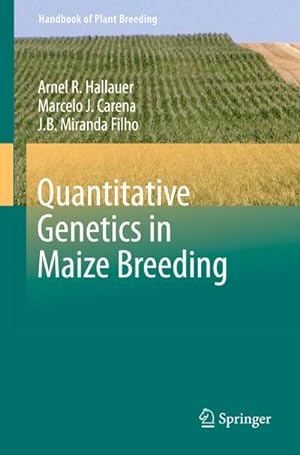
9781441907653 - quantitative genetics in maize breeding: 6 di carena, marcelo j.; hallauer, arnel r.; filho, j. b. miranda (8 risultati)

Lingua: Inglese
Editore: Springer, 2010
Serie: Handbook of Plant Breeding, Libro 4 di 11. Libro 4 di 11 - Handbook of Plant Breeding
- Rilegato
Da: Ria Christie Collections, Uxbridge, Regno UnitoRia Christie Collections
Contatta il venditoreVenditore con 5 stelleCondizione: Nuovo
EUR 352,96
EUR 14,09 spedizioneSpedito da Regno Unito a U.S.A.Quantità: Più di 20 disponibili
Condizione: New. In.
Lingua: Inglese
Editore: Springer, Springer US, 2010
Serie: Handbook of Plant Breeding, Libro 4 di 11. Libro 4 di 11 - Handbook of Plant Breeding
- Rilegato
Da: AHA-BUCH GmbH, Einbeck, GermaniaAHA-BUCH GmbH
Contatta il venditoreVenditore con 5 stelleCondizione: Nuovo
EUR 383,21
EUR 66,49 spedizioneSpedito da Germania a U.S.A.Quantità: 1 disponibili
Buch. Condizione: Neu. Druck auf Anfrage Neuware - Printed after ordering - Maize is used in an endless list of products that are directly or indirectly related to human nutrition and food security. Maize is grown in producer farms, farmers depend on genetically improved cultivars, and maize breeders develop improved maize culti…vars for farmers. Nikolai I. Vavilov defined plant breeding as plant evolution directed by man. Among crops, maize is one of the most successful examples for breeder-directed evolution. Maize is a cross-pollinated species with unique and separate male and female organs allowing techniques from both self and cross-pollinated crops to be utilized. As a consequence, a diverse set of breeding methods can be utilized for the development of various maize cultivar types for all economic conditions (e.g., improved populations, inbred lines, and their hybrids for different types of markets). Maize breeding is the science of maize cultivar development. Public investment in maize breeding from 1865 to 1996 was $3 billion (Crosbie et al., 2004) and the return on investment was $260 billion as a consequence of applied maize breeding, even without full understanding of the genetic basis of heterosis. The principles of quantitative genetics have been successfully applied by maize breeders worldwide to adapt and improve germplasm sources of cultivars for very simple traits (e.g. maize flowering) and very complex ones (e.g., grain yield). For instance, genomic efforts have isolated early-maturing genes and QTL for potential MAS but very simple and low cost phenotypic efforts have caused significant and fast genetic progress across genotypes moving elite tropical and late temperate maize northward with minimal investment. Quantitative genetics has allowed the integration of pre-breeding with cultivar development by characterizing populations genetically, adapting them to places never thought of (e.g., tropical to short-seasons), improving them by all sorts of intra- and inter-population recurrent selection methods, extracting lines with more probability of success, and exploiting inbreeding and heterosis. Quantitative genetics in maize breeding has improved the odds of developing outstanding maize cultivars from genetically broad based improved populations such as B73. The inbred-hybrid concept in maize was a public sector invention 100 years ago and it is still considered one of the greatest achievements in plant breeding. Maize hybrids grown by farmers today are still produced following this methodology and there is still no limit to genetic improvement when most genes are targeted in the breeding process. Heterotic effects are unique for each hybrid and exotic genetic materials (e.g., tropical, early maturing) carry useful alleles for complex traits not present in the B73 genome just sequenced while increasing the genetic diversity of U.S. hybrids. Breeding programs based on classical quantitative genetics and selection methods will be the basis for proving theoretical approaches on breeding plans based on molecular markers. Mating designs still offer large sample sizes when compared to QTL approaches and there is still a need to successful integration of these methods. There is a need to increase the genetic diversity of maize hybrids available in the market (e.g., there is a need to increase the number of early maturing testers in the northern U.S.). Public programs can still develop new and genetically diverse products not available in industry. However, public U.S. maize breeding programs have either been discontinued or are eroding because of decreasing state and federal funding toward basic science. Future significant genetic gains in maize are dependent on the incorporation of useful and unique genetic diversity not available in industry (e.g., NDSU EarlyGEM lines). The integration of pre-breeding methods with cultivar development should enhance future breeding efforts to maintain active public breeding programs not only adapting and.
Lingua: Inglese
Editore: Springer Verlag, 2010
Serie: Handbook of Plant Breeding, Libro 4 di 11. Libro 4 di 11 - Handbook of Plant Breeding
- Rilegato
Da: Revaluation Books, Exeter, Regno UnitoRevaluation Books
Contatta il venditoreVenditore con 5 stelleCondizione: Nuovo
EUR 528,62
EUR 17,64 spedizioneSpedito da Regno Unito a U.S.A.Quantità: 2 disponibili
Hardcover. Condizione: Brand New. reprint edition. 663 pages. 9.25x6.25x1.50 inches. In Stock.
Lingua: Inglese
Editore: Springer, 2010
Serie: Handbook of Plant Breeding, Libro 4 di 11. Libro 4 di 11 - Handbook of Plant Breeding
- Rilegato
- Print on Demand
Da: Basi6 International, Irving, TX, U.S.A.Basi6 International
Contatta il venditoreVenditore con 5 stelleCondizione: Nuovo
EUR 269,50
Spedizione gratuitaSpedito in U.S.A.Quantità: 10 disponibili
Condizione: Brand New. New. US edition. Print on demand title. Delivery takes 20-25 days.

Lingua: Inglese
Editore: Springer New York, 2010
Serie: Handbook of Plant Breeding, Libro 4 di 11. Libro 4 di 11 - Handbook of Plant Breeding
- Rilegato
- Print on Demand
Da: moluna, Greven, Germaniamoluna
Contatta il venditoreVenditore con 5 stelleCondizione: Nuovo
EUR 311,76
EUR 48,99 spedizioneSpedito da Germania a U.S.A.Quantità: Più di 20 disponibili
Gebunden. Condizione: New. Dieser Artikel ist ein Print on Demand Artikel und wird nach Ihrer Bestellung fuer Sie gedruckt. This updated version of, the what is considered to be, the Maize Breeding Bible A unique and permanent contribution to breeders, geneticists, students, and policy makersIntegrative text which promotes colla…bortive work on sustainable crop improvement and .

Lingua: Inglese
Editore: Springer New York Sep 2010, 2010
Serie: Handbook of Plant Breeding, Libro 4 di 11. Libro 4 di 11 - Handbook of Plant Breeding
- Rilegato
- Print on Demand
Da: BuchWeltWeit Ludwig Meier e.K., Bergisch Gladbach, GermaniaBuchWeltWeit Ludwig Meier e.K.
Contatta il venditoreVenditore con 5 stelleCondizione: Nuovo
EUR 374,49
EUR 23,00 spedizioneSpedito da Germania a U.S.A.Quantità: 2 disponibili
Buch. Condizione: Neu. This item is printed on demand - it takes 3-4 days longer - Neuware -Maize is used in an endless list of products that are directly or indirectly related to human nutrition and food security. Maize is grown in producer farms, farmers depend on genetically improved cultivars, and maize breeders develop impr…oved maize cultivars for farmers. Nikolai I. Vavilov defined plant breeding as plant evolution directed by man. Among crops, maize is one of the most successful examples for breeder-directed evolution. Maize is a cross-pollinated species with unique and separate male and female organs allowing techniques from both self and cross-pollinated crops to be utilized. As a consequence, a diverse set of breeding methods can be utilized for the development of various maize cultivar types for all economic conditions (e.g., improved populations, inbred lines, and their hybrids for different types of markets). Maize breeding is the science of maize cultivar development. Public investment in maize breeding from 1865 to 1996 was $3 billion (Crosbie et al., 2004) and the return on investment was $260 billion as a consequence of applied maize breeding, even without full understanding of the genetic basis of heterosis. The principles of quantitative genetics have been successfully applied by maize breeders worldwide to adapt and improve germplasm sources of cultivars for very simple traits (e.g. maize flowering) and very complex ones (e.g., grain yield). For instance, genomic efforts have isolated early-maturing genes and QTL for potential MAS but very simple and low cost phenotypic efforts have caused significant and fast genetic progress across genotypes moving elite tropical and late temperate maize northward with minimal investment. Quantitative genetics has allowed the integration of pre-breeding with cultivar development by characterizing populations genetically, adapting them to places never thought of (e.g., tropical to short-seasons), improving them by all sorts of intra- and inter-population recurrent selection methods, extracting lines with more probability of success, and exploiting inbreeding and heterosis. Quantitative genetics in maize breeding has improved the odds of developing outstanding maize cultivars from genetically broad based improved populations such as B73. The inbred-hybrid concept in maize was a public sector invention 100 years ago and it is still considered one of the greatest achievements in plant breeding. Maize hybrids grown by farmers today are still produced following this methodology and there is still no limit to genetic improvement when most genes are targeted in the breeding process. Heterotic effects are unique for each hybrid and exotic genetic materials (e.g., tropical, early maturing) carry useful alleles for complex traits not present in the B73 genome just sequenced while increasing the genetic diversity of U.S. hybrids. Breeding programs based on classical quantitative genetics and selection methods will be the basis for proving theoretical approaches on breeding plans based on molecular markers. Mating designs still offer large sample sizes when compared to QTL approaches and there is still a need to successful integration of these methods. There is a need to increase the genetic diversity of maize hybrids available in the market (e.g., there is a need to increase the number of early maturing testers in the northern U.S.). Public programs can still develop new and genetically diverse products not available in industry. However, public U.S. maize breeding programs have either been discontinued or are eroding because of decreasing state and federal funding toward basic science. Future significant genetic gains in maize are dependent on the incorporation of useful and unique genetic diversity not available in industry (e.g., NDSU EarlyGEM lines). The integration of pre-breeding methods with cultivar development should enhance future breeding efforts to maintain active public breeding programs not o.

Lingua: Inglese
Editore: Springer, Springer US Sep 2010, 2010
Serie: Handbook of Plant Breeding, Libro 4 di 11. Libro 4 di 11 - Handbook of Plant Breeding
- Rilegato
- Print on Demand
Da: buchversandmimpf2000, Emtmannsberg, BAYE, Germaniabuchversandmimpf2000
Contatta il venditoreVenditore con 5 stelleCondizione: Nuovo
EUR 374,49
EUR 60,00 spedizioneSpedito da Germania a U.S.A.Quantità: 1 disponibili
Buch. Condizione: Neu. This item is printed on demand - Print on Demand Titel. Neuware -Maize is used in an endless list of products that are directly or indirectly related to human nutrition and food security. Maize is grown in producer farms, farmers depend on genetically improved cultivars, and maize breeders develop improved… maize cultivars for farmers. Nikolai I. Vavilov defined plant breeding as plant evolution directed by man. Among crops, maize is one of the most successful examples for breeder-directed evolution. Maize is a cross-pollinated species with unique and separate male and female organs allowing techniques from both self and cross-pollinated crops to be utilized. As a consequence, a diverse set of breeding methods can be utilized for the development of various maize cultivar types for all economic conditions (e.g., improved populations, inbred lines, and their hybrids for different types of markets). Maize breeding is the science of maize cultivar development. Public investment in maize breeding from 1865 to 1996 was $3 billion (Crosbie et al., 2004) and the return on investment was $260 billion as a consequence of applied maize breeding, even without full understanding of the genetic basis of heterosis. The principles of quantitative genetics have been successfully applied by maize breeders worldwide to adapt and improve germplasm sources of cultivars for very simple traits (e.g. maize flowering) and very complex ones (e.g., grain yield). For instance, genomic efforts have isolated early-maturing genes and QTL for potential MAS but very simple and low cost phenotypic efforts have caused significant and fast genetic progress across genotypes moving elite tropical and late temperate maize northward with minimal investment. Quantitative genetics has allowed the integration of pre-breeding with cultivar development by characterizing populations genetically, adapting them to places never thought of (e.g., tropical to short-seasons), improving them by all sorts of intra- and inter-population recurrent selection methods, extracting lines with more probability of success, and exploiting inbreeding and heterosis. Quantitative genetics in maize breeding has improved the odds of developing outstanding maize cultivars from genetically broad based improved populations such as B73. The inbred-hybrid concept in maize was a public sector invention 100 years ago and it is still considered one of the greatest achievements in plant breeding. Maize hybrids grown by farmers today are still produced following this methodology and there is still no limit to genetic improvement when most genes are targeted in the breeding process. Heterotic effects are unique for each hybrid and exotic genetic materials (e.g., tropical, early maturing) carry useful alleles for complex traits not present in the B73 genome just sequenced while increasing the genetic diversity of U.S. hybrids. Breeding programs based on classical quantitative genetics and selection methods will be the basis for proving theoretical approaches on breeding plans based on molecular markers. Mating designs still offer large sample sizes when compared to QTL approaches and there is still a need to successful integration of these methods. There is a need to increase the genetic diversity of maize hybrids available in the market (e.g., there is a need to increase the number of early maturing testers in the northern U.S.). Public programs can still develop new and genetically diverse products not available in industry. However, public U.S. maize breeding programs have either been discontinued or are eroding because of decreasing state and federal funding toward basic science. Future significant genetic gains in maize are dependent on the incorporation of useful and unique genetic diversity not available in industry (e.g., NDSU EarlyGEM lines). The integration of pre-breeding methods with cultivar development should enhance future breeding efforts to maintain active public breeding programs not only.
Editore: Springer
- Print on Demand
Da: Brook Bookstore On Demand, Napoli, NA, ItaliaBrook Bookstore On Demand
Contatta il venditoreVenditore con 5 stelleCondizione: Nuovo
EUR 286,35
EUR 11,00 spedizioneSpedito da Italia a U.S.A.Quantità: Più di 20 disponibili
Condizione: new. Questo è un articolo print on demand.


