
Importo totale (1 articolo articoli):
Destinazione ordine:

9781441920362 - Transitions Before the Transition: Evolution and Stability in the Middle Paleolithic and Middle Stone Age (9 risultati)
Vai alla pagina principale dei risultati di ricerca
Filtri di ricerca
Tipo di articolo
- Tutti i tipi di prodotto
- Libri (9)
- Riviste e Giornali (Nessun altro risultato corrispondente a questo perfezionamento)
- Fumetti (Nessun altro risultato corrispondente a questo perfezionamento)
- Spartiti (Nessun altro risultato corrispondente a questo perfezionamento)
- Arte, Stampe e Poster (Nessun altro risultato corrispondente a questo perfezionamento)
- Fotografie (Nessun altro risultato corrispondente a questo perfezionamento)
- Mappe (Nessun altro risultato corrispondente a questo perfezionamento)
- Manoscritti e Collezionismo cartaceo (Nessun altro risultato corrispondente a questo perfezionamento)
Condizioni Maggiori informazioni
- Nuovo (8)
- Come nuovo, Ottimo o Quasi ottimo (1)
- Molto buono o Buono (Nessun altro risultato corrispondente a questo perfezionamento)
- Discreto o Mediocre (Nessun altro risultato corrispondente a questo perfezionamento)
- Come descritto (Nessun altro risultato corrispondente a questo perfezionamento)
Legatura
- Tutte
- Rilegato (Nessun altro risultato corrispondente a questo perfezionamento)
- Brossura (9)
Ulteriori caratteristiche
- Prima ed. (Nessun altro risultato corrispondente a questo perfezionamento)
- Copia autograf. (Nessun altro risultato corrispondente a questo perfezionamento)
- Sovracoperta (Nessun altro risultato corrispondente a questo perfezionamento)
- Con foto (5)
- Non Print on Demand (4)
Lingua (1)
Prezzo
- Qualsiasi prezzo
- Inferiore a EUR 20 (Nessun altro risultato corrispondente a questo perfezionamento)
- EUR 20 a EUR 40 (Nessun altro risultato corrispondente a questo perfezionamento)
- Superiore a EUR 40
Spedizione gratuita
- Spedizione gratuita in U.S.A. (Nessun altro risultato corrispondente a questo perfezionamento)
Paese del venditore
Valutazione venditore
-

Transitions Before the Transition: Evolution and Stability in the Middle Paleolithic and Middle Stone Age (Interdisciplinary Contributions to Archaeology)
Da: Ria Christie Collections, Uxbridge, Regno Unito
Valutazione del venditore 5 su 5 stelle

EUR 136,29
Spedizione EUR 13,83
Spedito da Regno Unito a U.S.A.Quantità: Più di 20 disponibili
Aggiungi al carrelloCondizione: New. In.
-
Transitions Before the Transition: Evolution and Stability in the Middle Paleolithic and Middle Stone Age
Da: Revaluation Books, Exeter, Regno Unito
Valutazione del venditore 5 su 5 stelle
EUR 188,52
Spedizione EUR 14,43
Spedito da Regno Unito a U.S.A.Quantità: 2 disponibili
Aggiungi al carrelloPaperback. Condizione: Brand New. 332 pages. 9.00x6.00x0.81 inches. In Stock.
-
EUR 143,31
Spedizione EUR 62,70
Spedito da Germania a U.S.A.Quantità: 1 disponibili
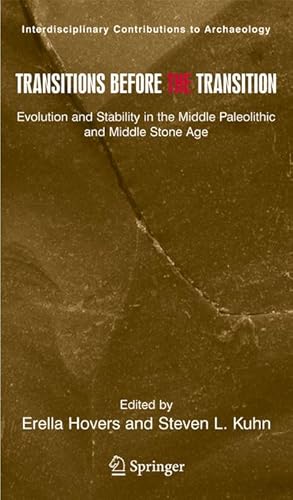
Aggiungi al carrelloTaschenbuch. Condizione: Neu. Druck auf Anfrage Neuware - Printed after ordering - Modern human origins and the fate of the Neanderthals are arguably the most compelling and contentious arenas in paleoanthropology. The much-discussed split between advocates of a single, early emergence of anatomically modern humans in sub-Saharan Africa and supporters of various regional continuity positions is only part of the picture. Equally if not more important are questions surrounding the origins of modern behavior, and the relationships between anatomical and behavioral changes that occurred during the past 200,000 years. Although modern humans as a species may be defined in terms of their skeletal anatomy, it is their behavior, and the social and cognitive structures that support that behavior, which most clearly distinguish Homo sapiens from earlier forms of humans.This book assembles researchers working in Eurasia and Africa to discuss the archaeological record of the Middle Paleolithic and the Middle Stone Age. This is a time period when Homo sapiens last shared the world with other species, and during which patterns of behavior characteristic of modern humans developed and coalesced. Contributions to this volume query and challenge some current notions about the tempo and mode of cultural evolution, and about the processes that underlie the emergence of modern behavior. The papers focus on several fundamental questions. Do typical elements of 'modern human behavior' appear suddenly, or are there earlier archaeological precursors of them Are the archaeological records of the Middle Paleolithic and Middle Stone Age unchanging and monotonous, or are there detectable evolutionary trends within these periods Coming to diverse conclusions, the papers in this volume open up new avenues to thinking about this crucial interval in human evolutionary history.
-
Transitions Before the Transition: Evolution and Stability in the Middle Paleolithic and Middle Stone Age (Interdisciplinary Contributions to Archaeology)
Da: Mispah books, Redhill, SURRE, Regno Unito
Valutazione del venditore 4 su 5 stelle

EUR 229,49
Spedizione EUR 28,86
Spedito da Regno Unito a U.S.A.Quantità: 1 disponibili
Aggiungi al carrelloPaperback. Condizione: Like New. Like New. book.
-

Transitions Before the Transition
Lingua: Inglese
Editore: Springer New York Nov 2010, 2010
ISBN 10: 1441920366 ISBN 13: 9781441920362
Da: BuchWeltWeit Ludwig Meier e.K., Bergisch Gladbach, Germania
Valutazione del venditore 5 su 5 stelle
EUR 139,09
Spedizione EUR 23,00
Spedito da Germania a U.S.A.Quantità: 2 disponibili
Aggiungi al carrelloTaschenbuch. Condizione: Neu. This item is printed on demand - it takes 3-4 days longer - Neuware -Modern human origins and the fate of the Neanderthals are arguably the most compelling and contentious arenas in paleoanthropology. The much-discussed split between advocates of a single, early emergence of anatomically modern humans in sub-Saharan Africa and supporters of various regional continuity positions is only part of the picture. Equally if not more important are questions surrounding the origins of modern behavior, and the relationships between anatomical and behavioral changes that occurred during the past 200,000 years. Although modern humans as a species may be defined in terms of their skeletal anatomy, it is their behavior, and the social and cognitive structures that support that behavior, which most clearly distinguish Homo sapiens from earlier forms of humans.This book assembles researchers working in Eurasia and Africa to discuss the archaeological record of the Middle Paleolithic and the Middle Stone Age. This is a time period when Homo sapiens last shared the world with other species, and during which patterns of behavior characteristic of modern humans developed and coalesced. Contributions to this volume query and challenge some current notions about the tempo and mode of cultural evolution, and about the processes that underlie the emergence of modern behavior. The papers focus on several fundamental questions. Do typical elements of 'modern human behavior' appear suddenly, or are there earlier archaeological precursors of them Are the archaeological records of the Middle Paleolithic and Middle Stone Age unchanging and monotonous, or are there detectable evolutionary trends within these periods Coming to diverse conclusions, the papers in this volume open up new avenues to thinking about this crucial interval in human evolutionary history. 356 pp. Englisch.
-

EUR 115,65
Spedizione EUR 48,99
Spedito da Germania a U.S.A.Quantità: Più di 20 disponibili
Aggiungi al carrelloCondizione: New. Dieser Artikel ist ein Print on Demand Artikel und wird nach Ihrer Bestellung fuer Sie gedruckt. The first book to bring together the three main questions regarding modern human origins: how different are we from our ancestors in the Paleolithc/Stone Age, how difficult was the transition, and did it occur quickly or graduallyAssembles resea.
-
Transitions Before the Transition: Evolution and Stability in the Middle Paleolithic and Middle Stone Age
Lingua: Inglese
Editore: Springer-Verlag New York Inc., 2010
ISBN 10: 1441920366 ISBN 13: 9781441920362
Da: THE SAINT BOOKSTORE, Southport, Regno Unito
Valutazione del venditore 5 su 5 stelle
EUR 165,06
Spedizione EUR 18,56
Spedito da Regno Unito a U.S.A.Quantità: Più di 20 disponibili
Aggiungi al carrelloPaperback / softback. Condizione: New. This item is printed on demand. New copy - Usually dispatched within 5-9 working days.
-
EUR 119,95
Spedizione EUR 70,00
Spedito da Germania a U.S.A.Quantità: 5 disponibili
Aggiungi al carrelloTaschenbuch. Condizione: Neu. Transitions Before the Transition | Evolution and Stability in the Middle Paleolithic and Middle Stone Age | Erella Hovers (u. a.) | Taschenbuch | xxiv | Englisch | 2010 | Springer | EAN 9781441920362 | Verantwortliche Person für die EU: Springer Verlag GmbH, Tiergartenstr. 17, 69121 Heidelberg, juergen[dot]hartmann[at]springer[dot]com | Anbieter: preigu Print on Demand.
-

Transitions Before the Transition
Lingua: Inglese
Editore: Springer New York, Springer US Nov 2010, 2010
ISBN 10: 1441920366 ISBN 13: 9781441920362
Da: buchversandmimpf2000, Emtmannsberg, BAYE, Germania
Valutazione del venditore 5 su 5 stelle
EUR 139,09
Spedizione EUR 60,00
Spedito da Germania a U.S.A.Quantità: 1 disponibili
Aggiungi al carrelloTaschenbuch. Condizione: Neu. This item is printed on demand - Print on Demand Titel. Neuware -Modern human origins and the fate of the Neanderthals are arguably the most compelling and contentious arenas in paleoanthropology. The much-discussed split between advocates of a single, early emergence of anatomically modern humans in sub-Saharan Africa and supporters of various regional continuity positions is only part of the picture. Equally if not more important are questions surrounding the origins of modern behavior, and the relationships between anatomical and behavioral changes that occurred during the past 200,000 years. Although modern humans as a species may be defined in terms of their skeletal anatomy, it is their behavior, and the social and cognitive structures that support that behavior, which most clearly distinguish Homo sapiens from earlier forms of humans.This book assembles researchers working in Eurasia and Africa to discuss the archaeological record of the Middle Paleolithic and the Middle Stone Age. This is a time period when Homo sapiens last shared the world with other species, and during which patterns of behavior characteristic of modern humans developed and coalesced. Contributions to this volume query and challenge some current notions about the tempo and mode of cultural evolution, and about the processes that underlie the emergence of modern behavior. The papers focus on several fundamental questions. Do typical elements of 'modern human behavior' appear suddenly, or are there earlier archaeological precursors of them Are the archaeological records of the Middle Paleolithic and Middle Stone Age unchanging and monotonous, or are there detectable evolutionary trends within these periods Coming to diverse conclusions, the papers in this volume open up new avenues to thinking about this crucial interval in human evolutionary history.Springer Verlag GmbH, Tiergartenstr. 17, 69121 Heidelberg 356 pp. Englisch.


