

Importo totale (1 articolo articoli):
Destinazione ordine:

9781461375623 - Functional Networks with Applications: A Neural-Based Paradigm: 473 di Castillo, Enrique; Cobo, Angel; Antonio Gutierrez, Jose; Pruneda, Rosa Eva (8 risultati)
Vai alla pagina principale dei risultati di ricerca
Filtri di ricerca
Tipo di articolo
- Tutti i tipi di prodotto
- Libri (8)
- Riviste e Giornali (Nessun altro risultato corrispondente a questo perfezionamento)
- Fumetti (Nessun altro risultato corrispondente a questo perfezionamento)
- Spartiti (Nessun altro risultato corrispondente a questo perfezionamento)
- Arte, Stampe e Poster (Nessun altro risultato corrispondente a questo perfezionamento)
- Fotografie (Nessun altro risultato corrispondente a questo perfezionamento)
- Mappe (Nessun altro risultato corrispondente a questo perfezionamento)
- Manoscritti e Collezionismo cartaceo (Nessun altro risultato corrispondente a questo perfezionamento)
Condizioni Maggiori informazioni
- Nuovo (8)
- Come nuovo, Ottimo o Quasi ottimo (Nessun altro risultato corrispondente a questo perfezionamento)
- Molto buono o Buono (Nessun altro risultato corrispondente a questo perfezionamento)
- Discreto o Mediocre (Nessun altro risultato corrispondente a questo perfezionamento)
- Come descritto (Nessun altro risultato corrispondente a questo perfezionamento)
Legatura
- Tutte
- Rilegato (Nessun altro risultato corrispondente a questo perfezionamento)
- Brossura (8)
Ulteriori caratteristiche
- Prima ed. (Nessun altro risultato corrispondente a questo perfezionamento)
- Copia autograf. (Nessun altro risultato corrispondente a questo perfezionamento)
- Sovracoperta (Nessun altro risultato corrispondente a questo perfezionamento)
- Con foto (5)
- Non Print on Demand (5)
Lingua (1)
Prezzo
- Qualsiasi prezzo
- Inferiore a EUR 20 (Nessun altro risultato corrispondente a questo perfezionamento)
- EUR 20 a EUR 40 (Nessun altro risultato corrispondente a questo perfezionamento)
- Superiore a EUR 40
Spedizione gratuita
- Spedizione gratuita in U.S.A. (Nessun altro risultato corrispondente a questo perfezionamento)
Paese del venditore
Valutazione venditore
-

Functional Networks with Applications: A Neural-Based Paradigm (The Springer International Series in Engineering and Computer Science)
Da: Ria Christie Collections, Uxbridge, Regno Unito
Valutazione del venditore 5 su 5 stelle

EUR 111,21
Spedizione EUR 13,72
Spedito da Regno Unito a U.S.A.Quantità: Più di 20 disponibili
Aggiungi al carrelloCondizione: New. In.
-
Functional Networks with Applications: A Neural-Based Paradigm (The Springer International Series in Engineering and Computer Science)
Da: Chiron Media, Wallingford, Regno Unito
Valutazione del venditore 5 su 5 stelle
EUR 111,89
Spedizione EUR 17,74
Spedito da Regno Unito a U.S.A.Quantità: 10 disponibili
Aggiungi al carrelloPaperback. Condizione: New.
-
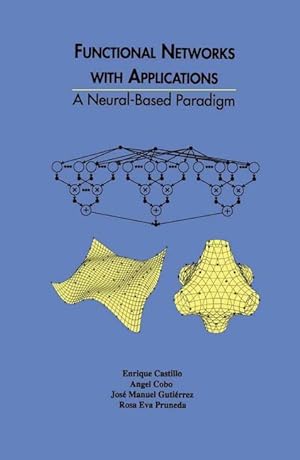
EUR 92,27
Spedizione EUR 48,99
Spedito da Germania a U.S.A.Quantità: Più di 20 disponibili
Aggiungi al carrelloCondizione: New.
-
Functional Networks with Applications: A Neural-Based Paradigm (The Springer International Series in Engineering and Computer Science)
Da: Revaluation Books, Exeter, Regno Unito
Valutazione del venditore 5 su 5 stelle
EUR 150,99
Spedizione EUR 11,45
Spedito da Regno Unito a U.S.A.Quantità: 2 disponibili
Aggiungi al carrelloPaperback. Condizione: Brand New. 320 pages. 9.25x6.10x0.73 inches. In Stock.
-

Functional Networks with Applications : A Neural-Based Paradigm
Lingua: Inglese
Editore: Springer US, Springer New York, 2013
ISBN 10: 1461375622 ISBN 13: 9781461375623
EUR 112,94
Spedizione EUR 62,47
Spedito da Germania a U.S.A.Quantità: 1 disponibili
Aggiungi al carrelloTaschenbuch. Condizione: Neu. Druck auf Anfrage Neuware - Printed after ordering - Artificial neural networks have been recognized as a powerful tool to learn and reproduce systems in various fields of applications. Neural net works are inspired by the brain behavior and consist of one or several layers of neurons, or computing units, connected by links. Each artificial neuron receives an input value from the input layer or the neurons in the previ ous layer. Then it computes a scalar output from a linear combination of the received inputs using a given scalar function (the activation function), which is assumed the same for all neurons. One of the main properties of neural networks is their ability to learn from data. There are two types of learning: structural and parametric. Structural learning consists of learning the topology of the network, that is, the number of layers, the number of neurons in each layer, and what neurons are connected. This process is done by trial and error until a good fit to the data is obtained. Parametric learning consists of learning the weight values for a given topology of the network. Since the neural functions are given, this learning process is achieved by estimating the connection weights based on the given information. To this aim, an error function is minimized using several well known learning methods, such as the backpropagation algorithm. Unfortunately, for these methods: (a) The function resulting from the learning process has no physical or engineering interpretation. Thus, neural networks are seen as black boxes.
-

Functional Networks with Applications
Da: BuchWeltWeit Ludwig Meier e.K., Bergisch Gladbach, Germania
Valutazione del venditore 5 su 5 stelle
EUR 106,99
Spedizione EUR 23,00
Spedito da Germania a U.S.A.Quantità: 2 disponibili
Aggiungi al carrelloTaschenbuch. Condizione: Neu. This item is printed on demand - it takes 3-4 days longer - Neuware -Artificial neural networks have been recognized as a powerful tool to learn and reproduce systems in various fields of applications. Neural net works are inspired by the brain behavior and consist of one or several layers of neurons, or computing units, connected by links. Each artificial neuron receives an input value from the input layer or the neurons in the previ ous layer. Then it computes a scalar output from a linear combination of the received inputs using a given scalar function (the activation function), which is assumed the same for all neurons. One of the main properties of neural networks is their ability to learn from data. There are two types of learning: structural and parametric. Structural learning consists of learning the topology of the network, that is, the number of layers, the number of neurons in each layer, and what neurons are connected. This process is done by trial and error until a good fit to the data is obtained. Parametric learning consists of learning the weight values for a given topology of the network. Since the neural functions are given, this learning process is achieved by estimating the connection weights based on the given information. To this aim, an error function is minimized using several well known learning methods, such as the backpropagation algorithm. Unfortunately, for these methods: (a) The function resulting from the learning process has no physical or engineering interpretation. Thus, neural networks are seen as black boxes. 324 pp. Englisch.
-
EUR 95,70
Spedizione EUR 70,00
Spedito da Germania a U.S.A.Quantità: 5 disponibili
Aggiungi al carrelloTaschenbuch. Condizione: Neu. Functional Networks with Applications | A Neural-Based Paradigm | Enrique Castillo (u. a.) | Taschenbuch | xi | Englisch | 2013 | Springer | EAN 9781461375623 | Verantwortliche Person für die EU: Springer Verlag GmbH, Tiergartenstr. 17, 69121 Heidelberg, juergen[dot]hartmann[at]springer[dot]com | Anbieter: preigu Print on Demand.
-

Functional Networks with Applications
Lingua: Inglese
Editore: Springer US, Springer New York Feb 2013, 2013
ISBN 10: 1461375622 ISBN 13: 9781461375623
Da: buchversandmimpf2000, Emtmannsberg, BAYE, Germania
Valutazione del venditore 5 su 5 stelle
EUR 106,99
Spedizione EUR 60,00
Spedito da Germania a U.S.A.Quantità: 1 disponibili
Aggiungi al carrelloTaschenbuch. Condizione: Neu. This item is printed on demand - Print on Demand Titel. Neuware -Artificial neural networks have been recognized as a powerful tool to learn and reproduce systems in various fields of applications. Neural net works are inspired by the brain behavior and consist of one or several layers of neurons, or computing units, connected by links. Each artificial neuron receives an input value from the input layer or the neurons in the previ ous layer. Then it computes a scalar output from a linear combination of the received inputs using a given scalar function (the activation function), which is assumed the same for all neurons. One of the main properties of neural networks is their ability to learn from data. There are two types of learning: structural and parametric. Structural learning consists of learning the topology of the network, that is, the number of layers, the number of neurons in each layer, and what neurons are connected. This process is done by trial and error until a good fit to the data is obtained. Parametric learning consists of learning the weight values for a given topology of the network. Since the neural functions are given, this learning process is achieved by estimating the connection weights based on the given information. To this aim, an error function is minimized using several well known learning methods, such as the backpropagation algorithm. Unfortunately, for these methods: (a) The function resulting from the learning process has no physical or engineering interpretation. Thus, neural networks are seen as black boxes.Springer Verlag GmbH, Tiergartenstr. 17, 69121 Heidelberg 324 pp. Englisch.


