
Importo totale (1 articolo articoli):
Destinazione ordine:

9783030129941 - Future Foods: How Modern Science Is Transforming the Way We Eat di McClements, David Julian (15 risultati)
Vai alla pagina principale dei risultati di ricerca
Filtri di ricerca
Tipo di articolo
- Tutti i tipi di prodotto
- Libri (15)
- Riviste e Giornali (Nessun altro risultato corrispondente a questo perfezionamento)
- Fumetti (Nessun altro risultato corrispondente a questo perfezionamento)
- Spartiti (Nessun altro risultato corrispondente a questo perfezionamento)
- Arte, Stampe e Poster (Nessun altro risultato corrispondente a questo perfezionamento)
- Fotografie (Nessun altro risultato corrispondente a questo perfezionamento)
- Mappe (Nessun altro risultato corrispondente a questo perfezionamento)
- Manoscritti e Collezionismo cartaceo (Nessun altro risultato corrispondente a questo perfezionamento)
Condizioni Maggiori informazioni
- Nuovo (11)
- Come nuovo, Ottimo o Quasi ottimo (Nessun altro risultato corrispondente a questo perfezionamento)
- Molto buono o Buono (4)
- Discreto o Mediocre (Nessun altro risultato corrispondente a questo perfezionamento)
- Come descritto (Nessun altro risultato corrispondente a questo perfezionamento)
Legatura
- Tutte
- Rilegato (Nessun altro risultato corrispondente a questo perfezionamento)
- Brossura (15)
Ulteriori caratteristiche
- Prima ed. (Nessun altro risultato corrispondente a questo perfezionamento)
- Copia autograf. (Nessun altro risultato corrispondente a questo perfezionamento)
- Sovracoperta (Nessun altro risultato corrispondente a questo perfezionamento)
- Con foto (5)
- Non Print on Demand (13)
Lingua (1)
Prezzo
- Qualsiasi prezzo
- Inferiore a EUR 20 (Nessun altro risultato corrispondente a questo perfezionamento)
- EUR 20 a EUR 40
- Superiore a EUR 40
Spedizione gratuita
Paese del venditore
Valutazione venditore
-

Future Foods: How Modern Science Is Transforming the Way We Eat
Da: Once Upon A Time Books, Siloam Springs, AR, U.S.A.
Valutazione del venditore 4 su 5 stelle

paperback. Condizione: Good. This is a used book in good condition and may show some signs of use or wear . This is a used book in good condition and may show some signs of use or wear .
-
Future Foods: How Modern Science Is Transforming the Way We Eat
Da: Evergreen Goodwill, Seattle, WA, U.S.A.
Valutazione del venditore 5 su 5 stelle

paperback. Condizione: Good.
-
Future Foods: How Modern Science Is Transforming the Way We Eat
Da: WorldofBooks, Goring-By-Sea, WS, Regno Unito
Valutazione del venditore 5 su 5 stelle
EUR 20,47
Spedizione EUR 6,47
Spedito da Regno Unito a U.S.A.Quantità: 1 disponibili
Aggiungi al carrelloPaperback. Condizione: Very Good. The book has been read, but is in excellent condition. Pages are intact and not marred by notes or highlighting. The spine remains undamaged.
-
Condizione: Brand New. New. US edition. Expediting shipping for all USA and Europe orders excluding PO Box. Excellent Customer Service.
-
Future Foods: How Modern Science Is Transforming the Way We Eat
Da: Books Puddle, New York, NY, U.S.A.
Valutazione del venditore 4 su 5 stelle
Condizione: New. pp. 400.
-
Future Foods: How Modern Science Is Transforming the Way We Eat
Da: Majestic Books, Hounslow, Regno Unito
Valutazione del venditore 4 su 5 stelle
EUR 35,66
Spedizione EUR 7,51
Spedito da Regno Unito a U.S.A.Quantità: 1 disponibili
Aggiungi al carrelloCondizione: New. pp. 400.
-
Future Foods: How Modern Science Is Transforming the Way We Eat
Da: Biblios, Frankfurt am main, HESSE, Germania
Valutazione del venditore 4 su 5 stelle
EUR 36,20
Spedizione EUR 9,95
Spedito da Germania a U.S.A.Quantità: 1 disponibili
Aggiungi al carrelloCondizione: New. pp. 400.
-
EUR 48,76
Spedizione gratuita
Spedito da Australia a U.S.A.Quantità: 1 disponibili
Aggiungi al carrelloBrand new book. Fast ship. Please provide full street address as we are not able to ship to P O box address.
-
Future Foods: How Modern Science Is Transforming the Way We Eat
Da: Revaluation Books, Exeter, Regno Unito
Valutazione del venditore 5 su 5 stelle
EUR 59,54
Spedizione EUR 14,44
Spedito da Regno Unito a U.S.A.Quantità: 1 disponibili
Aggiungi al carrelloPaperback. Condizione: Brand New. 395 pages. 9.25x6.25x1.00 inches. In Stock.
-
Future Foods: How Modern Science Is Transforming the Way We Eat
Da: Mooney's bookstore, Den Helder, Paesi Bassi
Valutazione del venditore 4 su 5 stelle
EUR 62,40
Spedizione EUR 14,95
Spedito da Paesi Bassi a U.S.A.Quantità: 1 disponibili
Aggiungi al carrelloCondizione: Very good.
-

Future Foods
Lingua: Inglese
Editore: Springer International Publishing, Springer International Publishing Mai 2019, 2019
ISBN 10: 3030129942 ISBN 13: 9783030129941
Da: buchversandmimpf2000, Emtmannsberg, BAYE, Germania
Valutazione del venditore 5 su 5 stelle
EUR 37,44
Spedizione EUR 60,00
Spedito da Germania a U.S.A.Quantità: 2 disponibili
Aggiungi al carrelloTaschenbuch. Condizione: Neu. Neuware -We are in the midst of an unprecedented era of rapid scientific and technological advances that are transforming the way our foods are produced and consumed. Food architecture is being used to construct healthier, tastier, and more sustainable foods. Functional foods are being created to combat chronic diseases such as obesity, cancer, diabetes, stroke, and heart disease. These foods are fortified with nutraceuticals or probiotics to improve our mood, performance, and health. The behavior of foods inside our guts is being controlled to increase their healthiness. Precision nutrition is being used to tailor diets to our unique genetic profiles, microbiomes, and metabolisms. Gene editing, nanotechnology, and artificial intelligence are being used to address modern food challenges such as feeding the growing global population,reducing greenhouse gas emissions, reducing waste, and improving sustainability. However, the application of these technologies is facing a backlash from consumers concerned about the potential risks posed to human and environmental health.Some of the questions addressed in this book are: What is food architecture How does sound and color impact taste Will we all have 3D food printers in all our homes Should nanotechnology and gene editing be used to enhance our foods Are these new technologies safe Would you eat bug-foods if it led to a more sustainable food supply Should vegetarians eat themselves Can nutraceuticals and probiotics stop cancer What is the molecular basis of a tasty sustainable burger David Julian McClements is a Distinguished Professor in food science who has used physics, chemistry, and biology to improve the quality, safety, and healthiness of foods for over 30years. He has published over 900 scientific articles and 10 books in this area and is currently the most highly cited food scientist in the world. He has won numerous scientific awards for his work. The aim of this book is to highlight the many exciting advances being made in the science of foods, and to show their application for solving important problems related to the modern food supply, such as tackling chronic diseases, feeding a global population, reducing food waste, and creating healthier and tastier foods.Springer Verlag GmbH, Tiergartenstr. 17, 69121 Heidelberg 420 pp. Englisch.
-

Future Foods : How Modern Science Is Transforming the Way We Eat
Lingua: Inglese
Editore: Springer International Publishing, Springer Nature Switzerland, 2019
ISBN 10: 3030129942 ISBN 13: 9783030129941
EUR 37,44
Spedizione EUR 63,61
Spedito da Germania a U.S.A.Quantità: 1 disponibili
Aggiungi al carrelloTaschenbuch. Condizione: Neu. Druck auf Anfrage Neuware - Printed after ordering - We are in the midst of an unprecedented era of rapid scientific and technological advances that are transforming the way our foods are produced and consumed.Food architectureis being used to construct healthier, tastier, and more sustainable foods.Functional foodsare being created to combat chronic diseases such as obesity, cancer, diabetes, stroke, and heart disease. These foods are fortified withnutraceuticalsorprobioticsto improve our mood, performance, and health. The behavior of foods inside our guts is being controlled to increase their healthiness.Precision nutritionis being used to tailor diets to our unique genetic profiles, microbiomes, and metabolisms.Gene editing,nanotechnology, andartificial intelligenceare being used to address modern food challenges such as feeding the growing global population,reducing greenhouse gas emissions, reducing waste, and improving sustainability. However, the application of these technologies is facing a backlash from consumers concerned about the potential risks posed to human and environmental health.Some of the questions addressed in this book are: What is food architecture How does sound and color impact taste Will we all have 3D food printers in all our homes Should nanotechnology and gene editing be used to enhance our foods Are these new technologies safe Would you eat bug-foods if it led to a more sustainable food supply Should vegetarians eat themselves Can nutraceuticals and probiotics stop cancer What is the molecular basis of a tasty sustainable burger David Julian McClements is a Distinguished Professor in food science who has used physics, chemistry, and biology to improve the quality, safety, and healthiness of foods for over 30years. He has published over 900 scientific articles and 10 books in this area and is currently the most highly cited food scientist in the world. He has won numerous scientific awards for his work. The aim of this book is to highlight the many exciting advances being made in the science of foods, and to show their application for solving important problems related to the modern food supply, such as tackling chronic diseases, feeding a global population, reducing food waste, and creating healthier and tastier foods.
-

Future Foods | How Modern Science Is Transforming the Way We Eat
Lingua: Inglese
Editore: Springer International Publishing, 2019
ISBN 10: 3030129942 ISBN 13: 9783030129941
EUR 34,35
Spedizione EUR 70,00
Spedito da Germania a U.S.A.Quantità: 5 disponibili
Aggiungi al carrelloTaschenbuch. Condizione: Neu. Future Foods | How Modern Science Is Transforming the Way We Eat | David Julian Mcclements | Taschenbuch | xxi | Englisch | 2019 | Springer International Publishing | EAN 9783030129941 | Verantwortliche Person für die EU: Springer Verlag GmbH, Tiergartenstr. 17, 69121 Heidelberg, juergen[dot]hartmann[at]springer[dot]com | Anbieter: preigu.
-
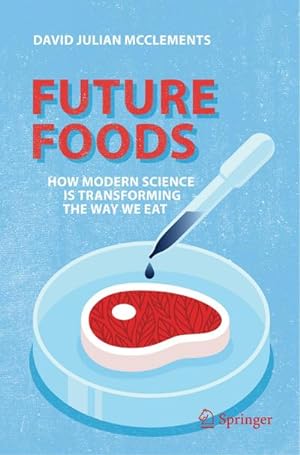
Future Foods
Lingua: Inglese
Editore: Springer International Publishing, Springer International Publishing Mai 2019, 2019
ISBN 10: 3030129942 ISBN 13: 9783030129941
Da: BuchWeltWeit Ludwig Meier e.K., Bergisch Gladbach, Germania
Valutazione del venditore 5 su 5 stelle
EUR 37,44
Spedizione EUR 23,00
Spedito da Germania a U.S.A.Quantità: 2 disponibili
Aggiungi al carrelloTaschenbuch. Condizione: Neu. This item is printed on demand - it takes 3-4 days longer - Neuware -We are in the midst of an unprecedented era of rapid scientific and technological advances that are transforming the way our foods are produced and consumed.Food architectureis being used to construct healthier, tastier, and more sustainable foods.Functional foodsare being created to combat chronic diseases such as obesity, cancer, diabetes, stroke, and heart disease. These foods are fortified withnutraceuticalsorprobioticsto improve our mood, performance, and health. The behavior of foods inside our guts is being controlled to increase their healthiness.Precision nutritionis being used to tailor diets to our unique genetic profiles, microbiomes, and metabolisms.Gene editing,nanotechnology, andartificial intelligenceare being used to address modern food challenges such as feeding the growing global population,reducing greenhouse gas emissions, reducing waste, and improving sustainability. However, the application of these technologies is facing a backlash from consumers concerned about the potential risks posed to human and environmental health.Some of the questions addressed in this book are: What is food architecture How does sound and color impact taste Will we all have 3D food printers in all our homes Should nanotechnology and gene editing be used to enhance our foods Are these new technologies safe Would you eat bug-foods if it led to a more sustainable food supply Should vegetarians eat themselves Can nutraceuticals and probiotics stop cancer What is the molecular basis of a tasty sustainable burger David Julian McClements is a Distinguished Professor in food science who has used physics, chemistry, and biology to improve the quality, safety, and healthiness of foods for over 30years. He has published over 900 scientific articles and 10 books in this area and is currently the most highly cited food scientist in the world. He has won numerous scientific awards for his work. The aim of this book is to highlight the many exciting advances being made in the science of foods, and to show their application for solving important problems related to the modern food supply, such as tackling chronic diseases, feeding a global population, reducing food waste, and creating healthier and tastier foods. 420 pp. Englisch.
-

Future Foods: How Modern Science Is Transforming the Way We Eat
Lingua: Inglese
Editore: Springer International Publishing, 2019
ISBN 10: 3030129942 ISBN 13: 9783030129941
EUR 32,41
Spedizione EUR 48,99
Spedito da Germania a U.S.A.Quantità: Più di 20 disponibili
Aggiungi al carrelloCondizione: New. Dieser Artikel ist ein Print on Demand Artikel und wird nach Ihrer Bestellung fuer Sie gedruckt. Discusses scientific and technological advances in the science of food in an engaging way Highlights how modern science is being used to improve the health of our bodies and our planet Addresses concerns with modern technol.

