

Importo totale (1 articolo articoli):
Destinazione ordine:

9783031052088 - Don't Tell the Boss!: How Poor Communication on Risks within Organizations Causes Major Catastrophes di Chernov, Dmitry; Sornette, Didier; Sansavini, Giovanni; Ayou... (18 risultati)
Vai alla pagina principale dei risultati di ricerca
Filtri di ricerca
Tipo di articolo
- Tutti i tipi di prodotto
- Libri (18)
- Riviste e Giornali (Nessun altro risultato corrispondente a questo perfezionamento)
- Fumetti (Nessun altro risultato corrispondente a questo perfezionamento)
- Spartiti (Nessun altro risultato corrispondente a questo perfezionamento)
- Arte, Stampe e Poster (Nessun altro risultato corrispondente a questo perfezionamento)
- Fotografie (Nessun altro risultato corrispondente a questo perfezionamento)
- Mappe (Nessun altro risultato corrispondente a questo perfezionamento)
- Manoscritti e Collezionismo cartaceo (Nessun altro risultato corrispondente a questo perfezionamento)
Condizioni Maggiori informazioni
- Nuovo (16)
- Come nuovo, Ottimo o Quasi ottimo (2)
- Molto buono o Buono (Nessun altro risultato corrispondente a questo perfezionamento)
- Discreto o Mediocre (Nessun altro risultato corrispondente a questo perfezionamento)
- Come descritto (Nessun altro risultato corrispondente a questo perfezionamento)
Legatura
- Tutte
- Rilegato (Nessun altro risultato corrispondente a questo perfezionamento)
- Brossura (18)
Ulteriori caratteristiche
- Prima ed. (Nessun altro risultato corrispondente a questo perfezionamento)
- Copia autograf. (Nessun altro risultato corrispondente a questo perfezionamento)
- Sovracoperta (Nessun altro risultato corrispondente a questo perfezionamento)
- Con foto (11)
- Non Print on Demand (15)
Lingua (1)
Prezzo
- Qualsiasi prezzo
- Inferiore a EUR 20 (Nessun altro risultato corrispondente a questo perfezionamento)
- EUR 20 a EUR 45
- Superiore a EUR 45
Spedizione gratuita
Paese del venditore
Valutazione venditore
-
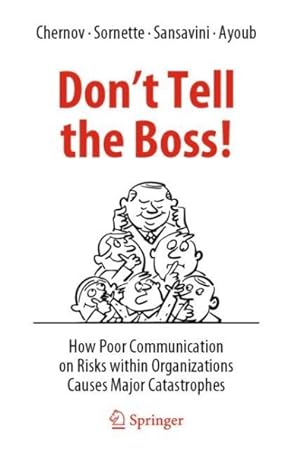
Don't Tell the Boss! : How Poor Communication on Risks Within Organizations Causes Major Catastrophes
Da: GreatBookPrices, Columbia, MD, U.S.A.
Valutazione del venditore 5 su 5 stelle

EUR 28,74
Spedizione EUR 2,30
Spedito in U.S.A.Quantità: Più di 20 disponibili
Aggiungi al carrelloCondizione: New.
-

Don't Tell the Boss!: How Poor Communication on Risks within Organizations Causes Major Catastrophes
Da: Lakeside Books, Benton Harbor, MI, U.S.A.
Valutazione del venditore 5 su 5 stelle
EUR 27,54
Spedizione EUR 3,48
Spedito in U.S.A.Quantità: Più di 20 disponibili
Aggiungi al carrelloCondizione: New. Brand New! Not Overstocks or Low Quality Book Club Editions! Direct From the Publisher! We're not a giant, faceless warehouse organization! We're a small town bookstore that loves books and loves it's customers! Buy from Lakeside Books!
-

Don't Tell the Boss! : How Poor Communication on Risks Within Organizations Causes Major Catastrophes
Da: GreatBookPrices, Columbia, MD, U.S.A.
Valutazione del venditore 5 su 5 stelle
EUR 33,89
Spedizione EUR 2,30
Spedito in U.S.A.Quantità: Più di 20 disponibili
Aggiungi al carrelloCondizione: As New. Unread book in perfect condition.
-

Don't Tell the Boss!
Lingua: Inglese
Editore: Springer International Publishing AG, CH, 2024
ISBN 10: 3031052080 ISBN 13: 9783031052088
Da: Rarewaves.com USA, London, LONDO, Regno Unito
Valutazione del venditore 5 su 5 stelle
EUR 42,71
Spedizione gratuita
Spedito da Regno Unito a U.S.A.Quantità: 1 disponibili
Aggiungi al carrelloPaperback. Condizione: New. 2022 ed. After a major disaster, when investigators are piecing together the story of what happened, a striking fact often emerges: before disaster struck, some people in the organization involved were aware of dangerous conditions that had the potential to escalate to a critical level. But for a variety of reasons, this crucial information did not reach decision-makers. So, the organization moved ever closer to catastrophe, effectively unaware of the possible threat-despite the fact that some of its employees could see it coming.What is the problem with communication about risk in an organization, and why does this problem exist? What stops people in organizations or project teams from freely reporting and discussing critical risks? This book seeks to answer these questions, starting from a deep analysis of 20 disasters where the concealment of risks played a major part.These case studies are drawn from around the world and span a range of industries: civil nuclear power,coal, oil and gas production, hydropower energy, metals and mining, space exploration, transport, finance, retail manufacturing and even the response of governments to wars, famines and epidemics.Together, case studies give an insight into why people hesitate to report risks-and even when they do, why their superiors often prefer to ignore the news. The book reviews existing research on the challenges of voice and silence in organizations.This helps to explain more generally why people dread passing on bad news to others-and why in the workplace they prefer to keep quiet about unpleasant facts or potential risks when they are talking to superiors and colleagues.The discussion section of the book includes important examples of concealment within the Chinese state hierarchy as well as by leading epidemiologists and governments in the West during the novel coronavirus outbreak in Wuhan in 2019-2020. The full picture of the very early stage of the COVID-19 pandemic remains unclear, and further research is obviously needed to better understand what motivated some municipal, provincial and national officials in China as well as Western counterparts to obfuscate facts in their internal communications about many issues associated with the outbreak.
-
Don't Tell the Boss! (Paperback)
Lingua: Inglese
Editore: Springer International Publishing AG, Cham, 2024
ISBN 10: 3031052080 ISBN 13: 9783031052088
Da: Grand Eagle Retail, Bensenville, IL, U.S.A.
Valutazione del venditore 5 su 5 stelle
Paperback. Condizione: new. Paperback. After a major disaster, when investigators are piecing together the story of what happened, a striking fact often emerges: before disaster struck, some people in the organization involved were aware of dangerous conditions that had the potential to escalate to a critical level. But for a variety of reasons, this crucial information did not reach decision-makers. So, the organization moved ever closer to catastrophe, effectively unaware of the possible threatdespite the fact that some of its employees could see it coming.What is the problem with communication about risk in an organization, and why does this problem exist? What stops people in organizations or project teams from freely reporting and discussing critical risks? This book seeks to answer these questions, starting from a deep analysis of 20 disasters where the concealment of risks played a major part.These case studies are drawn from around the world and span a range of industries: civil nuclear power,coal, oil and gas production, hydropower energy, metals and mining, space exploration, transport, finance, retail manufacturing and even the response of governments to wars, famines and epidemics.Together, case studies give an insight into why people hesitate to report risksand even when they do, why their superiors often prefer to ignore the news. The book reviews existing research on the challenges of voice and silence in organizations.This helps to explain more generally why people dread passing on bad news to othersand why in the workplace they prefer to keep quiet about unpleasant facts or potential risks when they are talking to superiors and colleagues.The discussion section of the book includes important examples of concealment within the Chinese state hierarchy as well as by leading epidemiologists and governments in the West during the novel coronavirus outbreak in Wuhan in 2019-2020. The full picture of the very early stage of the COVID-19 pandemic remains unclear, and further research is obviously needed to better understand what motivated some municipal, provincial and national officials in China as well as Western counterparts to obfuscate facts in their internal communications about many issues associated with the outbreak. Shipping may be from multiple locations in the US or from the UK, depending on stock availability.
-
Don't Tell the Boss!: How Poor Communication on Risks within Organizations Causes Major Catastrophes
Da: Chiron Media, Wallingford, Regno Unito
Valutazione del venditore 5 su 5 stelle
EUR 37,61
Spedizione EUR 17,92
Spedito da Regno Unito a U.S.A.Quantità: 1 disponibili
Aggiungi al carrellopaperback. Condizione: New.
-

Don't Tell the Boss! : How Poor Communication on Risks Within Organizations Causes Major Catastrophes
Da: GreatBookPricesUK, Woodford Green, Regno Unito
Valutazione del venditore 5 su 5 stelle
EUR 40,20
Spedizione EUR 17,36
Spedito da Regno Unito a U.S.A.Quantità: Più di 20 disponibili
Aggiungi al carrelloCondizione: New.
-

Don't Tell the Boss! : How Poor Communication on Risks Within Organizations Causes Major Catastrophes
Da: GreatBookPricesUK, Woodford Green, Regno Unito
Valutazione del venditore 5 su 5 stelle
EUR 41,18
Spedizione EUR 17,36
Spedito da Regno Unito a U.S.A.Quantità: Più di 20 disponibili
Aggiungi al carrelloCondizione: As New. Unread book in perfect condition.
-
Don't Tell the Boss!: How Poor Communication on Risks Within Organizations Causes Major Catastrophes
Da: Revaluation Books, Exeter, Regno Unito
Valutazione del venditore 5 su 5 stelle
EUR 48,55
Spedizione EUR 14,46
Spedito da Regno Unito a U.S.A.Quantità: 2 disponibili
Aggiungi al carrelloPaperback. Condizione: Brand New. 497 pages. 9.25x6.10x1.01 inches. In Stock.
-
Don't Tell the Boss!: How Poor Communication on Risks within Organizations Causes Major Catastrophes
Da: Ria Christie Collections, Uxbridge, Regno Unito
Valutazione del venditore 5 su 5 stelle
EUR 50,41
Spedizione EUR 13,86
Spedito da Regno Unito a U.S.A.Quantità: Più di 20 disponibili
Aggiungi al carrelloCondizione: New. In.
-
Don't Tell the Boss! (Paperback)
Lingua: Inglese
Editore: Springer International Publishing AG, Cham, 2024
ISBN 10: 3031052080 ISBN 13: 9783031052088
Da: AussieBookSeller, Truganina, VIC, Australia
Valutazione del venditore 5 su 5 stelle
EUR 71,69
Spedizione EUR 32,28
Spedito da Australia a U.S.A.Quantità: 1 disponibili
Aggiungi al carrelloPaperback. Condizione: new. Paperback. After a major disaster, when investigators are piecing together the story of what happened, a striking fact often emerges: before disaster struck, some people in the organization involved were aware of dangerous conditions that had the potential to escalate to a critical level. But for a variety of reasons, this crucial information did not reach decision-makers. So, the organization moved ever closer to catastrophe, effectively unaware of the possible threatdespite the fact that some of its employees could see it coming.What is the problem with communication about risk in an organization, and why does this problem exist? What stops people in organizations or project teams from freely reporting and discussing critical risks? This book seeks to answer these questions, starting from a deep analysis of 20 disasters where the concealment of risks played a major part.These case studies are drawn from around the world and span a range of industries: civil nuclear power,coal, oil and gas production, hydropower energy, metals and mining, space exploration, transport, finance, retail manufacturing and even the response of governments to wars, famines and epidemics.Together, case studies give an insight into why people hesitate to report risksand even when they do, why their superiors often prefer to ignore the news. The book reviews existing research on the challenges of voice and silence in organizations.This helps to explain more generally why people dread passing on bad news to othersand why in the workplace they prefer to keep quiet about unpleasant facts or potential risks when they are talking to superiors and colleagues.The discussion section of the book includes important examples of concealment within the Chinese state hierarchy as well as by leading epidemiologists and governments in the West during the novel coronavirus outbreak in Wuhan in 2019-2020. The full picture of the very early stage of the COVID-19 pandemic remains unclear, and further research is obviously needed to better understand what motivated some municipal, provincial and national officials in China as well as Western counterparts to obfuscate facts in their internal communications about many issues associated with the outbreak. Shipping may be from our Sydney, NSW warehouse or from our UK or US warehouse, depending on stock availability.
-

Don't Tell the Boss!
Lingua: Inglese
Editore: Springer International Publishing, Springer Nature Switzerland Jan 2024, 2024
ISBN 10: 3031052080 ISBN 13: 9783031052088
Da: buchversandmimpf2000, Emtmannsberg, BAYE, Germania
Valutazione del venditore 5 su 5 stelle
EUR 44,93
Spedizione EUR 60,00
Spedito da Germania a U.S.A.Quantità: 2 disponibili
Aggiungi al carrelloTaschenbuch. Condizione: Neu. Neuware -After a major disaster, when investigators are piecing together the story of what happened, a striking fact often emerges: before disaster struck, some people in the organization involved were aware of dangerous conditions that had the potential to escalate to a critical level. But for a variety of reasons, this crucial information did not reach decision-makers. So, the organization moved ever closer to catastrophe, effectively unaware of the possible threat¿despite the fact that some of its employees could see it coming.What is the problem with communication about risk in an organization, and why does this problem exist What stops people in organizations or project teams from freely reporting and discussing critical risks This book seeks to answer these questions, starting from a deep analysis of 20 disasters where the concealment of risks played a major part.These case studies are drawn from around the world and span a range of industries: civil nuclear power,coal, oil and gas production, hydropower energy, metals and mining, space exploration, transport, finance, retail manufacturing and even the response of governments to wars, famines and epidemics.Together, case studies give an insight into why people hesitate to report risks¿and even when they do, why their superiors often prefer to ignore the news.The book reviews existing research on the challenges of voice and silence in organizations.This helps to explain more generally why people dread passing on bad news to others¿and why in the workplace they prefer to keep quiet about unpleasant facts or potential risks when they are talking to superiors and colleagues.The discussion section of the book includes important examples of concealment within the Chinese state hierarchy as well as by leading epidemiologists and governments in the West during the novel coronavirus outbreak in Wuhan in 2019-2020. The full picture of the very early stage of the COVID-19 pandemic remains unclear, and further research is obviously needed to better understand what motivated some municipal, provincial and national officials in China as well as Western counterparts to obfuscate facts in their internal communications about many issues associated with the outbreak.Springer Verlag GmbH, Tiergartenstr. 17, 69121 Heidelberg 500 pp. Englisch.
-
EUR 39,50
Spedizione EUR 70,00
Spedito da Germania a U.S.A.Quantità: 5 disponibili
Aggiungi al carrelloTaschenbuch. Condizione: Neu. Don't Tell the Boss! | How Poor Communication on Risks within Organizations Causes Major Catastrophes | Dmitry Chernov (u. a.) | Taschenbuch | xvi | Englisch | 2024 | Springer | EAN 9783031052088 | Verantwortliche Person für die EU: Springer Verlag GmbH, Tiergartenstr. 17, 69121 Heidelberg, juergen[dot]hartmann[at]springer[dot]com | Anbieter: preigu.
-

Don't Tell the Boss! : How Poor Communication on Risks within Organizations Causes Major Catastrophes
Lingua: Inglese
Editore: Springer International Publishing, Springer International Publishing, 2024
ISBN 10: 3031052080 ISBN 13: 9783031052088
EUR 44,93
Spedizione EUR 63,75
Spedito da Germania a U.S.A.Quantità: 1 disponibili
Aggiungi al carrelloTaschenbuch. Condizione: Neu. Druck auf Anfrage Neuware - Printed after ordering - After a major disaster, when investigators are piecing together the story of what happened, a striking fact often emerges: before disaster struck, some people in the organization involved were aware of dangerous conditions that had the potential to escalate to a critical level. But for a variety of reasons, this crucial information did not reach decision-makers. So, the organization moved ever closer to catastrophe, effectively unaware of the possible threat-despite the fact that some of its employees could see it coming.What is the problem with communication about risk in an organization, and why does this problem exist What stops people in organizations or project teams from freely reporting and discussing critical risks This book seeks to answer these questions, starting from a deep analysis of 20 disasters where the concealment of risks played a major part.These case studies are drawn from around the world and span a range of industries: civil nuclear power,coal, oil and gas production, hydropower energy, metals and mining, space exploration, transport, finance, retail manufacturing and even the response of governments to wars, famines and epidemics.Together, case studies give an insight into why people hesitate to report risks-and even when they do, why their superiors often prefer to ignore the news.The book reviews existing research on the challenges of voice and silence in organizations.This helps to explain more generally why people dread passing on bad news to others-and why in the workplace they prefer to keep quiet about unpleasant facts or potential risks when they are talking to superiors and colleagues.The discussion section of the book includes important examples of concealment within the Chinese state hierarchy as well as by leading epidemiologists and governments in the West during the novel coronavirus outbreak in Wuhan in 2019-2020. The full picture of the very early stage of the COVID-19 pandemic remains unclear, and further research is obviously needed to better understand what motivated some municipal, provincial and national officials in China as well as Western counterparts to obfuscate facts in their internal communications about many issues associated with the outbreak.
-

Don't Tell the Boss!
Lingua: Inglese
Editore: Springer International Publishing AG, CH, 2024
ISBN 10: 3031052080 ISBN 13: 9783031052088
Da: Rarewaves.com UK, London, Regno Unito
Valutazione del venditore 5 su 5 stelle
EUR 40,21
Spedizione EUR 75,21
Spedito da Regno Unito a U.S.A.Quantità: 1 disponibili
Aggiungi al carrelloPaperback. Condizione: New. 2022 ed. After a major disaster, when investigators are piecing together the story of what happened, a striking fact often emerges: before disaster struck, some people in the organization involved were aware of dangerous conditions that had the potential to escalate to a critical level. But for a variety of reasons, this crucial information did not reach decision-makers. So, the organization moved ever closer to catastrophe, effectively unaware of the possible threat-despite the fact that some of its employees could see it coming.What is the problem with communication about risk in an organization, and why does this problem exist? What stops people in organizations or project teams from freely reporting and discussing critical risks? This book seeks to answer these questions, starting from a deep analysis of 20 disasters where the concealment of risks played a major part.These case studies are drawn from around the world and span a range of industries: civil nuclear power,coal, oil and gas production, hydropower energy, metals and mining, space exploration, transport, finance, retail manufacturing and even the response of governments to wars, famines and epidemics.Together, case studies give an insight into why people hesitate to report risks-and even when they do, why their superiors often prefer to ignore the news. The book reviews existing research on the challenges of voice and silence in organizations.This helps to explain more generally why people dread passing on bad news to others-and why in the workplace they prefer to keep quiet about unpleasant facts or potential risks when they are talking to superiors and colleagues.The discussion section of the book includes important examples of concealment within the Chinese state hierarchy as well as by leading epidemiologists and governments in the West during the novel coronavirus outbreak in Wuhan in 2019-2020. The full picture of the very early stage of the COVID-19 pandemic remains unclear, and further research is obviously needed to better understand what motivated some municipal, provincial and national officials in China as well as Western counterparts to obfuscate facts in their internal communications about many issues associated with the outbreak.
-
Don't Tell the Boss! (eng)
Da: Brook Bookstore On Demand, Napoli, NA, Italia
Valutazione del venditore 4 su 5 stelle

EUR 37,02
Spedizione EUR 8,00
Spedito da Italia a U.S.A.Quantità: Più di 20 disponibili
Aggiungi al carrelloCondizione: new. Questo è un articolo print on demand.
-

Don't Tell the Boss!
Lingua: Inglese
Editore: Springer, Berlin, Springer International Publishing, Springer, 2024
ISBN 10: 3031052080 ISBN 13: 9783031052088
Da: BuchWeltWeit Ludwig Meier e.K., Bergisch Gladbach, Germania
Valutazione del venditore 5 su 5 stelle
EUR 44,93
Spedizione EUR 23,00
Spedito da Germania a U.S.A.Quantità: 2 disponibili
Aggiungi al carrelloTaschenbuch. Condizione: Neu. This item is printed on demand - it takes 3-4 days longer - Neuware -After a major disaster, when investigators are piecing together the story of what happened, a striking fact often emerges: before disaster struck, some people in the organization involved were aware of dangerous conditions that had the potential to escalate to a critical level. But for a variety of reasons, this crucial information did not reach decision-makers. So, the organization moved ever closer to catastrophe, effectively unaware of the possible threat-despite the fact that some of its employees could see it coming.What is the problem with communication about risk in an organization, and why does this problem exist What stops people in organizations or project teams from freely reporting and discussing critical risks This book seeks to answer these questions, starting from a deep analysis of 20 disasters where the concealment of risks played a major part.These case studies are drawn from around the world and span a range of industries: civil nuclear power, coal, oil and gas production, hydropower energy, metals and mining, space exploration, transport, finance, retail manufacturing and even the response of governments to wars, famines and epidemics.Together, case studies give an insight into why people hesitate to report risks-and even when they do, why their superiors often prefer to ignore the news.The book reviews existing research on the challenges of voice and silence in organizations.This helps to explain more generally why people dread passing on bad news to others-and why in the workplace they prefer to keep quiet about unpleasant facts or potential risks when they are talking to superiors and colleagues.The discussion section of the book includes important examples of concealment within the Chinese state hierarchy as well as by leading epidemiologists and governments in the West during the novel coronavirus outbreak in Wuhan in 2019-2020. The full picture of the very early stage of the COVID-19 pandemic remains unclear, and further research is obviously needed to better understand what motivated some municipal, provincial and national officials in China as well as Western counterparts to obfuscate facts in their internal communications about many issues associated with the outbreak. 481 pp. Englisch.
-

Don t Tell the Boss!
Lingua: Inglese
Editore: Springer International Publishing, 2024
ISBN 10: 3031052080 ISBN 13: 9783031052088
EUR 38,00
Spedizione EUR 48,99
Spedito da Germania a U.S.A.Quantità: Più di 20 disponibili
Aggiungi al carrelloKartoniert / Broschiert. Condizione: New. Dieser Artikel ist ein Print on Demand Artikel und wird nach Ihrer Bestellung fuer Sie gedruckt. Presents a large and unique collection of 20 historical cases of risk information concealment from different industries and countriesExplains how intra-organizational risk communication failures can lead / have led to disasters Sets out the.


