

Importo totale (1 articolo articoli):
Destinazione ordine:

9783031261428 - Indigenous Knowledge and Disaster Risk Reduction: Insight Towards Perception, Response, Adaptation and Sustainability (12 risultati)
Vai alla pagina principale dei risultati di ricerca
Filtri di ricerca
Tipo di articolo
- Tutti i tipi di prodotto
- Libri (12)
- Riviste e Giornali (Nessun altro risultato corrispondente a questo perfezionamento)
- Fumetti (Nessun altro risultato corrispondente a questo perfezionamento)
- Spartiti (Nessun altro risultato corrispondente a questo perfezionamento)
- Arte, Stampe e Poster (Nessun altro risultato corrispondente a questo perfezionamento)
- Fotografie (Nessun altro risultato corrispondente a questo perfezionamento)
- Mappe (Nessun altro risultato corrispondente a questo perfezionamento)
- Manoscritti e Collezionismo cartaceo (Nessun altro risultato corrispondente a questo perfezionamento)
Condizioni Maggiori informazioni
- Nuovo (10)
- Come nuovo, Ottimo o Quasi ottimo (2)
- Molto buono o Buono (Nessun altro risultato corrispondente a questo perfezionamento)
- Discreto o Mediocre (Nessun altro risultato corrispondente a questo perfezionamento)
- Come descritto (Nessun altro risultato corrispondente a questo perfezionamento)
Legatura
- Tutte
- Rilegato (12)
- Brossura (Nessun altro risultato corrispondente a questo perfezionamento)
Ulteriori caratteristiche
- Prima ed. (Nessun altro risultato corrispondente a questo perfezionamento)
- Copia autograf. (Nessun altro risultato corrispondente a questo perfezionamento)
- Sovracoperta (Nessun altro risultato corrispondente a questo perfezionamento)
- Con foto (8)
- Non Print on Demand (9)
Lingua (1)
Prezzo
- Qualsiasi prezzo
- Inferiore a EUR 20 (Nessun altro risultato corrispondente a questo perfezionamento)
- EUR 20 a EUR 45 (Nessun altro risultato corrispondente a questo perfezionamento)
- Superiore a EUR 45
Spedizione gratuita
- Spedizione gratuita in U.S.A. (Nessun altro risultato corrispondente a questo perfezionamento)
Paese del venditore
Valutazione venditore
-

Indigenous Knowledge and Disaster Risk Reduction : Insight Towards Perception, Response, Adaptation and Sustainability
Libro 36: Disaster Risk ReductionDa: GreatBookPrices, Columbia, MD, U.S.A.
Valutazione del venditore 5 su 5 stelle

EUR 142,90
Spedizione EUR 2,30
Spedito in U.S.A.Quantità: Più di 20 disponibili
Aggiungi al carrelloCondizione: New.
-

Indigenous Knowledge and Disaster Risk Reduction: Insight Towards Perception, Response, Adaptation and Sustainability
Libro 36: Disaster Risk ReductionDa: Ria Christie Collections, Uxbridge, Regno Unito
Valutazione del venditore 5 su 5 stelle
EUR 147,93
Spedizione EUR 13,81
Spedito da Regno Unito a U.S.A.Quantità: Più di 20 disponibili
Aggiungi al carrelloCondizione: New. In.
-

Indigenous Knowledge and Disaster Risk Reduction : Insight Towards Perception, Response, Adaptation and Sustainability
Libro 36: Disaster Risk ReductionDa: GreatBookPricesUK, Woodford Green, Regno Unito
Valutazione del venditore 5 su 5 stelle
EUR 147,92
Spedizione EUR 17,29
Spedito da Regno Unito a U.S.A.Quantità: Più di 20 disponibili
Aggiungi al carrelloCondizione: New.
-

Indigenous Knowledge and Disaster Risk Reduction : Insight Towards Perception, Response, Adaptation and Sustainability
Libro 36: Disaster Risk ReductionDa: GreatBookPrices, Columbia, MD, U.S.A.
Valutazione del venditore 5 su 5 stelle
EUR 167,77
Spedizione EUR 2,30
Spedito in U.S.A.Quantità: Più di 20 disponibili
Aggiungi al carrelloCondizione: As New. Unread book in perfect condition.
-

Indigenous Knowledge and Disaster Risk Reduction : Insight Towards Perception, Response, Adaptation and Sustainability
Libro 36: Disaster Risk ReductionDa: GreatBookPricesUK, Woodford Green, Regno Unito
Valutazione del venditore 5 su 5 stelle
EUR 167,67
Spedizione EUR 17,29
Spedito da Regno Unito a U.S.A.Quantità: Più di 20 disponibili
Aggiungi al carrelloCondizione: As New. Unread book in perfect condition.
-

Indigenous Knowledge and Disaster Risk Reduction
Lingua: Inglese
Editore: Springer International Publishing Mai 2023, 2023
ISBN 10: 3031261429 ISBN 13: 9783031261428
Da: buchversandmimpf2000, Emtmannsberg, BAYE, Germania
Valutazione del venditore 5 su 5 stelle
EUR 160,49
Spedizione EUR 60,00
Spedito da Germania a U.S.A.Quantità: 2 disponibili
Aggiungi al carrelloBuch. Condizione: Neu. Neuware -The book seeks to comprehend how indigenous knowledge systems of local communities can be effectively used in disaster management of various types. A prime example is the 2015 Sendai Framework for Disaster Risk Reduction, promoting indigenous environmental management knowledge and practices. Traditional knowledge of indigenous peoples includes information and insight that supplement conventional science and environmental observations, a comprehensive understanding of the environment, natural resources, culture, and human interactions with them which is not documented before. A great deal of this knowledge have been lost in translation. In this book, the authors attempt to keep a record of each and every traditional knowledge study of the indigenous communities in managing the disasters.The use of indigenous knowledge systems in disaster understanding and management is the primary focus of the chapters.This book is organized into four major sections. Thefirst part gives an overview and help in conceptualizing the different concepts of hazard and disaster perception and how response and adaptation are connected with it. This part also discusses the concept of the connection between hazard and sustainable development and how the understanding of risk reduction and resilience can happen with the help of indigenous knowledge, insights, and strategies.The second part of the book introduces the different approaches to disaster and risk management. It establishes how vulnerability influences the risk associated with a hazard and the responses can be both positive and negative in disaster management. The approaches of the indigenous communities in managing a disaster, their resilience, capacity building, and community-based preparedness will be the area of prime focus in this chapter.Part 3 of this book describes the concept of sustainability through indigenous knowledge and practice. The sole highlight of this chapter is the indigenous knowledge efficacies in disaster identification, risk reduction, climate risk management, and climate action.The last section of the book explores how to meet the gaps between local knowledge and policy formulation. It highlights how traditional knowledge of the indigenous communities can prove to be beneficial in developing a holistic regional-based policy framework which will be easily accepted by the target stakeholders since they will be more acquainted with the local strategies and methods. This section ends with an assessment and discussion of the gaps and future scopes in disaster risk reduction through integrating local knowledge and modern technologies.Springer-Verlag GmbH, Tiergartenstr. 17, 69121 Heidelberg 636 pp. Englisch.
-
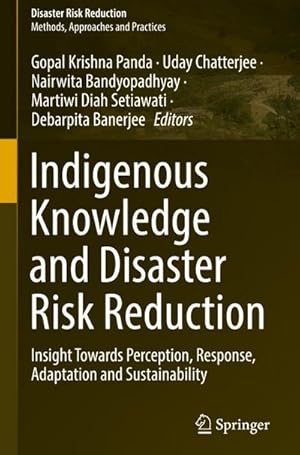
Indigenous Knowledge and Disaster Risk Reduction : Insight Towards Perception, Response, Adaptation and Sustainability
Libro 36: Disaster Risk ReductionLingua: Inglese
Editore: Springer International Publishing, 2023
ISBN 10: 3031261429 ISBN 13: 9783031261428
EUR 160,49
Spedizione EUR 65,55
Spedito da Germania a U.S.A.Quantità: 1 disponibili
Aggiungi al carrelloBuch. Condizione: Neu. Druck auf Anfrage Neuware - Printed after ordering - The book seeks to comprehend how indigenous knowledge systems of local communities can be effectively used in disaster management of various types. A prime example is the 2015 Sendai Framework for Disaster Risk Reduction, promoting indigenous environmental management knowledge and practices. Traditional knowledge of indigenous peoples includes information and insight that supplement conventional science and environmental observations, a comprehensive understanding of the environment, natural resources, culture, and human interactions with them which is not documented before. A great deal of this knowledge have been lost in translation. In this book, the authors attempt to keep a record of each and every traditional knowledge study of the indigenous communities in managing the disasters.The use of indigenous knowledge systems in disaster understanding and management is the primary focus of the chapters.This book is organized into four major sections. Thefirst part gives an overview and help in conceptualizing the different concepts of hazard and disaster perception and how response and adaptation are connected with it. This part also discusses the concept of the connection between hazard and sustainable development and how the understanding of risk reduction and resilience can happen with the help of indigenous knowledge, insights, and strategies.The second part of the book introduces the different approaches to disaster and risk management. It establishes how vulnerability influences the risk associated with a hazard and the responses can be both positive and negative in disaster management. The approaches of the indigenous communities in managing a disaster, their resilience, capacity building, and community-based preparedness will be the area of prime focus in this chapter.Part 3 of this book describes the concept of sustainability through indigenous knowledge and practice. The sole highlight of this chapter is the indigenous knowledge efficacies in disaster identification, risk reduction, climate risk management, and climate action.The last section of the book explores how to meet the gaps between local knowledge and policy formulation. It highlights how traditional knowledge of the indigenous communities can prove to be beneficial in developing a holistic regional-based policy framework which will be easily accepted by the target stakeholders since they will be more acquainted with the local strategies and methods. This section ends with an assessment and discussion of the gaps and future scopes in disaster risk reduction through integrating local knowledge and modern technologies.
-
 Edizione Internazionale
INDIGENOUS KNOWLEDGE AND DISASTER RISK REDUCTION INSIGHT TOWARDS PERCEPTION RESPONSE ADAPTATION AND SUSTAINABILITY (HB 2023)
Libro 36: Disaster Risk ReductionDa: UK BOOKS STORE, London, LONDO, Regno Unito
Valutazione del venditore 5 su 5 stelle
EUR 232,07
Spedizione EUR 8,06
Spedito da Regno Unito a U.S.A.Quantità: 1 disponibili
Aggiungi al carrelloCondizione: New. Brand New! Fast Delivery This is an International Edition and ship within 24-48 hours. Deliver by FedEx and Dhl, & Aramex, UPS, & USPS and we do accept APO and PO BOX Addresses. Order can be delivered worldwide within 7-12 days and we do have flat rate for up to 2LB. Extra shipping charges will be requested if the Book weight is more than 5 LB. This Item May be shipped from India, United states & United Kingdom. Depending on your location and availability.
-
Indigenous Knowledge and Disaster Risk Reduction: Insight Towards Perception, Response, Adaptation and Sustainability
Libro 36: Disaster Risk ReductionDa: Revaluation Books, Exeter, Regno Unito
Valutazione del venditore 5 su 5 stelle
EUR 240,88
Spedizione EUR 17,29
Spedito da Regno Unito a U.S.A.Quantità: 2 disponibili
Aggiungi al carrelloHardcover. Condizione: Brand New. 633 pages. 9.25x6.10x1.38 inches. In Stock.
-
Indigenous Knowledge and Disaster Risk (eng)
Da: Brook Bookstore On Demand, Napoli, NA, Italia
Valutazione del venditore 4 su 5 stelle

EUR 126,26
Spedizione EUR 11,00
Spedito da Italia a U.S.A.Quantità: Più di 20 disponibili
Aggiungi al carrelloCondizione: new. Questo è un articolo print on demand.
-

Indigenous Knowledge and Disaster Risk Reduction
Libro 36: Disaster Risk ReductionLingua: Inglese
Editore: Springer International Publishing Mai 2023, 2023
ISBN 10: 3031261429 ISBN 13: 9783031261428
Da: BuchWeltWeit Ludwig Meier e.K., Bergisch Gladbach, Germania
Valutazione del venditore 5 su 5 stelle
EUR 160,49
Spedizione EUR 23,00
Spedito da Germania a U.S.A.Quantità: 2 disponibili
Aggiungi al carrelloBuch. Condizione: Neu. This item is printed on demand - it takes 3-4 days longer - Neuware -The book seeks to comprehend how indigenous knowledge systems of local communities can be effectively used in disaster management of various types. A prime example is the 2015 Sendai Framework for Disaster Risk Reduction, promoting indigenous environmental management knowledge and practices. Traditional knowledge of indigenous peoples includes information and insight that supplement conventional science and environmental observations, a comprehensive understanding of the environment, natural resources, culture, and human interactions with them which is not documented before. A great deal of this knowledge have been lost in translation. In this book, the authors attempt to keep a record of each and every traditional knowledge study of the indigenous communities in managing the disasters.The use of indigenous knowledge systems in disaster understanding and management is the primary focus of the chapters.This book is organized into four major sections. Thefirst part gives an overview and help in conceptualizing the different concepts of hazard and disaster perception and how response and adaptation are connected with it. This part also discusses the concept of the connection between hazard and sustainable development and how the understanding of risk reduction and resilience can happen with the help of indigenous knowledge, insights, and strategies.The second part of the book introduces the different approaches to disaster and risk management. It establishes how vulnerability influences the risk associated with a hazard and the responses can be both positive and negative in disaster management. The approaches of the indigenous communities in managing a disaster, their resilience, capacity building, and community-based preparedness will be the area of prime focus in this chapter.Part 3 of this book describes the concept of sustainability through indigenous knowledge and practice. The sole highlight of this chapter is the indigenous knowledge efficacies in disaster identification, risk reduction, climate risk management, and climate action.The last section of the book explores how to meet the gaps between local knowledge and policy formulation. It highlights how traditional knowledge of the indigenous communities can prove to be beneficial in developing a holistic regional-based policy framework which will be easily accepted by the target stakeholders since they will be more acquainted with the local strategies and methods. This section ends with an assessment and discussion of the gaps and future scopes in disaster risk reduction through integrating local knowledge and modern technologies. 636 pp. Englisch.
-

Indigenous Knowledge and Disaster Risk Reduction
Libro 36: Disaster Risk ReductionLingua: Inglese
Editore: Springer, Berlin|Springer International Publishing|Springer, 2023
ISBN 10: 3031261429 ISBN 13: 9783031261428
EUR 136,16
Spedizione EUR 48,99
Spedito da Germania a U.S.A.Quantità: Più di 20 disponibili
Aggiungi al carrelloCondizione: New. Dieser Artikel ist ein Print on Demand Artikel und wird nach Ihrer Bestellung fuer Sie gedruckt. The book seeks to comprehend how indigenous knowledge systems of local communities can be effectively used in disaster management of various types. A prime example is the 2015 Sendai Framework for Disaster Risk Reduction, promoting indigenous environment.


