

Importo totale (1 articolo articoli):
Destinazione ordine:

9783111631783 - Applicative Morphology: Neglected Syntactic and Non-syntactic Functions: 373 (16 risultati)
Vai alla pagina principale dei risultati di ricerca
Filtri di ricerca
Tipo di articolo
- Tutti i tipi di prodotto
- Libri (16)
- Riviste e Giornali (Nessun altro risultato corrispondente a questo perfezionamento)
- Fumetti (Nessun altro risultato corrispondente a questo perfezionamento)
- Spartiti (Nessun altro risultato corrispondente a questo perfezionamento)
- Arte, Stampe e Poster (Nessun altro risultato corrispondente a questo perfezionamento)
- Fotografie (Nessun altro risultato corrispondente a questo perfezionamento)
- Mappe (Nessun altro risultato corrispondente a questo perfezionamento)
- Manoscritti e Collezionismo cartaceo (Nessun altro risultato corrispondente a questo perfezionamento)
Condizioni Maggiori informazioni
- Nuovo (13)
- Come nuovo, Ottimo o Quasi ottimo (2)
- Molto buono o Buono (1)
- Discreto o Mediocre (Nessun altro risultato corrispondente a questo perfezionamento)
- Come descritto (Nessun altro risultato corrispondente a questo perfezionamento)
Legatura
- Tutte
- Rilegato (Nessun altro risultato corrispondente a questo perfezionamento)
- Brossura (16)
Ulteriori caratteristiche
- Prima ed. (Nessun altro risultato corrispondente a questo perfezionamento)
- Copia autograf. (Nessun altro risultato corrispondente a questo perfezionamento)
- Sovracoperta (Nessun altro risultato corrispondente a questo perfezionamento)
- Con foto (14)
- Non Print on Demand (14)
Lingua (1)
Prezzo
- Qualsiasi prezzo
- Inferiore a EUR 20
- EUR 20 a EUR 45
- Superiore a EUR 45 (Nessun altro risultato corrispondente a questo perfezionamento)
Spedizione gratuita
Paese del venditore
Valutazione venditore
-
![Immagine dell'editore per Applicative Morphology: Neglected Syntactic and Non-syntactic Functions (Trends in Linguistics. Studies and Monographs [TiLSM], 373) venduto da Books From California](https://pictures.abebooks.com/isbn/9783111631783-it-300.jpg)
Applicative Morphology: Neglected Syntactic and Non-syntactic Functions (Trends in Linguistics. Studies and Monographs [TiLSM], 373)
Libro 350 di 360: Trends in Linguistics. Studies and Monographs [TiLSM]Da: Books From California, Simi Valley, CA, U.S.A.
Valutazione del venditore 4 su 5 stelle

perfect. Condizione: Very Good.
-

Applicative Morphology : Neglected Syntactic and Non-syntactic Functions
Libro 350 di 360: Trends in Linguistics. Studies and Monographs [TiLSM]Da: GreatBookPrices, Columbia, MD, U.S.A.
Valutazione del venditore 5 su 5 stelle

Condizione: New.
-

Applicative Morphology: Neglected Syntactic and Non-Syntactic Functions (Paperback or Softback)
Libro 350 di 360: Trends in Linguistics. Studies and Monographs [TiLSM]Lingua: Inglese
Editore: de Gruyter Mouton 11/4/2024, 2024
ISBN 10: 3111631788 ISBN 13: 9783111631783
Da: BargainBookStores, Grand Rapids, MI, U.S.A.
Valutazione del venditore 5 su 5 stelle
Paperback or Softback. Condizione: New. Applicative Morphology: Neglected Syntactic and Non-Syntactic Functions. Book.
-
Applicative Morphology: Neglected Syntactic and Non-syntactic Functions (Trends in Linguistics. Studies and Monographs [TiLSM], 373)
Libro 350 di 360: Trends in Linguistics. Studies and Monographs [TiLSM]Da: California Books, Miami, FL, U.S.A.
Valutazione del venditore 5 su 5 stelle
EUR 23,16
Spedizione gratuita
Spedito in U.S.A.Quantità: Più di 20 disponibili
Aggiungi al carrelloCondizione: New.
-

Applicative Morphology : Neglected Syntactic and Non-syntactic Functions
Libro 350 di 360: Trends in Linguistics. Studies and Monographs [TiLSM]Da: GreatBookPrices, Columbia, MD, U.S.A.
Valutazione del venditore 5 su 5 stelle
Condizione: As New. Unread book in perfect condition.
-

EUR 25,20
Spedizione gratuita
Spedito in U.S.A.Quantità: Più di 20 disponibili
Aggiungi al carrelloPaperback. Condizione: New. This book is about recurrent functions of applicative morphology not included in typologically-oriented definitions. Based on substantial cross-linguistic evidence, it challenges received wisdom on applicatives in several ways. First, in many of the surveyed languages, applicatives are the sole means to introduce a non-Actor semantic role into a clause. When there is an alternative way of expression, the applicative counterpart often has no valence-increasing effect on the targeted root. Second, applicative morphology can introduce constituents which are not syntactic objects and/or co-occur with obliques. Third, functions such as conveying aspectual nuances to the predicate (intensity, repetition, habituality) or its arguments (partitive P, highly individuated P), narrow-focusing constituents, and functioning as category-changing devices are attested in geographically distant and genetically unrelated languages. Further, this volume reveals that spatial-related morphology is prone to developing applicative functions in disparate languages and phyla. Finally, several contributions discuss the diachrony of applicative constructions and their (non-syntactic) attested functions, including a case of applicatives-in-the-making.
-

Applicative Morphology
Libro 350 di 360: Trends in Linguistics. Studies and Monographs [TiLSM]Da: Rarewaves.com USA, London, LONDO, Regno Unito
Valutazione del venditore 5 su 5 stelle
EUR 34,11
Spedizione gratuita
Spedito da Regno Unito a U.S.A.Quantità: Più di 20 disponibili
Aggiungi al carrelloPaperback. Condizione: New. This book is about recurrent functions of applicative morphology not included in typologically-oriented definitions. Based on substantial cross-linguistic evidence, it challenges received wisdom on applicatives in several ways. First, in many of the surveyed languages, applicatives are the sole means to introduce a non-Actor semantic role into a clause. When there is an alternative way of expression, the applicative counterpart often has no valence-increasing effect on the targeted root. Second, applicative morphology can introduce constituents which are not syntactic objects and/or co-occur with obliques. Third, functions such as conveying aspectual nuances to the predicate (intensity, repetition, habituality) or its arguments (partitive P, highly individuated P), narrow-focusing constituents, and functioning as category-changing devices are attested in geographically distant and genetically unrelated languages. Further, this volume reveals that spatial-related morphology is prone to developing applicative functions in disparate languages and phyla. Finally, several contributions discuss the diachrony of applicative constructions and their (non-syntactic) attested functions, including a case of applicatives-in-the-making.
-

Applicative Morphology : Neglected Syntactic and Non-syntactic Functions
Libro 350 di 360: Trends in Linguistics. Studies and Monographs [TiLSM]Da: GreatBookPricesUK, Woodford Green, Regno Unito
Valutazione del venditore 5 su 5 stelle
EUR 28,21
Spedizione EUR 17,30
Spedito da Regno Unito a U.S.A.Quantità: Più di 20 disponibili
Aggiungi al carrelloCondizione: As New. Unread book in perfect condition.
-

Applicative Morphology : Neglected Syntactic and Non-syntactic Functions
Libro 350 di 360: Trends in Linguistics. Studies and Monographs [TiLSM]Da: GreatBookPricesUK, Woodford Green, Regno Unito
Valutazione del venditore 5 su 5 stelle
EUR 28,93
Spedizione EUR 17,30
Spedito da Regno Unito a U.S.A.Quantità: Più di 20 disponibili
Aggiungi al carrelloCondizione: New.
-
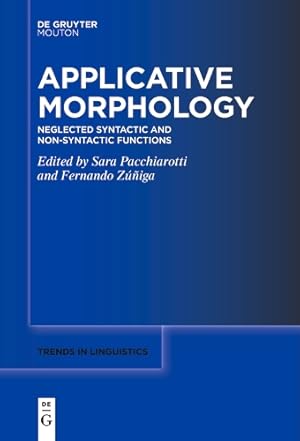
Applicative Morphology
Libro 350 di 360: Trends in Linguistics. Studies and Monographs [TiLSM]Da: Rarewaves USA United, OSWEGO, IL, U.S.A.
Valutazione del venditore 5 su 5 stelle
EUR 28,92
Spedizione EUR 43,25
Spedito in U.S.A.Quantità: Più di 20 disponibili
Aggiungi al carrelloPaperback. Condizione: New. This book is about recurrent functions of applicative morphology not included in typologically-oriented definitions. Based on substantial cross-linguistic evidence, it challenges received wisdom on applicatives in several ways. First, in many of the surveyed languages, applicatives are the sole means to introduce a non-Actor semantic role into a clause. When there is an alternative way of expression, the applicative counterpart often has no valence-increasing effect on the targeted root. Second, applicative morphology can introduce constituents which are not syntactic objects and/or co-occur with obliques. Third, functions such as conveying aspectual nuances to the predicate (intensity, repetition, habituality) or its arguments (partitive P, highly individuated P), narrow-focusing constituents, and functioning as category-changing devices are attested in geographically distant and genetically unrelated languages. Further, this volume reveals that spatial-related morphology is prone to developing applicative functions in disparate languages and phyla. Finally, several contributions discuss the diachrony of applicative constructions and their (non-syntactic) attested functions, including a case of applicatives-in-the-making.
-

EUR 24,43
Spedizione EUR 48,99
Spedito da Germania a U.S.A.Quantità: Più di 20 disponibili
Aggiungi al carrelloCondizione: New.
-

Applicative Morphology | Neglected Syntactic and Non-syntactic Functions
Libro 350 di 360: Trends in Linguistics. Studies and Monographs [TiLSM]EUR 24,50
Spedizione EUR 70,00
Spedito da Germania a U.S.A.Quantità: 5 disponibili
Aggiungi al carrelloTaschenbuch. Condizione: Neu. Applicative Morphology | Neglected Syntactic and Non-syntactic Functions | Fernando Zuniga (u. a.) | Taschenbuch | VI | Englisch | 2024 | De Gruyter Mouton | EAN 9783111631783 | Verantwortliche Person für die EU: Walter de Gruyter GmbH, De Gruyter GmbH, Genthiner Str. 13, 10785 Berlin, productsafety[at]degruyterbrill[dot]com | Anbieter: preigu.
-

Applicative Morphology : Neglected Syntactic and Non-syntactic Functions
Libro 350 di 360: Trends in Linguistics. Studies and Monographs [TiLSM]EUR 24,95
Spedizione EUR 70,67
Spedito da Germania a U.S.A.Quantità: 1 disponibili
Aggiungi al carrelloTaschenbuch. Condizione: Neu. Druck auf Anfrage Neuware - Printed after ordering - This book is about recurrent functions of applicative morphology not included in typologically-oriented definitions. Based on substantial cross-linguistic evidence, it challenges received wisdom on applicatives in several ways. First, in many of the surveyed languages, applicatives are the sole means to introduce a non-Actor semantic role into a clause. When there is an alternative way of expression, the applicative counterpart often has no valence-increasing effect on the targeted root. Second, applicative morphology can introduce constituents which are not syntactic objects and/or co-occur with obliques. Third, functions such as conveying aspectual nuances to the predicate (intensity, repetition, habituality) or its arguments (partitive P, highly individuated P), narrow-focusing constituents, and functioning as category-changing devices are attested in geographically distant and genetically unrelated languages. Further, this volume reveals that spatial-related morphology is prone to developing applicative functions in disparate languages and phyla. Finally, several contributions discuss the diachrony of applicative constructions and their (non-syntactic) attested functions, including a case of applicatives-in-the-making.
-

Applicative Morphology
Libro 350 di 360: Trends in Linguistics. Studies and Monographs [TiLSM]Da: Rarewaves.com UK, London, Regno Unito
Valutazione del venditore 5 su 5 stelle
EUR 30,68
Spedizione EUR 74,96
Spedito da Regno Unito a U.S.A.Quantità: Più di 20 disponibili
Aggiungi al carrelloPaperback. Condizione: New. This book is about recurrent functions of applicative morphology not included in typologically-oriented definitions. Based on substantial cross-linguistic evidence, it challenges received wisdom on applicatives in several ways. First, in many of the surveyed languages, applicatives are the sole means to introduce a non-Actor semantic role into a clause. When there is an alternative way of expression, the applicative counterpart often has no valence-increasing effect on the targeted root. Second, applicative morphology can introduce constituents which are not syntactic objects and/or co-occur with obliques. Third, functions such as conveying aspectual nuances to the predicate (intensity, repetition, habituality) or its arguments (partitive P, highly individuated P), narrow-focusing constituents, and functioning as category-changing devices are attested in geographically distant and genetically unrelated languages. Further, this volume reveals that spatial-related morphology is prone to developing applicative functions in disparate languages and phyla. Finally, several contributions discuss the diachrony of applicative constructions and their (non-syntactic) attested functions, including a case of applicatives-in-the-making.
-

Applicative Morphology
Libro 350 di 360: Trends in Linguistics. Studies and Monographs [TiLSM]Lingua: Inglese
Editore: De Gruyter Mouton, De Gruyter Mouton Nov 2024, 2024
ISBN 10: 3111631788 ISBN 13: 9783111631783
Da: BuchWeltWeit Ludwig Meier e.K., Bergisch Gladbach, Germania
Valutazione del venditore 5 su 5 stelle
EUR 24,95
Spedizione EUR 23,00
Spedito da Germania a U.S.A.Quantità: 1 disponibili
Aggiungi al carrelloTaschenbuch. Condizione: Neu. This item is printed on demand - it takes 3-4 days longer - Neuware -This book is about recurrent functions of applicative morphology not included in typologically-oriented definitions. Based on substantial cross-linguistic evidence, it challenges received wisdom on applicatives in several ways. First, in many of the surveyed languages, applicatives are the sole means to introduce a non-Actor semantic role into a clause. When there is an alternative way of expression, the applicative counterpart often has no valence-increasing effect on the targeted root. Second, applicative morphology can introduce constituents which are not syntactic objects and/or co-occur with obliques. Third, functions such as conveying aspectual nuances to the predicate (intensity, repetition, habituality) or its arguments (partitive P, highly individuated P), narrow-focusing constituents, and functioning as category-changing devices are attested in geographically distant and genetically unrelated languages. Further, this volume reveals that spatial-related morphology is prone to developing applicative functions in disparate languages and phyla. Finally, several contributions discuss the diachrony of applicative constructions and their (non-syntactic) attested functions, including a case of applicatives-in-the-making. 484 pp. Englisch.
-

Applicative Morphology
Libro 350 di 360: Trends in Linguistics. Studies and Monographs [TiLSM]Lingua: Inglese
Editore: De Gruyter Mouton, De Gruyter Mouton Nov 2024, 2024
ISBN 10: 3111631788 ISBN 13: 9783111631783
Da: buchversandmimpf2000, Emtmannsberg, BAYE, Germania
Valutazione del venditore 5 su 5 stelle
EUR 24,95
Spedizione EUR 60,00
Spedito da Germania a U.S.A.Quantità: 1 disponibili
Aggiungi al carrelloTaschenbuch. Condizione: Neu. This item is printed on demand - Print on Demand Titel. Neuware -This book is about recurrent functions of applicative morphology not included in typologically-oriented definitions. Based on substantial cross-linguistic evidence, it challenges received wisdom on applicatives in several ways. First, in many of the surveyed languages, applicatives are the sole means to introduce a non-Actor semantic role into a clause. When there is an alternative way of expression, the applicative counterpart often has no valence-increasing effect on the targeted root. Second, applicative morphology can introduce constituents which are not syntactic objects and/or co-occur with obliques. Third, functions such as conveying aspectual nuances to the predicate (intensity, repetition, habituality) or its arguments (partitive P, highly individuated P), narrow-focusing constituents, and functioning as category-changing devices are attested in geographically distant and genetically unrelated languages. Further, this volume reveals that spatial-related morphology is prone to developing applicative functions in disparate languages and phyla. Finally, several contributions discuss the diachrony of applicative constructions and their (non-syntactic) attested functions, including a case of applicatives-in-the-making.De Gruyter Mouton, Genthiner Straße 13, 10785 Berlin 484 pp. Englisch.

