

Importo totale (1 articolo articoli):
Destinazione ordine:

9783319362465 - Generative Mechanisms Transforming the Social Order (9 risultati)
Vai alla pagina principale dei risultati di ricerca
Filtri di ricerca
Tipo di articolo
- Tutti i tipi di prodotto
- Libri (9)
- Riviste e Giornali (Nessun altro risultato corrispondente a questo perfezionamento)
- Fumetti (Nessun altro risultato corrispondente a questo perfezionamento)
- Spartiti (Nessun altro risultato corrispondente a questo perfezionamento)
- Arte, Stampe e Poster (Nessun altro risultato corrispondente a questo perfezionamento)
- Fotografie (Nessun altro risultato corrispondente a questo perfezionamento)
- Mappe (Nessun altro risultato corrispondente a questo perfezionamento)
- Manoscritti e Collezionismo cartaceo (Nessun altro risultato corrispondente a questo perfezionamento)
Condizioni Maggiori informazioni
- Nuovo (9)
- Come nuovo, Ottimo o Quasi ottimo (Nessun altro risultato corrispondente a questo perfezionamento)
- Molto buono o Buono (Nessun altro risultato corrispondente a questo perfezionamento)
- Discreto o Mediocre (Nessun altro risultato corrispondente a questo perfezionamento)
- Come descritto (Nessun altro risultato corrispondente a questo perfezionamento)
Legatura
- Tutte
- Rilegato (Nessun altro risultato corrispondente a questo perfezionamento)
- Brossura (9)
Ulteriori caratteristiche
- Prima ed. (Nessun altro risultato corrispondente a questo perfezionamento)
- Copia autograf. (Nessun altro risultato corrispondente a questo perfezionamento)
- Sovracoperta (Nessun altro risultato corrispondente a questo perfezionamento)
- Con foto (5)
- Non Print on Demand (7)
Lingua (1)
Prezzo
- Qualsiasi prezzo
- Inferiore a EUR 20 (Nessun altro risultato corrispondente a questo perfezionamento)
- EUR 20 a EUR 45 (Nessun altro risultato corrispondente a questo perfezionamento)
- Superiore a EUR 45
Spedizione gratuita
- Spedizione gratuita in U.S.A. (Nessun altro risultato corrispondente a questo perfezionamento)
Paese del venditore
Valutazione venditore
-

Generative Mechanisms Transforming the Social Order (Social Morphogenesis)
Da: Ria Christie Collections, Uxbridge, Regno Unito
Valutazione del venditore 5 su 5 stelle

EUR 58,96
Spedizione EUR 13,83
Spedito da Regno Unito a U.S.A.Quantità: Più di 20 disponibili
Aggiungi al carrelloCondizione: New. In.
-
Generative Mechanisms Transforming the Social Order (Social Morphogenesis)
Da: Chiron Media, Wallingford, Regno Unito
Valutazione del venditore 5 su 5 stelle
EUR 56,78
Spedizione EUR 17,88
Spedito da Regno Unito a U.S.A.Quantità: 10 disponibili
Aggiungi al carrelloPaperback. Condizione: New.
-

Generative Mechanisms Transforming the Social Order
Lingua: Inglese
Editore: Springer International Publishing, 2016
ISBN 10: 3319362461 ISBN 13: 9783319362465
EUR 48,37
Spedizione EUR 48,99
Spedito da Germania a U.S.A.Quantità: Più di 20 disponibili
Aggiungi al carrelloCondizione: New.
-
Generative Mechanisms Transforming the Social Order
Da: Revaluation Books, Exeter, Regno Unito
Valutazione del venditore 5 su 5 stelle
EUR 78,31
Spedizione EUR 28,85
Spedito da Regno Unito a U.S.A.Quantità: 2 disponibili
Aggiungi al carrelloPaperback. Condizione: Brand New. reprint edition. 256 pages. 9.25x6.10x0.58 inches. In Stock.
-
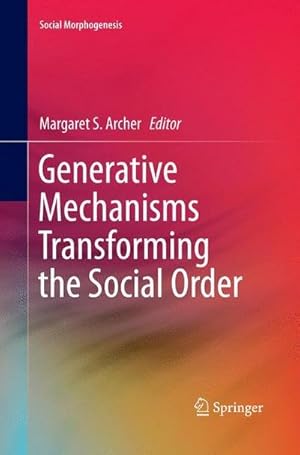
Generative Mechanisms Transforming the Social Order
Lingua: Inglese
Editore: Springer International Publishing, 2016
ISBN 10: 3319362461 ISBN 13: 9783319362465
EUR 53,49
Spedizione EUR 61,97
Spedito da Germania a U.S.A.Quantità: 1 disponibili
Aggiungi al carrelloTaschenbuch. Condizione: Neu. Druck auf Anfrage Neuware - Printed after ordering - This volume examines how generative mechanisms emerge in the social order and their consequences. It does so in the light of finding answers to the general question posed in this book series: Will Late Modernity be replaced by a social formation that could be called Morphogenic Society This volume clarifies what a 'generative mechanism' is, to achieve a better understanding of their social origins, and to delineate in what way such mechanisms exert effects within a current social formation, either stabilizing it or leading to changes potentially replacing it . The book explores questions about conjuncture, convergence and countervailing effects of morphogenetic mechanisms in order to assess their impact. Simultaneously, it looks at how products of positive feedback intertwine with the results of (morphostatic) negative feedback. This process also requires clarification, especially about the conditions under which morphostasis prevails over morphogenesis and vice versa. It raises the issue as to whether their co-existence can be other than short-lived. The volume addresses whether or not there also is a process of 'morpho-necrosis', i.e. the ultimate demise of certain morphostatic mechanisms, such that they cannot 'recover'. The book concludes that not only are generative mechanisms required to explain associations between variables involved in the replacement of Late Modernity by Morphogenic Society, but they are also robust enough to account for cases and times when such variables show no significant correlations.
-

Generative Mechanisms Transforming the Social Order
Lingua: Inglese
Editore: Springer International Publishing, Springer International Publishing Okt 2016, 2016
ISBN 10: 3319362461 ISBN 13: 9783319362465
Da: buchversandmimpf2000, Emtmannsberg, BAYE, Germania
Valutazione del venditore 5 su 5 stelle
EUR 53,49
Spedizione EUR 60,00
Spedito da Germania a U.S.A.Quantità: 2 disponibili
Aggiungi al carrelloTaschenbuch. Condizione: Neu. Neuware -This volume examines how generative mechanisms emerge in the social order and their consequences. It does so in the light of finding answers to the general question posed in this book series: Will Late Modernity be replaced by a social formation that could be called Morphogenic Society This volume clarifies what a ¿generative mechanism¿ is, to achieve a better understanding of their social origins, and to delineate in what way such mechanisms exert effects within a current social formation, either stabilizing it or leading to changes potentially replacing it . The book explores questions about conjuncture, convergence and countervailing effects of morphogenetic mechanisms in order to assess their impact. Simultaneously, it looks at how products of positive feedback intertwine with the results of (morphostatic) negative feedback. This process also requires clarification, especially about the conditions under which morphostasis prevails over morphogenesis and vice versa. It raises the issue as to whether their co-existence can be other than short-lived. The volume addresses whether or not there also is a process of ¿morpho-necrosis¿, i.e. the ultimate demise of certain morphostatic mechanisms, such that they cannot ¿recover¿. The book concludes that not only are generative mechanisms required to explain associations between variables involved in the replacement of Late Modernity by Morphogenic Society, but they are also robust enough to account for cases and times when such variables show no significant correlations.Springer Verlag GmbH, Tiergartenstr. 17, 69121 Heidelberg 256 pp. Englisch.
-

Generative Mechanisms Transforming the Social Order
Lingua: Inglese
Editore: Springer International Publishing, 2016
ISBN 10: 3319362461 ISBN 13: 9783319362465
EUR 50,25
Spedizione EUR 70,00
Spedito da Germania a U.S.A.Quantità: 5 disponibili
Aggiungi al carrelloTaschenbuch. Condizione: Neu. Generative Mechanisms Transforming the Social Order | Margaret S. Archer | Taschenbuch | viii | Englisch | 2016 | Springer International Publishing | EAN 9783319362465 | Verantwortliche Person für die EU: Springer Verlag GmbH, Tiergartenstr. 17, 69121 Heidelberg, juergen[dot]hartmann[at]springer[dot]com | Anbieter: preigu.
-
Generative Mechanisms Transforming the Social Order (eng)
Da: Brook Bookstore On Demand, Napoli, NA, Italia
Valutazione del venditore 4 su 5 stelle

EUR 46,22
Spedizione EUR 24,20
Spedito da Italia a U.S.A.Quantità: Più di 20 disponibili
Aggiungi al carrelloCondizione: new. Questo è un articolo print on demand.
-

Generative Mechanisms Transforming the Social Order
Lingua: Inglese
Editore: Springer International Publishing Okt 2016, 2016
ISBN 10: 3319362461 ISBN 13: 9783319362465
Da: BuchWeltWeit Ludwig Meier e.K., Bergisch Gladbach, Germania
Valutazione del venditore 5 su 5 stelle
EUR 53,49
Spedizione EUR 23,00
Spedito da Germania a U.S.A.Quantità: 2 disponibili
Aggiungi al carrelloTaschenbuch. Condizione: Neu. This item is printed on demand - it takes 3-4 days longer - Neuware -This volume examines how generative mechanisms emerge in the social order and their consequences. It does so in the light of finding answers to the general question posed in this book series: Will Late Modernity be replaced by a social formation that could be called Morphogenic Society This volume clarifies what a 'generative mechanism' is, to achieve a better understanding of their social origins, and to delineate in what way such mechanisms exert effects within a current social formation, either stabilizing it or leading to changes potentially replacing it . The book explores questions about conjuncture, convergence and countervailing effects of morphogenetic mechanisms in order to assess their impact. Simultaneously, it looks at how products of positive feedback intertwine with the results of (morphostatic) negative feedback. This process also requires clarification, especially about the conditions under which morphostasis prevails over morphogenesis and vice versa. It raises the issue as to whether their co-existence can be other than short-lived. The volume addresses whether or not there also is a process of 'morpho-necrosis', i.e. the ultimate demise of certain morphostatic mechanisms, such that they cannot 'recover'. The book concludes that not only are generative mechanisms required to explain associations between variables involved in the replacement of Late Modernity by Morphogenic Society, but they are also robust enough to account for cases and times when such variables show no significant correlations. 256 pp. Englisch.

