

Importo totale (1 articolo articoli):
Destinazione ordine:

9783540189664 - Empirical Modeling of Exchange Rate Dynamics: 303 di Diebold, Francis X. (10 risultati)
Vai alla pagina principale dei risultati di ricerca
Filtri di ricerca
Tipo di articolo
- Tutti i tipi di prodotto
- Libri (10)
- Riviste e Giornali (Nessun altro risultato corrispondente a questo perfezionamento)
- Fumetti (Nessun altro risultato corrispondente a questo perfezionamento)
- Spartiti (Nessun altro risultato corrispondente a questo perfezionamento)
- Arte, Stampe e Poster (Nessun altro risultato corrispondente a questo perfezionamento)
- Fotografie (Nessun altro risultato corrispondente a questo perfezionamento)
- Mappe (Nessun altro risultato corrispondente a questo perfezionamento)
- Manoscritti e Collezionismo cartaceo (Nessun altro risultato corrispondente a questo perfezionamento)
Condizioni Maggiori informazioni
- Nuovo (9)
- Come nuovo, Ottimo o Quasi ottimo (Nessun altro risultato corrispondente a questo perfezionamento)
- Molto buono o Buono (Nessun altro risultato corrispondente a questo perfezionamento)
- Discreto o Mediocre (Nessun altro risultato corrispondente a questo perfezionamento)
- Come descritto (1)
Legatura
- Tutte
- Rilegato (Nessun altro risultato corrispondente a questo perfezionamento)
- Brossura (10)
Ulteriori caratteristiche
- Prima ed. (Nessun altro risultato corrispondente a questo perfezionamento)
- Copia autograf. (Nessun altro risultato corrispondente a questo perfezionamento)
- Sovracoperta (Nessun altro risultato corrispondente a questo perfezionamento)
- Con foto (5)
- Non Print on Demand (5)
Lingua (1)
Prezzo
- Qualsiasi prezzo
- Inferiore a EUR 20 (Nessun altro risultato corrispondente a questo perfezionamento)
- EUR 20 a EUR 45 (Nessun altro risultato corrispondente a questo perfezionamento)
- Superiore a EUR 45
Spedizione gratuita
- Spedizione gratuita in U.S.A. (Nessun altro risultato corrispondente a questo perfezionamento)
Paese del venditore
Valutazione venditore
-
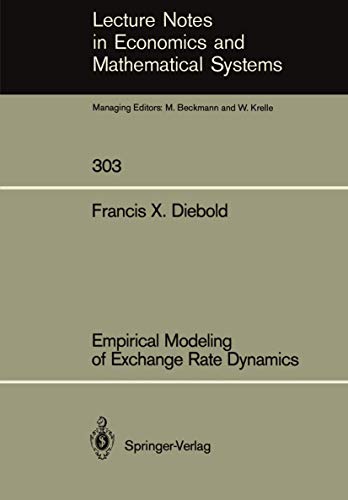
Empirical Modeling of Exchange Rate Dynamics (Lecture Notes in Economics and Mathematical Systems, 303)
Da: Ria Christie Collections, Uxbridge, Regno Unito
Valutazione del venditore 5 su 5 stelle

EUR 60,51
Spedizione EUR 13,86
Spedito da Regno Unito a U.S.A.Quantità: Più di 20 disponibili
Aggiungi al carrelloCondizione: New. In.
-
Empirical Modeling of Exchange Rate Dynamics
Da: Books Puddle, New York, NY, U.S.A.
Valutazione del venditore 4 su 5 stelle

Condizione: New. pp. 160.
-
Empirical Modeling of Exchange Rate Dynamics (Lecture Notes in Economics and Mathematical Systems)
Da: Revaluation Books, Exeter, Regno Unito
Valutazione del venditore 5 su 5 stelle
EUR 76,76
Spedizione EUR 11,57
Spedito da Regno Unito a U.S.A.Quantità: 2 disponibili
Aggiungi al carrelloPaperback. Condizione: Brand New. 150 pages. 9.61x6.69x0.37 inches. In Stock.
-

Empirical modeling of exchange rate dynamics. Lecture notes in economics and mathematical systems.
Da: Antiquariat Bookfarm, Löbnitz, Germania
Valutazione del venditore 5 su 5 stelle
EUR 48,36
Spedizione EUR 40,00
Spedito da Germania a U.S.A.Quantità: 1 disponibili
Aggiungi al carrelloSoftcover. 143 S. Ehem. Bibliotheksexemplar mit Signatur und Stempel. GUTER Zustand, ein paar Gebrauchsspuren. Ex-library with stamp and library-signature. GOOD condition, some traces of use. L07646 3540189661 Sprache: Englisch Gewicht in Gramm: 330.
-
Empirical Modeling of Exchange Rate Dynamics
Lingua: Inglese
Editore: Springer, Springer Berlin Heidelberg, 1988
ISBN 10: 3540189661 ISBN 13: 9783540189664
EUR 53,49
Spedizione EUR 61,45
Spedito da Germania a U.S.A.Quantità: 1 disponibili
Aggiungi al carrelloTaschenbuch. Condizione: Neu. Druck auf Anfrage Neuware - Printed after ordering - Structural exchange rate modeling has proven extremely difficult during the recent post-1973 float. The disappointment climaxed with the papers of Meese and Rogoff (1983a, 1983b), who showed that a 'naive' random walk model distinctly dominated received theoretical models in terms of predictive performance for the major dollar spot rates. One purpose of this monograph is to seek the reasons for this failure by exploring the temporal behavior of seven major dollar exchange rates using nonstructural time-series methods. The Meese-Rogoff finding does not mean that exchange rates evolve as random walks; rather it simply means that the random walk is a better stochastic approximation than any of their other candidate models. In this monograph, we use optimal model specification techniques, including formal unit root tests which allow for trend, and find that all of the exchange rates studied do in fact evolve as random walks or random walks with drift (to a very close approximation). This result is consistent with efficient asset markets, and provides an explanation for the Meese-Rogoff results. Far more subtle forces are at work, however, which lead to interesting econometric problems and have implications for the measurement of exchange rate volatility and moment structure. It is shown that all exchange rates display substantial conditional heteroskedasticity. A particularly reasonable parameterization of this conditional heteroskedasticity, which captures the observed clustering of prediction error variances, is developed in Chapter 2.
-
Empirical Modeling of Exchange Rate Dynamics
Lingua: Inglese
Editore: Springer, Springer Mär 1988, 1988
ISBN 10: 3540189661 ISBN 13: 9783540189664
Da: BuchWeltWeit Ludwig Meier e.K., Bergisch Gladbach, Germania
Valutazione del venditore 5 su 5 stelle
EUR 53,49
Spedizione EUR 23,00
Spedito da Germania a U.S.A.Quantità: 2 disponibili
Aggiungi al carrelloTaschenbuch. Condizione: Neu. This item is printed on demand - it takes 3-4 days longer - Neuware -Structural exchange rate modeling has proven extremely difficult during the recent post-1973 float. The disappointment climaxed with the papers of Meese and Rogoff (1983a, 1983b), who showed that a 'naive' random walk model distinctly dominated received theoretical models in terms of predictive performance for the major dollar spot rates. One purpose of this monograph is to seek the reasons for this failure by exploring the temporal behavior of seven major dollar exchange rates using nonstructural time-series methods. The Meese-Rogoff finding does not mean that exchange rates evolve as random walks; rather it simply means that the random walk is a better stochastic approximation than any of their other candidate models. In this monograph, we use optimal model specification techniques, including formal unit root tests which allow for trend, and find that all of the exchange rates studied do in fact evolve as random walks or random walks with drift (to a very close approximation). This result is consistent with efficient asset markets, and provides an explanation for the Meese-Rogoff results. Far more subtle forces are at work, however, which lead to interesting econometric problems and have implications for the measurement of exchange rate volatility and moment structure. It is shown that all exchange rates display substantial conditional heteroskedasticity. A particularly reasonable parameterization of this conditional heteroskedasticity, which captures the observed clustering of prediction error variances, is developed in Chapter 2. 160 pp. Englisch.
-
Empirical Modeling of Exchange Rate Dynamics
Da: Majestic Books, Hounslow, Regno Unito
Valutazione del venditore 4 su 5 stelle
EUR 75,69
Spedizione EUR 7,52
Spedito da Regno Unito a U.S.A.Quantità: 4 disponibili
Aggiungi al carrelloCondizione: New. Print on Demand pp. 160 67:B&W 6.69 x 9.61 in or 244 x 170 mm (Pinched Crown) Perfect Bound on White w/Gloss Lam.
-
Empirical Modeling of Exchange Rate Dynamics
Da: Biblios, Frankfurt am main, HESSE, Germania
Valutazione del venditore 4 su 5 stelle
EUR 76,50
Spedizione EUR 9,95
Spedito da Germania a U.S.A.Quantità: 4 disponibili
Aggiungi al carrelloCondizione: New. PRINT ON DEMAND pp. 160.
-

Empirical Modeling of Exchange Rate Dynamics
Lingua: Inglese
Editore: Springer Berlin Heidelberg, 1988
ISBN 10: 3540189661 ISBN 13: 9783540189664
EUR 48,37
Spedizione EUR 48,99
Spedito da Germania a U.S.A.Quantità: Più di 20 disponibili
Aggiungi al carrelloCondizione: New. Dieser Artikel ist ein Print on Demand Artikel und wird nach Ihrer Bestellung fuer Sie gedruckt. Structural exchange rate modeling has proven extremely difficult during the recent post-1973 float. The disappointment climaxed with the papers of Meese and Rogoff (1983a, 1983b), who showed that a naive random walk model distinctly dominated received the.
-

Empirical Modeling of Exchange Rate Dynamics
Lingua: Inglese
Editore: Springer, J.B. Metzler Mär 1988, 1988
ISBN 10: 3540189661 ISBN 13: 9783540189664
Da: buchversandmimpf2000, Emtmannsberg, BAYE, Germania
Valutazione del venditore 5 su 5 stelle
EUR 53,49
Spedizione EUR 60,00
Spedito da Germania a U.S.A.Quantità: 1 disponibili
Aggiungi al carrelloTaschenbuch. Condizione: Neu. This item is printed on demand - Print on Demand Titel. Neuware -Structural exchange rate modeling has proven extremely difficult during the recent post-1973 float. The disappointment climaxed with the papers of Meese and Rogoff (1983a, 1983b), who showed that a 'naive' random walk model distinctly dominated received theoretical models in terms of predictive performance for the major dollar spot rates. One purpose of this monograph is to seek the reasons for this failure by exploring the temporal behavior of seven major dollar exchange rates using nonstructural time-series methods. The Meese-Rogoff finding does not mean that exchange rates evolve as random walks; rather it simply means that the random walk is a better stochastic approximation than any of their other candidate models. In this monograph, we use optimal model specification techniques, including formal unit root tests which allow for trend, and find that all of the exchange rates studied do in fact evolve as random walks or random walks with drift (to a very close approximation). This result is consistent with efficient asset markets, and provides an explanation for the Meese-Rogoff results. Far more subtle forces are at work, however, which lead to interesting econometric problems and have implications for the measurement of exchange rate volatility and moment structure. It is shown that all exchange rates display substantial conditional heteroskedasticity. A particularly reasonable parameterization of this conditional heteroskedasticity, which captures the observed clustering of prediction error variances, is developed in Chapter 2.Springer-Verlag KG, Sachsenplatz 4-6, 1201 Wien 160 pp. Englisch.

