

Importo totale (1 articolo articoli):
Destinazione ordine:

9783540660446 - Knowledge Acquisition, Modeling and Management: 11th European Workshop, EKAW'99, Dagstuhl Castle, Germany, May 26-29, 1999, Proceedings: 1621 di Fensel, Dieter; Stu... (15 risultati)
Vai alla pagina principale dei risultati di ricerca
Filtri di ricerca
Tipo di articolo
- Tutti i tipi di prodotto
- Libri (15)
- Riviste e Giornali (Nessun altro risultato corrispondente a questo perfezionamento)
- Fumetti (Nessun altro risultato corrispondente a questo perfezionamento)
- Spartiti (Nessun altro risultato corrispondente a questo perfezionamento)
- Arte, Stampe e Poster (Nessun altro risultato corrispondente a questo perfezionamento)
- Fotografie (Nessun altro risultato corrispondente a questo perfezionamento)
- Mappe (Nessun altro risultato corrispondente a questo perfezionamento)
- Manoscritti e Collezionismo cartaceo (Nessun altro risultato corrispondente a questo perfezionamento)
Condizioni Maggiori informazioni
- Nuovo (10)
- Come nuovo, Ottimo o Quasi ottimo (3)
- Molto buono o Buono (2)
- Discreto o Mediocre (Nessun altro risultato corrispondente a questo perfezionamento)
- Come descritto (Nessun altro risultato corrispondente a questo perfezionamento)
Legatura
- Tutte
- Rilegato (Nessun altro risultato corrispondente a questo perfezionamento)
- Brossura (15)
Ulteriori caratteristiche
- Prima ed. (Nessun altro risultato corrispondente a questo perfezionamento)
- Copia autograf. (Nessun altro risultato corrispondente a questo perfezionamento)
- Sovracoperta (Nessun altro risultato corrispondente a questo perfezionamento)
- Con foto (10)
- Non Print on Demand (13)
Lingua (1)
Spedizione gratuita
Paese del venditore
Valutazione venditore
-
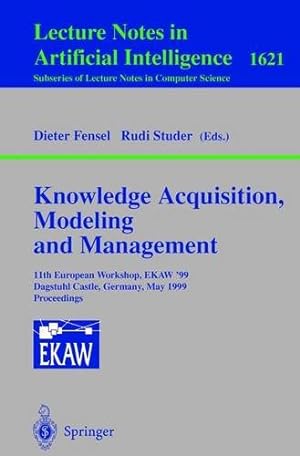
Knowledge Acquisition, Modeling and Management: 11th European Workshop, EKAW'99, Dagstuhl Castle, Germany, May 26-29, 1999, Proceedings. Lecture Notes in Artificial Intelligence 1621
Lingua: Inglese
Editore: Berlin, Heidelberg, New York.: Springer, 1999
ISBN 10: 3540660445 ISBN 13: 9783540660446
Da: Kepler-Buchversand Huong Bach, Weil der Stadt, Germania
Valutazione del venditore 4 su 5 stelle

EUR 19,90
Spedizione EUR 19,90
Spedito da Germania a U.S.A.Quantità: 1 disponibili
Aggiungi al carrelloGr.-8°, Taschenbuch. Condizione: Gut. 404 S., graf. Darst. Gebraucht: guter und sauberer Zustand. Past, Present, and Future of Knowledge Acquisition This book contains the proceedings of the 11th European Workshop on Kno- edge Acquisition, Modeling, and Management (EKAW '99), held at Dagstuhl Castle (Germany) in May of 1999. This continuity and the high number of s- missions re?ect the mature status of the knowledge acquisition community. Knowledge Acquisition started as an attempt to solve the main bottleneck in developing expert systems (now called knowledge-based systems): Acquiring knowledgefromahumanexpert. Variousmethodsandtoolshavebeendeveloped to improve this process. These approaches signi?cantly reduced the cost of - veloping knowledge-based systems. However, these systems often only partially ful?lled the taskthey weredevelopedfor andmaintenanceremainedanunsolved problem. This required a paradigm shift that views the development process of knowledge-based systems as a modeling activity. Instead of simply transf- ring human knowledge into machine-readable code, building a knowledge-based system is now viewed as a modeling activity. A so-called knowledge model is constructed in interaction with users and experts. This model need not nec- sarily re?ect the already available human expertise. Instead it should provide a knowledgelevelcharacterizationof the knowledgethat is requiredby the system to solve the application task. Economy and quality in system development and maintainability are achieved by reusable problem-solving methods and onto- gies. The former describe the reasoning process of the knowledge-based system (i. e. , the algorithms it uses) and the latter describe the knowledge structures it uses (i. e. , the data structures). Both abstract from speci?c application and domain speci?c circumstances to enable knowledge reuse. Sprache: Englisch Gewicht in Gramm: 518.
-

Knowledge Acquisition, Modeling and Management: 11th European Workshop, EKAW'99, Dagstuhl Castle, Germany, May 26-29, 1999, Proceedings (Lecture Notes . / Lecture Notes in Artificial Intelligence)
Da: GuthrieBooks, Spring Branch, TX, U.S.A.
Valutazione del venditore 5 su 5 stelle

Paperback. Condizione: Very Good. Ex-library paperback in very nice condition with the usual markings and attachments. Except for library markings, interior clean and unmarked. Tight binding.
-

Knowledge Acquisition, Modeling and Management : 11th European Workshop, Ekaw '99, Dagstuhl Castle, Germany, May 26-29, 1999 Proceedings
Da: GreatBookPrices, Columbia, MD, U.S.A.
Valutazione del venditore 5 su 5 stelle
EUR 62,49
Spedizione EUR 2,24
Spedito in U.S.A.Quantità: Più di 20 disponibili
Aggiungi al carrelloCondizione: New.
-
Knowledge Acquisition, Modeling and Management: 11th European Workshop, EKAW'99, Dagstuhl Castle, Germany, May 26-29, 1999, Proceedings (Lecture Notes in Computer Science, 1621)
Da: California Books, Miami, FL, U.S.A.
Valutazione del venditore 5 su 5 stelle
EUR 64,81
Spedizione gratuita
Spedito in U.S.A.Quantità: Più di 20 disponibili
Aggiungi al carrelloCondizione: New.
-
Knowledge Acquisition, Modeling and Management: 11th European Workshop, EKAW'99, Dagstuhl Castle, Germany, May 26-29, 1999, Proceedings (Lecture Notes in Computer Science, 1621)
Da: Ria Christie Collections, Uxbridge, Regno Unito
Valutazione del venditore 5 su 5 stelle
EUR 57,89
Spedizione EUR 13,66
Spedito da Regno Unito a U.S.A.Quantità: Più di 20 disponibili
Aggiungi al carrelloCondizione: New. In.
-
Knowledge Acquisition, Modeling and Management: 11th European Workshop, EKAW'99, Dagstuhl Castle, Germany, May 26-29, 1999, Proceedings: European . 11th (Lecture Notes in Computer Science)
Da: Chiron Media, Wallingford, Regno Unito
Valutazione del venditore 5 su 5 stelle
EUR 56,19
Spedizione EUR 17,66
Spedito da Regno Unito a U.S.A.Quantità: 10 disponibili
Aggiungi al carrelloPaperback. Condizione: New.
-

Knowledge Acquisition, Modeling and Management : 11th European Workshop, Ekaw '99, Dagstuhl Castle, Germany, May 26-29, 1999 Proceedings
Da: GreatBookPricesUK, Woodford Green, Regno Unito
Valutazione del venditore 5 su 5 stelle
EUR 57,88
Spedizione EUR 17,10
Spedito da Regno Unito a U.S.A.Quantità: Più di 20 disponibili
Aggiungi al carrelloCondizione: New.
-

Knowledge Acquisition, Modeling and Management
Lingua: Inglese
Editore: Springer Berlin Heidelberg, 1999
ISBN 10: 3540660445 ISBN 13: 9783540660446
EUR 48,37
Spedizione EUR 48,99
Spedito da Germania a U.S.A.Quantità: Più di 20 disponibili
Aggiungi al carrelloCondizione: New.
-

Knowledge Acquisition, Modeling and Management : 11th European Workshop, EKAW'99, Dagstuhl Castle, Germany, May 26-29, 1999, Proceedings
Lingua: Inglese
Editore: Springer Berlin Heidelberg, 1999
ISBN 10: 3540660445 ISBN 13: 9783540660446
EUR 53,49
Spedizione EUR 63,20
Spedito da Germania a U.S.A.Quantità: 1 disponibili
Aggiungi al carrelloTaschenbuch. Condizione: Neu. Druck auf Anfrage Neuware - Printed after ordering - Past, Present, and Future of Knowledge Acquisition This book contains the proceedings of the 11th European Workshop on Kno- edge Acquisition, Modeling, and Management (EKAW '99), held at Dagstuhl Castle (Germany) in May of 1999. This continuity and the high number of s- missions re ect the mature status of the knowledge acquisition community. Knowledge Acquisition started as an attempt to solve the main bottleneck in developing expert systems (now called knowledge-based systems): Acquiring knowledgefromahumanexpert. Variousmethodsandtoolshavebeendeveloped to improve this process. These approaches signi cantly reduced the cost of - veloping knowledge-based systems. However, these systems often only partially ful lled the taskthey weredevelopedfor andmaintenanceremainedanunsolved problem. This required a paradigm shift that views the development process of knowledge-based systems as a modeling activity. Instead of simply transf- ring human knowledge into machine-readable code, building a knowledge-based system is now viewed as a modeling activity. A so-called knowledge model is constructed in interaction with users and experts. This model need not nec- sarily re ect the already available human expertise. Instead it should provide a knowledgelevelcharacterizationof the knowledgethat is requiredby the system to solve the application task. Economy and quality in system development and maintainability are achieved by reusable problem-solving methods and onto- gies. The former describe the reasoning process of the knowledge-based system (i. e. , the algorithms it uses) and the latter describe the knowledge structures it uses (i. e. , the data structures). Both abstract from speci c application and domain speci c circumstances to enable knowledge reuse.
-
EUR 50,25
Spedizione EUR 70,00
Spedito da Germania a U.S.A.Quantità: 5 disponibili
Aggiungi al carrelloTaschenbuch. Condizione: Neu. Knowledge Acquisition, Modeling and Management | 11th European Workshop, EKAW'99, Dagstuhl Castle, Germany, May 26-29, 1999, Proceedings | Rudi Studer | Taschenbuch | xii | Englisch | 1999 | Springer | EAN 9783540660446 | Verantwortliche Person für die EU: Springer Verlag GmbH, Tiergartenstr. 17, 69121 Heidelberg, juergen[dot]hartmann[at]springer[dot]com | Anbieter: preigu.
-

Knowledge Acquisition, Modeling and Management : 11th European Workshop, Ekaw '99, Dagstuhl Castle, Germany, May 26-29, 1999 Proceedings
Da: GreatBookPricesUK, Woodford Green, Regno Unito
Valutazione del venditore 5 su 5 stelle
EUR 117,41
Spedizione EUR 17,10
Spedito da Regno Unito a U.S.A.Quantità: Più di 20 disponibili
Aggiungi al carrelloCondizione: As New. Unread book in perfect condition.
-
Knowledge Acquisition, Modeling and Management: 11th European Workshop, EKAW*99, Dagstuhl Castle, Germany, May 26-29, 1999, Proceedings (Lecture Notes in Computer Science, 1621)
Da: Mispah books, Redhill, SURRE, Regno Unito
Valutazione del venditore 4 su 5 stelle
EUR 108,03
Spedizione EUR 28,50
Spedito da Regno Unito a U.S.A.Quantità: 1 disponibili
Aggiungi al carrelloPaperback. Condizione: Like New. LIKE NEW. SHIPS FROM MULTIPLE LOCATIONS. book.
-

Knowledge Acquisition, Modeling and Management : 11th European Workshop, Ekaw '99, Dagstuhl Castle, Germany, May 26-29, 1999 Proceedings
Da: GreatBookPrices, Columbia, MD, U.S.A.
Valutazione del venditore 5 su 5 stelle
EUR 139,90
Spedizione EUR 2,24
Spedito in U.S.A.Quantità: Più di 20 disponibili
Aggiungi al carrelloCondizione: As New. Unread book in perfect condition.
-
Knowledge Acquisition, Modeling and Management
Lingua: Inglese
Editore: Springer Berlin Heidelberg, Springer Berlin Heidelberg Mai 1999, 1999
ISBN 10: 3540660445 ISBN 13: 9783540660446
Da: BuchWeltWeit Ludwig Meier e.K., Bergisch Gladbach, Germania
Valutazione del venditore 5 su 5 stelle
EUR 53,49
Spedizione EUR 23,00
Spedito da Germania a U.S.A.Quantità: 2 disponibili
Aggiungi al carrelloTaschenbuch. Condizione: Neu. This item is printed on demand - it takes 3-4 days longer - Neuware -Past, Present, and Future of Knowledge Acquisition This book contains the proceedings of the 11th European Workshop on Kno- edge Acquisition, Modeling, and Management (EKAW '99), held at Dagstuhl Castle (Germany) in May of 1999. This continuity and the high number of s- missions re ect the mature status of the knowledge acquisition community. Knowledge Acquisition started as an attempt to solve the main bottleneck in developing expert systems (now called knowledge-based systems): Acquiring knowledgefromahumanexpert. Variousmethodsandtoolshavebeendeveloped to improve this process. These approaches signi cantly reduced the cost of - veloping knowledge-based systems. However, these systems often only partially ful lled the taskthey weredevelopedfor andmaintenanceremainedanunsolved problem. This required a paradigm shift that views the development process of knowledge-based systems as a modeling activity. Instead of simply transf- ring human knowledge into machine-readable code, building a knowledge-based system is now viewed as a modeling activity. A so-called knowledge model is constructed in interaction with users and experts. This model need not nec- sarily re ect the already available human expertise. Instead it should provide a knowledgelevelcharacterizationof the knowledgethat is requiredby the system to solve the application task. Economy and quality in system development and maintainability are achieved by reusable problem-solving methods and onto- gies. The former describe the reasoning process of the knowledge-based system (i. e. , the algorithms it uses) and the latter describe the knowledge structures it uses (i. e. , the data structures). Both abstract from speci c application and domain speci c circumstances to enable knowledge reuse. 424 pp. Englisch.
-

Knowledge Acquisition, Modeling and Management
Lingua: Inglese
Editore: Springer Berlin Heidelberg, Springer Berlin Heidelberg Mai 1999, 1999
ISBN 10: 3540660445 ISBN 13: 9783540660446
Da: buchversandmimpf2000, Emtmannsberg, BAYE, Germania
Valutazione del venditore 5 su 5 stelle
EUR 53,49
Spedizione EUR 60,00
Spedito da Germania a U.S.A.Quantità: 1 disponibili
Aggiungi al carrelloTaschenbuch. Condizione: Neu. This item is printed on demand - Print on Demand Titel. Neuware -Past, Present, and Future of Knowledge Acquisition This book contains the proceedings of the 11th European Workshop on Kno- edge Acquisition, Modeling, and Management (EKAW ¿99), held at Dagstuhl Castle (Germany) in May of 1999. This continuity and the high number of s- missions re ect the mature status of the knowledge acquisition community. Knowledge Acquisition started as an attempt to solve the main bottleneck in developing expert systems (now called knowledge-based systems): Acquiring knowledgefromahumanexpert. Variousmethodsandtoolshavebeendeveloped to improve this process. These approaches signi cantly reduced the cost of - veloping knowledge-based systems. However, these systems often only partially ful lled the taskthey weredevelopedfor andmaintenanceremainedanunsolved problem. This required a paradigm shift that views the development process of knowledge-based systems as a modeling activity. Instead of simply transf- ring human knowledge into machine-readable code, building a knowledge-based system is now viewed as a modeling activity. A so-called knowledge model is constructed in interaction with users and experts. This model need not nec- sarily re ect the already available human expertise. Instead it should provide a knowledgelevelcharacterizationof the knowledgethat is requiredby the system to solve the application task. Economy and quality in system development and maintainability are achieved by reusable problem-solving methods and onto- gies. The former describe the reasoning process of the knowledge-based system (i. e. , the algorithms it uses) and the latter describe the knowledge structures it uses (i. e. , the data structures). Both abstract from speci c application and domain speci c circumstances to enable knowledge reuse.Springer Verlag GmbH, Tiergartenstr. 17, 69121 Heidelberg 424 pp. Englisch.


