

Importo totale (1 articolo articoli):
Destinazione ordine:

9783642834646 - Syntactic and Structural Pattern Recognition: 45 (10 risultati)
Vai alla pagina principale dei risultati di ricerca
Filtri di ricerca
Tipo di articolo
- Tutti i tipi di prodotto
- Libri (10)
- Riviste e Giornali (Nessun altro risultato corrispondente a questo perfezionamento)
- Fumetti (Nessun altro risultato corrispondente a questo perfezionamento)
- Spartiti (Nessun altro risultato corrispondente a questo perfezionamento)
- Arte, Stampe e Poster (Nessun altro risultato corrispondente a questo perfezionamento)
- Fotografie (Nessun altro risultato corrispondente a questo perfezionamento)
- Mappe (Nessun altro risultato corrispondente a questo perfezionamento)
- Manoscritti e Collezionismo cartaceo (Nessun altro risultato corrispondente a questo perfezionamento)
Condizioni Maggiori informazioni
- Nuovo (9)
- Come nuovo, Ottimo o Quasi ottimo (1)
- Molto buono o Buono (Nessun altro risultato corrispondente a questo perfezionamento)
- Discreto o Mediocre (Nessun altro risultato corrispondente a questo perfezionamento)
- Come descritto (Nessun altro risultato corrispondente a questo perfezionamento)
Legatura
- Tutte
- Rilegato (Nessun altro risultato corrispondente a questo perfezionamento)
- Brossura (10)
Ulteriori caratteristiche
- Prima ed. (Nessun altro risultato corrispondente a questo perfezionamento)
- Copia autograf. (Nessun altro risultato corrispondente a questo perfezionamento)
- Sovracoperta (Nessun altro risultato corrispondente a questo perfezionamento)
- Con foto (5)
- Non Print on Demand (6)
Lingua (1)
Prezzo
- Qualsiasi prezzo
- Inferiore a EUR 20 (Nessun altro risultato corrispondente a questo perfezionamento)
- EUR 20 a EUR 45 (Nessun altro risultato corrispondente a questo perfezionamento)
- Superiore a EUR 45
Spedizione gratuita
- Spedizione gratuita in U.S.A. (Nessun altro risultato corrispondente a questo perfezionamento)
Paese del venditore
Valutazione venditore
-

Syntactic and Structural Pattern Recognition (NATO ASI Subseries F:)
Da: Ria Christie Collections, Uxbridge, Regno Unito
Valutazione del venditore 5 su 5 stelle

EUR 58,78
Spedizione EUR 13,87
Spedito da Regno Unito a U.S.A.Quantità: Più di 20 disponibili
Aggiungi al carrelloCondizione: New. In.
-
Syntactic and Structural Pattern Recognition (Nato ASI Subseries F)
Da: Chiron Media, Wallingford, Regno Unito
Valutazione del venditore 5 su 5 stelle
EUR 57,26
Spedizione EUR 17,93
Spedito da Regno Unito a U.S.A.Quantità: 10 disponibili
Aggiungi al carrelloPaperback. Condizione: New.
-
Syntactic and Structural Pattern Recognition
Lingua: Inglese
Editore: Springer-Verlag New York Inc, 2013
ISBN 10: 3642834647 ISBN 13: 9783642834646
Da: Revaluation Books, Exeter, Regno Unito
Valutazione del venditore 5 su 5 stelle
EUR 83,58
Spedizione EUR 14,47
Spedito da Regno Unito a U.S.A.Quantità: 2 disponibili
Aggiungi al carrelloPaperback. Condizione: Brand New. 492 pages. 9.61x6.69x1.11 inches. In Stock.
-
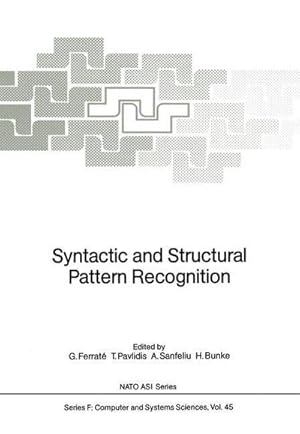
Syntactic and Structural Pattern Recognition
Lingua: Inglese
Editore: Springer Berlin Heidelberg, 2011
ISBN 10: 3642834647 ISBN 13: 9783642834646
EUR 53,49
Spedizione EUR 64,21
Spedito da Germania a U.S.A.Quantità: 1 disponibili
Aggiungi al carrelloTaschenbuch. Condizione: Neu. Druck auf Anfrage Neuware - Printed after ordering - Thirty years ago pattern recognition was dominated by the learning machine concept: that one could automate the process of going from the raw data to a classifier. The derivation of numerical features from the input image was not considered an important step. One could present all possible features to a program which in turn could find which ones would be useful for pattern recognition. In spite of significant improvements in statistical inference techniques, progress was slow. It became clear that feature derivation was a very complex process that could not be automated and that features could be symbolic as well as numerical. Furthennore the spatial relationship amongst features might be important. It appeared that pattern recognition might resemble language analysis since features could play the role of symbols strung together to form a word. This led. to the genesis of syntactic pattern recognition, pioneered in the middle and late 1960's by Russel Kirsch, Robert Ledley, Nararimhan, and Allan Shaw. However the thorough investigation of the area was left to King-Sun Fu and his students who, until his untimely death, produced most of the significant papers in this area. One of these papers (syntactic recognition of fingerprints) received the distinction of being selected as the best paper published that year in the IEEE Transaction on Computers. Therefore syntactic pattern recognition has a long history of active research and has been used in industrial applications.
-
EUR 50,25
Spedizione EUR 70,00
Spedito da Germania a U.S.A.Quantità: 5 disponibili
Aggiungi al carrelloTaschenbuch. Condizione: Neu. Syntactic and Structural Pattern Recognition | Gabriel Ferrate (u. a.) | Taschenbuch | xv | Englisch | 2011 | Springer | EAN 9783642834646 | Verantwortliche Person für die EU: Springer Verlag GmbH, Tiergartenstr. 17, 69121 Heidelberg, juergen[dot]hartmann[at]springer[dot]com | Anbieter: preigu.
-
Syntactic and Structural Pattern Recognition (Nato ASI Subseries F:, 45)
Da: Mispah books, Redhill, SURRE, Regno Unito
Valutazione del venditore 4 su 5 stelle

EUR 103,73
Spedizione EUR 28,94
Spedito da Regno Unito a U.S.A.Quantità: 1 disponibili
Aggiungi al carrelloPaperback. Condizione: Like New. LIKE NEW. SHIPS FROM MULTIPLE LOCATIONS. book.
-
Syntactic and Structural Pattern Recognition (eng)
Da: Brook Bookstore On Demand, Napoli, NA, Italia
Valutazione del venditore 4 su 5 stelle
EUR 46,22
Spedizione EUR 8,00
Spedito da Italia a U.S.A.Quantità: Più di 20 disponibili
Aggiungi al carrelloCondizione: new. Questo è un articolo print on demand.
-

Syntactic and Structural Pattern Recognition
Lingua: Inglese
Editore: Springer, Springer Dez 2011, 2011
ISBN 10: 3642834647 ISBN 13: 9783642834646
Da: BuchWeltWeit Ludwig Meier e.K., Bergisch Gladbach, Germania
Valutazione del venditore 5 su 5 stelle
EUR 53,49
Spedizione EUR 23,00
Spedito da Germania a U.S.A.Quantità: 2 disponibili
Aggiungi al carrelloTaschenbuch. Condizione: Neu. This item is printed on demand - it takes 3-4 days longer - Neuware -Thirty years ago pattern recognition was dominated by the learning machine concept: that one could automate the process of going from the raw data to a classifier. The derivation of numerical features from the input image was not considered an important step. One could present all possible features to a program which in turn could find which ones would be useful for pattern recognition. In spite of significant improvements in statistical inference techniques, progress was slow. It became clear that feature derivation was a very complex process that could not be automated and that features could be symbolic as well as numerical. Furthennore the spatial relationship amongst features might be important. It appeared that pattern recognition might resemble language analysis since features could play the role of symbols strung together to form a word. This led. to the genesis of syntactic pattern recognition, pioneered in the middle and late 1960's by Russel Kirsch, Robert Ledley, Nararimhan, and Allan Shaw. However the thorough investigation of the area was left to King-Sun Fu and his students who, until his untimely death, produced most of the significant papers in this area. One of these papers (syntactic recognition of fingerprints) received the distinction of being selected as the best paper published that year in the IEEE Transaction on Computers. Therefore syntactic pattern recognition has a long history of active research and has been used in industrial applications. 492 pp. Englisch.
-
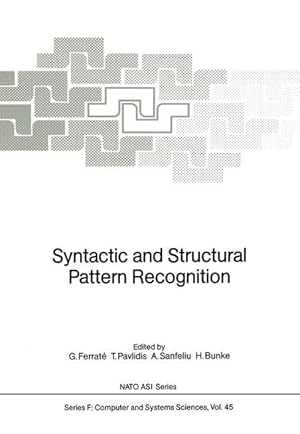
Syntactic and Structural Pattern Recognition
Lingua: Inglese
Editore: Springer Berlin Heidelberg, 2011
ISBN 10: 3642834647 ISBN 13: 9783642834646
EUR 48,37
Spedizione EUR 48,99
Spedito da Germania a U.S.A.Quantità: Più di 20 disponibili
Aggiungi al carrelloCondizione: New. Dieser Artikel ist ein Print on Demand Artikel und wird nach Ihrer Bestellung fuer Sie gedruckt. Proceedings of the NATO Advanced Research Workshop on Syntactic and Structural Pattern Recognition, held in Barcelona-Sitges, Spain, October 23-25, 1986Thirty years ago pattern recognition was dominated by the learning machine concept: that one could au.
-

Syntactic and Structural Pattern Recognition
Lingua: Inglese
Editore: Springer Berlin Heidelberg, Springer Berlin Heidelberg Dez 2011, 2011
ISBN 10: 3642834647 ISBN 13: 9783642834646
Da: buchversandmimpf2000, Emtmannsberg, BAYE, Germania
Valutazione del venditore 5 su 5 stelle
EUR 53,49
Spedizione EUR 60,00
Spedito da Germania a U.S.A.Quantità: 1 disponibili
Aggiungi al carrelloTaschenbuch. Condizione: Neu. This item is printed on demand - Print on Demand Titel. Neuware -Thirty years ago pattern recognition was dominated by the learning machine concept: that one could automate the process of going from the raw data to a classifier. The derivation of numerical features from the input image was not considered an important step. One could present all possible features to a program which in turn could find which ones would be useful for pattern recognition. In spite of significant improvements in statistical inference techniques, progress was slow. It became clear that feature derivation was a very complex process that could not be automated and that features could be symbolic as well as numerical. Furthennore the spatial relationship amongst features might be important. It appeared that pattern recognition might resemble language analysis since features could play the role of symbols strung together to form a word. This led. to the genesis of syntactic pattern recognition, pioneered in the middle and late 1960's by Russel Kirsch, Robert Ledley, Nararimhan, and Allan Shaw. However the thorough investigation of the area was left to King-Sun Fu and his students who, until his untimely death, produced most of the significant papers in this area. One of these papers (syntactic recognition of fingerprints) received the distinction of being selected as the best paper published that year in the IEEE Transaction on Computers. Therefore syntactic pattern recognition has a long history of active research and has been used in industrial applications.Springer Verlag GmbH, Tiergartenstr. 17, 69121 Heidelberg 492 pp. Englisch.


