
ISBN: 9789048158423 - evolution and progress in democracies: towards new foundations of a knowledge society: 31 (11 risultati)

- Brossura
Da: GreatBookPrices, Columbia, MD, U.S.A.GreatBookPrices
Contatta il venditoreVenditore con 5 stelleCondizione: Nuovo
EUR 284,51
EUR 2,35 spedizioneSpedito in U.S.A.Quantità: 15 disponibili
Condizione: New.
 Altre immagini
- Brossura
Da: preigu, Osnabrück, Germaniapreigu
Contatta il venditoreVenditore con 5 stelleCondizione: Nuovo
EUR 229,80
EUR 70,00 spedizioneSpedito da Germania a U.S.A.Quantità: 5 disponibili
Taschenbuch. Condizione: Neu. Evolution and Progress in Democracies | Towards New Foundations of a Knowledge Society | Johann Götschl | Taschenbuch | Theory and Decision Library A: | iv | Englisch | 2010 | Springer | EAN 9789048158423 | Verantwortliche Person für die EU: Springer Verlag GmbH, Tiergartenstr. 17, 69121 Heidelberg, juergen[dot]hartmann[at]springer[dot]com | Anbieter: preigu. …

- Brossura
Da: GreatBookPrices, Columbia, MD, U.S.A.GreatBookPrices
Contatta il venditoreVenditore con 5 stelleCondizione: Usato - Come nuovo
EUR 314,55
EUR 2,35 spedizioneSpedito in U.S.A.Quantità: 15 disponibili
Condizione: As New. Unread book in perfect condition.
- Brossura
Da: Ria Christie Collections, Uxbridge, Regno UnitoRia Christie Collections
Contatta il venditoreVenditore con 5 stelleCondizione: Nuovo
EUR 308,75
EUR 13,39 spedizioneSpedito da Regno Unito a U.S.A.Quantità: Più di 20 disponibili
Condizione: New. In English.
- Brossura
Da: California Books, Miami, FL, U.S.A.California Books
Contatta il venditoreVenditore con 5 stelleCondizione: Nuovo
EUR 321,69
Spedizione gratuitaSpedito in U.S.A.Quantità: Più di 20 disponibili
Condizione: New.

- Brossura
Da: AHA-BUCH GmbH, Einbeck, GermaniaAHA-BUCH GmbH
Contatta il venditoreVenditore con 5 stelleCondizione: Nuovo
EUR 300,21
EUR 35,00 spedizioneSpedito da Germania a U.S.A.Quantità: 1 disponibile
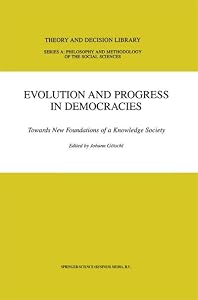
Taschenbuch. Condizione: Neu. Druck auf Anfrage Neuware - Printed after ordering - In a ground-breaking series of articles, one of them written by a Nobel Laureate, this volume demonstrates the evolutionary dynamic and the transformation of today's democratic societies into scientific-democratic societies. It highlights the progress of modeling individual and societal evaluation by neo-Bayesian utility theory. It shows how social learning and collective opinion formation work, and how democracies cope with randomness caused by randomizers. Nonlinear `evolution equations' and serial stochastic matrices of evolutionary game theory allow us to optimally compute possible serial evolutionary solutions of societal conflicts. But in democracies progress can be defined as any positive, gradual, innovative and creative change of culturally used, transmitted and stored mentifacts (models, theories), sociofacts (customs, opinions), artifacts and technifacts, within and across generations. The most important changes are caused, besides randomness, by conflict solutions and their realizations by citizens who follow democratic laws. These laws correspond to the extended Pareto principle, a supreme, socioethical democratic rule. According to this principle, progress is any increase in the individual and collective welfare which is achieved during any evolutionary progress. Central to evolutionary modeling is the criterion of the empirical realization of computed solutions. Applied to serial conflict solutions (decisions), evolutionary trajectories are formed; they become the most influential causal attractors of the channeling of societal evolution. Democratic constitutions, legal systems etc., store all advantageous, present and past, adaptive, competitive, cooperative and collective solutions and their rules; they have been accepted by majority votes. Societal laws are codes of statutes (default or statistical rules), and they serve to optimally solve societal conflicts, in analogy to game theoretical models or to statistical decision theory. Such solutions become necessary when we face harmful or advantageous random events always lurking at the edge of societal and external chaos. The evolutionary theory of societal evolution in democracies presents a new type of stochastic theory; it is based on default rules and stresses realization. The rules represent the change of our democracies into information, science and technology-based societies; they will revolutionize social sciences, especially economics. Their methods have already found their way into neural brain physiology and research into intelligence. In this book, neural activity and the creativity of human thinking are no longer regarded as linear-deductive. Only evolutive nonlinear thinking can include multiple causal choices by many individuals and the risks of internal and external randomness; this serves the increasing welfare of all individuals and society as a whole. Evolution and Progress in Democracies is relevant for social scientists, economists, evolution theorists, statisticians, philosophers, philosophers of science, and interdisciplinary researchers.…
- Brossura
Da: Revaluation Books, Exeter, Regno UnitoRevaluation Books
Contatta il venditoreVenditore con 5 stelleCondizione: Nuovo
EUR 395,67
EUR 14,82 spedizioneSpedito da Regno Unito a U.S.A.Quantità: 2 disponibili
Paperback. Condizione: Brand New. 392 pages. 9.50x6.25x0.91 inches. In Stock.
- Brossura
- Print on Demand
Da: Brook Bookstore On Demand, Napoli, NA, ItaliaBrook Bookstore On Demand
Contatta il venditoreVenditore con 5 stelleCondizione: Nuovo
EUR 206,31
EUR 6,80 spedizioneSpedito da Italia a U.S.A.Quantità: Più di 20 disponibili
Condizione: new. Questo è un articolo print on demand.

- Brossura
- Print on Demand
Da: moluna, Greven, Germaniamoluna
Contatta il venditoreVenditore con 5 stelleCondizione: Nuovo
EUR 223,97
EUR 48,99 spedizioneSpedito da Germania a U.S.A.Quantità: Più di 20 disponibili
Kartoniert / Broschiert. Condizione: New. Dieser Artikel ist ein Print on Demand Artikel und wird nach Ihrer Bestellung fuer Sie gedruckt. In a ground-breaking series of articles, one of them written by a Nobel Laureate, this volume demonstrates the evolutionary dynamic and the transformation of today s democratic societies into scientific-democratic societies. It highlights the progress of.…

- Brossura
- Print on Demand
Da: BuchWeltWeit Ludwig Meier e.K., Bergisch Gladbach, GermaniaBuchWeltWeit Ludwig Meier e.K.
Contatta il venditoreVenditore con 5 stelleCondizione: Nuovo
EUR 267,49
EUR 23,00 spedizioneSpedito da Germania a U.S.A.Quantità: 2 disponibili
Taschenbuch. Condizione: Neu. This item is printed on demand - it takes 3-4 days longer - Neuware -In a ground-breaking series of articles, one of them written by a Nobel Laureate, this volume demonstrates the evolutionary dynamic and the transformation of today's democratic societies into scientific-democratic societies. It highlights the progress of modeling individual and societal evaluation by neo-Bayesian utility theory. It shows how social learning and collective opinion formation work, and how democracies cope with randomness caused by randomizers. Nonlinear `evolution equations' and serial stochastic matrices of evolutionary game theory allow us to optimally compute possible serial evolutionary solutions of societal conflicts. But in democracies progress can be defined as any positive, gradual, innovative and creative change of culturally used, transmitted and stored mentifacts (models, theories), sociofacts (customs, opinions), artifacts and technifacts, within and across generations. The most important changes are caused, besides randomness, by conflict solutions and their realizations by citizens who follow democratic laws. These laws correspond to the extended Pareto principle, a supreme, socioethical democratic rule. According to this principle, progress is any increase in the individual and collective welfare which is achieved during any evolutionary progress. Central to evolutionary modeling is the criterion of the empirical realization of computed solutions. Applied to serial conflict solutions (decisions), evolutionary trajectories are formed; they become the most influential causal attractors of the channeling of societal evolution. Democratic constitutions, legal systems etc., store all advantageous, present and past, adaptive, competitive, cooperative and collective solutions and their rules; they have been accepted by majority votes. Societal laws are codes of statutes (default or statistical rules), and they serve to optimally solve societal conflicts, in analogy to game theoretical models or to statistical decision theory. Such solutions become necessary when we face harmful or advantageous random events always lurking at the edge of societal and external chaos. The evolutionary theory of societal evolution in democracies presents a new type of stochastic theory; it is based on default rules and stresses realization. The rules represent the change of our democracies into information, science and technology-based societies; they will revolutionize social sciences, especially economics. Their methods have already found their way into neural brain physiology and research into intelligence. In this book, neural activity and the creativity of human thinking are no longer regarded as linear-deductive. Only evolutive nonlinear thinking can include multiple causal choices by many individuals and the risks of internal and external randomness; this serves the increasing welfare of all individuals and society as a whole. Evolution and Progress in Democracies is relevant for social scientists, economists, evolution theorists, statisticians, philosophers, philosophers of science, and interdisciplinary researchers. 404 pp. Englisch.…
- Brossura
- Print on Demand
Da: buchversandmimpf2000, Emtmannsberg, BAYE, Germaniabuchversandmimpf2000
Contatta il venditoreVenditore con 5 stelleCondizione: Nuovo
EUR 267,49
EUR 60,00 spedizioneSpedito da Germania a U.S.A.Quantità: 1 disponibile
Taschenbuch. Condizione: Neu. This item is printed on demand - Print on Demand Titel. Neuware -In a ground-breaking series of articles, one of them written by a Nobel Laureate, this volume demonstrates the evolutionary dynamic and the transformation of today's democratic societies into scientific-democratic societies. It highlights the progress of modeling individual and societal evaluation by neo-Bayesian utility theory. It shows how social learning and collective opinion formation work, and how democracies cope with randomness caused by randomizers. Nonlinear `evolution equations' and serial stochastic matrices of evolutionary game theory allow us to optimally compute possible serial evolutionary solutions of societal conflicts. But in democracies progress can be defined as any positive, gradual, innovative and creative change of culturally used, transmitted and stored mentifacts (models, theories), sociofacts (customs, opinions), artifacts and technifacts, within and across generations. The most important changes are caused, besides randomness, by conflict solutions and their realizations by citizens who follow democratic laws. These laws correspond to the extended Pareto principle, a supreme, socioethical democratic rule. According to this principle, progress is any increase in the individual and collective welfare which is achieved during any evolutionary progress. Central to evolutionary modeling is the criterion of the empirical realization of computed solutions. Applied to serial conflict solutions (decisions), evolutionary trajectories are formed; they become the most influential causal attractors of the channeling of societal evolution. Democratic constitutions, legal systems etc., store all advantageous, present and past, adaptive, competitive, cooperative and collective solutions and their rules; they have been accepted by majority votes. Societal laws are codes of statutes (default or statistical rules), and they serve to optimally solve societal conflicts, in analogy to game theoretical models or to statistical decision theory. Such solutions become necessary when we face harmful or advantageous random events always lurking at the edge of societal and external chaos. The evolutionary theory of societal evolution in democracies presents a new type of stochastic theory; it is based on default rules and stresses realization. The rules represent the change of our democracies into information, science and technology-based societies; they will revolutionize social sciences, especially economics. Their methods have already found their way into neural brain physiology and research into intelligence. In this book, neural activity and the creativity of human thinking are no longer regarded as linear-deductive. Only evolutive nonlinear thinking can include multiple causal choices by many individuals and the risks of internal and external randomness; this serves the increasing welfare of all individuals and society as a whole. Evolution and Progress in Democracies is relevant for social scientists, economists, evolution theorists, statisticians, philosophers, philosophers of science, and interdisciplinary researchers.Springer-Verlag KG, Sachsenplatz 4-6, 1201 Wien 404 pp. Englisch.…


