

Importo totale (1 articolo articoli):
Destinazione ordine:

applied toxicology approaches basic (9 risultati)
Vai alla pagina principale dei risultati di ricerca
Filtri di ricerca
Tipo di articolo
- Tutti i tipi di prodotto
- Libri (9)
- Riviste e Giornali (Nessun altro risultato corrispondente a questo perfezionamento)
- Fumetti (Nessun altro risultato corrispondente a questo perfezionamento)
- Spartiti (Nessun altro risultato corrispondente a questo perfezionamento)
- Arte, Stampe e Poster (Nessun altro risultato corrispondente a questo perfezionamento)
- Fotografie (Nessun altro risultato corrispondente a questo perfezionamento)
- Mappe (Nessun altro risultato corrispondente a questo perfezionamento)
- Manoscritti e Collezionismo cartaceo (Nessun altro risultato corrispondente a questo perfezionamento)
Condizioni Maggiori informazioni
- Nuovo (7)
- Come nuovo, Ottimo o Quasi ottimo (2)
- Molto buono o Buono (Nessun altro risultato corrispondente a questo perfezionamento)
- Discreto o Mediocre (Nessun altro risultato corrispondente a questo perfezionamento)
- Come descritto (Nessun altro risultato corrispondente a questo perfezionamento)
Legatura
- Tutte
- Rilegato (Nessun altro risultato corrispondente a questo perfezionamento)
- Brossura (9)
Ulteriori caratteristiche
- Prima ed. (Nessun altro risultato corrispondente a questo perfezionamento)
- Copia autograf. (Nessun altro risultato corrispondente a questo perfezionamento)
- Sovracoperta (Nessun altro risultato corrispondente a questo perfezionamento)
- Con foto (6)
- Non Print on Demand (8)
Lingua (1)
Prezzo
- Qualsiasi prezzo
- Inferiore a EUR 20 (Nessun altro risultato corrispondente a questo perfezionamento)
- EUR 20 a EUR 45 (Nessun altro risultato corrispondente a questo perfezionamento)
- Superiore a EUR 45
Spedizione gratuita
- Spedizione gratuita in U.S.A. (Nessun altro risultato corrispondente a questo perfezionamento)
Paese del venditore
Valutazione venditore
-

Applied Toxicology: Approaches Through Basic Science: Proceedings of the 1996 EUROTOX Congress Meeting Held in Alicante, Spain, September 22-25, 1996 (Archives of Toxicology, 19)
Da: Ria Christie Collections, Uxbridge, Regno Unito
Valutazione del venditore 5 su 5 stelle

EUR 117,02
Spedizione EUR 14,05
Spedito da Regno Unito a U.S.A.Quantità: Più di 20 disponibili
Aggiungi al carrelloCondizione: New. In.
-
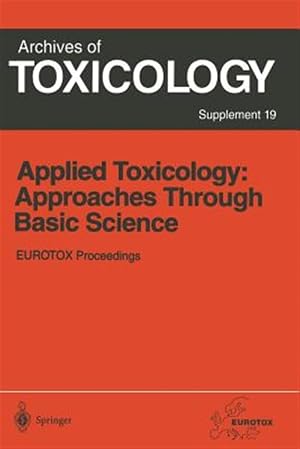
Applied Toxicology : Approaches Through Basic Science - Proceedings of the 1996 Eurotox Congress Meeting Held in Alicante, Spain, September 22?25, 1996
Da: GreatBookPrices, Columbia, MD, U.S.A.
Valutazione del venditore 5 su 5 stelle
Condizione: New.
-
EUR 95,25
Spedizione EUR 70,00
Spedito da Germania a U.S.A.Quantità: 5 disponibili
Aggiungi al carrelloTaschenbuch. Condizione: Neu. Applied Toxicology: Approaches Through Basic Science | Proceedings of the 1996 EUROTOX Congress Meeting Held in Alicante, Spain, September 22-25, 1996 | Jürg P. Seiler (u. a.) | Taschenbuch | Einband - flex.(Paperback) | Englisch | 2011 | Springer | EAN 9783642645051 | Verantwortliche Person für die EU: Lauinger, Sonia, Sonia Lauinger, Lauinger Verlag, Heinrich-Köhler-Platz 8, 76187 Karlsruhe, mail[at]lauinger-verlag[dot]de | Anbieter: preigu.
-
Applied Toxicology: Approaches Through Basic Science: Proceedings of the 1996 Eurotox Congress Meeting Held in Alicante, Spain, September 22-25, 1996 (Archives of Toxicology)
Lingua: Inglese
Editore: Springer Berlin Heidelberg, 2012
ISBN 10: 3642645054 ISBN 13: 9783642645051
Da: Revaluation Books, Exeter, Regno Unito
Valutazione del venditore 5 su 5 stelle
EUR 157,27
Spedizione EUR 14,66
Spedito da Regno Unito a U.S.A.Quantità: 2 disponibili
Aggiungi al carrelloPaperback. Condizione: Brand New. reprint edition. 429 pages. Delaware language. 9.06x5.98x0.94 inches. In Stock.
-

Applied Toxicology: Approaches Through Basic Science
Lingua: Inglese
Editore: Springer Berlin Heidelberg, 2011
ISBN 10: 3642645054 ISBN 13: 9783642645051
EUR 118,64
Spedizione EUR 48,99
Spedito da Germania a U.S.A.Quantità: Più di 20 disponibili
Aggiungi al carrelloCondizione: New. Ultraviolet radiation, a component of sunlight, has been recognized by photobiologists, dermatologists, and oculists as a potential hazard for human health because of its genotoxic, carcinogenic and immunotoxic properties. Its effects on human health includ.
-

Applied Toxicology: Approaches Through Basic Science : Proceedings of the 1996 EUROTOX Congress Meeting Held in Alicante, Spain, September 22-25, 1996
Lingua: Inglese
Editore: Springer, Berlin, Springer Berlin Heidelberg, Springer, 2011
ISBN 10: 3642645054 ISBN 13: 9783642645051
EUR 114,36
Spedizione EUR 63,25
Spedito da Germania a U.S.A.Quantità: 1 disponibili
Aggiungi al carrelloTaschenbuch. Condizione: Neu. Druck auf Anfrage Neuware - Printed after ordering - Ultraviolet radiation, a component of sunlight, has been recognized by photobiologists, dermatologists, and oculists as a potential hazard for human health because of its genotoxic, carcinogenic and immunotoxic properties. Its effects on human health include the induction of skin cancers, ocular damage and impairment of immunity to certain infections. A few decennia ago it was demonstrated that UV photons can affect the activity of the immune system through interactions with the skin. This means that UV not only changes normal cells into cancer cells but also permits the outgrowth of the UV -transformed cells by depressing the immune system. An intriguing question is what interactions between UV radiation and the skin initiates alterations in immune function in the exposed skin and systemically, i. e. in other places than the exposed skin. During the last 20 years many studies have been performed in order to investigate the immunosuppressive activities of UVB in laboratory animals and in human volunteers. In particular effects of UVB radiation on resistance to tumours and skin associated infections have been examined. In addition, effects of UVB radiation on immune parameters such as contact hypersensitivity and delayed-type hypersensitivity (both type IV hypersensitivity reactions), mixed lymphocyte reactions, mixed skin lymphocyte reactions, antigen presentation and numbers and function of Langerhans cells have been studied intensively. The antigenicity of murine tumours which are caused by UVB radiation was one of the first items to be investigated (Kripke, 1974).
-
Applied Toxicology: Approaches Through Basic Science: Proceedings of the 1996 EUROTOX Congress Meeting Held in Alicante, Spain, September 2225, 1996 (Archives of Toxicology (19))
Da: Mispah books, Redhill, SURRE, Regno Unito
Valutazione del venditore 4 su 5 stelle

EUR 184,80
Spedizione EUR 29,32
Spedito da Regno Unito a U.S.A.Quantità: 1 disponibili
Aggiungi al carrelloPaperback. Condizione: Like New. Like New. book.
-

Applied Toxicology : Approaches Through Basic Science - Proceedings of the 1996 Eurotox Congress Meeting Held in Alicante, Spain, September 22?25, 1996
Da: GreatBookPrices, Columbia, MD, U.S.A.
Valutazione del venditore 5 su 5 stelle
Condizione: As New. Unread book in perfect condition.
-

Applied Toxicology: Approaches Through Basic Science
Lingua: Inglese
Editore: Springer Berlin Heidelberg Sep 2011, 2011
ISBN 10: 3642645054 ISBN 13: 9783642645051
Da: BuchWeltWeit Ludwig Meier e.K., Bergisch Gladbach, Germania
Valutazione del venditore 5 su 5 stelle
EUR 106,99
Spedizione EUR 23,00
Spedito da Germania a U.S.A.Quantità: 2 disponibili
Aggiungi al carrelloTaschenbuch. Condizione: Neu. This item is printed on demand - it takes 3-4 days longer - Neuware -Ultraviolet radiation, a component of sunlight, has been recognized by photobiologists, dermatologists, and oculists as a potential hazard for human health because of its genotoxic, carcinogenic and immunotoxic properties. Its effects on human health include the induction of skin cancers, ocular damage and impairment of immunity to certain infections. A few decennia ago it was demonstrated that UV photons can affect the activity of the immune system through interactions with the skin. This means that UV not only changes normal cells into cancer cells but also permits the outgrowth of the UV -transformed cells by depressing the immune system. An intriguing question is what interactions between UV radiation and the skin initiates alterations in immune function in the exposed skin and systemically, i. e. in other places than the exposed skin. During the last 20 years many studies have been performed in order to investigate the immunosuppressive activities of UVB in laboratory animals and in human volunteers. In particular effects of UVB radiation on resistance to tumours and skin associated infections have been examined. In addition, effects of UVB radiation on immune parameters such as contact hypersensitivity and delayed-type hypersensitivity (both type IV hypersensitivity reactions), mixed lymphocyte reactions, mixed skin lymphocyte reactions, antigen presentation and numbers and function of Langerhans cells have been studied intensively. The antigenicity of murine tumours which are caused by UVB radiation was one of the first items to be investigated (Kripke, 1974). 432 pp. Englisch.


