
Importo totale (1 articolo articoli):
Destinazione ordine:

clause effect prolog programming di clocksin william (12 risultati)
Vai alla pagina principale dei risultati di ricerca
Filtri di ricerca
Tipo di articolo
- Tutti i tipi di prodotto
- Libri (12)
- Riviste e Giornali (Nessun altro risultato corrispondente a questo perfezionamento)
- Fumetti (Nessun altro risultato corrispondente a questo perfezionamento)
- Spartiti (Nessun altro risultato corrispondente a questo perfezionamento)
- Arte, Stampe e Poster (Nessun altro risultato corrispondente a questo perfezionamento)
- Fotografie (Nessun altro risultato corrispondente a questo perfezionamento)
- Mappe (Nessun altro risultato corrispondente a questo perfezionamento)
- Manoscritti e Collezionismo cartaceo (Nessun altro risultato corrispondente a questo perfezionamento)
Condizioni Maggiori informazioni
- Nuovo (6)
- Come nuovo, Ottimo o Quasi ottimo (1)
- Molto buono o Buono (5)
- Discreto o Mediocre (Nessun altro risultato corrispondente a questo perfezionamento)
- Come descritto (Nessun altro risultato corrispondente a questo perfezionamento)
Legatura
- Tutte
- Rilegato (Nessun altro risultato corrispondente a questo perfezionamento)
- Brossura (12)
Ulteriori caratteristiche
- Prima ed. (Nessun altro risultato corrispondente a questo perfezionamento)
- Copia autograf. (Nessun altro risultato corrispondente a questo perfezionamento)
- Sovracoperta (Nessun altro risultato corrispondente a questo perfezionamento)
- Con foto (3)
- Non Print on Demand (12)
Lingua (1)
Prezzo
- Qualsiasi prezzo
- Inferiore a EUR 20 (Nessun altro risultato corrispondente a questo perfezionamento)
- EUR 20 a EUR 45
- Superiore a EUR 45
Spedizione gratuita
- Spedizione gratuita in U.S.A. (Nessun altro risultato corrispondente a questo perfezionamento)
Paese del venditore
Valutazione venditore
-
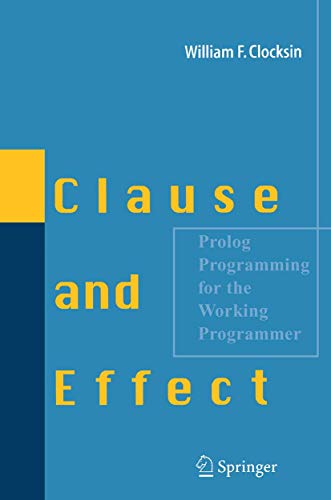
Clause and Effect: Prolog Programming for the Working Programmer
Da: Inquiring Minds, Saugerties, NY, U.S.A.
Valutazione del venditore 4 su 5 stelle

Trade Paperback. Condizione: Used - Good.
-
Paperback. Condizione: Good. Connecting readers with great books since 1972! Used textbooks may not include companion materials such as access codes, etc. May have some wear or writing/highlighting. We ship orders daily and Customer Service is our top priority!
-

Clause and Effect: Prolog Programming for the Working Programmer
Da: Big River Books, Powder Springs, GA, U.S.A.
Valutazione del venditore 5 su 5 stelle

Condizione: good. This book is in good condition. The cover has minor creases or bends. The binding is tight and pages are intact. Some pages may have writing or highlighting.
-
Paperback. Condizione: Very Good-. Condizione sovraccoperta: No Dust Jacket. 9.1 X 6.1 X 0.4 inches; 152 pages.
-
EUR 56,76
EUR 15,29 shipping
Spedito da Regno Unito a U.S.A.Quantità: 1 disponibili
Aggiungi al carrelloCondizione: Good. This is an ex-library book and may have the usual library/used-book markings inside.This book has soft covers. In good all round condition. Please note the Image in this listing is a stock photo and may not match the covers of the actual item,350grams, ISBN:9783540629719.
-
Clause and Effect: Prolog Programming for the Working Programmer
Da: Lucky's Textbooks, Dallas, TX, U.S.A.
Valutazione del venditore 5 su 5 stelle
Condizione: New.
-
Paperback. Condizione: new. Excellent Condition.Excels in customer satisfaction, prompt replies, and quality checks.
-
Clause and Effect : Prolog Programming for the Working Programmer
Da: Chiron Media, Wallingford, Regno Unito
Valutazione del venditore 5 su 5 stelle
EUR 74,20
EUR 17,67 shipping
Spedito da Regno Unito a U.S.A.Quantità: 10 disponibili
Aggiungi al carrelloPF. Condizione: New.
-
Clause and Effect: Prolog Programming for the Working Programmer
Da: BennettBooksLtd, San Diego, NV, U.S.A.
Valutazione del venditore 5 su 5 stelle
paperback. Condizione: New. In shrink wrap. Looks like an interesting title!
-
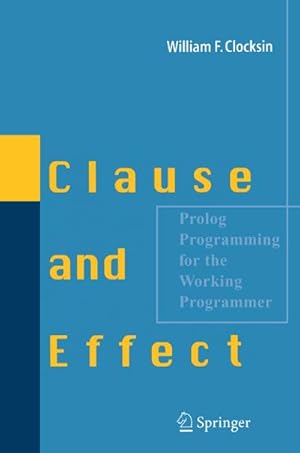
Clause and Effect : Prolog Programming for the Working Programmer
Lingua: Inglese
Editore: Springer Berlin Heidelberg, 1997
ISBN 10: 3540629718 ISBN 13: 9783540629719
EUR 80,24
EUR 61,24 shipping
Spedito da Germania a U.S.A.Quantità: 1 disponibili
Aggiungi al carrelloTaschenbuch. Condizione: Neu. Druck auf Anfrage Neuware - Printed after ordering - This book is for people who have done some programming, either in Prolog or in a language other than Prolog, and who can find their way around a reference manual. The emphasis of this book is on a simplified and disciplined methodology for discerning the mathematical structures related to a problem, and then turning these structures into Prolog programs. This book is therefore not concerned about the particular features of the language nor about Prolog programming skills or techniques in general. A relatively pure subset of Prolog is used, which includes the 'cut', but no input/output, no assert/retract, no syntactic extensions such as if then-else and grammar rules, and hardly any built-in predicates apart from arithmetic operations. I trust that practitioners of Prolog program ming who have a particular interest in the finer details of syntactic style and language features will understand my purposes in not discussing these matters. The presentation, which I believe is novel for a Prolog programming text, is in terms of an outline of basic concepts interleaved with worksheets. The idea is that worksheets are rather like musical exercises. Carefully graduated in scope, each worksheet introduces only a limited number of new ideas, and gives some guidance for practising them. The principles introduced in the worksheets are then applied to extended examples in the form of case studies.
-
EUR 71,30
EUR 70,00 shipping
Spedito da Germania a U.S.A.Quantità: 5 disponibili
Aggiungi al carrelloTaschenbuch. Condizione: Neu. Clause and Effect | Prolog Programming for the Working Programmer | William F. Clocksin | Taschenbuch | ix | Englisch | 1997 | Springer-Verlag GmbH | EAN 9783540629719 | Verantwortliche Person für die EU: Springer Verlag GmbH, Tiergartenstr. 17, 69121 Heidelberg, juergen[dot]hartmann[at]springer[dot]com | Anbieter: preigu.
-
Affare
EUR 38,75
EUR 105,00 shipping
Spedito da Germania a U.S.A.Quantità: 1 disponibili
Aggiungi al carrelloCondizione: Sehr gut. Zustand: Sehr gut | Sprache: Englisch | Produktart: Bücher | This book is for people who have done some programming, either in Prolog or in a language other than Prolog, and who can find their way around a reference manual. The emphasis of this book is on a simplified and disciplined methodology for discerning the mathematical structures related to a problem, and then turning these structures into Prolog programs. This book is therefore not concerned about the particular features of the language nor about Prolog programming skills or techniques in general. A relatively pure subset of Prolog is used, which includes the 'cut', but no input/output, no assert/retract, no syntactic extensions such as if then-else and grammar rules, and hardly any built-in predicates apart from arithmetic operations. I trust that practitioners of Prolog program ming who have a particular interest in the finer details of syntactic style and language features will understand my purposes in not discussing these matters. The presentation, which I believe is novel for a Prolog programming text, is in terms of an outline of basic concepts interleaved with worksheets. The idea is that worksheets are rather like musical exercises. Carefully graduated in scope, each worksheet introduces only a limited number of new ideas, and gives some guidance for practising them. The principles introduced in the worksheets are then applied to extended examples in the form of case studies.


