
Articoli correlati a Making All the Difference: Inclusion, Exclusion and...
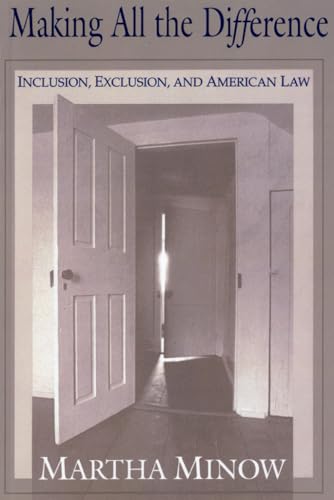
Sinossi
Should a court order medical treatment for a severely disabled newborn in the face of the parents' refusal to authorize it? How does the law apply to a neighborhood that objects to a group home for developmentally disabled people? Does equality mean treating everyone the same, even if such treatment affects some people adversely? Does a state requirement of employee maternity leave serve or violate the commitment to gender equality?
Martha Minow takes a hard look at the way our legal system functions in dealing with people on the basis of race, gender, age, ethnicity, religion, and disability. Minow confronts a variety of dilemmas of difference resulting from contradictory legal strategies—strategies that attempt to correct inequalities by sometimes recognizing and sometimes ignoring differences. Exploring the historical sources of ideas about difference, she offers challenging alternative ways of conceiving of traits that legal and social institutions have come to regard as "different." She argues, in effect, for a constructed jurisprudence based on the ability to recognize and work with perceptible forms of difference.
Minow is passionately interested in the people—"different" people—whose lives are regularly (mis)shaped and (mis)directed by the legal system's ways of handling them. Drawing on literary and feminist theories and the insights of anthropology and social history, she identifies the unstated assumptions that tend to regenerate discrimination through the very reforms that are supposed to eliminate it. Education for handicapped children, conflicts between job and family responsibilities, bilingual education, Native American land claims—these are among the concrete problems she discusses from a fresh angle of vision.
Minow firmly rejects the prevailing conception of the self that she believes underlies legal doctrine—a self seen as either separate and autonomous, or else disabled and incompetent in some way. In contrast, she regards the self as being realized through connection, capable of shaping an identity only in relationship to other people. She shifts the focus for problem solving from the "different" person to the relationships that construct that difference, and she proposes an analysis that can turn "difference" from a basis of stigma and a rationale for unequal treatment into a point of human connection. "The meanings of many differences can change when people locate and revise their relationships to difference," she asserts. "The student in a wheelchair becomes less different when the building designed without him in mind is altered to permit his access." Her book evaluates contemporary legal theories and reformulates legal rights for women, children, persons with disabilities, and others historically identified as different.
Here is a powerful voice for change, speaking to issues that permeate our daily lives and form a central part of the work of law. By illuminating the many ways in which people differ from one another, this book shows how lawyers, political theorist, teachers, parents, students—every one of us—can make all the difference,
Should a court order medical treatment for a severely disabled newborn in the face of the parents' refusal to authorize it? How does the law apply to a neighborhood that objects to a group home for developmentally disabled people? Does equality mean treating everyone the same, even if such treatment affects some people adversely? Does a state requirement of employee maternity leave serve or violate the commitment to gender equality?Martha Minow takes a hard look at the way our legal system functions in dealing with people on the basis of race, gender, age, ethnicity, religion, and disability. Minow confronts a variety of dilemmas of difference resulting from contradictory legal strategies—strategies that attempt to correct inequalities by sometimes recognizing and sometimes ignoring differences. Exploring the historical sources of ideas about difference, she offers challenging alternative ways of conceiving of traits that legal and social institutions have come to regard as "different." She argues, in effect, for a constructed jurisprudence based on the ability to recognize and work with perceptible forms of difference.Minow is passionately interested in the people—"different" people—whose lives are regularly (mis)shaped and (mis)directed by the legal system's ways of handling them. Drawing on literary and feminist theories and the insights of anthropology and social history, she identifies the unstated assumptions that tend to regenerate discrimination through the very reforms that are supposed to eliminate it. Education for handicapped children, conflicts between job and family responsibilities, bilingual education, Native American land claims—these are among the concrete problems she discusses from a fresh angle of vision.Minow firmly rejects the prevailing conception of the self that she believes underlies legal doctrine—a self seen as either separate and autonomous, or else disabled and incompetent in some way. In contrast, she regards the self as being realized through connection, capable of shaping an identity only in relationship to other people. She shifts the focus for problem solving from the "different" person to the relationships that construct that difference, and she proposes an analysis that can turn "difference" from a basis of stigma and a rationale for unequal treatment into a point of human connection. "The meanings of many differences can change when people locate and revise their relationships to difference," she asserts. "The student in a wheelchair becomes less different when the building designed without him in mind is altered to permit his access." Her book evaluates contemporary legal theories and reformulates legal rights for women, children, persons with disabilities, and others historically identified as different.Here is a powerful voice for change, speaking to issues that permeate our daily lives and form a central part of the work of law. By illuminating the many ways in which people differ from one another, this book shows how lawyers, political theorist, teachers, parents, students—every one of us—can make all the difference,
Le informazioni nella sezione "Riassunto" possono far riferimento a edizioni diverse di questo titolo.
Informazioni sull'autore
Martha Minow is the Morgan and Helen Chu Professor of Law and the Dean of Harvard Law School.
Le informazioni nella sezione "Su questo libro" possono far riferimento a edizioni diverse di questo titolo.
Risultati della ricerca per Making All the Difference: Inclusion, Exclusion and...

Foto dell'editore
Making All the Difference: Inclusion, Exclusion, and American Law
Editore:
Cornell University Press, 1990
ISBN 10: 0801424461
ISBN 13: 9780801424465
Antico o usato
Rilegato
Da: World of Books (was SecondSale), Montgomery, IL, U.S.A.
Valutazione del venditore 5 su 5 stelle

Hardback. Condizione: Good. Martha Minow takes a hard look at the way our legal system functions in dealing with people on the basis of race, gender, age, ethnicity, religion, and disability. Codice articolo CIN0801424461G
Compra usato
EUR 5,53
Spedizione gratuita
Spedito in U.S.A.
Spedito in U.S.A.
Quantità: 1 disponibili
Foto dell'editore
Making All the Difference: Inclusion, Exclusion, and American Law
Editore:
Cornell University Press, 1990
ISBN 10: 0801424461
ISBN 13: 9780801424465
Antico o usato
Rilegato
Da: World of Books (was SecondSale), Montgomery, IL, U.S.A.
Valutazione del venditore 5 su 5 stelle
Condizione: Very Good. Item in very good condition! Textbooks may not include supplemental items i.e. CDs, access codes etc. Codice articolo 00110382433
Compra usato
EUR 5,53
Spedizione gratuita
Spedito in U.S.A.
Spedito in U.S.A.
Quantità: 1 disponibili
Foto dell'editore
Making All the Difference: Inclusion, Exclusion, and American Law
Editore:
Cornell University Press (edition First Edition), 1990
ISBN 10: 0801424461
ISBN 13: 9780801424465
Antico o usato
Rilegato
Prima edizione
Da: BooksRun, Philadelphia, PA, U.S.A.
Valutazione del venditore 5 su 5 stelle
Hardcover. Condizione: Fair. First Edition. With dust jacket. The item might be beaten up but readable. May contain markings or highlighting, as well as stains, bent corners, or any other major defect, but the text is not obscured in any way. Codice articolo 0801424461-7-18-29
Compra usato
EUR 6,00
Spedizione gratuita
Spedito in U.S.A.
Spedito in U.S.A.
Quantità: 1 disponibili
Foto dell'editore
Making All the Difference: Inclusion, Exclusion and the American Law
Editore:
Cornell University Press, 1990
ISBN 10: 0801424461
ISBN 13: 9780801424465
Antico o usato
Rilegato
Da: Wonder Book, Frederick, MD, U.S.A.
Valutazione del venditore 5 su 5 stelle
Condizione: Good. Good condition. Very Good dust jacket. A copy that has been read but remains intact. May contain markings such as bookplates, stamps, limited notes and highlighting, or a few light stains. Bundled media such as CDs, DVDs, floppy disks or access codes may not be included. Codice articolo P07P-00293
Compra usato
EUR 6,45
Spedizione gratuita
Spedito in U.S.A.
Spedito in U.S.A.
Quantità: 1 disponibili
Foto dell'editore
Making All the Difference : Inclusion, Exclusion, and American Law
Editore:
Cornell University Press, 1990
ISBN 10: 0801424461
ISBN 13: 9780801424465
Antico o usato
Rilegato
Da: Better World Books, Mishawaka, IN, U.S.A.
Valutazione del venditore 5 su 5 stelle
Condizione: Good. Former library copy. Pages intact with minimal writing/highlighting. The binding may be loose and creased. Dust jackets/supplements are not included. Includes library markings. Stock photo provided. Product includes identifying sticker. Better World Books: Buy Books. Do Good. Codice articolo 4128892-75
Compra usato
EUR 6,53
Spedizione gratuita
Spedito in U.S.A.
Spedito in U.S.A.
Quantità: 2 disponibili
Foto dell'editore
Making All the Difference: Inclusion, Exclusion, and American Law
Editore:
Cornell University Press, 1990
ISBN 10: 0801424461
ISBN 13: 9780801424465
Antico o usato
Rilegato
Da: ThriftBooks-Atlanta, AUSTELL, GA, U.S.A.
Valutazione del venditore 5 su 5 stelle
Hardcover. Condizione: Fair. No Jacket. Readable copy. Pages may have considerable notes/highlighting. ~ ThriftBooks: Read More, Spend Less. Codice articolo G0801424461I5N00
Compra usato
EUR 6,54
Spedizione gratuita
Spedito in U.S.A.
Spedito in U.S.A.
Quantità: 1 disponibili
Foto dell'editore
Making All the Difference: Inclusion, Exclusion, and American Law
Editore:
Cornell University Press, 1990
ISBN 10: 0801424461
ISBN 13: 9780801424465
Antico o usato
Rilegato
Da: ThriftBooks-Atlanta, AUSTELL, GA, U.S.A.
Valutazione del venditore 5 su 5 stelle
Hardcover. Condizione: Very Good. No Jacket. May have limited writing in cover pages. Pages are unmarked. ~ ThriftBooks: Read More, Spend Less. Codice articolo G0801424461I4N00
Compra usato
EUR 6,54
Spedizione gratuita
Spedito in U.S.A.
Spedito in U.S.A.
Quantità: 1 disponibili
Foto dell'editore
Making All the Difference: Inclusion, Exclusion, and American Law
Editore:
Cornell University Press, 1990
ISBN 10: 0801424461
ISBN 13: 9780801424465
Antico o usato
Rilegato
Da: World of Books Inc, Montgomery, IL, U.S.A.
Valutazione del venditore 4 su 5 stelle

Hardback. Condizione: Very Good. Martha Minow takes a hard look at the way our legal system functions in dealing with people on the basis of race, gender, age, ethnicity, religion, and disability. Codice articolo CIN0801424461VG
Compra usato
EUR 7,38
Spedizione gratuita
Spedito in U.S.A.
Spedito in U.S.A.
Quantità: 1 disponibili
Foto dell'editore
Making All the Difference: Inclusion, Exclusion, and American Law
Editore:
Cornell University Press, 1990
ISBN 10: 0801424461
ISBN 13: 9780801424465
Antico o usato
Rilegato
Da: World of Books Inc, Montgomery, IL, U.S.A.
Valutazione del venditore 4 su 5 stelle
Hardback. Condizione: Good. Martha Minow takes a hard look at the way our legal system functions in dealing with people on the basis of race, gender, age, ethnicity, religion, and disability. Codice articolo CIN0801424461G
Compra usato
EUR 7,38
Spedizione gratuita
Spedito in U.S.A.
Spedito in U.S.A.
Quantità: 1 disponibili
Foto dell'editore
Making All the Difference: Inclusion, Exclusion, and American Law
Editore:
Cornell University Press, 1990
ISBN 10: 0801424461
ISBN 13: 9780801424465
Antico o usato
Rilegato
Da: Midtown Scholar Bookstore, Harrisburg, PA, U.S.A.
Valutazione del venditore 5 su 5 stelle
hardcover. Condizione: Acceptable. Acceptable, Reading copy only, with writing/markings, bumps/creasing, and heavy wear. Standard-sized. Codice articolo mon0000360350
Compra usato
EUR 4,62
Spedizione EUR 5,38
Spedito in U.S.A.
Spedito in U.S.A.
Quantità: 1 disponibili