
Articoli correlati a Dividuum: Machinic Capitalism and Molecular Revolution
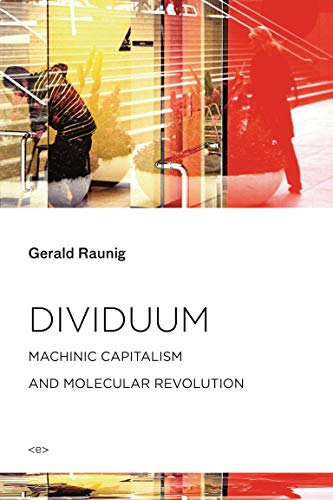
Sinossi
Raunig develops a philosophy of dividuality as a way of addressing contemporary modes of production and forms of life.
The animal of the molecular revolution will be neither mole nor snake, but a drone-animal-thing that is solid, liquid, and a gas.
—from Dividuum
As the philosophical, religious, and historical systems that have produced the “individual” (and its counterparts, society and community) over the years continue to break down, the age of “dividuality” is now upon us. The roots of the concept of the “dividuum” can be traced back to Latin philosophy, when Cicero used the term to translate the “divisible” in the writings of Epicurus and Plato; later, medieval scholars utilized the term in theological discussions on the unity of the trinity. Grounding himself in the writings of the medieval bishop Gilbert de Poitiers and his extensive commentaries on Boethius, Gerald Raunig charts a genealogy of the concept and develops a philosophy of dividuality as a way of addressing contemporary modes of production and forms of life. Through its components of dispersion, subsistence, and similarity, dividuality becomes a hidden principle of obedience and conformity, but it also brings with it the potential to realize disobedience and noncompliant con/dividualities.
Raunig's bad news is that dividuality is responsible for much of the intensified exploitation and enslavement taking place under contemporary machinic capitalism. Algorithms, derivatives, big data, and social media technology all contribute to the rampant expansion of divisive management strategies and desires for self-division. The good news, however, is that this same terrain of dividuality presents an opportunity for a new kind of resistance, one that can be realized in the form of con/division.
Le informazioni nella sezione "Riassunto" possono far riferimento a edizioni diverse di questo titolo.
Informazioni sull'autore
Gerald Raunig is a philosopher and art theorist. He works at the Zürich University of the Arts, Zürich and the eipcp (European Institute for Progressive Cultural Policies), Vienna. He is coeditor of the multilingual publishing platform Transversal Texts and the Austrian journal Kamion. He is the author of Art and Revolution, A Thousand Machines, and Factories of Knowledge, Industries of Creativity, all published by Semiotext[e].
Le informazioni nella sezione "Su questo libro" possono far riferimento a edizioni diverse di questo titolo.
Risultati della ricerca per Dividuum: Machinic Capitalism and Molecular Revolution

Foto dell'editore
Dividuum: Machinic Capitalism and Molecular Revolution (Semiotext(e) / Foreign Agents)
Da: HPB-Red, Dallas, TX, U.S.A.
Valutazione del venditore 5 su 5 stelle

paperback. Condizione: Good. Connecting readers with great books since 1972! Used textbooks may not include companion materials such as access codes, etc. May have some wear or writing/highlighting. We ship orders daily and Customer Service is our top priority! Codice articolo S_469404650
Compra usato
EUR 5,74
Spedizione EUR 3,23
Spedito in U.S.A.
Spedito in U.S.A.
Quantità: 1 disponibili
Foto dell'editore
Dividuum: Machinic Capitalism and Molecular Revolution
Da: ThriftBooks-Atlanta, AUSTELL, GA, U.S.A.
Valutazione del venditore 5 su 5 stelle
Paperback. Condizione: Very Good. No Jacket. May have limited writing in cover pages. Pages are unmarked. ~ ThriftBooks: Read More, Spend Less. Codice articolo G1584351802I4N00
Compra usato
EUR 9,28
Spedizione gratuita
Spedito in U.S.A.
Spedito in U.S.A.
Quantità: 1 disponibili
Immagini fornite dal venditore
Dividuum : Machinic Capitalism and Molecular Revolution
Da: GreatBookPrices, Columbia, MD, U.S.A.
Valutazione del venditore 5 su 5 stelle
Condizione: New. Codice articolo 24824673-n
Compra nuovo
EUR 11,87
Spedizione EUR 2,27
Spedito in U.S.A.
Spedito in U.S.A.
Quantità: Più di 20 disponibili
Foto dell'editore
Dividuum (Paperback)
Da: Grand Eagle Retail, Bensenville, IL, U.S.A.
Valutazione del venditore 5 su 5 stelle
Paperback. Condizione: new. Paperback. Raunig develops a philosophy of dividuality as a way of addressing contemporary modes of production and forms of life.The animal of the molecular revolution will be neither mole nor snake, but a drone-animal-thing that is solid, liquid, and a gas.-from DividuumAs the philosophical, religious, and historical systems that have produced the "individual" (and its counterparts, society and community) over the years continue to break down, the age of "dividuality" is now upon us. The roots of the concept of the "dividuum" can be traced back to Latin philosophy, when Cicero used the term to translate the "divisible" in the writings of Epicurus and Plato; later, medieval scholars utilized the term in theological discussions on the unity of the trinity. Grounding himself in the writings of the medieval bishop Gilbert de Poitiers and his extensive commentaries on Boethius, Gerald Raunig charts a genealogy of the concept and develops a philosophy of dividuality as a way of addressing contemporary modes of production and forms of life. Through its components of dispersion, subsistence, and similarity, dividuality becomes a hidden principle of obedience and conformity, but it also brings with it the potential to realize disobedience and noncompliant con/dividualities.Raunig's bad news is that dividuality is responsible for much of the intensified exploitation and enslavement taking place under contemporary machinic capitalism. Algorithms, derivatives, big data, and social media technology all contribute to the rampant expansion of divisive management strategies and desires for self-division. The good news, however, is that this same terrain of dividuality presents an opportunity for a new kind of resistance, one that can be realized in the form of con/division. Raunig develops a philosophy of dividuality as a way of addressing contemporary modes of production and forms of life. Shipping may be from multiple locations in the US or from the UK, depending on stock availability. Codice articolo 9781584351801
Compra nuovo
EUR 14,22
Spedizione gratuita
Spedito in U.S.A.
Spedito in U.S.A.
Quantità: 1 disponibili
Foto dell'editore
Machinic Capitalism and Molecular Revolution Format: Paperback
Da: INDOO, Avenel, NJ, U.S.A.
Valutazione del venditore 5 su 5 stelle
Condizione: New. Codice articolo 9781584351801
Compra nuovo
EUR 14,23
Spedizione gratuita
Spedito in U.S.A.
Spedito in U.S.A.
Quantità: Più di 20 disponibili
Immagini fornite dal venditore
Dividuum
Da: Rarewaves USA, HEBRON, KY, U.S.A.
Valutazione del venditore 5 su 5 stelle
Paperback. Condizione: New. Codice articolo LU-9781584351801
Compra nuovo
EUR 14,36
Spedizione gratuita
Spedito in U.S.A.
Spedito in U.S.A.
Quantità: Più di 20 disponibili
Immagini fornite dal venditore
Dividuum : Machinic Capitalism and Molecular Revolution
Da: GreatBookPrices, Columbia, MD, U.S.A.
Valutazione del venditore 5 su 5 stelle
Condizione: As New. Unread book in perfect condition. Codice articolo 24824673
Compra usato
EUR 12,32
Spedizione EUR 2,27
Spedito in U.S.A.
Spedito in U.S.A.
Quantità: Più di 20 disponibili
Foto dell'editore
Machinic Capitalism and Molecular Revolution Format: Paperback
Editore:
Penguin Random House, 2016
ISBN 10: 1584351802
ISBN 13: 9781584351801
Antico o usato
Brossura
Da: INDOO, Avenel, NJ, U.S.A.
Valutazione del venditore 5 su 5 stelle
Condizione: As New. Unread copy in mint condition. Codice articolo RH9781584351801
Compra usato
EUR 14,67
Spedizione gratuita
Spedito in U.S.A.
Spedito in U.S.A.
Quantità: Più di 20 disponibili
Foto dell'editore
Dividuum: Machinic Capitalism and Molecular Revolution (Semiotext(e) / Foreign Agents)
Da: Broad Street Books, Branchville, NJ, U.S.A.
Valutazione del venditore 5 su 5 stelle
paperback. Condizione: New. Brand New Book. Codice articolo 67913
Compra nuovo
EUR 11,04
Spedizione EUR 4,26
Spedito in U.S.A.
Spedito in U.S.A.
Quantità: 1 disponibili
Foto dell'editore
Dividuum: Machinic Capitalism and Molecular Revolution
Da: Massive Bookshop, Erving, MA, U.S.A.
Valutazione del venditore 4 su 5 stelle

Paperback. Condizione: New. Codice articolo 9781584351801
Compra nuovo
EUR 15,03
Spedizione EUR 4,09
Spedito in U.S.A.
Spedito in U.S.A.
Quantità: 10 disponibili