
Articoli correlati a Cross-Border Management: Theory, Method and Application
Sinossi
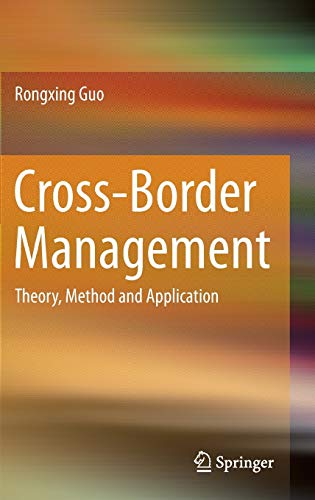
This book presents a new approach to management in an increasingly interactive world. In this context, the use of the word new has two meanings. The first relates to a new definition of borders (which are natural, institutional, functional, or mixed); the second concerns the fact that the book applies (and, where necessary, develops) analytical tools, methods and models that are different from those used in other similar books. The objectives of this book are: to clarify whether existing management theories and methods can be effectively applied in an entity (which can be defined as a sovereign country, a region, a community, a culture, or a firm) as the latter increasingly interacts with the rest of the world; to develop qualitative and quantitative methods to help leaders make optimal decisions for their entity and, at the same time, to maximize the positive (or minimize the negative) effects of those decisions on the rest of the world; and to design workable cross-border cooperation plans and conflict-management schemes that allow policy-makers to better cope with the challenges and problems posed by our increasingly interactive world.
Le informazioni nella sezione "Riassunto" possono far riferimento a edizioni diverse di questo titolo.
Dalla quarta di copertina
This book presents a new approach to management in an increasingly interactive world. In this context, the use of the word new has two meanings. The first relates to a new definition of borders (which are natural, institutional, functional, or mixed); the second concerns the fact that the book applies (and, where necessary, develops) analytical tools, methods and models that are different from those used in other similar books. The objectives of this book are: to clarify whether existing management theories and methods can be effectively applied in an entity (which can be defined as a sovereign country, a region, a community, a culture, or a firm) as the latter increasingly interacts with the rest of the world; to develop qualitative and quantitative methods to help leaders make optimal decisions for their entity and, at the same time, to maximize the positive (or minimize the negative) effects of those decisions on the rest of the world; and to design workable cross-border cooperation plans and conflict-management schemes that allow policy-makers to better cope with the challenges and problems posed by our increasingly interactive world.
Le informazioni nella sezione "Su questo libro" possono far riferimento a edizioni diverse di questo titolo.
Risultati della ricerca per Cross-Border Management: Theory, Method and Application

Immagini fornite dal venditore
Cross-Border Management
Editore:
Springer Berlin Heidelberg Jan 2015, 2015
ISBN 10: 3662451557
ISBN 13: 9783662451557
Nuovo
Rilegato
Da: BuchWeltWeit Ludwig Meier e.K., Bergisch Gladbach, Germania
Valutazione del venditore 5 su 5 stelle

Buch. Condizione: Neu. This item is printed on demand - it takes 3-4 days longer - Neuware -This book presents a new approach to management in an increasingly interactive world. In this context, the use of the word 'new' has two meanings. The first relates to a new definition of borders (which are natural, institutional, functional, or mixed); the second concerns the fact that the book applies (and, where necessary, develops) analytical tools, methods and models that are different from those used in other similar books. The objectives of this book are: to clarify whether existing management theories and methods can be effectively applied in an entity (which can be defined as a sovereign country, a region, a community, a culture, or a firm) as the latter increasingly interacts with the rest of the world; to develop qualitative and quantitative methods to help leaders make optimal decisions for their entity and, at the same time, to maximize the positive (or minimize the negative) effects of those decisions on the rest of the world; and to design workable cross-border cooperation plans and conflict-management schemes that allow policy-makers to better cope with the challenges and problems posed by our increasingly interactive world. 440 pp. Englisch. Codice articolo 9783662451557
Compra nuovo
EUR 106,99
Spedizione EUR 23,00
Spedito da Germania a U.S.A.
Spedito da Germania a U.S.A.
Quantità: 2 disponibili
Foto dell'editore
Cross-Border Management: Theory, Method and Application (eng)
Print on DemandDa: Brook Bookstore On Demand, Napoli, NA, Italia
Valutazione del venditore 5 su 5 stelle
Condizione: new. Questo è un articolo print on demand. Codice articolo 690e535b37cb632ba6c398ea93f5de15
Compra nuovo
EUR 86,24
Spedizione EUR 51,00
Spedito da Italia a U.S.A.
Spedito da Italia a U.S.A.
Quantità: Più di 20 disponibili
Foto dell'editore
Cross-Border Management : Theory, Method and Application
Da: GreatBookPrices, Columbia, MD, U.S.A.
Valutazione del venditore 5 su 5 stelle
Condizione: New. Codice articolo 22081704-n
Compra nuovo
EUR 134,89
Spedizione EUR 2,36
Spedito in U.S.A.
Spedito in U.S.A.
Quantità: 15 disponibili
Immagini fornite dal venditore
Cross-Border Management
Print on DemandDa: moluna, Greven, Germania
Valutazione del venditore 5 su 5 stelle
Gebunden. Condizione: New. Dieser Artikel ist ein Print on Demand Artikel und wird nach Ihrer Bestellung fuer Sie gedruckt. Develops a so-called crossing-border framework by which to solve bilateral and multilateral problems and challengesMeasures, qualitatively or quantitatively, various effects of borders on global and local economic activitiesProvides vario. Codice articolo 11340948
Compra nuovo
EUR 92,27
Spedizione EUR 48,99
Spedito da Germania a U.S.A.
Spedito da Germania a U.S.A.
Quantità: Più di 20 disponibili
Foto dell'editore
Cross-Border Management: Theory, Method and Application
Da: Ria Christie Collections, Uxbridge, Regno Unito
Valutazione del venditore 5 su 5 stelle
Condizione: New. In English. Codice articolo ria9783662451557_new
Compra nuovo
EUR 129,85
Spedizione EUR 13,34
Spedito da Regno Unito a U.S.A.
Spedito da Regno Unito a U.S.A.
Quantità: Più di 20 disponibili
Immagini fornite dal venditore
Cross-Border Management : Theory, Method and Application
Da: AHA-BUCH GmbH, Einbeck, Germania
Valutazione del venditore 5 su 5 stelle
Buch. Condizione: Neu. Druck auf Anfrage Neuware - Printed after ordering - This book presents a new approach to management in an increasingly interactive world. In this context, the use of the word 'new' has two meanings. The first relates to a new definition of borders (which are natural, institutional, functional, or mixed); the second concerns the fact that the book applies (and, where necessary, develops) analytical tools, methods and models that are different from those used in other similar books. The objectives of this book are: to clarify whether existing management theories and methods can be effectively applied in an entity (which can be defined as a sovereign country, a region, a community, a culture, or a firm) as the latter increasingly interacts with the rest of the world; to develop qualitative and quantitative methods to help leaders make optimal decisions for their entity and, at the same time, to maximize the positive (or minimize the negative) effects of those decisions on the rest of the world; and to design workable cross-border cooperation plans and conflict-management schemes that allow policy-makers to better cope with the challenges and problems posed by our increasingly interactive world. Codice articolo 9783662451557
Compra nuovo
EUR 122,94
Spedizione EUR 35,00
Spedito da Germania a U.S.A.
Spedito da Germania a U.S.A.
Quantità: 1 disponibili
Foto dell'editore
Cross-Border Management: Theory, Method and Application
Da: Books Puddle, Woodside, NY, U.S.A.
Valutazione del venditore 4 su 5 stelle

Condizione: New. 440. Codice articolo 26372195472
Compra nuovo
EUR 162,99
Spedizione EUR 3,56
Spedito in U.S.A.
Spedito in U.S.A.
Quantità: 4 disponibili
Immagini fornite dal venditore
Cross-Border Management
Editore:
Springer, Springer Jan 2015, 2015
ISBN 10: 3662451557
ISBN 13: 9783662451557
Nuovo
Rilegato
Da: buchversandmimpf2000, Emtmannsberg, BAYE, Germania
Valutazione del venditore 5 su 5 stelle
Buch. Condizione: Neu. This item is printed on demand - Print on Demand Titel. Neuware -This book presents a new approach to management in an increasingly interactive world. In this context, the use of the word ¿new¿ has two meanings. The first relates to a new definition of borders (which are natural, institutional, functional, or mixed); the second concerns the fact that the book applies (and, where necessary, develops) analytical tools, methods and models that are different from those used in other similar books. The objectives of this book are: to clarify whether existing management theories and methods can be effectively applied in an entity (which can be defined as a sovereign country, a region, a community, a culture, or a firm) as the latter increasingly interacts with the rest of the world; to develop qualitative and quantitative methods to help leaders make optimal decisions for their entity and, at the same time, to maximize the positive (or minimize the negative) effects of those decisions on the rest of the world; and to design workable cross-border cooperation plans and conflict-management schemes that allow policy-makers to better cope with the challenges and problems posed by our increasingly interactive world.Springer-Verlag KG, Sachsenplatz 4-6, 1201 Wien 440 pp. Englisch. Codice articolo 9783662451557
Compra nuovo
EUR 106,99
Spedizione EUR 60,00
Spedito da Germania a U.S.A.
Spedito da Germania a U.S.A.
Quantità: 1 disponibili
Foto dell'editore
Cross-Border Management: Theory, Method and Application
Da: Revaluation Books, Exeter, Regno Unito
Valutazione del venditore 5 su 5 stelle
Hardcover. Condizione: Brand New. 2015 edition. 400 pages. 9.25x6.25x1.25 inches. In Stock. Codice articolo x-3662451557
Compra nuovo
EUR 162,49
Spedizione EUR 14,77
Spedito da Regno Unito a U.S.A.
Spedito da Regno Unito a U.S.A.
Quantità: 2 disponibili
Foto dell'editore
Cross-Border Management: Theory, Method and Application
Print on DemandDa: Majestic Books, Hounslow, Regno Unito
Valutazione del venditore 4 su 5 stelle
Condizione: New. Print on Demand 440. Codice articolo 374931279
Compra nuovo
EUR 170,01
Spedizione EUR 7,68
Spedito da Regno Unito a U.S.A.
Spedito da Regno Unito a U.S.A.
Quantità: 4 disponibili