

Importo totale (1 articolo articoli):
Destinazione ordine:

aleksander professor (14 risultati)
Vai alla pagina principale dei risultati di ricerca
Filtri di ricerca
Tipo di articolo
- Tutti i tipi di prodotto
- Libri (14)
- Riviste e Giornali (Nessun altro risultato corrispondente a questo perfezionamento)
- Fumetti (Nessun altro risultato corrispondente a questo perfezionamento)
- Spartiti (Nessun altro risultato corrispondente a questo perfezionamento)
- Arte, Stampe e Poster (Nessun altro risultato corrispondente a questo perfezionamento)
- Fotografie (Nessun altro risultato corrispondente a questo perfezionamento)
- Mappe (Nessun altro risultato corrispondente a questo perfezionamento)
- Manoscritti e Collezionismo cartaceo (Nessun altro risultato corrispondente a questo perfezionamento)
Condizioni Maggiori informazioni
- Nuovo (10)
- Come nuovo, Ottimo o Quasi ottimo (3)
- Molto buono o Buono (1)
- Discreto o Mediocre (Nessun altro risultato corrispondente a questo perfezionamento)
- Come descritto (Nessun altro risultato corrispondente a questo perfezionamento)
Legatura
Ulteriori caratteristiche
- Prima ed. (1)
- Copia autograf. (Nessun altro risultato corrispondente a questo perfezionamento)
- Sovracoperta (1)
- Con foto (2)
- Non Print on Demand (9)
Lingua (1)
Spedizione gratuita
Paese del venditore
Valutazione venditore
-
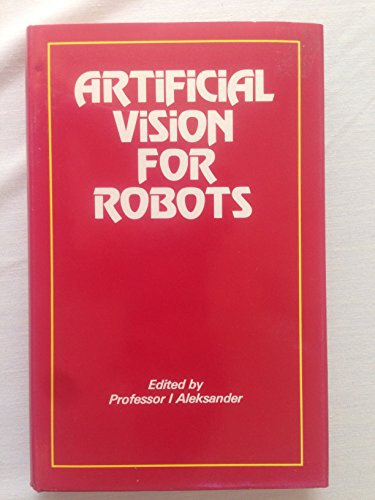
Artificial Vision for Robots
Da: About Books, Henderson, NV, U.S.A.
Valutazione del venditore 5 su 5 stelle

Prima edizione
Hardcover. Condizione: Fine condition. Condizione sovraccoperta: Fine dust jacket. 1st US printing of First Collected ed. New York: Chapman & Hall, 1984. Bright, shiny, clean, square, tight, unmarked copy. Sharp corners. Not a book club edition. No owner's name or bookplate. No remainder mark. No chips or tears. Illustrated. From the Dust Jacket: "This book brings together for the first time papers on robot vision written by some of the leading academics and researchers in the world. The next stage of development, discussed in this book, is concerned with the design and use of the adaptive robot - the robot that can react to changes in its environment. The principal aim of the authors is to demonstrate that the creation of the sensate robot is now a technical possibility, whilst keeping in mind the need for economic viability." Chapters 2 to 10 were previously published in: Digital Systems for Industrial Automation [Crane Russak & Company, Inc., c1981 and 1982]. Chapters 1, 11 and 12 are new and are first published here. 1st US printing of First Collected ed. Hardcover. Fine condition/Fine dust jacket. 8vo. 233pp. Great Packaging, Fast Shipping.
-
Impossible Minds: My Neurons, My Consciousness
Da: Zoom Books East, Glendale Heights, IL, U.S.A.
Valutazione del venditore 5 su 5 stelle
Condizione: good. Book is in good condition and may include underlining highlighting and minimal wear. The book can also include "From the library of" labels. May not contain miscellaneous items toys, dvds, etc. . We offer 100% money back guarantee and 24 7 customer service.
-

East Anglia and its North Sea World in the Middle Ages (eng)
Da: Brook Bookstore On Demand, Napoli, NA, Italia
Valutazione del venditore 5 su 5 stelle
EUR 37,01
Spedizione EUR 8,00
Spedito da Italia a U.S.A.Quantità: Più di 20 disponibili
Aggiungi al carrelloCondizione: new.
-

Neural Computing Architectures
Da: GreatBookPrices, Columbia, MD, U.S.A.
Valutazione del venditore 5 su 5 stelle
EUR 55,28
Spedizione EUR 2,31
Spedito in U.S.A.Quantità: Più di 20 disponibili
Aggiungi al carrelloCondizione: As New. Unread book in perfect condition.
-
Neural Computing Architectures
Da: GreatBookPrices, Columbia, MD, U.S.A.
Valutazione del venditore 5 su 5 stelle
EUR 62,60
Spedizione EUR 2,31
Spedito in U.S.A.Quantità: Più di 20 disponibili
Aggiungi al carrelloCondizione: New.
-
Neural Computing Architectures
Da: GreatBookPricesUK, Woodford Green, Regno Unito
Valutazione del venditore 5 su 5 stelle
EUR 62,41
Spedizione EUR 17,59
Spedito da Regno Unito a U.S.A.Quantità: Più di 20 disponibili
Aggiungi al carrelloCondizione: As New. Unread book in perfect condition.
-
Neural Computing Architectures
Da: GreatBookPricesUK, Woodford Green, Regno Unito
Valutazione del venditore 5 su 5 stelle
EUR 62,88
Spedizione EUR 17,59
Spedito da Regno Unito a U.S.A.Quantità: Più di 20 disponibili
Aggiungi al carrelloCondizione: New.
-
Neural Computing Architectures The Design of BrainLike Machines
Da: Revaluation Books, Exeter, Regno Unito
Valutazione del venditore 5 su 5 stelle
EUR 74,89
Spedizione EUR 14,66
Spedito da Regno Unito a U.S.A.Quantità: 2 disponibili
Aggiungi al carrelloPaperback. Condizione: Brand New. 410 pages. 8.98x5.98x1.02 inches. In Stock.
-

Wolves and the Wilderness in the Middle Ages
Da: Ria Christie Collections, Uxbridge, Regno Unito
Valutazione del venditore 5 su 5 stelle
EUR 123,98
Spedizione EUR 14,05
Spedito da Regno Unito a U.S.A.Quantità: Più di 20 disponibili
Aggiungi al carrelloCondizione: New. In.
-
Neural Computing Architectures ? The Design of Brain?Like Machines
Da: Majestic Books, Hounslow, Regno Unito
Valutazione del venditore 4 su 5 stelle

EUR 57,16
Spedizione EUR 7,62
Spedito da Regno Unito a U.S.A.Quantità: 4 disponibili
Aggiungi al carrelloCondizione: New. Print on Demand pp. 320.
-
Neural Computing Architectures ? The Design of Brain?Like Machines
Da: Books Puddle, New York, NY, U.S.A.
Valutazione del venditore 4 su 5 stelle
Condizione: New. Print on Demand pp. 320.
-
Neural Computing Architectures ? The Design of Brain?Like Machines
Da: Biblios, Frankfurt am main, HESSE, Germania
Valutazione del venditore 4 su 5 stelle
EUR 56,76
Spedizione EUR 9,95
Spedito da Germania a U.S.A.Quantità: 4 disponibili
Aggiungi al carrelloCondizione: New. PRINT ON DEMAND pp. 320.
-

EUR 46,50
Spedizione EUR 48,99
Spedito da Germania a U.S.A.Quantità: Più di 20 disponibili
Aggiungi al carrelloCondizione: New. Dieser Artikel ist ein Print on Demand Artikel und wird nach Ihrer Bestellung fuer Sie gedruckt. Über den AutorIgor Aleksander is Professor of Computer Science at Imperial College in London.KlappentextAn overview and synopsis of European connectionist research from both classical and.
-

EUR 57,65
Spedizione EUR 63,33
Spedito da Germania a U.S.A.Quantità: 1 disponibili
Aggiungi al carrelloTaschenbuch. Condizione: Neu. nach der Bestellung gedruckt Neuware - Printed after ordering - McClelland and Rumelhart's Parallel Distributed Processing was the first book to present a definitive account of the newly revived connectionist/neural net paradigm for artificial intelligence and cognitive science. While Neural Computing Architectures addresses the same issues, there is little overlap in the research it reports. These 18 contributions provide a timely and informative overview and synopsis of both pioneering and recent European connectionist research. Several chapters focus on cognitive modeling; however, most of the work covered revolves around abstract neural network theory or engineering applications, bringing important complementary perspectives to currently published work in PDP. In four parts, chapters take up neural computing from the classical perspective, including both foundational and current work; the mathematical perspective (of logic, automata theory, and probability theory), presenting less well-known work in which the neuron is modeled as a logic truth function that can be implemented in a direct way as a silicon read only memory. They present new material both in the form of analytical tools and models and as suggestions for implementation in optical form, and summarize the PDP perspective in a single extended chapter covering PDP theory, application, and speculation in US research. Each part is introduced by the editor.

