Importo totale (1 articolo articoli):
Destinazione ordine:

bardeen john (58 risultati)
Vai alla pagina principale dei risultati di ricerca
Filtri di ricerca
Tipo di articolo
- Tutti i tipi di prodotto
- Libri (53)
- Riviste e Giornali (2)
- Fumetti (Nessun altro risultato corrispondente a questo perfezionamento)
- Spartiti (Nessun altro risultato corrispondente a questo perfezionamento)
- Arte, Stampe e Poster (Nessun altro risultato corrispondente a questo perfezionamento)
- Fotografie (Nessun altro risultato corrispondente a questo perfezionamento)
- Mappe (Nessun altro risultato corrispondente a questo perfezionamento)
- Manoscritti e Collezionismo cartaceo (3)
Condizioni Maggiori informazioni
- Nuovo (24)
- Come nuovo, Ottimo o Quasi ottimo (11)
- Molto buono o Buono (15)
- Discreto o Mediocre (Nessun altro risultato corrispondente a questo perfezionamento)
- Come descritto (8)
Legatura
Ulteriori caratteristiche
- Prima ed. (18)
- Copia autograf. (2)
- Sovracoperta (Nessun altro risultato corrispondente a questo perfezionamento)
- Con foto (32)
- Non Print on Demand (36)
Lingua (2)
Spedizione gratuita
Paese del venditore
Valutazione venditore
-

Hardcover. Condizione: Very Good. Connecting readers with great books since 1972! Used books may not include companion materials, and may have some shelf wear or limited writing. We ship orders daily and Customer Service is our top priority!
-

Impact of Basic Research on Technology
Da: Better World Books, Mishawaka, IN, U.S.A.
Valutazione del venditore 5 su 5 stelle

Condizione: Good. Former library copy. Pages intact with minimal writing/highlighting. The binding may be loose and creased. Dust jackets/supplements are not included. Includes library markings. Stock photo provided. Product includes identifying sticker. Better World Books: Buy Books. Do Good.
-

The Anatomical Record; Volume 10
Da: California Books, Miami, FL, U.S.A.
Valutazione del venditore 5 su 5 stelle
EUR 30,16
Spedizione gratuita
Spedito in U.S.A.Quantità: Più di 20 disponibili
Aggiungi al carrelloCondizione: New.
-
Highlights of condensed-matter theory (Proceedings of the International School of Physics "Enrico Fermi")
Da: Arroyo Seco Books, Pasadena, Member IOBA, Pasadena, CA, U.S.A.
Membro dell'associazione: IOBA
Valutazione del venditore 5 su 5 stelle
Prima edizione
Hardcover. Condizione: Near Fine. 1st Edition. Xviii, 916 , (Iv). Grey Cloth, Gilt. First Printing. Near Fine, No Marks, Light Rubbing, Gilt Brilliant.
-

The Many-Body Problem (Series: Frontiers In Physics: A Lecture Note & Reprint Series)
Lingua: Inglese
Editore: W. A. Benjamin, New York, 1961
Da: Arroyo Seco Books, Pasadena, Member IOBA, Pasadena, CA, U.S.A.
Membro dell'associazione: IOBA
Valutazione del venditore 5 su 5 stelle
Prima edizione
Soft cover. Condizione: Very Good. 1st Edition. Xii, 456 (The Reprints Are Pp. 102-456), + 1 Pp Comments And Corrections At Rear. Printed Wrappers. First Printing. Very Good, Light Usage, No Marks.
-

Quantum Fluids: Proceedings Of The Sussex University Symposium 16-20 August 1965
Lingua: Inglese
Editore: North-Holland Publishing Company / John Wiley And Sons, Amsterdam / New York, 1966
Da: Arroyo Seco Books, Pasadena, Member IOBA, Pasadena, CA, U.S.A.
Membro dell'associazione: IOBA
Valutazione del venditore 5 su 5 stelle
Prima edizione
Hardcover. Condizione: Near Fine. No Jacket. 1st Edition. Viii, 360 Pp. Red Cloth, Gilt. First Printing. Barely A Sign Of Wear, Spine Cloth A Little Faded But All Gilt Lettering Still Brilliant. Name Stamp Of Cal Tech Physicist Milton S. Plesset.
-

Proceedings Of The International Conference On Electron Transport In Metals And Solids, Held At The National Research Laboratories, Ottawa, September 10-14, 1956 (Issued As A Supplementaty Number Of The Canadian Journal Of Physics), Volume 34 December 1956, No. 12A
Lingua: Inglese
Editore: University Of Toronto Press/ Canadian Journal Of Physics, Toronto, 1956
Da: Arroyo Seco Books, Pasadena, Member IOBA, Pasadena, CA, U.S.A.
Membro dell'associazione: IOBA
Valutazione del venditore 5 su 5 stelle
Rivista / Giornale Prima edizione
Soft cover. Condizione: Very Good. 1st Edition. 171-1423 Pp. Original Yellow Wrappers. Copy Of Jan Korringa, One Of The Authors Who Presented At This Conference; Not Marked As Such But With His Place Marker At His Article.
-

Physical Review Letters, Volume 14 Number 4, January 25 1965 With "Viscosity Of Type-Ii Superconductors" By Stephen And Bardeen
Lingua: Inglese
Editore: The American Physical Society, New York, 1965
Da: Arroyo Seco Books, Pasadena, Member IOBA, Pasadena, CA, U.S.A.
Membro dell'associazione: IOBA
Valutazione del venditore 5 su 5 stelle
Rivista / Giornale Prima edizione
Soft cover. Condizione: Near Fine. 1st Edition. Entire Issue In Original Blue-Green Wrappers. Near Fine. Bardeen Was Nobel Laureate In 1956 And Again In 1972.
-
Portraits of Success: Impressions of Silicon Valley Pioneers
Da: BennettBooksLtd, Los Angeles, CA, U.S.A.
Valutazione del venditore 5 su 5 stelle
Hardcover. Condizione: New. In shrink wrap. Looks like an interesting title!
-
SYMMETRY EFFECTS IN THE SPACING OF NUCLEAR ENERGY LEVELS
Data di pubblicazione: 1938
Da: Xerxes Fine and Rare Books and Documents, Glen Head, NY, U.S.A.
Valutazione del venditore 5 su 5 stelle
Condizione: Near Fine. Article on pp. 809-817 in single complete issue of The Physical Review, volume 54, no. 10 for November 15, 1938. Lancaster, PA. American Physical Society. Original green printed wraps. 4to. Near Fine. no ownership marks. Other articles in issue as well. Bardeen won the Nobel twice - in both 1956 and 1972.
-
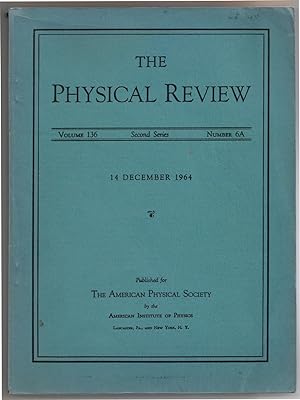
The Physical Review / Second Series / Volume 136 Number 6A / Superconductor, Magnetics / John Bardeen, J.M. Luttinger, Kyozi Kawasaki, Michael E. Fisher, Herbert B. Callen et al
Lingua: Inglese
Editore: American Institute of Physics (for the American Physical Society), Lancaster, PA and New York, 1964
Da: Singularity Rare & Fine, Baldwinsville, NY, U.S.A.
Valutazione del venditore 5 su 5 stelle
Prima edizione
Soft cover. Condizione: Very Good Plus. 1st Edition. Lancaster, PA and New York: American Institute of Physics (for the American Physical Society), 1964. First Edition thus. Quarto, light blue printed adhered wraps, pp A 1471 through A 1774 for the series are in this volume.Very Good plus, really quite close to Near Fine; sharp condition. No interior markings. See scan for the rich contents of this issue, but superconducting and magneto-studies pieces dominate. J.M. Luttinger; John Bardeen (the only person to have won the Nobel Prize for Physics twice); Alexander L. Fetter; Miroslav Synek; Kyozi Kawasaki (Boltzmann Medal winner); Michael E. Fisher (Boltzmann Medal winner)(2 articles herein); Herbert B. Callen (Elliott Cresson Medal winner). L67.
-
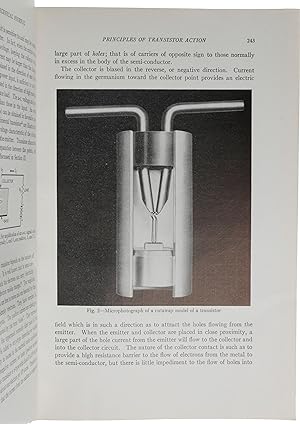
Physical Principles Involved in Transistor Action. WITH: The Theory of p-n Junctions in Semiconductors and p-n Junction Transistors.
Lingua: Inglese
Editore: Taylor and Francis, London, 1949
Da: Alexander Macaulay Rare Books, Toronto, ON, Canada
Valutazione del venditore 4 su 5 stelle

Prima edizione
EUR 1.197,54
Spedizione EUR 15,50
Spedito da Canada a U.S.A.Quantità: 1 disponibili
Aggiungi al carrelloFirst edition of the revolutionary transistor issue of The Bell System Technical Journal featuring the first account of the invention of the transistor, which ushered in the information age. Offered is the entire volume for 1949 (753 pages, complete with index), which also contains the July semiconductor issue dedicated to the semiconductor. Also included is Claude Shannon's Communication Theory of Secrecy Systems (pp. 656-715). New York: American Telephone and Telegraph Company, 1949. Contemporary green buckram. X-Libris but with minimal markings. Pages clean and bright. Near fine copy. Brattain, Walter H. and John Bardeen. "Physical Principles Involved in Transistor Action," Physical Principles Involved in Transistor Action. WITH: The Theory of p-n Junctions in Semiconductors and p-n Junction Transistors. Et al. Walter H. Brattain, John Bardeen, 1949. "Surface Properties of Germanium," Bell System Technical Journal 32(1), pp. 239-277. Hamming, R. W. "Error detecting and error correcting codes," The Bell System Technical Journal. 29 (1950), pp. 147-160. Shannon C. E. "Prediction and entropy of printed English," The Bell System Technical Journal. 30 (1951), pp. 50-64. Clos, Charles. "A study of non-blocking switching networks." In The Bell System Technical Journal, volume 32 (1953), 406-424.
-
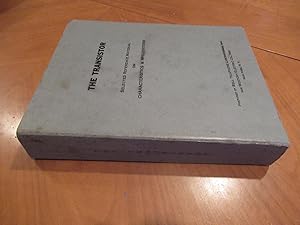
The Transistor / Selected Reference Material on Characteristics & Applications / Contract DA 36-039 Sc-5589 (Task 3) (including) "The P - N Transistor Junction" By Sparks and Shockley
Lingua: Inglese
Editore: Bell Telephone Laboratories, Inc. / Western Electric Co., Inc., New York, 1951
Da: Arroyo Seco Books, Pasadena, Member IOBA, Pasadena, CA, U.S.A.
Membro dell'associazione: IOBA
Valutazione del venditore 5 su 5 stelle
Prima edizione Copia autografata
Soft cover. Condizione: Very Good. First Edition. 792 Pp. Grey Card Covers Printed In Black. First Printing. "The Material Included Herein Covers The Same Ground And Supplements The Talks Given At A Symposium On Transistors, Which Was Held At The Bell Telephone Laboratories During The Week Beginning September 17, 1951. Includes Reprints Of Important Shockley Papers Including The "The Theory Of P-N Junctions In Semiconductors And P-N Junction Transistors" From The 1949 Bell System Telephone Journal, And 33 Other Articles By Shockley And Others, Most Of Which Are First Published Here, Representing A Comprehensive Overview Of The Latest Developments In This Important Milestone In Electronics. Includes A Joint Article By Shockley And Sparks On P - N Transistor Junctions; The Junction Transistor, First Announced By Bell Labs In 1951, Was More Efficient And Consumed Far Less Power Than The Original 1947 Type, And Led To The Electronics Revolution In Small Devices; Sparks Was Later Directore Of Sandia Labs 1972-1981, And Was Involved In Plasma Research. (Note: No Articles Credited To Bardeen Or Brattain). Some Wear And Light Soiling To Covers, But All Lettering Clear On Front Cover And All Lettering Worn But Present On Spine. Internally A Clean Copy. Laid In Loosely Are Signed First Day Covers Commemorating Their Achievements, One Each Signed By Shockley, Brattain And Bardeen. Signed by Author(s).
-
JOHN ROBERT SCHRIEFFER (John R. Schrieffer, 1931-2019) Professor Dr., US-amerikanischer Physiker /Nobelpreis Physik 1972 für die Theorie des Supraleitungsphänomens, auch BCS-Theorie (Bardeen-Cooper-Schrieffer-Theorie)
Da: Herbst-Auktionen, Detmold, Germania
Valutazione del venditore 3 su 5 stelle

Manoscritto / Collezionismo cartaceo Copia autografata
EUR 35,00
Spedizione EUR 8,50
Spedito da Germania a U.S.A.Quantità: 1 disponibili
Aggiungi al carrelloAUTOGRAMMKARTE (blanko) mit Unterschrift signiert (dito : Blanko-Briefbogen mit Unterschrift , 4° für Euro 45,-).
-
Bardeen, John. "Tunneling from a Many-Particle Point of View" in Physical Review Letters.
Editore: American Physical Society, 1961
Da: JF Ptak Science Books, Hendersonville, NC, U.S.A.
Valutazione del venditore 5 su 5 stelle
Soft cover. Condizione: Near Fine. Bardeen, John. "Tunneling from a Many-Particle Point of View" in Physical Review Letters, volume 6 no. 2, 15 January 1961, American Physical Society. Significant paper (cited 3800+ times) from the double-Nobelist (1956 for the invention of the transistor with Walter Brattain and William Shockley; and 1972 for the development with Leon Cooper and J Robert Schrieffer of the Bardeen Cooper Schrieffer (BCS) theory of superconductivity.) . Original wrappers. Original owner name in pen at top right corner from cover. Fine copy. "Bardeen has very recently pointed out, however, that in the case of a many-electron system, the tunnelling process is very conveniently regarded as in time-dependent perturbation theory. In other words, it is seen as a transition process from one set of nearly Stationary states to another."--Richard Prange, "Tunneling from a Many-Particle Point of View", University of Maryland, 1962.
-
![Immagine del venditore per Theory of superconductivity, by J. Bardeen, L. N. Cooper [and] J. R. Schrieffer. 1957 [LeatherBound] venduto da S N Books World](https://pictures.abebooks.com/inventory/md/md30877519683.jpg)
Theory of superconductivity, by J. Bardeen, L. N. Cooper [and] J. R. Schrieffer. 1957 [LeatherBound]
Lingua: Inglese
Data di pubblicazione: 2025
EUR 27,49
Spedizione gratuita
Spedito da India a U.S.A.Quantità: 18 disponibili
Aggiungi al carrelloLeatherBound. Condizione: NEW. BOOKS ARE EXEMPT FROM IMPORT DUTIES AND TARIFFS; NO EXTRA CHARGES APPLY. Leatherbound edition. Condition: New. Leather Binding on Spine and Corners with Golden leaf printing on spine. Bound in genuine leather with Satin ribbon page markers and Spine with raised gilt bands. Pages: 236. A perfect gift for your loved ones. Reprinted from 1957 edition. NO changes have been made to the original text. This is NOT a retyped or an ocr'd reprint. Illustrations, Index, if any, are included in black and white. Each page is checked manually before printing. As this print on demand book is reprinted from a very old book, there could be some missing or flawed pages, but we always try to make the book as complete as possible. Fold-outs, if any, are not part of the book. If the original book was published in multiple volumes then this reprint is of only one volume, not the whole set. IF YOU WISH TO ORDER PARTICULAR VOLUME OR ALL THE VOLUMES YOU CAN CONTACT US. Resized as per current standards. Sewing binding for longer life, where the book block is actually sewn (smythe sewn/section sewn) with thread before binding which results in a more durable type of binding. Language: English Pages: 236.
-
Surface States and Rectification at a Metal Semi-Conductor Contact and WITH: FERMI, Enrico and L. Marshall. Interference Phenomena of Slow Neutrons in Physical Review.
Editore: American Physical Society, 1947
Da: JF Ptak Science Books, Hendersonville, NC, U.S.A.
Valutazione del venditore 5 su 5 stelle
Soft cover. Condizione: Good. John BARDEEN, Surface States and Rectification at a Metal Semi-Conductor Contact and WITH: FERMI, Enrico and L. Marshall. Interference Phenomena of Slow Neutrons in Physical Review, vol 71 number 10, 15 May 1947, pp 717-727 and pp 666-677 in the issue of p. 649-744. The issue has been cleanly extracted from a larger bound volume. GOOD copy. Fresh. [++] BARDEEN: "The earliest paper that seems to have a direct bearing on the development of the transistor which was followed by the two letters reporting verification of the predictions of the theory" [these located in Physical Review, 72, 845 (1947)].--George L. Trigg, "Landmark Experiments in Twentieth Century Physics", p 153, bibliography for the chapter on the transistor. (Fermi (Cited 342 times): the interference phenomena of slow neutrons, as studied by Enrico Fermi and others, relate to the wave-like behavior of neutrons and their interactions with matter.).
-
"The Conditions for a Quantum Field Theory to be Relativistic": in Reviews of Modern Physics
Editore: American Institute of Physics, 1962
Da: JF Ptak Science Books, Hendersonville, NC, U.S.A.
Valutazione del venditore 5 su 5 stelle
Prima edizione
Soft cover. Condizione: Very Good. 1st Edition. DIRAC, P. A.M. "The Conditions for a Quantum Field Theory to be Relativistic": in Reviews of Modern Physics, vol 34 no. 4, October 1962. American Institute of Physics. Original wrappers. VG copy, in the original wrappers. The spine is coated with some sort of plastic-like substance that I think was place there to protect the paper spine, and it worked (the former owner was a long-time NBS scientist). It is a little shiny, otherwise this is a VG copy. __+__ The issue contains pp 587-892, with the Dirac on pp 592-596. Also includes papers by John Archibald Wheeler, Problems on the Frontiers between General Relativity and Differential Geometry; P. Jordan, Geophysical Consequences of Dirac's Hypothesis; Wesley E. Brittin and Willard R. Chappell, The Wigner Distribution Function and Second Quantization in Phase Space; Edward Teller, On the Stability of Molecules in the Thomas-Fermi Theory; John Bardeen, Critical Fields and Currents in Superconductors; C. N. Yang, Concept of Off-Diagonal Long-Range Order and the Quantum Phases of Liquid He and of Superconductors; V. Bargmann, On the Representations of the Rotation Group; A. S. Wightman, On the Localizability of Quantum Mechanical Systems. [+].
-

"Two-Fluid Model of Superconductivity", in Physical Review Letters, December 1, 1958
Editore: American Physical Society, 1958
Da: JF Ptak Science Books, Hendersonville, NC, U.S.A.
Valutazione del venditore 5 su 5 stelle
Soft cover. Condizione: Fine. BARDEEN, John. "Two-Fluid Model of Superconductivity", in Physical Review Letters, December 1, 1958, volume 1/11, pp 399-400, In the original wrappers. Owner's name at top right corner of the front wrapper. Fine copy. "The famous Bardeen-Cooper-Schrieffer (BCS) theory of superconductivity, for which the Nobel prize was awarded in 1972, was announced in 1957, before the creation of Physical Review Letters. Many papers following up on that theory subsequently appeared in PRL. In this paper Bardeen raises the question of the oft-made comparison between superconductivity and the superfluidity of liquid helium 4. The phenomenological two fluid (normal and superfluid) model of helium 4 introduced by Fritz London was applied to superconducting electrons as well, but the BCS theory justification for this was not obvious. Bardeen here shows that there is a basis for that comparison, based on reasonable approximations."--American Physical Society website for PRL Milestone papers.
-
"Surface States and Rectification at a Metal Semi-Conductor Contact", in the Physical Review, 1947
Editore: American Physical Society, 1947
Da: JF Ptak Science Books, Hendersonville, NC, U.S.A.
Valutazione del venditore 5 su 5 stelle
Soft cover. Condizione: Fine. Bardeen, John. "Surface States and Rectification at a Metal Semi-Conductor Contact", in the Physical Review, volume 71, number 10, 717-735 in the issue of pp 649-743 (1947). Original wrappers, original owner's surname on the front wrapper at upper left. Fine copy. __+__ "The earliest paper that seems to have a direct bearing on the development of the transistor.which was followed by the two letters reporting verification of the predictions of the theory." [these located in Physical Review, 72, 845 (1947)].--George L. Trigg, "Landmark Experiments in Twentieth Century Physics", p 153, bibliography for the chapter on the transistor.
-
The Transistor and the Foundation of Modern Cryptography [Bell System Technical Journal] [Vol. 28]
Editore: American Telephone And Telegraph, New York, 1949
Da: Lux Mentis, Booksellers, ABAA/ILAB, Portland, ME, U.S.A.
Membro dell'associazione: ABAA ILAB MABA
Valutazione del venditore 4 su 5 stelle
Prima edizione
Hardcover. Condizione: Near Fine. First Edition. First Edition. Hardcover. Includes: Shannon, "The Synthesis of Two-Terminal Switching Circuits" [not in OOC]. Shannon, "Communication Theory of Secrecy Systems" [not in OOC]. Bardeen & Brattain, "Physical Principles Involved in Transistor Action" [OOC 450]. Shockley, "The Theory of p-n Junctions in Semiconductors and p-n Junction Transistors" [not in OOC]. Vol 28 is best known for No. 3, entirely devoted to the semiconductor/transistor. It includes articles by John Bardeen, Walter Brattain and William Shockley (jointly awarded the 1956 Nobel Prize in Physics for work on the subject). Other issues includes Claude E. Shannon's 'The Synthesis of Two-Terminal Switching Circuits', and Bardeen and Brattain's 'Physical Principles Involved in Transistor Action'. However, it is worth noting that Shannon's "Communication Theory of Secrecy Systems", exploring cryptography as a function of information theory is monumental for modern crypto theory. It is "one of the foundation treatments (arguably THE foundational treatment) of modern cryptography. It is also a proof that all theoretically unbreakable ciphers must have the same requirements as the one-time pad [a secret random key used only once]" [Wikipedia] N.B. Shannon published an earlier iteration of this research in the classified report, "A Mathematical Theory of Cryptography (Memorandum MM 45-110-02, Bell Laboratory, 1945). [Shannon, Collected Papers, no. 25.40610]. Minimal shelf/edge wear, else tight, bright, and unmarred. Blue cloth boards, gilt lettering. 8vo. 753pp. Illus. (b/w plates).
-
'Physical Principles Involved in Transistor Action,' pp. 239-77 in The Bell System Technical Journal, Vol. XXVIII, No. 2
Editore: American Telephone and Telegraph Company, New York, 1949
Da: SOPHIA RARE BOOKS, Koebenhavn V, Danimarca
Membro dell'associazione: ABF ILAB
Valutazione del venditore 5 su 5 stelle
Prima edizione
EUR 2.217,66
Spedizione gratuita
Spedito da Danimarca a U.S.A.Quantità: 1 disponibili
Aggiungi al carrelloHardcover. First edition. THE INVENTION OF THE TRANSISTOR. First edition, journal issue in original printed wrappers, of the first comprehensive report on the transistor, one of the most important inventions of the 20th Century. "In the 1930s, Bell Labs scientists were trying to use ultrahigh frequency waves for telephone communications, and needed a more reliable detection method than the vacuum tube, which proved incapable of picking up rapid vibrations . John Bardeen, Walter Brattain and William Shockley spearheaded the Bell Labs effort to develop a new means of amplification," developing, by 1948, a novel device that would effectively amplify and control electric signals. "At roughly half an inch high, the first transistor was huge by today's standards, when 7 million transistors can fit onto a single silicon chip. But it was the very first solid state device capable of doing the amplification work of a vacuum tube, earning Bardeen, Brattain and Shockley the Nobel Prize in Physics in 1956. More significantly, it spawned an entire industry and ushered in the Information Age, revolutionizing global society" (The American Physical Society). The invention of the transistor was first announced in three short letters by Bardeen, Brattain, Shockley, and Pearson, in The Physical Review (July 1948). The following year Bardeen and Brattain published the more comprehensive report 'Physical Principles Involved in Transistor Action'. This paper was simultaneously published, the same month, in The Physical Review and The Bell System Technical Journal. Offered here is the Bell printing [no priority established]. In 1956 Bardeen and Brattain shared the Nobel Prize in Physics with William Shockley "for their researches on semiconductors and their discovery of the transistor effect". In 1972 Bardeen again received the Nobel Prize in Physics for his part in the development of the theory of superconductivity (BCS-theory), and thus became the only person, until this day, to receive the Nobel Prize more than once in the same field. Provenance: Regnar Holfrid Svensson (1910-90), Swedish engineer and inventor (signature to front wrapper). "The first patent for the field-effect transistor principle was filed in Canada by Austrian-Hungarian physicist Julius Edgar Lilienfeld on October 22, 1925, but Lilienfeld published no research articles about his devices, and his work was ignored by industry. In 1934 German physicist Dr. Oskar Heil patented another field-effect transistor. There is no direct evidence that these devices were built, but later work in the 1990s show that one of Lilienfeld's designs worked as described and gave substantial gain. Legal papers from the Bell Labs patent show that William Shockley and a co-worker at Bell Labs, Gerald Pearson, had built operational versions from Lilienfeld's patents, yet they never referenced this work in any of their later research papers or historical articles. "The Bell Labs work on the transistor emerged from war-time efforts to produce extremely pure germanium 'crystal' mixer diodes, used in radar units as a frequency mixer element in microwave radar receivers. UK researchers had produced models using a tungsten filament on a germanium disk, but these were difficult to manufacture and not particularly robust. Bell's version was a single-crystal design that was both smaller and completely solid. A parallel project on germanium diodes at Purdue University succeeded in producing the good-quality germanium semiconducting crystals that were used at Bell Labs. Early tube-based circuits did not switch fast enough for this role, leading the Bell team to use solid-state diodes instead. After the war, Shockley decided to attempt the building of a triode-like semiconductor device. He secured funding and lab space, and went to work on the problem with Bardeen and Brattain. John Bardeen eventually developed a new branch of quantum mechanics known as surface physics to account for the 'odd' behavior they saw, and Bardeen and Walter Brattain eventually succeeded in building a working device. "The key to the development of the transistor was the further understanding of the process of the electron mobility in a semiconductor. It was realized that if there was some way to control the flow of the electrons from the emitter to the collector of this newly discovered diode (discovered 1874; patented 1906), one could build an amplifier. For instance, if one placed contacts on either side of a single type of crystal, the current would not flow through it. However, if a third contact could then 'inject' electrons or holes into the material, the current would flow. "Actually doing this appeared to be very difficult. If the crystal were of any reasonable size, the number of electrons (or holes) required to be injected would have to be very large, making it less useful as an amplifier because it would require a large injection current to start with. That said, the whole idea of the crystal diode was that the crystal itself could provide the electrons over a very small distance, the depletion region. The key appeared to be to place the input and output contacts very close together on the surface of the crystal on either side of this region. "Brattain started working on building such a device, and tantalizing hints of amplification continued to appear as the team worked on the problem. Sometimes the system would work, but then stop working unexpectedly. In one instance a non-working system started working when placed in water. The electrons in any one piece of the crystal would migrate about due to nearby charges. Electrons in the emitters, or the 'holes' in the collectors, would cluster at the surface of the crystal, where they could find their opposite charge 'floating around' in the air (or water). Yet they could be pushed away from the surface with the application of a small amount of charge from any other location on the crystal. Instead of needing a large supply of injected electrons, a very small number in.
-
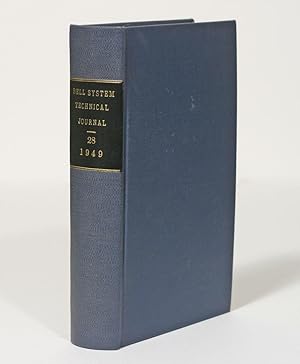
Physical Principles Involved in Transistor Action. WITH: The Theory of p-n Junctions in Semiconductors and p-n Junction Transistors. Et al
Editore: American Telephone and Telegraph Company, New York, 1949
Da: Manhattan Rare Book Company, ABAA, ILAB, New York, NY, U.S.A.
Membro dell'associazione: ABAA ILAB
Valutazione del venditore 5 su 5 stelle
Prima edizione
Hardcover. Condizione: Fine. 1st Edition. FIRST EDITION of two landmark journals documenting the revolutionary invention of the transistor: the April 1949 issue of The Bell System Technical Journal containing the first description of the invention (published simultaneously in The Physical Review), and the famous July 1949 "Semiconductor Issue" dedicated entirely to the discuss of the transistor and semiconductor devices. The entire 1949 volume offered. "In the 1930s, Bell Labs scientists were trying to use ultrahigh frequency waves for telephone communications, and needed a more reliable detection method than the vacuum tube, which proved incapable of picking up rapid vibrations. John Bardeen, Walter Brattain and William Shockley spearheaded the Bell Labs effort to develop a new means of amplification," developing, by 1948, a novel device that would effectively amplify and control electric signals. "At roughly half an inch high, the first transistor was huge by today's standards, when 7 million transistors can fit onto a single silicon chip. But it was the very first solid state device capable of doing the amplification work of a vacuum tube, earning Bardeen, Brattain and Shockley the Nobel Prize in Physics in 1956. More significantly, it spawned an entire industry and ushered in the Information Age, revolutionizing global society" (The American Physical Society). The 1956 Nobel Prize in Physics was awarded jointly to William Shockley, John Bardeen and Walter Brattain "for their researches on semiconductors and their discovery of the transistor effect". Also included is Claude Shannon's Communication Theory of Secrecy Systems (pp. 656-715). BARDEEN, J., and BRATTAIN, W. H. Physical Principles Involved in Transistor Action. In The Bell System Technical Journal, Vol. 28, No. 2, April 1949 (pp. 239-277). WITH: BARDEEN, J., and BRATTAIN, W.H., and SHOCKLEY, W., et al. The Bell System Technical Journal, Vol. 28, No. 3. July, 1949. New York: American Telephone and Telegraph Company, 1949. Octavo, contemporary blue buckram. The whole volume with all the issues for 1949 (753 pages, complete with contents and index). Fine copy.
-
Eigenh. Unterschrift auf Albumblatt.
Editore: ohne Ort und Datum
Da: Kotte Autographs GmbH, Roßhaupten, Germania
Membro dell'associazione: ILAB VDA
Valutazione del venditore 5 su 5 stelle
Manoscritto / Collezionismo cartaceo
EUR 80,00
Spedizione EUR 20,00
Spedito da Germania a U.S.A.Quantità: 1 disponibili
Aggiungi al carrelloQuer-32mo. Er ist der einzige zweifache Preisträger in dieser Kategorie und einer von fünf Menschen, die den Nobelpreis zweimal erhielten.
-
![Immagine del venditore per Recent developments in superconductivity, by J. Bardeen and J. R. Schrieffer. 1960 [LeatherBound] venduto da S N Books World](https://pictures.abebooks.com/inventory/md/md30877522903.jpg)
Recent developments in superconductivity, by J. Bardeen and J. R. Schrieffer. 1960 [LeatherBound]
Lingua: Inglese
Data di pubblicazione: 2025
EUR 34,59
Spedizione gratuita
Spedito da India a U.S.A.Quantità: 18 disponibili
Aggiungi al carrelloLeatherBound. Condizione: NEW. BOOKS ARE EXEMPT FROM IMPORT DUTIES AND TARIFFS; NO EXTRA CHARGES APPLY. Leatherbound edition. Condition: New. Leather Binding on Spine and Corners with Golden leaf printing on spine. Bound in genuine leather with Satin ribbon page markers and Spine with raised gilt bands. Pages: 502. A perfect gift for your loved ones. Reprinted from 1960 edition. NO changes have been made to the original text. This is NOT a retyped or an ocr'd reprint. Illustrations, Index, if any, are included in black and white. Each page is checked manually before printing. As this print on demand book is reprinted from a very old book, there could be some missing or flawed pages, but we always try to make the book as complete as possible. Fold-outs, if any, are not part of the book. If the original book was published in multiple volumes then this reprint is of only one volume, not the whole set. IF YOU WISH TO ORDER PARTICULAR VOLUME OR ALL THE VOLUMES YOU CAN CONTACT US. Resized as per current standards. Sewing binding for longer life, where the book block is actually sewn (smythe sewn/section sewn) with thread before binding which results in a more durable type of binding. Language: English Pages: 502.
-
SURFACE PROPERTIES OF GERMANIUM (contained in one complete issue of The Bell System Technical Journal, January 1953)
Data di pubblicazione: 1953
Da: Xerxes Fine and Rare Books and Documents, Glen Head, NY, U.S.A.
Valutazione del venditore 5 su 5 stelle
Prima edizione
Condizione: Good. NY 1953. first edition. In The Bell System Technical Journal, Volume XXXII, Number 1 January 1953 at pp. 1-41. Whole issue. Bardeen shared Nobel Prize with Shockley and Brattain for the invention of the Transistor in 1956 and won it again in 1972. Good, date stamp on front cover - no other ownership marks; some rubbing and wear on cover and slight slant to spine.
-
The Physical Review. Second Series, Volume 80 Number 4, November 15, 1950
Editore: American Physical Society, 1950
Da: Zubal-Books, Since 1961, Cleveland, OH, U.S.A.
Valutazione del venditore 5 su 5 stelle
Condizione: Very Good. pp. 495-770; softcover, spine has been professionally rebacked, a hand stamps to the title page else text clean & binding tight. - If you are reading this, this item is actually (physically) in our stock and ready for shipment once ordered. We are not bookjackers. Buyer is responsible for any additional duties, taxes, or fees required by recipient's country. Photos available upon request.
-
Tunnelling from a Many-Particle Point of View. - [FROM THE FATHER OF THE TRANSISTOR]
Da: Herman H. J. Lynge & Søn ILAB-ABF, Copenhagen, Danimarca
Membro dell'associazione: ABF ILAB
Valutazione del venditore 5 su 5 stelle
Prima edizione
EUR 130,96
Spedizione EUR 42,00
Spedito da Danimarca a U.S.A.Quantità: 1 disponibili
Aggiungi al carrello(New York), American physical Society, 1961. Lex8vo. Volume 6, No. 2, January 15, 1961 of "Physical Review Letters", entire volume offered. In the original printed blue wrappers. Back wrapper has some scratches and minor sunning. Otherwise a very nice and clean copy externally as well as internally. Pp. 57-9. [Entire issue: Pp. 47-84]. First printing of Bardeen's paper in which he discusses Tunneling from a many-particle point of view after Giaever (see link below), Nicol, Shapiro and Smith observed the tunneling current flowing between two metals separated by a thin oxide layer. In 1956 Bardeen and Brattain shared the Nobel Prize in Physics with William Shockley "for their researches on semiconductors and their discovery of the transistor effect". In 1972 Bardeen again received the Nobel Prize in Physics for his part in the development of the theory of superconductivity (BCS-theory), and thus became the only person, until this day, to receive the Nobel Prize more than once in the same field.
-
DIFFUSION IN BINARY ALLOYS - article in one complete issue of THE PHYSICAL REVIEW , November 1, 1949
Data di pubblicazione: 1949
Da: Xerxes Fine and Rare Books and Documents, Glen Head, NY, U.S.A.
Valutazione del venditore 5 su 5 stelle
Prima edizione
Condizione: Fine. Lancaster, PA. 1949 first edition. American Physical Society. volume 76 second series number 9. 4to green wraps. issue paginated 1275-1422. Bardeen article pp. 1403-1405. Fine. no wear, no owner marks. Binding secure; text clean. Bardeen was awarded the Nobel Prize in both 1956 and in 1972 for his work in superconductivity and development of the transistor.
-

Originalphotographie mit eigenh. U.
Editore: O. O. u. D.
Da: Kotte Autographs GmbH, Roßhaupten, Germania
Membro dell'associazione: ILAB VDA
Valutazione del venditore 5 su 5 stelle
Manoscritto / Collezionismo cartaceo
EUR 180,00
Spedizione EUR 20,00
Spedito da Germania a U.S.A.Quantità: 1 disponibili
Aggiungi al carrello147:105 mm. Portrait en face in S/W bei einem Nobelpreis-Treffen in Lindau (so auf einer beiliegenden Beschreibung vermerkt). John Bardeen ist neben Frederick Sanger der einzige Nobelpreisträger, der bislang zweimal in ein und derselben Disziplin ausgezeichnet wurde: 1956 wurde er zusammen mit William B. Shockley und Walter H. Brattain mit dem Physiknobelpreis ausgezeichnet für ihre Untersuchungen über Halbleiter und ihre Entdeckung des Transistoreffekts"; 1972 erhielt er zusammen mit Leon Neil Cooper und John Robert Schrieffer einen halben Nobelpreis für ihre gemeinsam entwickelte Theorie des Supraleitungsphänomens, auch BCS-Theorie (Bardeen-Cooper-Schrieffer Theorie) genannt"; die andere Hälfte war an Dennis Gábor für seine Erfindung und Entwicklung der holographischen Methode" ergangen.