

Importo totale (1 articolo articoli):
Destinazione ordine:

ben luzzatto (8 risultati)
Vai alla pagina principale dei risultati di ricerca
Filtri di ricerca
Tipo di articolo
- Tutti i tipi di prodotto
- Libri (8)
- Riviste e Giornali (Nessun altro risultato corrispondente a questo perfezionamento)
- Fumetti (Nessun altro risultato corrispondente a questo perfezionamento)
- Spartiti (Nessun altro risultato corrispondente a questo perfezionamento)
- Arte, Stampe e Poster (Nessun altro risultato corrispondente a questo perfezionamento)
- Fotografie (Nessun altro risultato corrispondente a questo perfezionamento)
- Mappe (Nessun altro risultato corrispondente a questo perfezionamento)
- Manoscritti e Collezionismo cartaceo (Nessun altro risultato corrispondente a questo perfezionamento)
Condizioni Maggiori informazioni
- Nuovo (3)
- Come nuovo, Ottimo o Quasi ottimo (Nessun altro risultato corrispondente a questo perfezionamento)
- Molto buono o Buono (5)
- Discreto o Mediocre (Nessun altro risultato corrispondente a questo perfezionamento)
- Come descritto (Nessun altro risultato corrispondente a questo perfezionamento)
Legatura
Ulteriori caratteristiche
- Prima ed. (1)
- Copia autograf. (Nessun altro risultato corrispondente a questo perfezionamento)
- Sovracoperta (Nessun altro risultato corrispondente a questo perfezionamento)
- Con foto (6)
- Non Print on Demand (6)
Lingua (4)
Spedizione gratuita
Paese del venditore
Valutazione venditore
-

The Theory of Everything: Abridged
Lingua: Inglese
Editore: Ugly Duckling Presse (edition y First printing), 2010
ISBN 10: 1933254483 ISBN 13: 9781933254487
Da: BooksRun, Philadelphia, PA, U.S.A.
Valutazione del venditore 5 su 5 stelle

Perfect Paperback. Condizione: Very Good. y First printing. It's a well-cared-for item that has seen limited use. The item may show minor signs of wear. All the text is legible, with all pages included. It may have slight markings and/or highlighting.
-

Mesilat Yesharim im biur Torat Yichud Hahatava [Messilat Yecharim]
Lingua: Ebraico
Editore: Kehilat Haramhal, 2009
EUR 37,00
Spedizione EUR 30,00
Spedito da Francia a U.S.A.Quantità: 1 disponibili
Aggiungi al carrelloHardback. Condizione: New. Hebrew only. Multiple copies of our books may be available on prior request. Please enquire if interested. // En hébreu. De multiples exemplaires peuvent être disponibles sur demande préalable.
-
Sefer Netivot Hashalom SEFER DVARIM [ONLY] [Book of Deuteronomy only] vehu khibur kolel khamisha khumshey Tora im targum ashkenazi ubeur me'et hakhakham hamefursam moreynu verabeinu harav rabbi Moshe ben Menachem meDessau venitvasef bo Targum Unkelos veperush Rashi venilve eilehem tosefet beur hanikra beshem hamishtadel mehakhakham hamefursam moreinu harav Shmuel David Luzzatto vehanikra beshem Botzer Olelot me'et ha'akhim Yosef veShimeon beney hagaon hamanoakh moreinu harav Meir Santa z.l. vehanikra beshem Hakorem mehakhakham hamefursam moreynu harav Herz Hamberg
Lingua: Ebraico
Editore: Franz Edlem von Schmid und I. I. Busch, Wien, Vienna, 1846
Hardcover. Condizione: Very Good. Hebrew (vowelized) in large font. Commentary on bottom (Rashi script for Rashi and for the Beur, vowelized Hebrew for Unkelos. There is also a Yiddish-German translation on every page, in Rashi script. Facing the title page is a full page frontispiece depicting various vignettes from the Bible. Very attractive brown full leather binding, probably the original one, with a leather label on spine with the word in Hebrew DVARIM [= Deuteronomy]. There is a second label, green, with the number 5, indicating that this is the fifth of the five books of Moses. Spine has some gilt decorations. 280, 20, 7 leaves. Traces of blue color on for edge. Front blank free endpaper has a purple ink stamped impression by former owner: BERNHARD TURK. BRATISLAVA Preysz Christofgasse 21. Lacks rear blank endpaper. There was a "Bernhard Turk" in Bratislava who escorted ten Jewish children from Bratislava to Prague to join the Kindertransport. Those children's lives were thus saved. This Bernhard Turk, or an ancestor of his, may have been at one time the owner of this 180 year old book. Yad Vashem has the following information about Bernhard Turk: "Bernhard Turk was born in Dunajska Streda, Czechoslovakia in 1887. Was a clerk. During the war was in Bratislava, Czechoslovakia. Deported with Transport from Bratislava, Slovakia, Czechoslovakia to Auschwitz Birkena Extermination Camp, Poland on 19/08/1942." Bernhard was murdered in the Shoah (according to this source). This information is based on a Deportation list, found in Slovakia Holocaust Jewish Names Project, Commenius University of Bratislava, Dept. of History, Bratislava.
-
Discorso circa il stato de gl'Hebrei : et in particolar dimoranti nell'inclita Città di Venetia / di Simone Luzzatto, rabbino Hebreo, et è un'appendice al trattato dell'openioni e dogmi de gl'Hebrei dall'uniersal non dissonanti, e de riti loro più principali [= Discourse on the State of the Jews and in particular]
Lingua: Italiano
Editore: Appresso Gioanne Calleone, 1638
Prima edizione
Hardcover. Condizione: Very Good. 1st Edition. In Italian, with a few lines of Latin that Luzzatto translated from Hebrew biblical passages. 92 leaves. 202 x 140 mm. The book is dedicated to the Doge and his counsellors and it contains 18 considerations on Jewish life, praising the Jews' contributions to economic life and also touches on culture, religion and the struggle against anti-Semitism. Luzzatto presents secular arguments in favor of Christian tolerance towards Jews and points out that the presence of Jews is beneficial to the economy of the country. Together with Menasseh Ben Israel's similar plea for tolerance, this work was an important step in the evolution of Jewish-Christian relations. Jews are beginning to defend themselves not against traditional Christian intolerance and religious prejudices, but against a secular and economically motivated anti-Semitism. Luzzatto states that Venice can halt its political decline by offering the Jews a monopoly on overseas commercial activity. This plan would work because the Jews are "well-suited for trade" because trade and moneylending are the only occupations that Christians permit them to pursue. The Jews developed relationships with partners in the Eastern Mediterranean, and their talent could help the Venetian government recover its political importance as an intermediary between East and West. Luzzatto was the first to define the role of the Jews on the basis of their economic and social functions. He further pleads in defense of the Venetian Jews, arguing against collective punishment. He states that it's contrary to divine and human law to punish a community for a crime of an individual. The Discorso has been seen as an apologia for the Jewish community of Venice. Luzzatto may have been prompted to compose a plea for recognition of the status of the Jews of Venice because in 1636 a portion of merchandise stolen from the main shopping thoroughfare of Venice, the "Merceria," was found in the Ghetto. Since a number of Christian noblemen were involved in the matter, it became a major affair, with political repercussions. For a time, the Jews were in danger of being expelled from Venice, and a number of them were, in fact, banished. To uncover the truth and bring about a reconciliation between the Jews and the Venetian government, a committee of inquiry was appointed, including three delegates from the Ghetto: Shmuel Meldola of Verona, Simone Luzzatto, and Israel Conigliano, a close friend of the minister Ser Marco Giustiniano. Establishing a link between the composition of the Discorso and the scandal of 1636 is difficult because the treatise may have circulated in the community before its publication in 1638. It seems that the book was comprised of different parts, one of which was used as an apologia for the Jews in Venice. The Discorso was probably composed for the court proceedings. The manuscript consists of a section which serves as the core of the document and then several "appendices" which formed the "considerations" of the Discorso. Based on recently found manuscripts, it seems that the first version of the Discorso was written for a speci?c purpose, and later, when Luzzatto decided to publish it, he added the necessary rhetorical ornamenta, taking them from the classic tradition. Simone Luzzatto lived his entire life in Venice, served as rabbi for over fifty years. Together with Leone Modena, he was a spiritual guide of the Ghetto of Venice. He lived in relative wealth, starting to publish his responsa as a young man. In 1618 he collected, at the request of the Jewish community of Padua, a substantial sum of money to be sent to charity in Jerusalem and Thessaloniki, also contributing to the ransom of several Jews who were enslaved. In 1631 he was one of the founders (later director) of the Ashkenazi school. After the death of Modena in 1648 he became president of the assembly of the rabbis of the city, helping to favor the integration of the Jewish community within the Venetian society of the time.
-
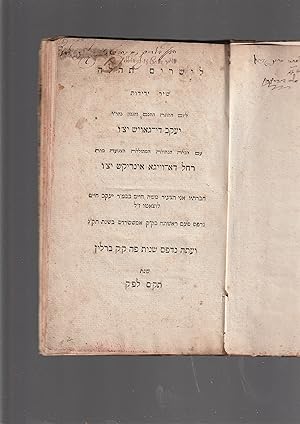
La-yeshrim tehillah: shir yedidut le-yom hatunat hakhakham vehanavon kevod harav Rabbi Ya'akov Di-Gavis, yishmerehu tsuro vegoalo, im ha-kalah habetula, hamehulelet, hatsnu'a, marat Rachel Da-Vega Enriqes
Lingua: Ebraico
Editore: [Press: Y. Satanov], Berlin, 1780
Hardcover. Condizione: Very Good. No Jacket. 2nd Edition. In Hebrew. 84 pages (10 signatures of 4 leaves, 11th signature is of 2) 225 x 133 mm. Libraries worldwide that own item: 5. Vinograd Berlin 306. StCB 6511,3. Moshe Chaim Luzzatto (also Moses Chaim, Moses Hayyim, also Luzzato) (1707-1746 (26 Iyar 5506)), also known by the Hebrew acronym RaMCHaL (RaMHaL), was a prominent Italian Jewish rabbi, kabbalist, and philosopher. Born in Padua, he received classical Jewish and Italian educations, showing a predilection for literature at a very early age. He may have attended the University of Padua and certainly associated with a group of students there, known to dabble in mysticism and alchemy. With his vast knowledge in religious lore, the arts, and science, he quickly became the dominant figure in that group. His writings demonstrate mastery of the Tanakh, the Talmud, and the rabbinical commentaries and codes of Jewish law. The turning point in Luzzatto's life came at the age of twenty, when he received direct instruction from a mystical being known as the maggid. While such stories were not unknown in kabbalistic circles, it was unheard of for someone of such a young age. His peers were enthralled by his written accounts of these "Divine lessons", but the leading Italian rabbinical authorities were highly suspicious and threatened to excommunicate him. Just one hundred years earlier another young mystic, Shabbatai Zvi (d.1676), had rocked the Jewish world by claiming to be the Messiah. Although, at one point, Zvi had convinced many European and Middle Eastern rabbis of his claim, the episode ended with him recanting and converting to Islam. The global Jewish community was still reeling from that, and the similarities between Luzzatto's writings and Zvi's were perceived as being particularly dangerous and heretical. These writings, only some of which have survived, are often misunderstood to describe a belief that the Ramchal and his followers were key figures in a messianic drama that was about to take place. He identified one of his followers as the Messiah son of David, but assumed for himself the role of Moses, claiming that he was that biblical figure's reincarnation. After threats of excommunication and many arguments, Luzzatto finally came to an understanding with many of the Rabbanim, including his decision not to write the maggid's lessons or teach mysticism. In 1735, Luzzatto left Italy for Amsterdam, believing that in the more liberal environment there, he would be able to pursue his mystical interests. Passing through Germany, he appealed to the local rabbinical authorities to protect him from the threats of the Italian rabbis. They refused and forced him to sign a document stating that all the teachings of the maggid were false. Most of his writings were burned, though some did survive. From the Zoharic writings, the 70 Tikounim `Hadashim re-appeared in 1958 against all odds, in the Library of Oxford. "Arrangements" of thoughts, these Tikounim expose 70 different essential uses of the last verse of the Humash (the five books of Moses). Taught word-by-word in Aramit by the maggid of the Ram`hal, they parallel the Tikouney haZohar of the Rashbi, which expose the 70 fundamental understandings of the first verse of the `Houmash. When Luzzatto finally reached Amsterdam, he was able to pursue his studies of the kabbalah relatively unhindered. Earning a living as a diamond cutter, he continued writing but refused to teach. One major rabbinic contemporary who praised Luzzatto's writing was Rabbi Eliyahu of Vilna, the Vilna Gaon (1720-1797), who was considered to be the most authoritative Torah sage of the modern era as well as a great kabbalist himself. He was reputed to have said after reading the Mesillat Yesharim, that were Luzzatto still alive, that he would have walked from Vilna to learn at Luzzatto's feet; Vilna is 2,000 km from Italy.
-
KOL SHAKHAL : Shiri Hashirim [= Sound (Not "roar" which is "sha'aga") of a Lion : My song of songs]
Lingua: Ebraico
Editore: [publisher not identified], Place of publication is listed as Ismir [Turkey] but was really Berlin, 1790
Hardcover. Condizione: Good. In Hebrew. 55 pages. 164 x 92 mm. Libraries worldwide that own item: 3 (Pennsylvania'; Ntil Lib IL; Tel Aviv) Mis-paginated. Penultimate leaf is marked Lamed Dalet, (=34), which apparently led Vinograd to wrote that there are 68 pages. In fact there are only 28 leaves in this edition. Vinograd Izmir number 90. Berlin 937. Beit Eked correctly states this is a variant of Ele Benei Neurim (published in London in 1766). The 1766 London edition does have at least some of the same poems.
-
![Immagine del venditore per Sefer Kawwanot ha-aggadot niqra Kaftor u-ferah 1580 [LeatherBound] venduto da True World of Books](https://pictures.abebooks.com/inventory/md/md31617366445.jpg)
Sefer Kawwanot ha-aggadot niqra Kaftor u-ferah 1580 [LeatherBound]
Data di pubblicazione: 2025
EUR 28,37
Spedizione gratuita
Spedito da India a U.S.A.Quantità: 18 disponibili
Aggiungi al carrelloLeatherBound. Condizione: New. BOOKS ARE EXEMPT FROM IMPORT DUTIES AND TARIFFS; NO EXTRA CHARGES APPLY. LeatherBound edition. Condition: New. Reprinted from 1580 edition. Leather Binding on Spine and Corners with Golden leaf printing on spine. Bound in genuine leather with Satin ribbon page markers and Spine with raised gilt bands. A perfect gift for your loved ones. Pages: 357 NO changes have been made to the original text. This is NOT a retyped or an ocr'd reprint. Illustrations, Index, if any, are included in black and white. Each page is checked manually before printing. As this print on demand book is reprinted from a very old book, there could be some missing or flawed pages, but we always try to make the book as complete as possible. Fold-outs, if any, are not part of the book. If the original book was published in multiple volumes then this reprint is of only one volume, not the whole set. Sewing binding for longer life, where the book block is actually sewn (smythe sewn/section sewn) with thread before binding which results in a more durable type of binding. Pages: 357.
-
![Immagine del venditore per Sefer Kawwanot ha-aggadot : nikra Kaftor u-ferah (1580 = 341 [jud. Zeit]) [Leather Bound] venduto da True World of Books](https://pictures.abebooks.com/inventory/md/md31619089248.jpg)
Sefer Kawwanot ha-aggadot : nikra Kaftor u-ferah (1580 = 341 [jud. Zeit]) [Leather Bound]
Data di pubblicazione: 2025
EUR 33,70
Spedizione gratuita
Spedito da India a U.S.A.Quantità: 18 disponibili
Aggiungi al carrelloLeatherBound. Condizione: NEW. LeatherBound edition. Condition: New. Reprinted from 1580 = 341 [jüd. Zeit] edition. Leather Binding on Spine and Corners with Golden leaf printing on spine. Bound in genuine leather with Satin ribbon page markers and Spine with raised gilt bands. A perfect gift for your loved ones. NO changes have been made to the original text. This is NOT a retyped or an ocr'd reprint. Illustrations, Index, if any, are included in black and white. Each page is checked manually before printing. As this print on demand book is reprinted from a very old book, there could be some missing or flawed pages, but we always try to make the book as complete as possible. Fold-outs, if any, are not part of the book. If the original book was published in multiple volumes then this reprint is of only one volume, not the whole set. Sewing binding for longer life, where the book block is actually sewn (smythe sewn/section sewn) with thread before binding which results in a more durable type of binding. Pages: 348.


![Immagine del venditore per Sefer Netivot Hashalom SEFER DVARIM [ONLY] [Book of Deuteronomy only] vehu khibur kolel khamisha khumshey Tora im targum ashkenazi ubeur me'et hakhakham hamefursam moreynu verabeinu harav rabbi Moshe ben Menachem meDessau venitvasef bo Targum Unkelos veperush Rashi venilve eilehem tosefet beur hanikra beshem hamishtadel mehakhakham hamefursam moreinu harav Shmuel David Luzzatto vehanikra beshem Botzer Olelot me'et ha'akhim Yosef veShimeon beney hagaon hamanoakh moreinu harav Meir Santa z.l. vehanikra beshem Hakorem mehakhakham hamefursam moreynu harav Herz Hamberg venduto da Meir Turner](https://pictures.abebooks.com/inventory/md/md5898257043.jpg)
![Immagine del venditore per Discorso circa il stato de gl'Hebrei : et in particolar dimoranti nell'inclita Città di Venetia / di Simone Luzzatto, rabbino Hebreo, et è un'appendice al trattato dell'openioni e dogmi de gl'Hebrei dall'uniersal non dissonanti, e de riti loro più principali [= Discourse on the State of the Jews and in particular] venduto da Meir Turner](https://pictures.abebooks.com/inventory/md/md31113094452.jpg)
![Immagine del venditore per KOL SHAKHAL : Shiri Hashirim [= Sound (Not "roar" which is "sha'aga") of a Lion : My song of songs] venduto da Meir Turner](https://pictures.abebooks.com/inventory/md/md30404319995.jpg)