

Importo totale (1 articolo articoli):
Destinazione ordine:

bernadette coleman (10 risultati)
Vai alla pagina principale dei risultati di ricerca
Filtri di ricerca
Tipo di articolo
- Tutti i tipi di prodotto
- Libri (10)
- Riviste e Giornali (Nessun altro risultato corrispondente a questo perfezionamento)
- Fumetti (Nessun altro risultato corrispondente a questo perfezionamento)
- Spartiti (Nessun altro risultato corrispondente a questo perfezionamento)
- Arte, Stampe e Poster (Nessun altro risultato corrispondente a questo perfezionamento)
- Fotografie (Nessun altro risultato corrispondente a questo perfezionamento)
- Mappe (Nessun altro risultato corrispondente a questo perfezionamento)
- Manoscritti e Collezionismo cartaceo (Nessun altro risultato corrispondente a questo perfezionamento)
Condizioni Maggiori informazioni
- Nuovo (1)
- Come nuovo, Ottimo o Quasi ottimo (1)
- Molto buono o Buono (8)
- Discreto o Mediocre (Nessun altro risultato corrispondente a questo perfezionamento)
- Come descritto (Nessun altro risultato corrispondente a questo perfezionamento)
Legatura
- Tutte
- Rilegato (Nessun altro risultato corrispondente a questo perfezionamento)
- Brossura (10)
Ulteriori caratteristiche
- Prima ed. (Nessun altro risultato corrispondente a questo perfezionamento)
- Copia autograf. (Nessun altro risultato corrispondente a questo perfezionamento)
- Sovracoperta (Nessun altro risultato corrispondente a questo perfezionamento)
- Con foto (1)
- Non Print on Demand (10)
Lingua (2)
Spedizione gratuita
- Spedizione gratuita in U.S.A. (Nessun altro risultato corrispondente a questo perfezionamento)
Paese del venditore
Valutazione venditore
-

Beyond Mind, Beyond Death
Da: The Oregon Room - Well described books!, Phoenix, OR, U.S.A.
Valutazione del venditore 5 su 5 stelle

paperback. Condizione: Very Good. VG+, 2009 1st softbound edition, tight binding, very light wear, no markings found, not a remainder.
-
Beyond Mind, Beyond Death
Da: Archives Books, Inc., Edmond, OK, U.S.A.
Valutazione del venditore 5 su 5 stelle
paperback. Condizione: Good. Crease on cover. No markings. Historic Oklahoma Bookstore on Route 66. Packages shipped daily, Mon-Friday.
-

Reporter's Space Flight Notepad. July 2011. STS-135. ISS-ULF7.
Editore: Boeing Communications, 2011
Da: Riverby Books, Fredericksburg, VA, U.S.A.
Valutazione del venditore 5 su 5 stelle
Soft cover. Condizione: Very Good. Spiral bound softcover. Illustration covers with white and black lettering. Divided into six sections, each individually paginated. Approximately 200 pages, with maybe 100 pages of blank loose-leaf paper for notes. In very good condition. Covers are clean and unmarked. Binding is strong. Pages are free of marks or tears. A very good, clean copy.
-
Reporter's Space Flight Notepad. November 2010. STS-133. ISS-ULF5.
Editore: Boeing Communications, 2010
Da: Riverby Books, Fredericksburg, VA, U.S.A.
Valutazione del venditore 5 su 5 stelle
Soft cover. Condizione: Very Good. Spiral bound softcover. Measures 3.5 x 9 inches. Illustrated covers with white lettering. Front cover dated November 2010. Divided into six sections, each individually paginated. Approximately 200 pages, with maybe 100 pages of blank loose-leaf paper for notes. In very good condition. Covers are clean and unmarked. Binding is strong. Pages are free of marks or tears. A very good, clean copy.
-
Beyond Mind, Beyond Death
Da: Revaluation Books, Exeter, Regno Unito
Valutazione del venditore 5 su 5 stelle
EUR 26,67
Spedizione EUR 11,58
Spedito da Regno Unito a U.S.A.Quantità: 1 disponibili
Aggiungi al carrelloPaperback. Condizione: Brand New. 292 pages. 8.90x6.00x0.80 inches. In Stock.
-

Dictionary of Australasian Signs for Communication with the Deaf
Lingua: Inglese
Editore: Victorian School for Deaf Children, Melbourne, VIC, 1982
ISBN 10: 0959883630 ISBN 13: 9780959883633
Da: A Small Bookshop, ELMHURST, VIC, Australia
Valutazione del venditore 5 su 5 stelle
EUR 37,62
Spedizione EUR 25,92
Spedito da Australia a U.S.A.Quantità: 1 disponibili
Aggiungi al carrelloLaminated Pictorial Card Cover. Condizione: Near Fine. Revised Edition. Prepared by members of the Australasian Sign Development Project. B&W illustrations throughout. Large Format Paperback. 30 x 21 cm. 270 pp.
-
STS-129 ISS-ULF3; Reporter's Space Flight Notepad
Editore: Boeing Communications, Creative Services, Huntington Beach, CA, 2009
Da: Ground Zero Books, Ltd., Silver Spring, MD, U.S.A.
Valutazione del venditore 5 su 5 stelle
Spiral bound. Condizione: Very good. Reginald Morris and Paul Bruinsma (illustratore). Rev. 10-09. The format is approximately 3.5 inches by 8.5 inches. Various paginations. Illustrations (many in color). Sections are NASA's Constellation Program (8 pages), Building the Future of Flight Together (1, [1] pages), Boeing and the Space Shuttle (15, [3] pages), Boeing and the International Space Station ( 75, [1] pages), Space Shuttle Mission Facts (118 pages) , and Upcoming Space Shuttle Missions (1, [1] pages). There is an unpaginated section of note pages but no notes are present. STS-129 (ISS assembly flight ULF3) was a NASA Space Shuttle mission to the International Space Station (ISS). Atlantis was launched on November 16, 2009, at 14:28 EST, and landed at 09:44 EST on November 27, 2009, on runway 33 at the Kennedy Space Center's Shuttle Landing Facility. It was also the last Shuttle mission of the 2000s. STS-129 focused on staging spare components outside the station. The 11-day flight included three spacewalks. The payload bay carried two large ExPRESS Logistics Carriers holding two spare gyroscopes, two nitrogen tank assemblies, two pump modules, an ammonia tank assembly, a spare latching end effector for the station's robotic arm, a spare trailing umbilical system for the Mobile Transporter, and a high-pressure gas tank. STS-129 was the first flight of an ExPRESS Logistics Carrier. The completion of this mission left six Space Shuttle flights remaining until the end of the Space Shuttle program, after STS-135 was approved in February 2011. STS-129 was the final Space Shuttle crew rotation flight to or from the ISS. The payload bay of STS-129 (ISS ULF-3 ELC-1 ELC-2) carried two large ExPRESS Logistics Carriers holding two spare gyroscopes, two nitrogen tank assemblies, two pump modules, an ammonia tank assembly, a spare latching end effector for the station's robotic arm, a spare trailing umbilical system for the Mobile Transporter, and a high-pressure gas tank. STS-129 was the first flight of an ExPRESS Logistics Carrier. While docked to the station, Atlantis' crew conducted three spacewalks to transfer the spare parts from the shuttle's payload bay to the station's external structures and continue assembly activities. At the end of the 11-day flight, Atlantis also brought home Expedition 20 and 21 Flight Engineer Nicole Stott, the final astronaut to use a space shuttle for a lift to or from the station. The ExPRESS Logistics Carrier (ELC) is a platform designed to support external payloads mounted to the International Space Station (ISS) starboard and port trusses with either deep space or Earth-ward views. Each pallet spans the entire width of the shuttle's payload bay, carries science experiments, and serves as a parking place for spare hardware that can be replaced robotically once on-orbit. STS-129/ULF3 will mark the first flight of ELC 1 and 2. Because of their expertise in building the Hubble Space Telescope (HST) cargo carriers, NASA Goddard Space Center served as the overall integrator and manufacturer for ELC 1 and 2. The ELC is designed to be carried in the space shuttle cargo bay to the ISS, fully integrated with cargo and/or payloads. Four ELCs were delivered to ISS before the scheduled retirement of the space shuttle. Two ELCs are attached to the starboard truss 3 (S3) and two ELCs are attached to the port truss 3 (P3). By attaching at the S3/P3 sites, a variety of views such as zenith (deep space) or nadir (Earthward) direction with a combination of ram (forward) or wake (aft) pointing allows for many possible viewing opportunities. The mass capacity for an ELC is 9,800 pounds with a volume of 98 feet cubed. The ISS provides power to the ELCs through two 3 Kilowatt (kW), 120 Volts direct current (V dc) feeds at the ISS to ELC interface. The ELC power distribution module converts the 120 V dc power to 120 V dc and 28 V dc. Both power voltages are provided to each payload attached site by separated buses. 120 V dc power is also provided to the other cargo attached site. A total of 14 large Orbital Replacem.
-
STS-132 ISS-ULF4; Reporter's Space Flight Notepad
Editore: Boeing Communications, Creative Services, Huntington Beach, CA, 2010
Da: Ground Zero Books, Ltd., Silver Spring, MD, U.S.A.
Valutazione del venditore 5 su 5 stelle
Spiral bound. Condizione: Very good. Reginald Morris (illustratore). Rev 5-10. The format is approximately 3.5 inches by 8.5 inches. Various paginations. Illustrations (many in color). Sections are Building the Future of Flight Together (1, [1] pages), Boeing and the Space Shuttle (18 pages),The Space Shuttle Orbiters (32,[2] pages) History of OV-104 - Atlantis, (4, [2] pages, Boeing and the International Space Station ( 88 pages), Space Shuttle Mission Facts (123 pages), and Upcoming Space Shuttle Missions (1, [1] pages). There is an unpaginated section of note pages but no notes are present. STS-132 (ISS assembly flight ULF4) was a NASA Space Shuttle mission, during which Space Shuttle Atlantis docked with the International Space Station on May 16, 2010. STS-132 was launched from the Kennedy Space Center on May 14, 2010. The primary payload was the Russian Rassvet Mini-Research Module, along with an Integrated Cargo Carrier-Vertical Light Deployable (ICC-VLD). Atlantis landed at the Kennedy Space Center on May 26, 2010. STS-132 was initially scheduled to be the final flight of Atlantis, provided that the STS-335/STS-135 Launch On Need rescue mission would not be needed. However, in February 2011, NASA declared that the final mission of Atlantis and of the Space Shuttle program, STS-135, would be flown regardless of the funding situation. Space shuttle Atlantis launched on its final planned mission to deliver an Integrated Cargo Carrier and the Russian-built Mini-Research Module-1 (MRM1) to the International Space Station. The 19.7-foot Russian module was installed on the Earth-facing port of the station's Zarya module. Known as Rassvet, Russian for "dawn," MRM1 provides cargo storage and an additional docking port to the station. STS-132 spacewalkers installed a spare antenna, replaced batteries on the P6 truss and retrieved a power data grapple fixture. First launched in October 1985, Atlantis flew five military missions, made seven flights to the Russian Mir space station and 11 to the International Space Station. It launched two planetary probes - Magellan to Venus and Galileo to Jupiter - deployed the Compton Gamma Ray Observatory and visited the Hubble Space Telescope. The International Space Station (ISS) is the largest modular space station in low Earth orbit. The project involves five space agencies: the United States' NASA, Russia's Roscosmos, Japan's JAXA, Europe's ESA, and Canada's CSA. The ownership and use of the space station is established by intergovernmental treaties and agreements. The station serves as a microgravity and space environment research laboratory in which scientific research is conducted in astrobiology, astronomy, meteorology, physics, and other fields. The ISS is suited for testing the spacecraft systems and equipment required for possible future long-duration missions to the Moon and Mars.
-
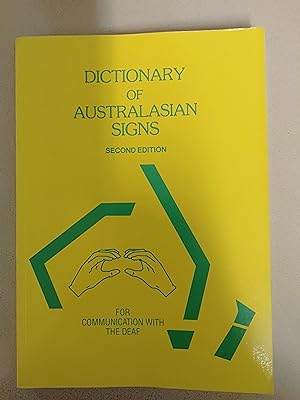
Dictionary of Australian Signs For Communication With The Deaf - Second Edition
Editore: Victorian School for Deaf Children, 1991
ISBN 10: 0959883657 ISBN 13: 9780959883657
Da: Rons Bookshop (Canberra, Australia), Canberra, ACT, Australia
Valutazione del venditore 5 su 5 stelle
EUR 35,60
Spedizione EUR 31,97
Spedito da Australia a U.S.A.Quantità: 1 disponibili
Aggiungi al carrelloSoft cover. Condizione: Very Good. 2nd Edition. Size 300mmX210mm. Since the publication of the first edition a group of interested deaf and hearing people from throughout Australia, has continued to meet to expand the number of signs for use as Signed English. The original criteria for sign selection has remained the same. As a result an additional 590 signs appear in this edition. This new volume of some 2,200 signs incorporates most of those in "Aid to Communication with the Deaf". Signs from other existing sources such as "Let's Talk with our Hands" (Sydney, 1976) and "Word for Word" (Sydney, 1976) have also been included. **The book has some shelf staining while the covers have light rubbing.**.
-
STS-135 ISS-ULF7; Reporter's Space Flight Notepad
Editore: Boeing Communications, Creative Services, Huntington Beach, CA, 2011
Da: Ground Zero Books, Ltd., Silver Spring, MD, U.S.A.
Valutazione del venditore 5 su 5 stelle
Spiral bound. Condizione: Very good. Reginald Morris (illustratore). Rev 7-11. The format is approximately 3.5 inches by 8.5 inches. Various paginations. Illustrations (many in color). Sections are Building the Future of Flight Together (1, [1] pages), Boeing and the Space Shuttle (18 pages),The Space Shuttle Orbiters (32, [2] pages) Boeing and the International Space Station (101, [1] pages), Space Shuttle Mission Facts (112 pages), and Upcoming Space Shuttle Missions (1, [1] pages). There is an unpaginated section of note pages but no notes are present. STS-135 (ISS assembly flight ULF7) was the 135th and final mission of the American Space Shuttle program. It used the orbiter Atlantis and hardware originally processed for the STS-335 contingency mission, which was not flown. STS-135 launched on July 8, 2011, and landed on July 21, 2011, following a one-day mission extension. The four-person crew was the smallest of any shuttle mission since STS-6 in April 1983. The mission's primary cargo was the Multi-Purpose Logistics Module (MPLM) Raffaello and a Lightweight Multi-Purpose Carrier (LMC), which were delivered to the International Space Station (ISS). The flight of Raffaello marked the only time that Atlantis carried an MPLM. On January 20, 2011, program managers changed STS-335 to STS-135 on the flight manifest. This allowed for training and other mission specific preparations. On February 13, 2011, program managers told their workforce that STS-135 would fly regardless of the funding situation via a continuing resolution. Until this point, there had been no official references to the STS-135 mission in NASA documentation for the general public. Space shuttle Atlantis, on the final spaceflight of the Space Shuttle Program, carried the Raffaello multipurpose logistics module to deliver supplies, logistics and spare parts to the International Space Station. The mission also flew a system to investigate the potential for robotically refueling existing spacecraft and returned a failed ammonia pump module to help NASA better understand the failure mechanism and improve pump designs for future systems. The STS-135 (ISS ULF-7 MPLM Raffaello) mission's primary cargo was the Multi-Purpose Logistics Module (MPLM) Raffaello and a Lightweight Multi-Purpose Carrier (LMC), which were delivered to the International Space Station (ISS). The flight of Raffaello marked the only time that Atlantis carried an MPLM. The module was filled with supplies and spare parts to sustain station operations once the shuttles are retired, transport of the Robotic Refueling Mission (RRM), an experiment designed to demonstrate and test the tools, technologies and techniques needed to robotically refuel satellites in space, even satellites not designed to be serviced. Among the objectives was the returning of an ammonia pump that recently failed on the station. Engineers want to understand why the pump failed and improve designs for future spacecraft. This was the final flight for shuttle Atlantis and the Space Shuttle Program. The Raffaello Multi-Purpose Logistics Module (MPLM) was one of three differently named large, reusable pressurized elements, carried in the space shuttle's cargo bay, used to ferry cargo back and forth to the station. Raffaello includes components that provide life support, fire detection and suppression, electrical distribution and computers when it is attached to the station. The cylindrical logistics module acts as a pressurized "moving van" for the Space Station, carrying cargo, experiments and supplies for delivery to support the six-person crew on board the station. The module also returned spent Orbital Replacement Units (ORUs) and components. Each MPLM module was 21 feet long and 15 feet in diameter - the same size as the European Space Agency's (ESA's) Columbus module. STS-135 was the last of seven missions for the workhorse LMC carriers. The LMCs were developed for use by station from existing Space Shuttle Multi-Purpose Equipment Support Structure, MPESS, hardware to carry Launch-On-Need, LON, and Orb.

