Importo totale (1 articolo articoli):
Destinazione ordine:

beverwijck jan (6 risultati)
Vai alla pagina principale dei risultati di ricerca
Filtri di ricerca
Tipo di articolo
- Tutti i tipi di prodotto
- Libri (6)
- Riviste e Giornali (Nessun altro risultato corrispondente a questo perfezionamento)
- Fumetti (Nessun altro risultato corrispondente a questo perfezionamento)
- Spartiti (Nessun altro risultato corrispondente a questo perfezionamento)
- Arte, Stampe e Poster (Nessun altro risultato corrispondente a questo perfezionamento)
- Fotografie (Nessun altro risultato corrispondente a questo perfezionamento)
- Mappe (Nessun altro risultato corrispondente a questo perfezionamento)
- Manoscritti e Collezionismo cartaceo (Nessun altro risultato corrispondente a questo perfezionamento)
Condizioni Maggiori informazioni
- Nuovo (2)
- Come nuovo, Ottimo o Quasi ottimo (Nessun altro risultato corrispondente a questo perfezionamento)
- Molto buono o Buono (Nessun altro risultato corrispondente a questo perfezionamento)
- Discreto o Mediocre (Nessun altro risultato corrispondente a questo perfezionamento)
- Come descritto (4)
Legatura
- Tutte
- Rilegato (3)
- Brossura (Nessun altro risultato corrispondente a questo perfezionamento)
Ulteriori caratteristiche
- Prima ed. (3)
- Copia autograf. (Nessun altro risultato corrispondente a questo perfezionamento)
- Sovracoperta (Nessun altro risultato corrispondente a questo perfezionamento)
- Con foto (6)
- Non Print on Demand (4)
Lingua (1)
Prezzo
- Qualsiasi prezzo
- Inferiore a EUR 20 (Nessun altro risultato corrispondente a questo perfezionamento)
- EUR 20 a EUR 45
- Superiore a EUR 45
Spedizione gratuita
Paese del venditore
Valutazione venditore
-
Exercitatio in Hippocratis aphorismum de calculo ad N.V. Claudium Salmasium Equitem et Cons. Regium. Accedunt eiusdem argumenti doctorum epistolæ
Editore: Lugduni Batavorum, (Leiden) ex officina Elseviriorum, 1641,, 1641
Da: Harteveld Rare Books Ltd., Marly, Svizzera
Membro dell'associazione: ILAB VEBUKU
Valutazione del venditore 4 su 5 stelle

Prima edizione
EUR 256,80
Spedizione EUR 20,00
Spedito da Svizzera a U.S.A.Quantità: 1 disponibili
Aggiungi al carrelloin-12°, 285 p., contemporary full leather / reliure plein veau d?époque, dos à cinq nerfs, charnière devant fendu, reliure usé. Rare first Elzevir edition of this epistolary essay by Jan van Beverwijck in which he argues against Claude Saumaise's interpretation of Hippocrates aphorism about urinary stones, the subject of van Beverwijck's thesis when graduating in Padua.Please notify before visiting to see a book. Prices are excl. VAT/TVA (only Switzerland) & postage.
-
Lof der medicine, ofte genees-konste.
Editore: Hendrick van Esch (for Jasper Goris?),, [Dordrecht,, 1641
Da: ASHER Rare Books, T Goy Houten, Paesi Bassi
Membro dell'associazione: ILAB NVVA
Valutazione del venditore 5 su 5 stelle

EUR 1.250,00
Spedizione EUR 25,00
Spedito da Paesi Bassi a U.S.A.Quantità: 1 disponibili
Aggiungi al carrelloSecond edition of an interesting medical work by Jan van Beverwijck, in Latin Beverovicus, (1594-1647), a Dutch translation of his Medicinae encomium, Dordrecht, 1633, in praise of medicine, first translated into Dutch for a 1635 folio edition, printed and published by Van Esch. New in the present edition are an introductory verse by the late Willem Nijssen (d. 1637), city physician of Dordrecht and an added a confutation of the complaint against the necessity of medicine in Montaigne's Essays (longer than the "main" work and presented in a sort of dialogue between Beverwijk and Montaigne). Next to Andreas Vesalius, Van Beverwijck was one of the few Dutch physicians enjoying international fame. He had studied at Padova, at the time the most advanced university for medicine, and became town physician and lector in surgery in his native Dordrecht. Pages 35-152 contain Bergh-val ofte wederlegginge van Michiel de Montaigne, tegens de nootsakelickheyt der genees-konste, with a divisional title (without imprint) on C2r and the text dated at the end, Dordrecht, 21 October 1641. The present edition is often bound with the 1642 first edition of Van Beverwijck's Schat der ongesontheyt, and the STCN suggests that the two were issued together.In good condition. Wrappers tattered, especially the spine, and nearly detached, parts of the sewing loose.l Baumann, Beverwijk, 19a (bound with Schat der ongesontheyt, 1642); Bibl. Med. Neerl. p. 1; Krivatsy 1202 (bound with Schat der ongesontheyt, 1642); STCN 832932388 (4 copies); cf. Waller 1013; Wellcome, p. 159 (both 1730 French ed.). Wrappers (ca. 1800?) made from laid paper coloured green and glazed on the outer surface; straight sewn at 3 stations, sewing supports not present. With Van Esch's woodcut Maid of Dordrecht device ("Virgo Dordracena." & "Libros non liberos pariens") on the title-page, a woodcut tail-piece (plus 1 repeat), a woodcut factotum and 2 woodcut decorative initials (2 different series). Pages: 152 pp.
-
![Immagine del venditore per Joh. Beverovicii de calculo renum et vesicae liber singularis,. 1638 [LeatherBound] venduto da True World of Books](https://pictures.abebooks.com/inventory/md/md31617421181.jpg)
Joh. Beverovicii de calculo renum et vesicae liber singularis,. 1638 [LeatherBound]
Data di pubblicazione: 2025
EUR 28,47
Spedizione gratuita
Spedito da India a U.S.A.Quantità: 18 disponibili
Aggiungi al carrelloLeatherBound. Condizione: New. BOOKS ARE EXEMPT FROM IMPORT DUTIES AND TARIFFS; NO EXTRA CHARGES APPLY. LeatherBound edition. Condition: New. Reprinted from 1638 edition. Leather Binding on Spine and Corners with Golden leaf printing on spine. Bound in genuine leather with Satin ribbon page markers and Spine with raised gilt bands. A perfect gift for your loved ones. Pages: 351 NO changes have been made to the original text. This is NOT a retyped or an ocr'd reprint. Illustrations, Index, if any, are included in black and white. Each page is checked manually before printing. As this print on demand book is reprinted from a very old book, there could be some missing or flawed pages, but we always try to make the book as complete as possible. Fold-outs, if any, are not part of the book. If the original book was published in multiple volumes then this reprint is of only one volume, not the whole set. Sewing binding for longer life, where the book block is actually sewn (smythe sewn/section sewn) with thread before binding which results in a more durable type of binding. Pages: 351.
-
![Immagine del venditore per Idea medecinae veterum. 1637 [LeatherBound] venduto da True World of Books](https://pictures.abebooks.com/inventory/md/md31617422091.jpg)
Idea medecinae veterum. 1637 [LeatherBound]
Data di pubblicazione: 2025
EUR 28,47
Spedizione gratuita
Spedito da India a U.S.A.Quantità: 18 disponibili
Aggiungi al carrelloLeatherBound. Condizione: New. BOOKS ARE EXEMPT FROM IMPORT DUTIES AND TARIFFS; NO EXTRA CHARGES APPLY. LeatherBound edition. Condition: New. Reprinted from 1637 edition. Leather Binding on Spine and Corners with Golden leaf printing on spine. Bound in genuine leather with Satin ribbon page markers and Spine with raised gilt bands. A perfect gift for your loved ones. Pages: 415 NO changes have been made to the original text. This is NOT a retyped or an ocr'd reprint. Illustrations, Index, if any, are included in black and white. Each page is checked manually before printing. As this print on demand book is reprinted from a very old book, there could be some missing or flawed pages, but we always try to make the book as complete as possible. Fold-outs, if any, are not part of the book. If the original book was published in multiple volumes then this reprint is of only one volume, not the whole set. Sewing binding for longer life, where the book block is actually sewn (smythe sewn/section sewn) with thread before binding which results in a more durable type of binding. Pages: 415.
-
Idea medicinae veterum.
Data di pubblicazione: 1637
Da: Antiq. F.-D. Söhn - Medicusbooks.Com, Marburg, Germania
Membro dell'associazione: ILAB VDA
Valutazione del venditore 5 su 5 stelle
Prima edizione
EUR 130,00
Spedizione EUR 36,45
Spedito da Germania a U.S.A.Quantità: 1 disponibili
Aggiungi al carrelloLugd. Batav. : Ex officina Elseviriorum, 1637, kl.-8°, [4] Bl., 390 S., [5] Bl. : Druckerm. (Holzschn.), alter Halbledereinband; minimal fleckig. First Edition! Johan (Jan) van Beverwijck (Latin: Beverovicius; 1594/95-1647) was a city physician of Dordrecht, a relative of Vesalius, who studied medicine in Leiden and took his doctorate in Padua. He became widely known through his Dutch language popular medical works (Medicinae encomium / Lof der medicine, Heel konste), in which he made contemporary medical knowledge accessible to lay readers and introduced Harvey's doctrine of the circulation of the blood to Continental audiences. "Idea medicinæ veterum" shows him as a convinced humanist physician who, despite his openness to new physiology, continued to value the moral and intellectual resources of antiquity for medical practice. For Beverwijck's contemporaries, the volume served as an erudite reservoir of quotations, useful for academic disputations, lectures, and Latin correspondence, but also as a way to "ennoble" medical practice through constant reference to antiquity. In the history of medical humanism, "Idea medicinæ veterum" is one of the more systematic early modern attempts to map the "medical knowledge outside medical books"-that is, to reconstruct ancient medicine from the broader literary canon rather than only from Hippocrates and Galen.
-
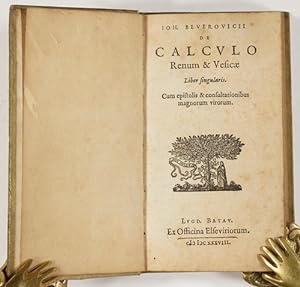
De Calculo Renum & Vesicae Liber singularis. Cum epistolis & consultationibus magnorum virorum.
Data di pubblicazione: 1638
Da: Antiq. F.-D. Söhn - Medicusbooks.Com, Marburg, Germania
Membro dell'associazione: ILAB VDA
Valutazione del venditore 5 su 5 stelle
Prima edizione
EUR 1.260,00
Spedizione EUR 36,45
Spedito da Germania a U.S.A.Quantità: 1 disponibili
Aggiungi al carrelloLeyden, Elsevir, 1638, 12°, (16), 305, (15) pp., Pergamenteinband der Zeit; feines Exemplar. First Medical Treatise to contain an Endorsement of Harvey's Discovery! The rare first edition of Johan van Beverwijck's (1594-1647) monograph present in the first book (pp. 1-208) Beverwijck's treatise on calculi in the kidney and bladder. The second part (pp. 209-305) contains letters addressed by Beverwijck to some prominent physicians, including Nuñez, Back, Saumaise, and Zacuto whom he consulted on that subject, along with their replies. Several consilia by Sanctorius, Spiegel, Horst, and others follow. At the end of 1637 Beverwyck wrote a letter to Harvey in which he expressed his admiration for Harvey's discovery of blood circulation. At the same time he sent him a copy of the present book. It is the first medical treatise to contain an endorsement of Harvey's discovery, a remarkable fact in view of the negative attitude within the academic circles in Holland. The passage in question "Harvei doctrina de Circulatione sanguinus comprobata" (pp.20-24) is discussed by Walter Pagel in his William Harvey's Biological Ideas (1967), who reproduces the title-page of our book and two pages of the passage on Harvey. Harvey replied to Beverwijck's letter in April 1638, praising his book as "learned and elegant, and truly original." Osler notes the significance of Beverwyck's correspondence with Harvey but was unable to obtain a copy of this rare book. Beverwijck, was born in Dordrecht on 17 November 1594. He was the son of Bartholomeus van Beverwijck ( -1615), a textile trader, and Maria Boot van Wezel, a relative of Vesalius. On 25 May 1611 he matriculated at Leiden University to study arts and philosophy but switched to medicine He is said to have taken his doctoral degree with a disputation on apoplexy, but this almost certainly refers to a disputatio exercitii gratia, a public or private disputation meant as an exercise (see Lindeboom, 128). In 1615 Van Beverwijck and Cornelis van Someren (1593-1649) travelled to Caen, Paris, Orléans, Montpellier and Avignon. He also visited Rome and Siena. Meanwhile in this last town he contracted the plague. Van Beverwijck also visited Bologna and Padua, where he entered the university as a student of medicine on 14 May 1616. Under the supervision of Hieronymus Fabricius ab Aquapendente (1537-1619) he graduated on a disputation on the 79th Aphorism of book IV (De calculo) of Hippocrates. On his return journey he visited Basle and Leuven (Louvain) in the company of a Dutch physician called Buggen. In Dordrecht Van Beverwijck set up a medical practice. On 8 November 1625 he was appointed town physician of Dordrecht in succession to Jorden van Foreest (1568-1625). On 25 October 1634 Van Beverwijck inaugurated the anatomical theatre of Dordrecht with a speech on the necessity of anatomy with the "Oratie van de nootsakelickheyt der anatomie" (1634). He also became professor of medicine and anatomy at the Illustrious School (founded 1635) as well as librarian (since 1636) and administrator (1648) of the municipal library in succession to Jacob Cats (1577-1660). Van Beverwijck was a prolific writer, publishing several books on practical medicine in Dutch, like Schat der gesontheyt (1635-1636) and Schat der ongesontheyt ofte genees-konste van de sieckten (1642), as well as literary works (Spaensche Xerxes, 1640) and essays on historical topics ('t Begin van Hollant in Dordrecht, 1640). In 1639 Van Beverwijck published Van de wtnementheyt des vrouvvelicken geslachts, a collection of texts (prose and poetry) in praise of (famous) women. In 1644 he also published Epistolicae quaestiones, a work on several popular subjects containing the answers of great men. Van Beverwijck's friends include a wide range of intellectuals, like Sir Kenelm Digby (1603-1655), Constantijn Huygens, Menasseh ben Israel (1604-1657) and Anna Maria van Schurman (1607-1678). Epistolica quaestio de vitae .