Importo totale (1 articolo articoli):
Destinazione ordine:

bialik chaim nahman (12 risultati)
Vai alla pagina principale dei risultati di ricerca
Filtri di ricerca
Tipo di articolo
- Tutti i tipi di prodotto
- Libri (12)
- Riviste e Giornali (Nessun altro risultato corrispondente a questo perfezionamento)
- Fumetti (Nessun altro risultato corrispondente a questo perfezionamento)
- Spartiti (Nessun altro risultato corrispondente a questo perfezionamento)
- Arte, Stampe e Poster (Nessun altro risultato corrispondente a questo perfezionamento)
- Fotografie (Nessun altro risultato corrispondente a questo perfezionamento)
- Mappe (Nessun altro risultato corrispondente a questo perfezionamento)
- Manoscritti e Collezionismo cartaceo (Nessun altro risultato corrispondente a questo perfezionamento)
Condizioni Maggiori informazioni
- Nuovo (Nessun altro risultato corrispondente a questo perfezionamento)
- Come nuovo, Ottimo o Quasi ottimo (1)
- Molto buono o Buono (9)
- Discreto o Mediocre (Nessun altro risultato corrispondente a questo perfezionamento)
- Come descritto (2)
Legatura
Ulteriori caratteristiche
- Prima ed. (2)
- Copia autograf. (Nessun altro risultato corrispondente a questo perfezionamento)
- Sovracoperta (2)
- Con foto (7)
- Non Print on Demand (12)
Lingua (3)
Spedizione gratuita
Paese del venditore
Valutazione venditore
-

GOLDEN TRADITION: JEWISH LIFE & THOUGHT IN EASTERN EUROPE (BEACON PAPERBACK)
Editore: Beacon Press, 1968
Da: WONDERFUL BOOKS BY MAIL, CHICO-CA, CA, U.S.A.
Valutazione del venditore 5 su 5 stelle

Prima edizione
Paperback. Condizione: Very Good. First Edition Thus. VERY GOOD CONDITION, clean, solid, bright. ; yellow, & white titles on dark green & Blue paper covers showing 3 beings joined at the waist. (Cabalistic drawing from work by RABBI JACOB EMDEN.UNITY OF ISLAM, JUDAISM AND CHRISTIANITY.).
-
Don Quichot Ish LaMancha [Quichotte] tirgum mekuzar [Abridged translation]
Lingua: Ebraico
Editore: Dvir Company Ltd., Tel Aviv, Israel, 1952
Hardcover. Condizione: Good. Condizione sovraccoperta: Fair. In vowelized Hebrew. Illustrated. Pages yellowed. Reprint of the 1923 Berlin edition. 326 pages. 172 x 130 mm. Portion of dust jacket missing at spine, see image here. Some consider Don Quixote the first modern novel, a classic of Western literature, and among the best works of fiction ever written. His influence on the Spanish language has been so great that the language is often called la lengua de Cervantes ("the language of Cervantes").
-
Don Quichot Ish LaMancha [Quichotte] tirgum mekuzar [Abridged translation]
Lingua: Ebraico
Editore: Dvir Company Ltd., Tel Aviv, Israel, 1952
Hardcover. Condizione: Good. Condizione sovraccoperta: Good. In vowelized Hebrew. Illustrated. Pages yellowed. Reprint of the 1923 Berlin edition. 326 pages. 172 x 130 mm. Some consider Don Quixote the first modern novel, a classic of Western literature, and among the best works of fiction ever written. His influence on the Spanish language has been so great that the language is often called la lengua de Cervantes ("the language of Cervantes").
-
Don Quichot Ish LaMancha [Quichotte] tirgum mekuzar [Abridged translation]
Lingua: Ebraico
Editore: Dvir Company Ltd., Tel Aviv, Eretz Israel, 1926
Hardcover. Condizione: Very Good. No Jacket. In vowelized Hebrew. Illustrated. Pages yellowed. Reprint of the 1923 Berlin edition. 326 pages. 26 x 19 cm. Some wear to binding, see image here. Some consider Don Quixote the first modern novel, a classic of Western literature, and among the best works of fiction ever written. His influence on the Spanish language has been so great that the language is often called la lengua de Cervantes ("the language of Cervantes").
-
Ch. N. Bialik: Gedichte
Editore: J�discher Verlag
Da: Wonder Book, Frederick, MD, U.S.A.
Membro dell'associazione: ABAA ILAB
Valutazione del venditore 5 su 5 stelle
Condizione: Good. Berlin: J�discher Verlag, 1911. Sm 4to. viii,158pp. German (Fraktur). Illus. Good book. Boards edgeworn. Hinges cracked. Owner's name on first two leaves and frontis. recto. (poetry, Hebrew poety, translations, books in German) Inquire if you need further information.
-

SEFER HA-AGGADAH: The Book of Jewish Folklore and Legends
Prima edizione
Hardcover. Condizione: As New. No Jacket. 1st Edition. Tel Aviv: Dvir; 1st Edition (1988). 299+ pages. Hardcover in AsNew condition, no dj. Minimal discoloration of the spine. Signature inside front cover otherwise The Book looks New. 9.1"x6.1"x0.9". be45980.
-
Complete Poetic Works of Hayyim Nahman Bialik: Volume I [THIS VOLUME ONLY].
Editore: The Histadruth Ivrith of America, New York, 1948
Da: The Book Gallery, Jerusalem, Israele
Valutazione del venditore 3 su 5 stelle

EUR 18,94
Spedizione EUR 34,00
Spedito da Israele a U.S.A.Quantità: 1 disponibili
Aggiungi al carrelloVOLUME I ONLY. 240x165 mm. XII+267 pages. Gilt hardcover. Cover edges and corners slightly bumped. Spine slightly stained. Spine edges slightly bumped. Pages slightly yellowing. Stamp on title page - NO damage to text. Else in good condition. The book is in : English.
-
Shisha Sidrey Mishna menukadim umforashim al yedey C[hayim] N[achman] Bialkk Seder Rishon [only] ZERA'IM
Lingua: Ebraico
Editore: Devir, Tel Aviv, Eretz Israel, 1932
Hardcover. Condizione: Very Good. No Jacket. In Hebrew. (2), 206 pages. 172 x 126 mm. Hayim Nahman Bialik (Chaim, Haim)(January 9, 1873 Ivnitsa, Volhynian Governorate, Russian Empire - July 4, 1934 Vienna, Austria) was a poet, journalist, writer of children's stories and translator. He wrote primarily in Hebrew but also in Yiddish and was one of the pioneers of modern Hebrew poetry. Though he died 14 years before Israel became a state, he was ultimately recognized as Israel's national poet. Bialk was born to Itzik-Yosef Bialik, a scholar and businessman from Zhitomir, and his wife, Dinah-Priveh. When Bialik was still a child, his father died. In his poems, Bialik exaggerated the misery of his childhood, describing seven orphans left behind for the widow to care for. In fact, there were fewer children, and some were grown up and supported themselves. Starting age 7 Bialik was raised in Zhitomir by his Orthodox grandfather, Yankl-Moishe Bialik. In Zhitomir Bialik received a traditional Jewish religious education, but he also explored European literature. At age 15, inspired by an article he read, he convinced his grandfather to send him to the Volozhin Yeshiva in Lithuania, to study at a famous Talmudic academy under Rabbi Naftali Zvi Yehuda Berlin, where he hoped he could continue his Jewish schooling while expanding his education to European literature. Bialik was attracted to the Jewish Enlightenment movement (Haskala), and he gradually drifted away from yeshiva life. There is a story in the biography of Rabbi Chaim Solevetchik that cites an anonymous student reputed to be Bialik: Rabbi Solevetchik expels Bialik from the yeshiva for being involved in the Haskala movement, personally escorts him out but asks him not to use his writing talents against the yeshiva world. Poems such as HaMatmid ("The Talmud student") written in 1898, reflect Bialik's great ambivalence toward that way of life. Bialik admired the dedication and devotion of the yeshiva students to their studies, but at the same time was troubled by the narrowness of their world. At 18 he left for Odessa, the center of modern Jewish culture in the southern Russian Empire, drawn by Mendele Mocher Sforim and Ahad Ha'am. In Odessa, Bialik studied Russian and German language and literature and dreamed of enrolling in the Modern Orthodox Rabbinical Seminary in Berlin. Alone and penniless, he made his living teaching Hebrew. The 1892 publication of his first poem, El Hatzipor "To the Bird", which expresses a longing for Zion, in a booklet edited by Yehoshua Ravnitzky (1859-1944) (a future collaborator), eased Bialik's way into Jewish literary circles in Odessa. He joined the Hovevei Zion movement and became friends with Ahad Ha'am, who had a great influence on his Zionist outlook. In 1892 Bialik heard news that the Volozhin Yeshiva had closed, so he returned home to Zhitomir to prevent his grandfather from discovering that he had discontinued his religious education. He arrived to find both his grandfather and his older brother close to death. . . .
-
Tirgum Vilhelm Tel / le-Fridrikh Shiler. (Wilhelm Tell / Friedrich Schiller). Übersetzt ins Hebräische von Ch. N. Bjalik.
Editore: Berlin: Druckerei Max Wolf., 1923
Da: Antiquariat Schwarz & Grömling GbR, Berlin, Germania
Membro dell'associazione: GIAQ
Valutazione del venditore 3 su 5 stelle
EUR 100,00
Spedizione EUR 20,50
Spedito da Germania a U.S.A.Quantità: 1 disponibili
Aggiungi al carrello3200 Exemplare. 4°. 25,4 x 20 cm. 186 S. Original grünes Leinen mit Golddekor, Rücken- und Deckeltitel, grüner Kopfschnitt, Lesebändchen. Etwas berieben. Vorsatzscharniere leicht angeplatzt, Klebereste eines Schildchens auf Vorsatz. Insgesamt guter Zustand. Hebräisch! - Schön gestaltete zweifarbige Vor- und Doppeltitel, farbige Kapitelüberschriften, 1 Illustration nach einer älteren Tell-Ausgabe.
-
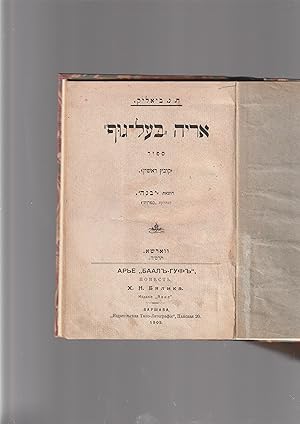
Arye "Ba'al Guf" : sipur (kovets rishon)
Lingua: Ebraico
Editore: Yavneh Publishing House, Warsaw Warszawa, Varsha, Poland, 1905
Hardcover. Condizione: Good. In Hebrew. 186 x 133 mm. 44 pages. Hayim Nahman Bialik (Chaim, Haim)(January 9, 1873 Ivnitsa, Volhynian Governorate, Russian Empire - July 4, 1934 Vienna, Austria). Poet, journalist, Children's writer, Translator. Bialik was a Jewish poet who wrote primarily in Hebrew but also in Yiddish. He was one of the pioneers of modern Hebrew poetry and part of the vanguard of Jewish thinkers who gave voice to the breath of new life in Jewish life. Although he died before Israel became a state, Bialik ultimately came to be recognized as Israel's national poet. Bialk was born to Itzik-Yosef Bialik, a scholar and businessman from Zhitomir, and his wife, Dinah-Priveh. He had older brother Sheftel (born in 1862) a sister, Chenya-Ides, (born in 1871), and a younger sister Blyuma (born in 1875). When Bialik was still a child, his father died. In his poems, Bialik romanticized the misery of his childhood, describing seven orphans left behind, though modern biographers believe there were fewer children, including grown step-siblings who did not need to be supported. From age 7 onwards Bialik was raised in Zhitomir by his Orthodox grandfather, Yankl-Moishe Bialik. In Zhitomir he received a traditional Jewish religious education, but also explored European literature. At age 15, inspired by an article he read, he convinced his grandfather to send him to the famous Volozhin Yeshiva, a Talmudic academy, in Lithuania, to study under Rabbi Naftali Zvi Yehuda Berlin, where he hoped he could continue his Jewish schooling while expanding his education to European literature as well. Attracted to the Jewish Enlightenment movement (Haskala), Bialik gradually drifted away from yeshiva life. There is a story in the biography of Rabbi Chaim Solevetchik that cites an anonymous student reputed to be Bialik. The story goes that Rabbi Chaim, after expelling Bialik from the yeshiva for being involved in the Haskala movement, personally escorted his former student out. When asked "Why?" the rabbi replied that he spent the time convincing Bialik not to use his writing talents against the yeshiva world. Poems such as HaMatmid ("The Talmud student") written in 1898, reflect Bialik's great ambivalence toward that way of life: on the one hand admiration for the dedication and devotion of the yeshiva students to their studies, on the other hand a disdain for the narrowness of their world. At 18 he left for Odessa, the center of modern Jewish culture in the southern Russian Empire, drawn by such luminaries as Mendele Mocher Sforim and Ahad Ha'am. In Odessa, Bialik studied Russian and German language and literature and dreamed of enrolling in the Modern Orthodox Rabbinical Seminary in Berlin. Alone and penniless, he made his living teaching Hebrew. The 1892 publication of his first poem, El Hatzipor "To the Bird", which expresses a longing for Zion, in a booklet edited by Yehoshua Ravnitzky (1859-1944), a future collaborator, eased Bialik's way into Jewish literary circles in Odessa. He joined the Hovevei Zion movement and befriended Ahad Ha'am, who had a great influence on his Zionist outlook. In 1892 Bialik heard news that the Volozhin Yeshiva had closed and so he returned home to Zhitomir to prevent his grandfather from discovering that he had discontinued his religious education. He arrived to find both his grandfather and his older brother close to death. Following their deaths, Bialik married Manya Averbuch in 1893, served as a bookkeeper in his father-in-law's lumber business in Korostyshiv, near Kiev, but when this proved unsuccessful, he moved in 1897 to Sosnowiec, a small town in Zaglebie, southern Poland, which was then part of the Russian Empire, near the border with Prussia and Austria. In Sosnowiec, Bialik worked as a Hebrew teacher and tried to earn extra income as a coal merchant, but the provincial life depressed him. He was finally able to return to Odessa in 1900, having secured a teaching job. For the next 20 years, Bialik taught and. . . >.
-
Hardcover. Condizione: Very Good. No Jacket. In Hebrew. 16 full page facial photos of Bialik, a title page in Hebrew, a title page in English and a page of the poem, in Hebrew, "After my death." Printed on high quality glossy paper. No paginated. 244 x 166 mm. All leaves printed on one side only. The photos are by the photographer Shuchman. Book block a bit loose in the binding. This album, with its black binding, was published the year after Bialik's death. Wide margins. Bialik is the greatest Hebrew poet of modern times, essayist, story writer, translator, and editor, who exercised a profound influence on modern Jewish culture.Hayim Nahman Bialik (Chaim, Haim)(January 9, 1873 Ivnitsa, Volhynian Governorate, Russian Empire - July 4, 1934 Vienna, Austria) was a poet, journalist, writer of children's stories and translator. He wrote primarily in Hebrew but also in Yiddish and was one of the pioneers of modern Hebrew poetry. Though he died 14 years before Israel became a state, he was ultimately recognized as Israel's national poet. Bialk was born to Itzik-Yosef Bialik, a scholar and businessman from Zhitomir, and his wife, Dinah-Priveh. When Bialik was still a child, his father died. In his poems, Bialik exaggerated the misery of his childhood, describing seven orphans left behind for the widow to care for. In fact, there were fewer children, and some were grown up and supported themselves. Starting age 7 Bialik was raised in Zhitomir by his Orthodox grandfather, Yankl-Moishe Bialik. In Zhitomir Bialik received a traditional Jewish religious education, but he also explored European literature. At age 15, inspired by an article he read, he convinced his grandfather to send him to the Volozhin Yeshiva in Lithuania, to study at a famous Talmudic academy under Rabbi Naftali Zvi Yehuda Berlin, where he hoped he could continue his Jewish schooling while expanding his education to European literature. Bialik was attracted to the Jewish Enlightenment movement (Haskala), and he gradually drifted away from yeshiva life. There is a story in the biography of Rabbi Chaim Solevetchik that cites an anonymous student reputed to be Bialik: Rabbi Solevetchik expels Bialik from the yeshiva for being involved in the Haskala movement, personally escorts him out but asks him not to use his writing talents against the yeshiva world. Poems such as HaMatmid ("The Talmud student") written in 1898, reflect Bialik's great ambivalence toward that way of life. Bialik admired the dedication and devotion of the yeshiva students to their studies, but at the same time was troubled by the narrowness of their world. At 18 he left for Odessa, the center of modern Jewish culture in the southern Russian Empire, drawn by Mendele Mocher Sforim and Ahad Ha'am. In Odessa, Bialik studied Russian and German language and literature and dreamed of enrolling in the Modern Orthodox Rabbinical Seminary in Berlin. Alone and penniless, he made his living teaching Hebrew. The 1892 publication of his first poem, El Hatzipor "To the Bird", which expresses a longing for Zion, in a booklet edited by Yehoshua Ravnitzky (1859-1944) (a future collaborator), eased Bialik's way into Jewish literary circles in Odessa. He joined the Hovevei Zion movement and became friends with Ahad Ha'am, who had a great influence on his Zionist outlook. In 1892 Bialik heard news that the Volozhin Yeshiva had closed, so he returned home to Zhitomir to prevent his grandfather from discovering that he had discontinued his religious education. He arrived to find both his grandfather and his older brother close to death. . . .
-
Soft cover. Condizione: Very Good. No Jacket. Markus-Shalit, Rachel (Rahel); Beham, A. (illustratore). In Hebrew. 32 pages. 31 x 23.5 cm. Story in verse about a small boy as big as a finger. Illustrated. Un-paginated. 16 leaves. 6 pages are in color, the rest in black and white. Fragile browned paper. Libraries worldwide that own item: 11. Hayim Nahman Bialik (Chaim, Haim)(January 9, 1873 Ivnitsa, Volhynian Governorate, Russian Empire - July 4, 1934 Vienna, Austria). Poet, journalist, Children's writer, Translator. Bialik was a Jewish poet who wrote primarily in Hebrew but also in Yiddish. He was one of the pioneers of modern Hebrew poetry. He was part of the vanguard of Jewish thinkers who gave voice to the breath of new life in Jewish life. Although he died before Israel became a state, Bialik ultimately came to be recognized as Israel's national poet. Bialk was born to Itzik-Yosef Bialik, a scholar and businessman from Zhitomir, and his wife, Dinah-Priveh. He had older brother Sheftel (born in 1862) and sister Chenya-Ides (born in 1871), as well as a younger sister Blyuma (born in 1875). When Bialik was still a child, his father died. In his poems, Bialik romanticized the misery of his childhood, describing seven orphans left behind, though modern biographers believe there were fewer children, including grown step-siblings who did not need to be supported. From age 7 onwards Bialik was raised in Zhitomir by his Orthodox grandfather, Yankl-Moishe Bialik. In Zhitomir he received a traditional Jewish religious education, but also explored European literature. At age 15, inspired by an article he read, he convinced his grandfather to send him to the Volozhin Yeshiva in Lithuania, to study at a famous Talmudic academy under Rabbi Naftali Zvi Yehuda Berlin, where he hoped he could continue his Jewish schooling while expanding his education to European literature as well. Attracted to the Jewish Enlightenment movement (Haskala), Bialik gradually drifted away from yeshiva life. There is a story in the biography of Rabbi Chaim Solevetchik that cites an anonymous student reputed to be him. The story goes that Rabbi Chaim, after expelling Bialik from the yeshiva for being involved in the Haskala movement, personally escorted his former student out. When asked "Why?" the rabbi replied that he spent the time convincing Bialik not to use his writing talents against the yeshiva world. Poems such as HaMatmid ("The Talmud student") written in 1898, reflect Bialik's great ambivalence toward that way of life: on the one hand admiration for the dedication and devotion of the yeshiva students to their studies, on the other hand a disdain for the narrowness of their world. At 18 he left for Odessa, the center of modern Jewish culture in the southern Russian Empire, drawn by such luminaries as Mendele Mocher Sforim and Ahad Ha'am. In Odessa, Bialik studied Russian and German language and literature and dreamed of enrolling in the Modern Orthodox Rabbinical Seminary in Berlin. Alone and penniless, he made his living teaching Hebrew. The 1892 publication of his first poem, El Hatzipor "To the Bird", which expresses a longing for Zion, in a booklet edited by Yehoshua Ravnitzky (1859-1944) (a future collaborator), eased Bialik's way into Jewish literary circles in Odessa. He joined the Hovevei Zion movement and befriended Ahad Ha'am, who had a great influence on his Zionist outlook. In 1892 Bialik heard news that the Volozhin Yeshiva had closed and returned home to Zhitomir to prevent his grandfather from discovering that he had discontinued his religious education. He arrived to find both his grandfather and his older brother close to death. . . .


![Immagine del venditore per Don Quichot Ish LaMancha [Quichotte] tirgum mekuzar [Abridged translation] venduto da Meir Turner](https://pictures.abebooks.com/inventory/md/md30748936150.jpg)
![Immagine del venditore per Don Quichot Ish LaMancha [Quichotte] tirgum mekuzar [Abridged translation] venduto da Meir Turner](https://pictures.abebooks.com/inventory/md/md30357378031.jpg)
![Immagine del venditore per Don Quichot Ish LaMancha [Quichotte] tirgum mekuzar [Abridged translation] venduto da Meir Turner](https://pictures.abebooks.com/inventory/md/md30383202335.jpg)


![Immagine del venditore per Shisha Sidrey Mishna menukadim umforashim al yedey C[hayim] N[achman] Bialkk Seder Rishon [only] ZERA'IM venduto da Meir Turner](https://pictures.abebooks.com/inventory/md/md30405778831.jpg)