Importo totale (1 articolo articoli):
Destinazione ordine:

carpenter thomas reporter (3 risultati)
Vai alla pagina principale dei risultati di ricerca
Filtri di ricerca
Tipo di articolo
- Tutti i tipi di prodotto
- Libri (3)
- Riviste e Giornali (Nessun altro risultato corrispondente a questo perfezionamento)
- Fumetti (Nessun altro risultato corrispondente a questo perfezionamento)
- Spartiti (Nessun altro risultato corrispondente a questo perfezionamento)
- Arte, Stampe e Poster (Nessun altro risultato corrispondente a questo perfezionamento)
- Fotografie (Nessun altro risultato corrispondente a questo perfezionamento)
- Mappe (Nessun altro risultato corrispondente a questo perfezionamento)
- Manoscritti e Collezionismo cartaceo (Nessun altro risultato corrispondente a questo perfezionamento)
Condizioni Maggiori informazioni
- Nuovo (Nessun altro risultato corrispondente a questo perfezionamento)
- Come nuovo, Ottimo o Quasi ottimo (Nessun altro risultato corrispondente a questo perfezionamento)
- Molto buono o Buono (Nessun altro risultato corrispondente a questo perfezionamento)
- Discreto o Mediocre (1)
- Come descritto (2)
Legatura
- Tutte
- Rilegato (3)
- Brossura (Nessun altro risultato corrispondente a questo perfezionamento)
Ulteriori caratteristiche
- Prima ed. (3)
- Copia autograf. (Nessun altro risultato corrispondente a questo perfezionamento)
- Sovracoperta (Nessun altro risultato corrispondente a questo perfezionamento)
- Con foto (2)
- Non Print on Demand (3)
Lingua (1)
Prezzo
- Qualsiasi prezzo
- Inferiore a EUR 20 (Nessun altro risultato corrispondente a questo perfezionamento)
- EUR 20 a EUR 45 (Nessun altro risultato corrispondente a questo perfezionamento)
- Superiore a EUR 45
Spedizione gratuita
- Spedizione gratuita in U.S.A. (Nessun altro risultato corrispondente a questo perfezionamento)
Paese del venditore
Valutazione venditore
-
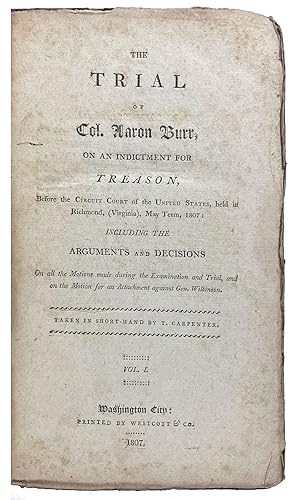
The Trial of Col. Aaron Burr, on an Indictment for Treason. Before the Circuit Court of the United States, Held in Richmond, (Virginia), May Term, 1807: Including the Arguments and Decisions on All the Motions Made During the Examination and Trial, and on the Motion for an Attachment against Gen. Wilkinson. Taken in Short-Hand by T. Carpenter. Vols. I-III
Editore: Westcott & Co, Washington City [Washington, D.C.], 1808
Da: Donald A. Heald Rare Books (ABAA), New York, NY, U.S.A.
Membro dell'associazione: ABAA ILAB
Valutazione del venditore 5 su 5 stelle

Prima edizione
8vo. 3 volumes. (8 1/4 x 5 inches). Vol. I: 147 [2] 4-135 [3]. 284 pp. Title, Deposit Notice, Publisher's Note. Vol II: 465 [1]. 466 pp. Title, Deposit Notice. Vol. III: 418 I [i-l] [4]. 472 pp. Title, Appendix, Index. Previous owner's small stamp on front pastedowns. Contemporary full sheep, expertly rebacked spines in six gilt-ruled compartments with red morocco lettering-pieces in second compartments and volume numbers in fourth First edition of all three volumes of "the rarest and best account of the trial," (Eberstadt) which made US legal history in its interpretations of treason and executive sovereignty. This elusive set, almost always found without the third volume, is Burr's own report and is crucial to understanding early democracy in America. Of especial relevance today as other high-profile American politicans face their own accusations of treason. "The most exciting trial held in this country during the first half of the nineteenth century." (Graff) Aaron Burr Jr. was an American politician, businessman, lawyer, co-founder of the Bank of New York, and Founding Father who served as Vice President during Jefferson's first term, and, more recently, served as the foil in Lin-Manuel Miranda's musical Hamilton. How Burr came to be arrested in Alabama in 1807 is bizarre and byzantine, but in brief: Burr was rejected by his own party, the Democratic-Republicans, for opposing Jefferson in the 1800 presidential election runoff in the House, and then was shunned by the Federalists for killing Alexander Hamilton in a duel. Burr went West to seek better fortunes, which included a rogue military adventure to seize lands belonging to Spain in Louisiana and Mexico, with incentive given to the Western states to join his adventure. However, Burr's longtime friend, General James Wilkinson, decided to abandon this dubious plan and inform the Feds instead. President Jefferson did not look kindly on his former Vice President's conspiracy to entice the Western states to leave the Union and join with him as he colonized new lands with the support of England. Jefferson alerted Congress and ordered Burr's arrest. Firm in his belief that Burr was a traitor, Jefferson had him charged as such. Luckily for Burr, Chief Justice John Marshall was Jefferson's longtime political foe and would preside at Burr's trial because he was also the federal judge for the US Circuit Court in Virginia. Burr was acquitted and fled for Europe. Cohen, Bibliography of Early American Law 14091, 14092. Eberstadt 134-68. Graff 506. Howes B1013. Sabin 9433. Tompkins, Burr 18.
-
The Trial of Col. Aaron Burr, on an Indictment for Treason, Before the Circuit Court of the United States, held in Richmond, (Virginia), May Term, 1807: Including the Arguments and Decisions on all the Motions made during the Examination and Trial, and on the Motion for an Attachment against Gen. Wilkinson. Taken in short-hand by T. Carpenter. Vols. I-III
Editore: Westcott & Co, Washington City [Washington D.C.], 1808
Da: Donald A. Heald Rare Books (ABAA), New York, NY, U.S.A.
Membro dell'associazione: ABAA ILAB
Valutazione del venditore 5 su 5 stelle
Prima edizione
3 Volumes. 8vo. (9 x 5 1/4 inches). Vol. I: First edition. 147 pp., 135 pp. (1). Vol. II: Second issue of first edition: 465 pp. Vol. III: First edition. 418, [50] [4]. Publisher's original grey paper boards. All volumes uncut; Volume II entirely unopened. Housed within a blue morocco clamshell box with gilt spine. "The rarest and best account of the trial," (Eberstadt) which made US legal history in its interpretations of treason and executive sovereignty. This elusive set, almost always found without the third volume, is Burr's own report and is crucial to understanding early democracy in America. Of especial relevance today as other high-profile American politicians face their own accusations of treason. "The most exciting trial held in this country during the first half of the nineteenth century." (Graff) Aaron Burr Jr. was an American politician, businessman, lawyer, co-founder of the Bank of New York, and Founding Father who served as Vice President during Jefferson's first term, and, more recently, served as the foil in Lin-Manuel Miranda's musical Hamilton. How Burr came to be arrested in Alabama in 1807 is bizarre and byzantine, but in brief: Burr was rejected by his own party, the Democratic-Republicans, for opposing Jefferson in the 1800 presidential election runoff in the House, and then was shunned by the Federalists for killing Alexander Hamilton in a duel. Burr went West to seek better fortunes, which included a rogue military adventure to seize lands belonging to Spain in Louisiana and Mexico, with incentive given to the Western states to join his adventure. However, Burr's longtime friend, General James Wilkinson, decided to abandon this dubious plan and inform the Feds instead. President Jefferson did not look kindly on his former Vice President's conspiracy to entice the Western states to leave the Union and join with him as he colonized new lands with the support of England. Jefferson alerted Congress and ordered Burr's arrest. Firm in his belief that Burr was a traitor, Jefferson had him charged as such. Luckily for Burr, Chief Justice John Marshall was Jefferson's longtime political foe and would preside at Burr's trial because he was also the federal judge for the US Circuit Court in Virginia. Burr was acquitted and fled for Europe. Cohen, Bibliography of Early American Law 14091, 14092. Eberstadt 134-68. Graff 506. Howes B1013. Sabin 9433. Tompkins, Burr 18.
-

A report of an action for a libel: brought by Dr. Benjamin Rush, against William Cobbett, in the Supreme Court of Pennsylvania, December term, 1799, for certain defamatory publications in a news-paper, entitled Porcupine's gazette, of which the said William Cobbett was editor
Editore: Philadelphia : Printed by W.W. Woodward, 1800
Da: Sequitur Books, Boonsboro, MD, U.S.A.
Membro dell'associazione: IOBA
Valutazione del venditore 5 su 5 stelle
Prima edizione
Hardcover. Condizione: Fair. First Edition. [Quackery: Early American Law and Medicine; Defamation, Slander] Rare publication of the infamous libel trial of William Cobbett by Dr. Benjamin Rush. Cobbett had printed strident criticism of Rush's advocacy of bloodletting in his Porcupine's Gazette in 1797. "The times are ominous indeed, When quack to quack cries purge and bleed." Under the pen-name Peter Porcupine, Cobbett had referred "to Rush as a bleeder, the Samson of medicine who had actually slaughtered thousands of citizens, and as a poisonous trans-Atlantic quack." During the calamitous Yellow Fever outbreak of 1797 Rush's advocacy of bleeding may have resulted in the death of numerous patients. Rush was a prominent founding father, and signer of the Declaration of Independence. Cobbett lost this libel trial and was ordered to pay Rush $5000. To avoid the hefty judgement, Cobbett left Philadelphia for New York, set up his "Rush Light" and fled ultimately to Britain. An interesting proceeding, where the question of what is a "quack" is explored and the patriotism and republicanism of Rush is oratorically chest thumped. Possibly Austin 1597. Collated: 64 pages [of 70] (Lacks first 2 leaves and final leaf, but complete provided in facsimile). Bound in modern cloth. Fine binding and cover. Library stamps. Title page has numerous marks. Scattered marginalia. Shelf wear to edges. Light damp stain along top edge. Lacking last leaf. Refs: Evans 37103. Sabin 14030. NLM 2182034R. IMPORTANT TRIAL, IN THE SUPREME COURT OF PENNSYLVANIA. Doctor Benjamin Rush, versus William Cobbett. December term, 1799. ACTION on the case for a Libel was brought in the autumn of 1797, by the Plaintiff against the Defendant, for certain defamatory publications which appeared in a newspaper entitled "Porcupine's Gazette," of which COBBETT was the Editor.