
Importo totale (1 articolo articoli):
Destinazione ordine:

casida j e (30 risultati)
Vai alla pagina principale dei risultati di ricerca
Filtri di ricerca
Tipo di articolo
- Tutti i tipi di prodotto
- Libri (30)
- Riviste e Giornali (Nessun altro risultato corrispondente a questo perfezionamento)
- Fumetti (Nessun altro risultato corrispondente a questo perfezionamento)
- Spartiti (Nessun altro risultato corrispondente a questo perfezionamento)
- Arte, Stampe e Poster (Nessun altro risultato corrispondente a questo perfezionamento)
- Fotografie (Nessun altro risultato corrispondente a questo perfezionamento)
- Mappe (Nessun altro risultato corrispondente a questo perfezionamento)
- Manoscritti e Collezionismo cartaceo (Nessun altro risultato corrispondente a questo perfezionamento)
Condizioni Maggiori informazioni
- Nuovo (25)
- Come nuovo, Ottimo o Quasi ottimo (3)
- Molto buono o Buono (1)
- Discreto o Mediocre (Nessun altro risultato corrispondente a questo perfezionamento)
- Come descritto (1)
Legatura
Ulteriori caratteristiche
- Prima ed. (Nessun altro risultato corrispondente a questo perfezionamento)
- Copia autograf. (Nessun altro risultato corrispondente a questo perfezionamento)
- Sovracoperta (Nessun altro risultato corrispondente a questo perfezionamento)
- Con foto (13)
- Non Print on Demand (24)
Lingua (2)
Spedizione gratuita
Paese del venditore
Valutazione venditore
-

Industrial Microbiology
Lingua: Inglese
Editore: New Age International (P) Ltd., 2016
ISBN 10: 8122438024 ISBN 13: 9788122438024
Da: Majestic Books, Hounslow, Regno Unito
Valutazione del venditore 4 su 5 stelle

EUR 9,55
Spedizione EUR 7,50
Spedito da Regno Unito a U.S.A.Quantità: 4 disponibili
Aggiungi al carrelloCondizione: New. pp. 418.
-
Industrial Microbiology
Lingua: Inglese
Editore: New Age International (P) Ltd., 2016
ISBN 10: 8122438024 ISBN 13: 9788122438024
Da: Books Puddle, New York, NY, U.S.A.
Valutazione del venditore 4 su 5 stelle
Condizione: New. pp. 418 2nd Edition.
-
Industrial Microbiology
Lingua: Inglese
Editore: New Age International (P) Ltd., 2016
ISBN 10: 8122438024 ISBN 13: 9788122438024
Da: Biblios, Frankfurt am main, HESSE, Germania
Valutazione del venditore 4 su 5 stelle
EUR 10,19
Spedizione EUR 9,95
Spedito da Germania a U.S.A.Quantità: 4 disponibili
Aggiungi al carrelloCondizione: New. pp. 418.
-

PYRETHRUM FLOWERS: PRODUCTION, CHEMISTRY, TOXICOLOGY, & USES
Da: Basi6 International, Irving, TX, U.S.A.
Valutazione del venditore 5 su 5 stelle

Condizione: Brand New. New. US edition. Expediting shipping for all USA and Europe orders excluding PO Box. Excellent Customer Service.
-
 Edizione Internazionale
PYRETHRUM FLOWERS: PRODUCTION, CHEMISTRY, TOXICOLOGY, & USES
Lingua: Inglese
Editore: SP OXFORD UNIVERSITY PRESS, 1995
ISBN 10: 0195082109 ISBN 13: 9780195082104
Da: UK BOOKS STORE, London, LONDO, Regno Unito
Valutazione del venditore 4 su 5 stelle
EUR 54,34
Spedizione EUR 6,91
Spedito da Regno Unito a U.S.A.Quantità: Più di 20 disponibili
Aggiungi al carrelloCondizione: New. Brand New ! Fast Delivery "International Edition " and ship within 24-48 hours. Deliver by FedEx and Dhl, & Aramex, UPS, & USPS and we do accept APO and PO BOX Addresses. Order can be delivered worldwide within 4-6 Working days .and we do have flat rate for up to 2LB. Extra shipping charges will be requested This Item May be shipped from India, United states & United Kingdom. Depending on your location and availability.
-

Oxidative metabolism of C14-labeled baygon by living house flies and
Da: Clivia Mueller, Isernhagen, Germania
Valutazione del venditore 5 su 5 stelle
EUR 7,74
Spedizione EUR 24,10
Spedito da Germania a U.S.A.Quantità: 1 disponibili
Aggiungi al carrelloby house fly enzyme preparations(S. A. J. Econ. Entomol. Vol. 62, Nr. 2)1969. S. 484-498. m. Abb. (St. )br. -2) -Sonderabdruck-.
-

Nicotinoid Insecticides and the Nicotinic Acetylcholine Receptor
Da: GreatBookPrices, Columbia, MD, U.S.A.
Valutazione del venditore 5 su 5 stelle
EUR 204,81
Spedizione EUR 2,27
Spedito in U.S.A.Quantità: Più di 20 disponibili
Aggiungi al carrelloCondizione: New.
-

Nicotinoid Insecticides and the Nicotinic Acetylcholine Receptor
Da: Lucky's Textbooks, Dallas, TX, U.S.A.
Valutazione del venditore 5 su 5 stelle
EUR 203,63
Spedizione EUR 3,43
Spedito in U.S.A.Quantità: Più di 20 disponibili
Aggiungi al carrelloCondizione: New.
-

Nicotinoid Insecticides and the Nicotinic Acetylcholine Receptor
Da: Lucky's Textbooks, Dallas, TX, U.S.A.
Valutazione del venditore 5 su 5 stelle
EUR 203,63
Spedizione EUR 3,43
Spedito in U.S.A.Quantità: Più di 20 disponibili
Aggiungi al carrelloCondizione: New.
-
Nicotinoid Insecticides and the Nicotinic Acetylcholine Receptor
Da: Ria Christie Collections, Uxbridge, Regno Unito
Valutazione del venditore 5 su 5 stelle
EUR 219,09
Spedizione EUR 13,83
Spedito da Regno Unito a U.S.A.Quantità: Più di 20 disponibili
Aggiungi al carrelloCondizione: New. In.
-
Nicotinoid Insecticides and the Nicotinic Acetylcholine Receptor
Da: Ria Christie Collections, Uxbridge, Regno Unito
Valutazione del venditore 5 su 5 stelle
EUR 219,09
Spedizione EUR 13,83
Spedito da Regno Unito a U.S.A.Quantità: Più di 20 disponibili
Aggiungi al carrelloCondizione: New. In.
-

Nicotinoid Insecticides and the Nicotinic Acetylcholine Receptor
Da: GreatBookPricesUK, Woodford Green, Regno Unito
Valutazione del venditore 5 su 5 stelle
EUR 216,76
Spedizione EUR 17,31
Spedito da Regno Unito a U.S.A.Quantità: Più di 20 disponibili
Aggiungi al carrelloCondizione: New.
-

Nicotinoid Insecticides and the Nicotinic Acetylcholine Receptor
Da: GreatBookPrices, Columbia, MD, U.S.A.
Valutazione del venditore 5 su 5 stelle
EUR 240,65
Spedizione EUR 2,27
Spedito in U.S.A.Quantità: Più di 20 disponibili
Aggiungi al carrelloCondizione: As New. Unread book in perfect condition.
-
hardcover. Condizione: Good. Connecting readers with great books since 1972! Used textbooks may not include companion materials such as access codes, etc. May have some wear or writing/highlighting. We ship orders daily and Customer Service is our top priority!
-
Nicotinoid Insecticides and the Nicotinic Acetylcholine Receptor
Da: BennettBooksLtd, San Diego, NV, U.S.A.
Valutazione del venditore 5 su 5 stelle
Hardcover. Condizione: New. In shrink wrap. Looks like an interesting title!
-
Nicotinoid Insecticides and the Nicotinic Acetylcholine Receptor
Da: BennettBooksLtd, San Diego, NV, U.S.A.
Valutazione del venditore 5 su 5 stelle
Hardcover. Condizione: New. In shrink wrap. Looks like an interesting title!
-

Nicotinoid Insecticides and the Nicotinic Acetylcholine Receptor
Da: GreatBookPricesUK, Woodford Green, Regno Unito
Valutazione del venditore 5 su 5 stelle
EUR 246,45
Spedizione EUR 17,31
Spedito da Regno Unito a U.S.A.Quantità: Più di 20 disponibili
Aggiungi al carrelloCondizione: As New. Unread book in perfect condition.
-

Nicotinoid Insecticides and the Nicotinic Acetylcholine Receptor
Lingua: Inglese
Editore: Springer Japan, Springer Japan Jul 1999, 1999
ISBN 10: 443170213X ISBN 13: 9784431702139
Da: buchversandmimpf2000, Emtmannsberg, BAYE, Germania
Valutazione del venditore 5 su 5 stelle
EUR 213,99
Spedizione EUR 60,00
Spedito da Germania a U.S.A.Quantità: 2 disponibili
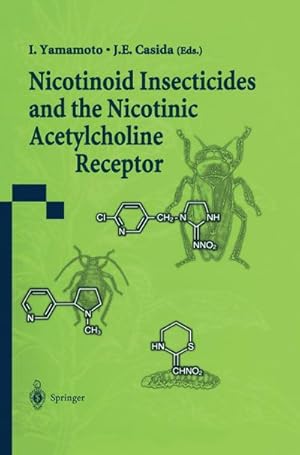
Aggiungi al carrelloBuch. Condizione: Neu. Neuware -Insect pest control has continuously evolved from inorganics to botanicals, to chlo rinated hydrocarbons, to organophosphorus compounds and methylcarbamates, then synthetic pyrethroids and most recently synthetic nicotinoids as the major classes. These insecticides allowed high standards of crop protection at minimal cost. A limitation in each new class of compounds is the selection of resistant strains and ultimate control failures and this serves as a driving force to discover and develop replacement compounds to circumvent resistance and overcome problem areas. The nicotinoids now play a critical role in meeting this need. Three generations of chemicals are involved in the history of nicotinoid insecti cides. The first generation was the botanical nicotine used for at least three centuries to control sucking insect pests but largely replaced in the 1940s and 1950s by the more effective organophosphorus compounds and methylcarbamates, some with systemic properties. Synthesis programs based on nicotine as a prototype did not yield compounds that could compete with other synthetic insecticides. The second generation was the nitromethylene type such as nithiazine, discovered by Shell sci entists in a screening/optimization program. The nitromethylenes had the potency, selectivity, and systemic properties but lacked the field effectiveness largely because of photolability (so close yet so far from a major commercial product). The third generation required a series of advances made by Bayer researchers starting from nithiazine as the model and enhancing its photostability and potency with a nitroimine and chloropyridyl moiety, respectively, to give imidacloprid, the subject of much of this monograph.Springer Verlag GmbH, Tiergartenstr. 17, 69121 Heidelberg 312 pp. Englisch.
-

Nicotinoid Insecticides and the Nicotinic Acetylcholine Receptor
Lingua: Inglese
Editore: Springer Japan, Springer Japan, 2013
ISBN 10: 443168011X ISBN 13: 9784431680116
EUR 217,46
Spedizione EUR 62,38
Spedito da Germania a U.S.A.Quantità: 1 disponibili
Aggiungi al carrelloTaschenbuch. Condizione: Neu. Druck auf Anfrage Neuware - Printed after ordering - Insect pest control has continuously evolved from inorganics to botanicals, to chlo rinated hydrocarbons, to organophosphorus compounds and methylcarbamates, then synthetic pyrethroids and most recently synthetic nicotinoids as the major classes. These insecticides allowed high standards of crop protection at minimal cost. A limitation in each new class of compounds is the selection of resistant strains and ultimate control failures and this serves as a driving force to discover and develop replacement compounds to circumvent resistance and overcome problem areas. The nicotinoids now play a critical role in meeting this need. Three generations of chemicals are involved in the history of nicotinoid insecti cides. The first generation was the botanical nicotine used for at least three centuries to control sucking insect pests but largely replaced in the 1940s and 1950s by the more effective organophosphorus compounds and methylcarbamates, some with systemic properties. Synthesis programs based on nicotine as a prototype did not yield compounds that could compete with other synthetic insecticides. The second generation was the nitromethylene type such as nithiazine, discovered by Shell sci entists in a screening/optimization program. The nitromethylenes had the potency, selectivity, and systemic properties but lacked the field effectiveness largely because of photolability (so close yet so far from a major commercial product). The third generation required a series of advances made by Bayer researchers starting from nithiazine as the model and enhancing its photostability and potency with a nitroimine and chloropyridyl moiety, respectively, to give imidacloprid, the subject of much of this monograph.
-
Nicotinoid Insecticides and the Nicotinic Acetylcholine Receptor
Lingua: Inglese
Editore: Springer Japan, Springer Japan, 1999
ISBN 10: 443170213X ISBN 13: 9784431702139
EUR 223,11
Spedizione EUR 63,46
Spedito da Germania a U.S.A.Quantità: 1 disponibili
Aggiungi al carrelloBuch. Condizione: Neu. Druck auf Anfrage Neuware - Printed after ordering - Insect pest control has continuously evolved from inorganics to botanicals, to chlo rinated hydrocarbons, to organophosphorus compounds and methylcarbamates, then synthetic pyrethroids and most recently synthetic nicotinoids as the major classes. These insecticides allowed high standards of crop protection at minimal cost. A limitation in each new class of compounds is the selection of resistant strains and ultimate control failures and this serves as a driving force to discover and develop replacement compounds to circumvent resistance and overcome problem areas. The nicotinoids now play a critical role in meeting this need. Three generations of chemicals are involved in the history of nicotinoid insecti cides. The first generation was the botanical nicotine used for at least three centuries to control sucking insect pests but largely replaced in the 1940s and 1950s by the more effective organophosphorus compounds and methylcarbamates, some with systemic properties. Synthesis programs based on nicotine as a prototype did not yield compounds that could compete with other synthetic insecticides. The second generation was the nitromethylene type such as nithiazine, discovered by Shell sci entists in a screening/optimization program. The nitromethylenes had the potency, selectivity, and systemic properties but lacked the field effectiveness largely because of photolability (so close yet so far from a major commercial product). The third generation required a series of advances made by Bayer researchers starting from nithiazine as the model and enhancing its photostability and potency with a nitroimine and chloropyridyl moiety, respectively, to give imidacloprid, the subject of much of this monograph.
-
Nicotinoid Insecticides and the Nicotinic Acetylcholine Receptor
Da: Revaluation Books, Exeter, Regno Unito
Valutazione del venditore 5 su 5 stelle
EUR 298,99
Spedizione EUR 11,54
Spedito da Regno Unito a U.S.A.Quantità: 2 disponibili
Aggiungi al carrelloPaperback. Condizione: Brand New. 312 pages. 9.25x6.10x0.74 inches. In Stock.
-
Nicotinoid Insecticides and the Nicotinic Acetylcholine Receptor
Da: Mispah books, Redhill, SURRE, Regno Unito
Valutazione del venditore 4 su 5 stelle
EUR 290,06
Spedizione EUR 28,85
Spedito da Regno Unito a U.S.A.Quantità: 1 disponibili
Aggiungi al carrelloHardcover. Condizione: Like New. Like New. book.
-
Nicotinoid Insecticides and the Nicotinic Acetylcholine Receptor
Da: Revaluation Books, Exeter, Regno Unito
Valutazione del venditore 5 su 5 stelle
EUR 300,48
Spedizione EUR 14,43
Spedito da Regno Unito a U.S.A.Quantità: 2 disponibili
Aggiungi al carrelloHardcover. Condizione: Brand New. 300 pages. 9.50x6.50x0.75 inches. In Stock.
-
Pyrethrum Flowers: Production, Chemistry, Toxicology, & Uses
Lingua: Inglese
Editore: Oxford University Press, 1995
Da: Books in my Basket, New Delhi, India
Valutazione del venditore 5 su 5 stelle
EUR 86,51
Spedizione EUR 16,00
Spedito da India a U.S.A.Quantità: 1 disponibili
Aggiungi al carrelloN.A. Condizione: New. ISBN:9780195082104.
-

EUR 180,07
Spedizione EUR 48,99
Spedito da Germania a U.S.A.Quantità: Più di 20 disponibili
Aggiungi al carrelloGebunden. Condizione: New. Dieser Artikel ist ein Print on Demand Artikel und wird nach Ihrer Bestellung fuer Sie gedruckt. The first book on nicotinoidsProvides concise and comprehensive information on its chemistry, mode of action, metabolism, application in agriculture, and basic knowledge on the target siteThe first book on nicotinoidsProvides concise and c.
-

EUR 180,07
Spedizione EUR 48,99
Spedito da Germania a U.S.A.Quantità: Più di 20 disponibili
Aggiungi al carrelloCondizione: New. Dieser Artikel ist ein Print on Demand Artikel und wird nach Ihrer Bestellung fuer Sie gedruckt. The first book on nicotinoidsProvides concise and comprehensive information on its chemistry, mode of action, metabolism, application in agriculture, and basic knowledge on the target siteThe first book on nicotinoidsProvides concise and c.
-

Nicotinoid Insecticides and the Nicotinic Acetylcholine Receptor
Da: BuchWeltWeit Ludwig Meier e.K., Bergisch Gladbach, Germania
Valutazione del venditore 5 su 5 stelle
EUR 213,99
Spedizione EUR 23,00
Spedito da Germania a U.S.A.Quantità: 2 disponibili
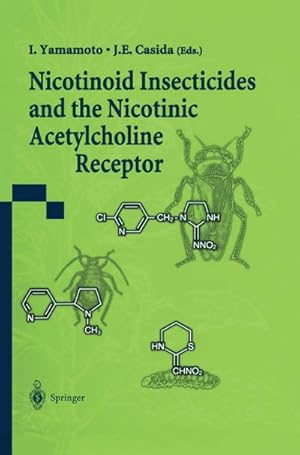
Aggiungi al carrelloBuch. Condizione: Neu. This item is printed on demand - it takes 3-4 days longer - Neuware -Insect pest control has continuously evolved from inorganics to botanicals, to chlo rinated hydrocarbons, to organophosphorus compounds and methylcarbamates, then synthetic pyrethroids and most recently synthetic nicotinoids as the major classes. These insecticides allowed high standards of crop protection at minimal cost. A limitation in each new class of compounds is the selection of resistant strains and ultimate control failures and this serves as a driving force to discover and develop replacement compounds to circumvent resistance and overcome problem areas. The nicotinoids now play a critical role in meeting this need. Three generations of chemicals are involved in the history of nicotinoid insecti cides. The first generation was the botanical nicotine used for at least three centuries to control sucking insect pests but largely replaced in the 1940s and 1950s by the more effective organophosphorus compounds and methylcarbamates, some with systemic properties. Synthesis programs based on nicotine as a prototype did not yield compounds that could compete with other synthetic insecticides. The second generation was the nitromethylene type such as nithiazine, discovered by Shell sci entists in a screening/optimization program. The nitromethylenes had the potency, selectivity, and systemic properties but lacked the field effectiveness largely because of photolability (so close yet so far from a major commercial product). The third generation required a series of advances made by Bayer researchers starting from nithiazine as the model and enhancing its photostability and potency with a nitroimine and chloropyridyl moiety, respectively, to give imidacloprid, the subject of much of this monograph. 312 pp. Englisch.
-
Nicotinoid Insecticides and the Nicotinic Acetylcholine Receptor
Da: BuchWeltWeit Ludwig Meier e.K., Bergisch Gladbach, Germania
Valutazione del venditore 5 su 5 stelle
EUR 213,99
Spedizione EUR 23,00
Spedito da Germania a U.S.A.Quantità: 2 disponibili
Aggiungi al carrelloTaschenbuch. Condizione: Neu. This item is printed on demand - it takes 3-4 days longer - Neuware -Insect pest control has continuously evolved from inorganics to botanicals, to chlo rinated hydrocarbons, to organophosphorus compounds and methylcarbamates, then synthetic pyrethroids and most recently synthetic nicotinoids as the major classes. These insecticides allowed high standards of crop protection at minimal cost. A limitation in each new class of compounds is the selection of resistant strains and ultimate control failures and this serves as a driving force to discover and develop replacement compounds to circumvent resistance and overcome problem areas. The nicotinoids now play a critical role in meeting this need. Three generations of chemicals are involved in the history of nicotinoid insecti cides. The first generation was the botanical nicotine used for at least three centuries to control sucking insect pests but largely replaced in the 1940s and 1950s by the more effective organophosphorus compounds and methylcarbamates, some with systemic properties. Synthesis programs based on nicotine as a prototype did not yield compounds that could compete with other synthetic insecticides. The second generation was the nitromethylene type such as nithiazine, discovered by Shell sci entists in a screening/optimization program. The nitromethylenes had the potency, selectivity, and systemic properties but lacked the field effectiveness largely because of photolability (so close yet so far from a major commercial product). The third generation required a series of advances made by Bayer researchers starting from nithiazine as the model and enhancing its photostability and potency with a nitroimine and chloropyridyl moiety, respectively, to give imidacloprid, the subject of much of this monograph. 312 pp. Englisch.
-
EUR 186,70
Spedizione EUR 70,00
Spedito da Germania a U.S.A.Quantità: 5 disponibili
Aggiungi al carrelloTaschenbuch. Condizione: Neu. Nicotinoid Insecticides and the Nicotinic Acetylcholine Receptor | I. Yamamoto (u. a.) | Taschenbuch | viii | Englisch | 2013 | Springer | EAN 9784431680116 | Verantwortliche Person für die EU: Springer Verlag GmbH, Tiergartenstr. 17, 69121 Heidelberg, juergen[dot]hartmann[at]springer[dot]com | Anbieter: preigu Print on Demand.
-

Nicotinoid Insecticides and the Nicotinic Acetylcholine Receptor
Lingua: Inglese
Editore: Springer Japan, Springer Japan Okt 2013, 2013
ISBN 10: 443168011X ISBN 13: 9784431680116
Da: buchversandmimpf2000, Emtmannsberg, BAYE, Germania
Valutazione del venditore 5 su 5 stelle
EUR 213,99
Spedizione EUR 60,00
Spedito da Germania a U.S.A.Quantità: 1 disponibili
Aggiungi al carrelloTaschenbuch. Condizione: Neu. This item is printed on demand - Print on Demand Titel. Neuware -Insect pest control has continuously evolved from inorganics to botanicals, to chlo rinated hydrocarbons, to organophosphorus compounds and methylcarbamates, then synthetic pyrethroids and most recently synthetic nicotinoids as the major classes. These insecticides allowed high standards of crop protection at minimal cost. A limitation in each new class of compounds is the selection of resistant strains and ultimate control failures and this serves as a driving force to discover and develop replacement compounds to circumvent resistance and overcome problem areas. The nicotinoids now play a critical role in meeting this need. Three generations of chemicals are involved in the history of nicotinoid insecti cides. The first generation was the botanical nicotine used for at least three centuries to control sucking insect pests but largely replaced in the 1940s and 1950s by the more effective organophosphorus compounds and methylcarbamates, some with systemic properties. Synthesis programs based on nicotine as a prototype did not yield compounds that could compete with other synthetic insecticides. The second generation was the nitromethylene type such as nithiazine, discovered by Shell sci entists in a screening/optimization program. The nitromethylenes had the potency, selectivity, and systemic properties but lacked the field effectiveness largely because of photolability (so close yet so far from a major commercial product). The third generation required a series of advances made by Bayer researchers starting from nithiazine as the model and enhancing its photostability and potency with a nitroimine and chloropyridyl moiety, respectively, to give imidacloprid, the subject of much of this monograph.Springer Verlag GmbH, Tiergartenstr. 17, 69121 Heidelberg 312 pp. Englisch.


