

Importo totale (1 articolo articoli):
Destinazione ordine:

century post (8 risultati)
Vai alla pagina principale dei risultati di ricerca
Filtri di ricerca
Tipo di articolo
- Tutti i tipi di prodotto
- Libri (7)
- Riviste e Giornali (1)
- Fumetti (Nessun altro risultato corrispondente a questo perfezionamento)
- Spartiti (Nessun altro risultato corrispondente a questo perfezionamento)
- Arte, Stampe e Poster (Nessun altro risultato corrispondente a questo perfezionamento)
- Fotografie (Nessun altro risultato corrispondente a questo perfezionamento)
- Mappe (Nessun altro risultato corrispondente a questo perfezionamento)
- Manoscritti e Collezionismo cartaceo (Nessun altro risultato corrispondente a questo perfezionamento)
Condizioni Maggiori informazioni
- Nuovo (Nessun altro risultato corrispondente a questo perfezionamento)
- Come nuovo, Ottimo o Quasi ottimo (Nessun altro risultato corrispondente a questo perfezionamento)
- Molto buono o Buono (4)
- Discreto o Mediocre (1)
- Come descritto (3)
Legatura
- Tutte
- Rilegato (Nessun altro risultato corrispondente a questo perfezionamento)
- Brossura (5)
Ulteriori caratteristiche
- Prima ed. (2)
- Copia autograf. (Nessun altro risultato corrispondente a questo perfezionamento)
- Sovracoperta (Nessun altro risultato corrispondente a questo perfezionamento)
- Con foto (6)
- Non Print on Demand (8)
Lingua (2)
Prezzo
- Qualsiasi prezzo
- Inferiore a EUR 20 (Nessun altro risultato corrispondente a questo perfezionamento)
- EUR 20 a EUR 40
- Superiore a EUR 40
Spedizione gratuita
- Spedizione gratuita in U.S.A. (Nessun altro risultato corrispondente a questo perfezionamento)
Paese del venditore
Valutazione venditore
-

Great French Paintings from The Barnes Foundation
Da: Redeemed Rare Books, La Jolla, CA, U.S.A.
Valutazione del venditore 4 su 5 stelle

Soft Cover. Condizione: Very Good. Impressionists, Post-impressionists, French Painters, 20th Century Masters (illustratore). Reprint. Museum collection in publisher's original vintage paperback softcover pictorial binding. Inner flap cut off price. Binding is tight, no creases on spine. Clean, unmarked pages. 11.60 X 9.80 X 0.90 inches. Please contact us with any inquiries. Book will be carefully wrapped and boxed securely with padding for safe handling during transit. We ship internationally. This book would make an excellent gift and/or addition to any collector's library. [Attributes: Softcover] 318 pp.
-
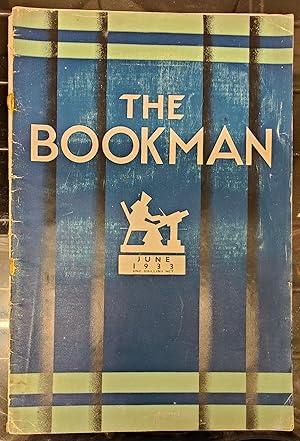
The Bookman June 1933 / Kenneth Ingram "A Century Of Anglo-Catholicism" / J R Glorney-Bolton "Polemics Without Literature" / Norah Nicholls "A Bibliography Of The Oxford Movement" / Llewelyn Powys "A Religious Reformer Of The Ancients Akhenaton, Pharaoh of Egypt, The Sun Worshipper" / Count Keyserling "'Whither Goes Germany'" / P M Stone "Long Life! - To Some Detectives" / S L Ricardo "Post Office People On The Bookshelf"
Editore: Hodder & Stoughton, 1933
Rivista / Giornale
EUR 35,36
Spedizione EUR 12,59
Spedito da Regno Unito a U.S.A.Quantità: 1 disponibili
Aggiungi al carrelloSoft cover. Condizione: Very Good. 50 pages. Illustrated. Kenneth Ingram "A Century Of Anglo-Catholicism" / J R Glorney-Bolton "Polemics Without Literature" / Norah Nicholls "A Bibliography Of The Oxford Movement" / Llewelyn Powys "A Religious Reformer Of The Ancients Akhenaton, Pharaoh of Egypt, The Sun Worshipper" / Count Keyserling "'Whither Goes Germany'" / P M Stone "Long Life! - To Some Detectives" / S L Ricardo "Post Office People On The Bookshelf" (SL#273).
-
The Whitehall Evening-Post London, from Tuesday June 7, To Thursday June 9, 1748 No. 363
Editore: The Whitehall Evening-Post, London, England, 1748
Da: Certain Books, ABAA, Bolivia, NC, U.S.A.
Membro dell'associazione: ABAA ESA ILAB
Valutazione del venditore 5 su 5 stelle

Prima edizione
Soft Cover. Condizione: Good. Periodical. [4] pages; with a couple of small woodcut illustrations; with English national, local and international newsworthy reportage as well as advertisements for medical cures & nostrums, publishers and legal announcements. Approx. 15 3/4" x 11" size; with the tax stamp lower right; very edge-chipped, closed tears, a few words lost at center-fold top; old stains; contents legible and in fair to good condition.
-

Circa 1920 Glass Plate Negative Photograph of Conditions in Germany Eight Children of Berlin Sleeping in One Room, on a Bed Made of a Broken Bedstead.by Keystone View Co.
Editore: Keystone View Co., Germany, Europe, 1920
Da: Certain Books, ABAA, Bolivia, NC, U.S.A.
Membro dell'associazione: ABAA ESA ILAB
Valutazione del venditore 5 su 5 stelle
Prima edizione
Not Bound. Condizione: Fair. Photograph. Black and white glass plate negative, approx. 6 1/2" x 7" size. Not dated, circa 1920. Remains of old paper envelope with penciled identification, "Conditions in Germany Eight Children of Berlin, Germany, sleeping in one room, on a bed made of a broken bedstead, a mattress a stool and a chair. This is typical of the present conditions existing in Germany." With the remains of the original Keystone paper mailing envelope. Plate broken, with about 20% chipped away and lost, at right margin. We have photographed this using a light-box and then inverted the image to give a positive. In fair condition.
-
The Why and the Wherefore of the Century Post Company's Mail Box - Ours, Yours and Uncle Sam's Favorite
Editore: Tecumseh, Michigan c. 1905, Tecumseh, Michigan, 1905
Da: High Ridge Books, Inc. - ABAA, South Deerfield, MA, U.S.A.
Membro dell'associazione: ABAA ESA ILAB SNEAB
Valutazione del venditore 5 su 5 stelle
12 pp. This small brochure With illustrated red wrappers touting the merits of a metal mailbox for home use. Front cover has the mailbox highlighted in silver.
-

Post Captain - Eighteenth Century - - - a Fine Coloured Print
Lingua: Inglese
Data di pubblicazione: 1898
Da: K Books Ltd ABA ILAB, York, YORKS, Regno Unito
Membro dell'associazione: ABA ILAB PBFA
Valutazione del venditore 5 su 5 stelle
EUR 23,58
Spedizione EUR 22,32
Spedito da Regno Unito a U.S.A.Quantità: 1 disponibili
Aggiungi al carrelloNo Binding. Condizione: Very Good. A splendid original antique coloured print circa 1898 . Mounted - matted - and ready to frame. Excellent condition. Shows Post Captain - eighteenth century - in full dress - in a shipping background - very detailed.
-
SECUNDA PARS HISTORIALIS VENERABILIS DÑI ANTONINI
Editore: Nicolaus Kessler, Basel, 1502
Da: Phillip J. Pirages Rare Books (ABAA), McMinnville, OR, U.S.A.
Membro dell'associazione: ABAA ILAB
Valutazione del venditore 4 su 5 stelle
313 x 215 mm. (12 1/4 x 8 1/2"). 13 p.l. (blank b6 cut away), CCXL (240), [5] leaves (lacking final blank). Part II, only, of three. Contemporary blind-stamped pigskin, raised bands, brass catch plates and remnant of two straps, thin strip of vellum from a 12th(?) century musical manuscript used as a sewing guard (visible before b1), rear cover WITH ORIGINAL IRON EYELET AND THREE LINKS OF CHAIN. Fo. I with 14-line Lombard initial in red, numerous four-line initials in red. VD16 A 2958; Adams A-1207; USTC 686502; ISTC ia00781500. Pigskin rather rubbed and darkened, vertical split to spine, corners quite worn, but the binding still completely sound and with a good deal of antique appeal. Occasional minor marginal smudges and stains, one opening with half a dozen small wax stains (nothing obscured), but excellent internally, generally clean and fresh, with leaves that crackle when you turn them. This history of the world up to the year 1360 comes in a pleasing example of a Renaissance chained binding, a design that announced to thieves and irresponsible borrowers that "this book does not circulate." Early ecclesiastical and scholastic libraries chained their most valuable books to a horizontal iron bar running along the desk where the volume would be used. An iron eyelet was typically set in the lower cover of the book, and a chain attached to this, ending in an iron ring, by which the book was fastened to the bar. This practice was common in the Middle Ages, when books were irreplaceable manuscripts, but fell out of use over the course of the 16th century, after which chained bindings became rare. It is not that uncommon to find an early binding with holes in the rear cover where the eyelet was attached, or even books where the eyelet is present, but it is a happy circumstance to find the chain still in place, as here. The present historical account is by Antonio Pierozzi (1389-1459), archbishop of Florence, canonized as St. Antoninus in 1523. He is best known for the "Summa Theologica," which earned him, in the Catholic Encyclopedia's words, "the place of honor in moral theology between St. Thomas and St. Alphonsus Ligouri." Although Antoninus unwisely accepted questionable accounts pertaining to the earlier periods of his history, "when writing of the events and politics of his own age he exercised a judgment that has been of the greatest value to later historians." (Catholic Encyclopedia) The history was first published at Venice in 1474-79, and went to four editions in the 15th century, the last being the 1491 printing from Nicolaus Kessler (or Kesler), on which this first 16th century edition is based. Kessler (ca. 1445 - ca. 1519) received his B.A. in Basel before going to work for printer Bernard Richel and marrying his employer's daughter. When Richel died in 1482, Kessler inherited the press.
-
TEXTUS SEQUENTIARUM COM EXPOSITIONE LUCIDA AC FACILI. [and its supplement] SEQUENTIE NOVITER ADDITE. [with] EXPOSITIO HIMNORUM
Editore: Michael Furter, Basel, 1504
Da: Phillip J. Pirages Rare Books (ABAA), McMinnville, OR, U.S.A.
Membro dell'associazione: ABAA ILAB
Valutazione del venditore 4 su 5 stelle
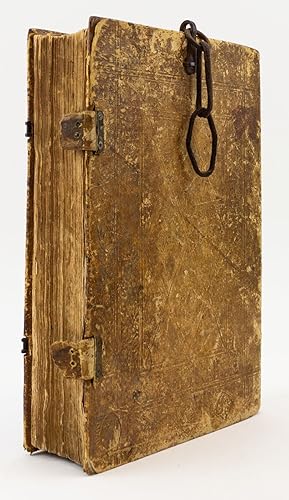
220 x 138 mm. (8 x 5 1/2"). CXXII, [10], LXX, [1] leaves. EXCELLENT CONTEMPORARY BLIND-TOOLED CALF, covers panelled in blind, title stamped in gothic letters at head of upper cover, central panel with vertical row of three large rosettes (EBDB tool s013635), this enclosed by a frame with eight carnation stamps (EBDB tool s013643), then by a roll-tooled frame filled with circles containing flowers, fruit, and stars (EBDB tool r000675; Kyriss 84, Roll 6), lower cover similarly framed, but with central panel divided by diagonal blind rules into four compartments, each containing a large rosette, raised bands, spine panels with one or two floral medallion stamps, upper cover with original brass catches stamped "IVIII," newer clasps and leather straps, probably newer pastedowns, fore edge with the number "75" in ink (subtle repairs to head and tail of spine as well as lower corner on back cover). Title and opening page with decorative woodcut initials, main title and sectional title each with woodcut vignette and full-page woodcut on verso. VD16 T-653; VD16 H-6510; Adams L-1124, L-1123. For the binding: Kyriss 84, Tafel 171, Rolle 6; EinbandDatenbank (EBDB) tools s013635 and r000675, workshop w002075. An ink stain touching text on one leaf and slightly affecting four adjacent leaves, but the vast majority of the contents clean, fresh, and in fine condition. Quarter-inch crack at top of each joint (with leather across the spine consequently becoming a small flap), light signs of wear to leather, hinges mostly open--but the binding entirely sound, with almost no wear at all to the joints. An extremely attractive volume, THE REMARKABLY WELL-PRESERVED BINDING FEATURING FINE, DEEP IMPRESSIONS OF ITS STAMPS. This is a rare early compilation of Medieval liturgical chants in an appealing binding by an Augsburg workshop. Kyriss dubbed this bindery Hirsch-Rolle I for its distinctive deer (i.e., "hirsch") roll tool, and noted it was active 1483-1532. EBDB, the bindings database of the Berlin State Library, has identified 26 bindings in German libraries from this workshop. The wide, attractive floral roll here is most unusual among the binding's wide array of design elements, from flowers and plants to stars, all contained in tightly packed circles that bring bubbles to mind. Our two texts contain "sequences"--words sung between the Gradual and the Gospel on festival occasions--written by, among others, Gregory the Great, the fourth century bishops Hilarius of Poitiers and Ambrose of Milan, and fifth century Latin Christian poet Coelius Sedulius. They were printed by Michael Furter (d. ca. 1516-17) who operated a press in Basel from 1489 into the second decade of the 16th century. He was especially known for the decorative nature of his volumes. Haebler's "Typenrepertorium" counted 12 sets of embellished woodcut initials Furter employed; examples from two of these sets may be seen here, on the title page of the first work and at the opening of the text in both. The woodcut illustrations here are also notable. The title woodcut (Schramm XXII, 1263) on the first work is a depiction of the Magi presenting gifts to the Christ Child and his mother, done early in the career of Albrecht Dürer (1471-1528). It was one of the "Basel Prayer Book Woodcuts," 25 illustrations likely meant for a "Hortulus Animae" Johann Bergmann von Olpe intended to print in 1494 but never issued. A large, striking woodcut depicting the Christ Child at the center of a sunburst, surrounded by medallions with the devices of the four Evangelists, appears on the verso of the title in the first work and on the title page of the second. On the verso of the second title page is a woodcut of the Crucifixion from the "Postilla" by Guillelmus Parisiensis, Basel 1491 (Schramm XXII, 336). This is an especially affecting and detailed scene: Mary Magdalene clings to the foot of the cross, while Jesus looks serenely down at the Virgin Mary, who is collapsing in the arms of another woman as several soldiers jeer. On either side of Christ, the souls of the thieves crucified with him are being taken, one--who had asked to be remembered when Jesus came into his Kingdom--by angels, the other by demons. A banner marked with the SPQR of the Roman Empire flutters in the background. All in all, this is a very pleasing exemplar of post-incunabular book-making.


![Immagine del venditore per TEXTUS SEQUENTIARUM COM EXPOSITIONE LUCIDA AC FACILI. [and its supplement] SEQUENTIE NOVITER ADDITE. [with] EXPOSITIO HIMNORUM venduto da Phillip J. Pirages Rare Books (ABAA)](https://pictures.abebooks.com/inventory/md/md31487226523.jpg)