

Importo totale (1 articolo articoli):
Destinazione ordine:

chneour s (13 risultati)
Vai alla pagina principale dei risultati di ricerca
Filtri di ricerca
Tipo di articolo
- Tutti i tipi di prodotto
- Libri (13)
- Riviste e Giornali (Nessun altro risultato corrispondente a questo perfezionamento)
- Fumetti (Nessun altro risultato corrispondente a questo perfezionamento)
- Spartiti (Nessun altro risultato corrispondente a questo perfezionamento)
- Arte, Stampe e Poster (Nessun altro risultato corrispondente a questo perfezionamento)
- Fotografie (Nessun altro risultato corrispondente a questo perfezionamento)
- Mappe (Nessun altro risultato corrispondente a questo perfezionamento)
- Manoscritti e Collezionismo cartaceo (Nessun altro risultato corrispondente a questo perfezionamento)
Condizioni Maggiori informazioni
- Nuovo (Nessun altro risultato corrispondente a questo perfezionamento)
- Come nuovo, Ottimo o Quasi ottimo (2)
- Molto buono o Buono (3)
- Discreto o Mediocre (Nessun altro risultato corrispondente a questo perfezionamento)
- Come descritto (8)
Legatura
Ulteriori caratteristiche
- Prima ed. (4)
- Copia autograf. (Nessun altro risultato corrispondente a questo perfezionamento)
- Sovracoperta (Nessun altro risultato corrispondente a questo perfezionamento)
- Con foto (8)
- Non Print on Demand (13)
Lingua (5)
Spedizione gratuita
- Spedizione gratuita in U.S.A. (Nessun altro risultato corrispondente a questo perfezionamento)
Paese del venditore
Valutazione venditore
-

Noë Pandré
Editore: NRF Gallimard, 1937
Da: Librairie des Possibles, ROUFFACH, Francia
Valutazione del venditore 5 su 5 stelle

EUR 10,00
Spedizione EUR 17,00
Spedito da Francia a U.S.A.Quantità: 1 disponibili
Aggiungi al carrellopaperback. Traduit du yiddish Fred Midal. NRF Gallimard Blanche 1937. in-12. 256 pages. Traduit du yiddish Fred Midal. NRF Gallimard Blanche 1937. in-12. 256 pages. Nb de volume : 1. Usure d'usage. Dos et bords des plats insolés. Une trace de mouillure sur le plat avant. Noë Pandré est le premier livre de S.Chnéour traduit en français. C?est aussi le premier volume d?une série dont le tritre général est Les Rustres. Le héros de l?ouvrage est une sorte de Don Quichotte, il symbolise les humbles, les illettrés, les «naïfs» qui étayent de l?épaule toute une société. S. Chneour est né en 1887 à Chklow, en Russie. En 1906, il émigre en Suisse, puis à Paris. Il passe la première guerre mondiale en Allemagne dans un camp de concentration. En 1924, il se fixe en France. En trente ans, il a écrit plus de quarante volumes, soit en hébreux, soit en yiddish. Il est connu comme classique de la langue hébraïque moderne.
-

Noë Pandré
Lingua: Francese
Editore: NRF - Gallimard, Paris, 1937
Da: AHA BOOKS, SAINT-JEAN-LE-COMTAL, Francia
Valutazione del venditore 5 su 5 stelle
EUR 13,10
Spedizione EUR 23,00
Spedito da Francia a U.S.A.Quantità: 1 disponibili
Aggiungi al carrelloBroché. Condizione: Très bon. 3ème Édition. Traduit du Yddisch par Fred MIDAL Cachet de bibliothèque de "Association Culturelle Israélite de Pau" Intérieur frais. Non découpé.
-

Noë Pandré.
Editore: Editions Gallimard. 1937., 1937
Da: Loïc Simon, Blaison-Saint Sulpice, FR, Francia
Valutazione del venditore 5 su 5 stelle
EUR 20,00
Spedizione EUR 19,00
Spedito da Francia a U.S.A.Quantità: 1 disponibili
Aggiungi al carrelloTraduit du Yddisch par Fred Midal. Broché. 255 pages.
-
Szklower Iden
Editore: Wilno 's, 1920
Da: John Trotter Books, London, Regno Unito
Valutazione del venditore 5 su 5 stelle
EUR 18,03
Spedizione EUR 22,76
Spedito da Regno Unito a U.S.A.Quantità: 1 disponibili
Aggiungi al carrelloHardcover. Yiddish Text. Loose in Binding. Reading Copy.
-

NOE PANDRE
Editore: GALLIMARD, 1937
Da: Le-Livre, SABLONS, Francia
Membro dell'associazione: ILAB
Valutazione del venditore 5 su 5 stelle
EUR 25,80
Spedizione EUR 42,00
Spedito da Francia a U.S.A.Quantità: 1 disponibili
Aggiungi al carrelloCouverture souple. Condizione: bon. R260182261: 14-6-1937. In-12. Broché. Bon état, Couv. convenable, Dos satisfaisant, Intérieur frais. 254 pages. . . . Classification Dewey : 840.091-XX ème siècle.
-
THE GHETTO LANE IN VILNA schaubucher 27
Lingua: Inglese
Editore: ORELL FUSSLI PUB., ZURICH, 1931
Da: Gian Luigi Fine Books, Albany, NY, U.S.A.
Valutazione del venditore 5 su 5 stelle
Prima edizione
Hardcover. Condizione: Very Good. 1st Edition. FELDHEIM'S BOOK STORE LABEL TO THE FRONT PASTE-DOWN.
-
EUR 242,00
Spedizione EUR 28,95
Spedito da Francia a U.S.A.Quantità: 1 disponibili
Aggiungi al carrelloCartonnage. DOCUMENT PHOTOGRAPHIQUE RECHERCHÉ SUR LE GHETTO DE VILNIUS DONT LA POPULATION QUI QUASIMENT ENTIÈREMENT EXTERMINÉE PAR L'ALLEMAGNE NAZI. Livre de photographies de 1931, In-8 (3 cm sur 19,4 cm), couvertures illustrées, dos toile orange, 7 pages d'introduction en allemand, suivi de 64 planches (certaines planches comportent plusieurs photographies) de photographies hors-texte. Le livre à pour quatrième de couverture, la couverture en yiddish puis la traduction du texte d'introduction de 7 pages en yiddish également, le livre peut donc être pris dans les deux sens ; bel exemplaire. Livraison a domicile (La Poste) ou en Mondial Relay sur simple demande. Vorobeichic Moshe.
-
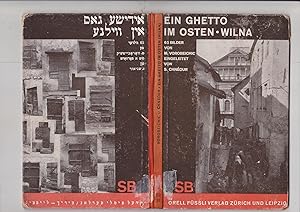
Ein Ghetto Im Osten - Wilna (A Ghetto in the East - Vilna) [WITH] A Collection of 14 Original Photographs by Moï Ver, Which Are Not Included in the Book
Editore: Orell Füssli Verlag, Zurich, 1931
Da: ERIC CHAIM KLINE, BOOKSELLER (ABAA ILAB), Santa Monica, CA, U.S.A.
Membro dell'associazione: ABAA ILAB
Valutazione del venditore 3 su 5 stelle

Prima edizione
Hardcover. Condizione: Good to very good+ condition. First German edition. Octavo. 7 (1)pp., 64 plates, 6 (1)pp. Orange quarter cloth over original b/w photo-sillustrated paper boards, protected in original glassine. Pre- W.W.II photo essay on the so-called Jewish Ghetto of Vilna and its residents. Published as number 27 in the famous series of German photo books, Schaubücher. This version is printed with text in German and Hebrew, with an introduction by S. Chneour. Lithuanian photographer Moshe Raviv-Vorobeichic studied at the Bauhaus in the 1920s and at the Ecole de Photo Cine in Paris. Following his studies, he returned home and created this scarce prewar document. Early montage and double exposure techniques exemplified in his work. Photographic study of Jewish Vilna prior to the Holocaust. Photographic reproductions, some photo-montages of Jews at play, many buildings, walkways, stairs, and portraits. Captions in German and Hebrew. Martin Parr: The Photobook Vol. 1, page 130. Text in German and Hebrew. Front cover with small bump at lower edge, near foredge. Text pages with some foxing. Binding in overall good, interior in good, photos in very good+ condition. [WITH] A collection of 14 original b/w photographs from the same Vilna Ghetto Project by Moï Ver, originally taken circa 1928. 12 of the photographs are smaller sized, measuring on average, approximately 4 1/2 x 3", with some variation in the cut dimensions. There are also 2 larger images, one measuring 5 1/4 x 7 1/2" showing the roof of the Great Synagogue of Vilna and the largest showing the gate of the synagogue's courtyard, measuring 8 1/4x 11 1/2". Surprisingly none of these evocative and striking images of the Vilna Ghetto and its inhabitants were used ultimately used in the book, but many are quite similar to the images which did get used. These photographs are likely later prints made from the original negatives, and all contain the ink stamp of the acclaimed phtographer's studio in Tel Aviv, on the verso. The versos of the two larger images also include notes in pen in German, with one dated to 1928.
-
Ein Ghetto im Osten (Wilna). 65 Bilder Von M. Vorobeichic. Eingeleitet Von S. Chneour
Lingua: Tedesco
Editore: Orell Füssli Verlag, Zürich and Leipzig, 1931
Prima edizione
Hardcover. Condizione: Very Good. No Jacket. 1st Edition. First edition 1931. Hebrew and German languages. Published by Orell Füssli Verlag, Zürich and Leipzig. SchauBucher 27. Hardcover in photographic boards with cloth spine without DJ as issued. Condition very good, square tight and clean book, edgewear, corners not bumped but worn, no names, no foxing, no names, no underlinings, no highlights, no bent page corners, not a reminder. 12mo, 8 + 5 pages, 65 plates. Scarce edition. ASIN ? : ? B000OTEIXC.
-
Ein Ghetto im Osten. Wilna. 65 Bilder von M. Vorobeichic, eingeleitet von S. Chnéour
Lingua: Medio alto tedesco (ca.1050 - 1500)
Editore: Orell Fussli Verlag, Zurich, Leipzig, 1931
Prima edizione
Hardcover. Condizione: Very Good. 1st Edition. Original orange and black publisher's photo-illustrated boards. First edition of Vorobeichic's pre-WWII photo-essay on Lithuanian Jews, with 65 black-and-white photographic images and photocollages. Lithuanian-born photographer Moshé Raviv-Vorobeichic trained at the Bauhaus in the 1920s and after studying at the École de Photo Ciné in Paris, returned to visit his family and photographed life in the Jewish community of Vilnius, Lithuania¿s capital. The result was Ein Ghetto im Osten, Wilna. A poignancy has been added in hindsight since it was made at the beginning of a desperate time for European Jewry. With preface by poet Zalman Chnéour in both Yiddish and German. "In the same year that his Paris was published, Moï Ver - under his real name of Moshé Vorobeichic- produced Ein Ghetto im Osten (A Ghetto in the East). Even more so than Paris, Ein Ghetto im Osten was ostensibly a documentary book, but as he had done in his view of the French city, Moï Ver once again used a variety of New Vision strategies, the most obvious being to take many images from upstairs windows looking on to the narrow streets of Vilnius's old Jewish quarter. This creates odd angles and a dynamic mise en scène for his pictures of people going about their everyday business on the street. He also introduced cinematic cutting and montaging techniques to heighten the interest. 7 pages in German, 64 leaves of photos, 7 pages in Yiddish.
-

Ein Ghetto im Osten (Wilna). Schaubücher 27
Editore: Zürich u. Leipzig, Orell Füssli,, 1931
Da: Antiquariat Kunsthaus-Adlerstrasse, Stuttgart, Germania
Valutazione del venditore 5 su 5 stelle
EUR 280,00
Spedizione EUR 11,95
Spedito da Germania a U.S.A.Quantità: 1 disponibili
Aggiungi al carrelloill. Orig.-Halbleinen. 7 S. u. 64 Tafeln mit insg. 65 fotogr. Bildern von M. Vorobeichic. Sprachen: Deutsch u. Hebräisch. Einb. etw. lichtverf. u. berieb., Name auf Vorsatz. Gutes Exemplar. Sprache: Deutsch.
-
Ein Ghetto Im Osten Wilna (A Ghetto in the East, Wilna [Vilna])
Editore: Zurich Orell Fussli, 1931
Da: Fishburn Books ABA, ILAB, London, Regno Unito
Membro dell'associazione: ABA ILAB PBFA
Valutazione del venditore 5 su 5 stelle
EUR 336,59
Spedizione EUR 29,18
Spedito da Regno Unito a U.S.A.Quantità: 1 disponibili
Aggiungi al carrelloFirst edition. Original decorative paper covered boards, 187 x 125 mm. Some wear to extremities, some foxing to end-papers otherwise overall good condition. 80 pp. 65 black and white photographs. This edition is in German and Hebrew. See Parr, M. and Badger, G. The Photobook: A History Volume 1. p. 130 ".he used a variety of New Vision Strategies, the most obvious to take many images from upstairs windows looking on to the narrow streets of Vilnius's old Jewish quarter. This created odd angles and a dynamic mise en scene for his pictures of people going about their everyday business on the street, dramatizing commonplace activities such as market shopping and conversing with neighbours. He also introduced cinematic cutting techniques to heighten the interest. He combined elements of imagery, sometimes by double-printing negatives, sometimes by repeating identical or similar pictures.".
-
Ein Ghetto Im Osten Wilna (A Ghetto in the East, Wilna [Vilna])
Editore: Zurich Orell Fussli, 1931
Da: Fishburn Books ABA, ILAB, London, Regno Unito
Membro dell'associazione: ABA ILAB PBFA
Valutazione del venditore 5 su 5 stelle
EUR 420,74
Spedizione EUR 29,18
Spedito da Regno Unito a U.S.A.Quantità: 1 disponibili
Aggiungi al carrelloFirst edition. Original decorative paper covered boards, 187 x 125 mm. Minor signs of wear, otherwise very good condition. 80 pp. 65 black and white photographs. This edition is in German and Hebrew. See Parr, M. and Badger, G. The Photobook: A History Volume 1. p. 130 ".he used a variety of New Vision Strategies, the most obvious to take many images from upstairs windows looking on to the narrow streets of Vilnius's old Jewish quarter. This created odd angles and a dynamic mise en scene for his pictures of people going about their everyday business on the street, dramatizing commonplace activities such as market shopping and conversing with neighbours. He also introduced cinematic cutting techniques to heighten the interest. He combined elements of imagery, sometimes by double-printing negatives, sometimes by repeating identical or similar pictures.".


![Immagine del venditore per Ein Ghetto Im Osten - Wilna (A Ghetto in the East - Vilna) [WITH] A Collection of 14 Original Photographs by Moï Ver, Which Are Not Included in the Book venduto da ERIC CHAIM KLINE, BOOKSELLER (ABAA ILAB)](https://pictures.abebooks.com/inventory/md/md31176449965.jpg)

![Immagine del venditore per Ein Ghetto Im Osten Wilna (A Ghetto in the East, Wilna [Vilna]) venduto da Fishburn Books ABA, ILAB](https://pictures.abebooks.com/inventory/md/md31920116744.jpg)