
Couse e i (3 risultati)

Lingua: Inglese
Editore: The Century Company, NY, 1900
Da: Legacy Books II, Louisville, KY, U.S.A.Legacy Books II
Contatta il venditoreVenditore con 4 stelleCondizione: Usato - Molto buono
EUR 7,67
EUR 5,12 spedizioneSpedito in U.S.A.Quantità: 1 disponibili
No Binding. Condizione: VG. Sized 6.5 x 9.5 inches, engraved by Chadwick after the Fogarty drawing, salvaged from a damaged issue of The Century Illustrated Monthly Magazine, Volume LX, No. 2, June, 1900. The winner of the shaw Prize Fund for Black-and-White, at the Salmagundi Club Exhibition, 1899.
Editore: W. J. Black; American Lithographic Company, Incorporated, 1931
Da: Barry Cassidy Rare Books, Sacramento, CA, U.S.A.Barry Cassidy Rare Books
Contatta il venditoreVenditore con 5 stelleCondizione: Usato - Molto buono
EUR 45,10
EUR 5,25 spedizioneSpedito in U.S.A.Quantità: 1 disponibili
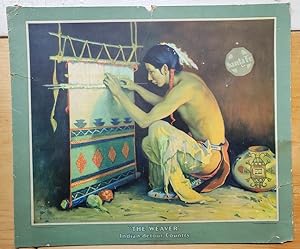
No Binding. Condizione: Very Good. Original advertising card for the Santa Fe Railway. Features a reprint on the front of E. I. Couse's painting, The Hopi Weaver. The painting depicts a Hopi man in the process of weaving on a loom. 13 3/4" x 11 3/4." The back of the card includes a map of the Santa Fe Railway lines in the United… States and a brief description about the painting. The card is clean and intact overall. Bumping to all of the corners. Lower-right corner has a small chip. Several holes from staples or pins in the margins. Slight edge wear. The center illustration has a wrinkle coming from the top edge. There are two closed tears on either side of the card, mostly limited to the margins and coming in slightly onto the center illustration (millimeters inward onto the illustration). A Very Good copy. Eanger Irving Couse (1866-1936) was an American painter best-known for his paintings of the Taos Pueblo and their culture. He helped found the Taos Society of Artists and was the organization's first president. Couse also depicted other Indigenous cultures in his art. The work of Couse was well-received in his career, especially at a time when it was perceived that the "Old American West" was disappearing. There is a description on the back about the tradition of weaving in the Hopi and Dine (Navajo) cultures. The following is an excerpt from this description: "Although the Navajo and Hopi have lived side by side for centuries, there are today almost as many interesting differences in the product of their looms as in their physical characteristics and modes of life. . Navajo weaving almost invariably is done by the women, while among the Hopis the man is the weaver. Some seventy-five years ago the Navajo weaver commenced to work with an ever growing variety of intricate geometrical designs: the Hopi, however, clings more closely to the simplicity of the ancient patterns." The Santa Fe Railway, or the Atchison, Topeka and Santa Fe Railway (AT&SF), was chartered in 1859. It serviced the cities of Atchison and Topeka in Kansas and Santa Fe, New Mexico. AT&SF eventually merged with the Burlington Northern Railroad to become the Burlington Northern & Santa Fe (BNSF) Railway which operates to this day. Couse, E. I. (illustratore).
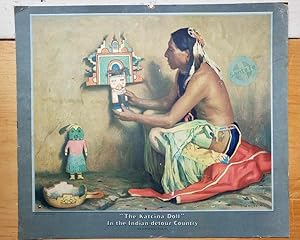
Original Advertising Card for the Santa Fe Railway: "The Katcina Doll," In the Indian-detour Country
Editore: W. J. Black; American Lithographic Company, Incorporated, 1929
Da: Barry Cassidy Rare Books, Sacramento, CA, U.S.A.Barry Cassidy Rare Books
Contatta il venditoreVenditore con 5 stelleCondizione: Usato - Molto buono
EUR 45,10
EUR 5,25 spedizioneSpedito in U.S.A.Quantità: 1 disponibili
No Binding. Condizione: Very Good. Original advertising card for the Santa Fe Railway. Features a reprint on the front of E. I. Couse's painting, The Katcina Doll. The painting depicts a Taos Pueblo man holding a kachina doll. 13 3/4" x 11 3/4." The back of the card includes a map of the Santa Fe Railway lines in the United Stat…es and a brief description about the painting. The card is clean and intact overall. Most of the wear is in the margins not affecting the center illustration. Bumping at the top corners and lower-left corner on front. Several holes from staples or pins in the margins. Slight edge wear. The center illustration has a couple wrinkles and a few tiny dampstains and marks. The back has several pen scribbles, mostly limited to the margin. Several dampstains are visible on the back. A Very Good copy. Eanger Irving Couse (1866-1936) was an American painter best-known for his paintings of the Taos Pueblo and their culture. He helped found the Taos Society of Artists and was the organization's first president. Couse also depicted other Indigenous cultures in his art. The work of Couse was well-received in his career, especially at a time when it was perceived that the "Old American West" was disappearing. There is a description on the back about the kachina doll and its role in Hopi and Taos Pueblo cultures. The following is an excerpt from this description: "Among the Hopi Indians the word 'Katcina' is applied to supernatural beings . to any ceremonial dance in which these masked figures appear, to the masks themselves, or to small wooden statuettes carved in imitation of masked dancers and known as tihus, or dolls. . These brilliantly colored and fantastically adorned Katcina dolls are not idols, nor are they worshipped. They are made by the Hopi men and are give to little girls by the women, either during the close of one of the tribe's great winter ceremonies or at the close of Niman, or farewell ceremony, in July. . For many years Katcina dolls have found their way into the Rio Grande pueblos, and possibly the Taos Indian depicted by Mr. Couse obtained his specimen in trade for some of his justly prized tanned buckskin." The Santa Fe Railway, or the Atchison, Topeka and Santa Fe Railway (AT&SF), was chartered in 1859. It serviced the cities of Atchison and Topeka in Kansas and Santa Fe, New Mexico. AT&SF eventually merged with the Burlington Northern Railroad to become the Burlington Northern & Santa Fe (BNSF) Railway which operates to this day. Couse, E. I. (illustratore).


