
Derome jeune (9 risultati)
 Altre immagini
Lingua: Inglese
Editore: Antoine Boudet, Paris 1752
- Rilegato
Da: Verba Vetera, Uppsala, UPPLA, SveziaVerba Vetera
Contatta il venditoreVenditore con 4 stelleCondizione: Usato - Buono
EUR 376,76
EUR 14,50 spedizioneSpedito da Svezia a U.S.A.Quantità: 1 disponibili
Full Leather (red morocco). Condizione: Good. Nouvelle édition. Red morocco gilt binding richly tooled in an 18th century Louis XV style, with gilt doublures and all edges gilt. Contemporary pencil note attributes the binding to the workshop of Derome le jeune (c.1760-1780). Printed in Paris by the Imprimeur du Roi Antoine Boude…t. Interior clean, crisp and complete at 360 pages. Binding sound with light rubbing to extremities, small tears at spine ends. A refined Jesuit devotional in a luxury binding. Derome le jeune (illustratore).
 Altre immagini
La Conjuracion de Catalina y la Guerra de Jugurtha.
Sallustius, Caius Crispus. Ibarra's magnificent Spanish Sallust bound by Derome le Jeune
Editore: Madrid, Joaquin Ibarra 1772
- Rilegato
Da: Hünersdorff Rare Books ABA ILAB, London, , Regno UnitoHünersdorff Rare Books ABA ILAB
Contatta il venditoreVenditore con 3 stelleCondizione: Usato - Ottimo
EUR 17.904,83
EUR 26,07 spedizioneSpedito da Regno Unito a U.S.A.Quantità: 1 disponibili
Hardcover. Condizione: Fine. Special Edition. Sallustius, Caius Crispus. La Conjuracion de Catalina y la Guerra de Jugurtha. Madrid, Joaquin Ibarra, 1772. Folio (35.7 x 26cm). [10]f including half title, engraved title, and portrait + 395 + [1]p. Spanish text set in a large calligraphic italic, Latin original below in a small ro…man type arranged in double columns, both designed by Antonio Espinoza. With 9 full-page engraved plates (including a map of Africa by Juan de la Cruz, the royal geographer) and a variety of 34 smaller textual illustrations (including 12 head- and tail-pieces, 6 initials, and 16 numismatic reproductions) engraved by E. Montfort, Salvador Carmona, T. Ballester, J. J. Fabregat. F. Assensio and Muntaner after designs by M. S. Maella, J. Carnizero and Selma. Bound in contemporary dark green morocco decorated with multiple gilt borders, six compartments of spine richly gilt, one with morocco title label, inner gilt doublures, pink silk end papers, edges gilt (by Derome le Jeune with engraved binder s ticket, dated 1785 in tailend blank margin of title); ends of spine and corners lightly worn. Large paper copy bound by Nicolas Denis Derome (1761-88) of Ibarra s magnificent Spanish Sallust, one of the finest books ever produced, and the most perfectly printed Spanish book. The beautiful large calligraphic italic and the delicate roman types, cut by Antonio Espinoza, are admirably complemented by exquisite engravings by leading artists, based mostly on designs by the court painter Maella. This Spanish version of Sallust s Conspiracy of Cataline and the Jugurthan War by the Infante Don Gabriel Antonio de Bourbon, the artistic second son of King Carlos III, was carefully revised and corrected by Pérez Bayer who had added a scholarly essay on the alphabets and the language of the Phoenicians (pp337-338) and extensive indices. The supplement is illustrated with 2 engraved plates with comparative tables of specimens of Phoenician, Hebrew and Maltese-Greek alphabets, and with 16 representations of Phoenician coins and medals. Updike states that 120 large paper copies were printed on a rich, creamy, handmade paper , and that these were mostly presented by the translator, Don Gabriel, to relations, friends, and persons of distinction. Outer edges of top margins with occasional light traces of foxing, otherwise a fine copy from the library of Dawson Turner (1775-1858), banker, botanist and antiquarian, with his ownership ink signature in top margin on recto of front blank leaf dated 1812. With 20th century bookplate of Antonio Llano Diaz de Quijano.Cohen-De Ricci, col.938; Heredia 2994 (Salvá copy); Palau 288134; Updike, Printing Types (1937), II, pp55 & 72-3 (with reproduction of text under no 233).

Les vies des plus illustres philosophes de l'antiquité. Avec leurs Dogmes, leurs Systêmes, leur Morale, & leurs Sentences les plus remarquables. Traduite du grec de Diogène Laërce. Auxquelles on a ajouté la Vie de l'Auteur, celles d'Epictete, de Confucius, . & un Abrégé historiques de la Vie des Femmes Philosophes de l'Antiquité (trans. by de Chaufepied). 3 vols.
BEAUTIFULLY BOUND PROBABLY BY DEROME LE JEUNE. - DIOGENES LAERTIUS.
Editore: Amsterdam, J. H. Schneider 1758
- Rilegato
Da: Hellmut Schumann Antiquariat, Zurich, , SvizzeraHellmut Schumann Antiquariat
Contatta il venditoreVenditore con 5 stelleCondizione: Usato
EUR 10.630,87
EUR 40,00 spedizioneSpedito da Svizzera a U.S.A.Quantità: 1 disponibili
With 3 engr. frontispieces by (Christian Friedrich) Fritzsch, 4 engr. title-vignettes, 1 vignette, and 28 engr. portrait plates. 12mo. Contemp. red morocco, flat spines richly gilt with tiny stars and dotted lines, wide gilt border composed of small stars and fleurons, fillets, dotted lines, and arabesques around sides, gilt out…er and inner dentelles, edges gilt (by Derome le jeune?). Amsterdam, J. H. Schneider, 1758. Fine set in an elegant binding of the lives of the most famous philosophers of antiquity, by the historian and epicurean philosopher Diogenes Laërtius (fl. c. A.D. 222-235). Not much is know about him, he is also sometimes thought to have been a Christian. The work is divided into two sections, dealing with the Ionian and the Italian schools. The present edition is illustrated with 28 fine full-page portraits; the plates are not signed, but they might be the work of Christian Friedrich Fritzsch (c. 1719-1774) who was active for Amsterdam publishers for some time and did portraits. As to the translator, Hoefer knows one Jacques-Georges de Chauffepié (1702-1786) from Leeuwarden, a biographer and protestant minister, who translated mostly from the English; he maybe identical to the present assumed de Chaufepied. - Quérard, La France littéraire, II, 564 (mentions Chaufepied as translator); Brunet II, 721; Lewine 147; Barbier 1028 c (mentions Schneider as translator). LITERATURE: FRENCH ; ILLUSTRATED BOOKS (BEFORE 1900) .
 Altre immagini
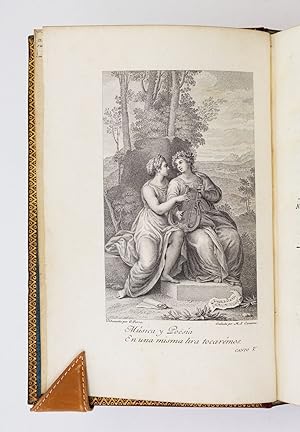
LA MUSICA, POEMA
(BINDINGS - DEROME LE JEUNE). (MUSIC, POETICAL TREATISES ON). YRIATE [or IRIATE], TOMAS DE
Editore: Imprenta Real, Madrid 1779
- Prima edizione
Da: Phillip J. Pirages Rare Books (ABAA), McMinnville, OR, U.S.A.Phillip J. Pirages Rare Books (ABAA)
Contatta il venditoreVenditore con 3 stelleCondizione: Usato
EUR 7218,40
EUR 8,64 spedizioneSpedito in U.S.A.Quantità: 1 disponibili
FIRST EDITION. 235 x 150 mm. (9 1/4 x 6"). 10 p.l., 126, XL pp., [1] leaf (errata). EXCELLENT CONTEMPORARY CRIMSON MOROCCO BY DEROME LE JEUNE (his ticket with address of Rue St. Jacques on verso of front free endpaper), covers framed with thick and thin gilt rules, raised bands, spine compartments with central floral sprig surro…unded by a lozenge of small tools, volute cornerpieces, gilt titling, gilt-rolled turn-ins, gilt edges, cobalt blue paste-paper endpapers. WITH SIX CHARMING ENGRAVED ALLEGORICAL PLATES after G. Ferre. Front pastedown with morocco bookplate of Mortimer L. Schiff and small book label with a gilt cipher on a red peach. A Large Paper Copy. Palau y Dulcet IV, 107; RSIM B VI, 429; MGG VI, 1403 f.; Gregory-Bartlett I, 129. Three minute dents to front board, a hint of wear to bands and corners, isolated faint foxing, blank recto of frontispiece leaf and blank verso of final leaf with faint blue shadown from endpapers, but all of these quite trivial, and otherwise A BEAUTIFUL COPY--fresh, clean, and bright internally, with very wide margins and strong impressions of the plates, and in a lustrous binding showing with few signs of use. This is surely one of the handsomest poetical treatises on music ever produced, and it is offered here in a binding done by one of the finest craftsmen working in Europe during the period of the book's publication. The work is written in the "silva" form of poetry used by persons of high rank, illustrated with fine engravings, and put into elegant morocco by the finest hands among the large Derome family of binders. According to Palau, our first edition is "beautiful, and printed on fine paper." He says further that, although the strongly expressed opinions of the youthful author on contemporary composers caused the work to be "unfairly attacked," it was "appreciated by professors of music and collectors of literature in that genre," especially in Italy and America. A child of the Enlightenment, Iriate (1750-91) gained entry to intellectual and artistic circles in Madrid through his uncle, who was librarian to the king of Spain. He translated works by Horace and Virgil into Spanish by royal request, and wrote criticism, poetry, and dramas. He is best known for his satirical fables on the contemporary literary scene, "Fábulas literarias." There were no fewer than 18 members of the Derome family who made their livings as binders in Paris from the middle of the 17th century until the first quarter of the 19th, but by far the most distinguished family member was Nicolas-Denis, called "le jeune" (1731-88). Known for the gracefulness of his bindings, and for being capable of "amazing delicacy" (in Hobson's words), Derome le jeune was, simply, the leading binder of the day, and his work was much in demand. Because he refused to turn away customers, Derome was forced to hire a number of assistants, whose work he could not always supervise closely. However, Thoinan says that the binder's best work is indicated by the presence of his ticket, as here. The volume's provenance adds to its luster: it was in the distinguished library of American bibliophile Mortimer Schiff (1877-1931). In Dickinson's words, Schiff, a financier and philanthropist, Schiff "brought together an unrivaled collection of decorative bindings." His library included works by great printers, important illustrated books, and works printed on vellum, but chiefly fine and historic bindings. The "Reliures" database of the Bibliothèque Nationale de France commends Schiff for assembling "one of the most important inter-war libraries," noting that his collection was "renowned for its collection of French bindings.".
 Altre immagini
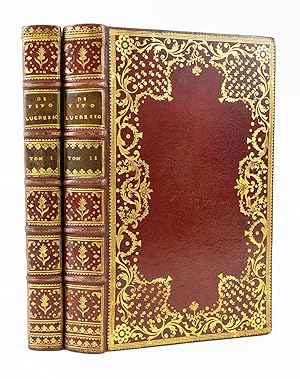
DI TITO LUCREZIO CARO DELLA NATURA DELLE COSE
(BINDINGS - DEROME LE JEUNE). (FRENCH ILLUSTRATED BOOKS). LUCRECE. [LUCRETIUS CARUS, TITUS]
Editore: A spese dell'editore To. Po, Amsterdam [i.e., Paris] 1754
Da: Phillip J. Pirages Rare Books (ABAA), McMinnville, OR, U.S.A.Phillip J. Pirages Rare Books (ABAA)
Contatta il venditoreVenditore con 3 stelleCondizione: Usato
EUR 7866,21
EUR 8,64 spedizioneSpedito in U.S.A.Quantità: 1 disponibili
230 x 144 mm. (9 1/8 x 5 3/4"). Two volumes. Translated from Latin into Italian by Alessandro Marchetti. SPLENDID CRIMSON MOROCCO, GILT, BY DEROME LE JEUNE (his ticket with address of Rue St. Jacques on front pastedown of volume I), covers with border of multiple gilt rules and dotted rolls enclosing an ornate Rococo frame of fl…owers, acanthus leaves, garlands, catkins, and grape clusters, the cornerpieces semé with floral sprigs, raised bands, spines gilt in compartments with pineapple centerpiece within a lozenge of small tools, volute cornerpieces, two brown morocco labels, gilt-rolled turn-ins, marbled endpapers, all edges gilt. Copper-engraved frontispiece and title page after Eisen in each volume, six engraved plates by Lemire, Aliamet and others after Cochin, Eisen, and Le Lorrain, and seven vignette headpieces and five vignette tailpieces, most after Cochin. Gordon 505; Brunet III, 1222. For the illustrations: Cohen-de Ricci 665-6; Fürstenberg, p. 86; Ray 9. âSlight wear to corners, somewhat broad (but faint) offsetting to flyleaves from turn-in glue, just a hint of offsetting from engravings, but A LOVELY SET IN VERY FINE CONDITION, clean and fresh internally with comfortable margins and excellent impressions of the engravings, and the nearly unworn bindings bright with gilt. This attractively printed Italian translation of "De Rerum Natura" boasts "very beautiful" engravings, in the opinion of Cohen-de Ricci, and opulent bindings by one of the greatest names in the history of French bookbinding. Written in the first century B.C., the text here is considered one of the best expositions on the philosophy of Epicurus. Popular in the Roman Empire, it fell into obscurity before being rediscovered by Italian humanist Poggio Bracciolini in the 15th century. It became one of the most influential humanist texts of the Renaissance and the Enlightenment, inspiring writers and thinkers from Montaigne to Thomas Jefferson, a self-professed Epicurean who owned multiple editions. Translator Alessandro Marchetti (1633-1714) completed the first Italian vernacular version of Lucretius in 1669 but was denied permission to publish; it finally appeared in print in 1717. The present edition was revised by Francisco Gerbault, Italian and Spanish interpreter to Louis XV. The beautiful vignettes, tailpieces, and plates are mostly the work of Charles-Nicolas Cochin (1715-90) and Charles-Dominique-Joseph Eisen (1720-78), and so impressed Gordon Ray that he declared this edition "the model for the sumptuous Rococo volumes of the ensuing twenty-five years." Ray considers this some of Cochin's finest work, noting that the artist was "more at home with Lucretius' philosophical poem than with the amorous classical scenes of Ovid's 'Metamorphoses,'" and that his engravings here "are marked not only by the mastery of outline and firmness of composition which never deserted him, but also by acute observation and unpretentious humor." There were no fewer than 18 members of the Derome family who made their livings as binders in Paris from the middle of the 17th century until the first quarter of the 19th, but by far the most distinguished family member was Nicolas-Denis, called "le jeune" (1731-88). Known for the gracefulness of his bindings, and for being capable of "amazing delicacy" (in Hobson's words), Derome le jeune was, simply, the leading binder of the day, and his work was much in demand. Because he refused to turn away customers, Derome was forced to hire a number of assistants, whose work he could not always supervise closely. However, Thoinan says that the binder's best work is indicated by the presence of his ticket, as here. The excellent condition of our volumes allows the reader to appreciate "ancien régime" French book arts at their zenith, with smooth, well-margined pages, seductive illustrations, and bindings exuberant with gilt.
 Altre immagini
Editore: Appresso Agostino Delalain et al., Parigi [Paris] 1771
Da: Phillip J. Pirages Rare Books (ABAA), McMinnville, OR, U.S.A.Phillip J. Pirages Rare Books (ABAA)
Contatta il venditoreVenditore con 3 stelleCondizione: Usato
EUR 8791,64
EUR 8,64 spedizioneSpedito in U.S.A.Quantità: 1 disponibili
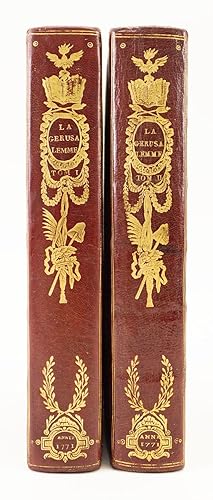
235 x 145 mm. (9 1/4 x 5 7/8"). Two volumes. LOVELY CONTEMPORARY RED MOROCCO "RELIURE DE PRÉSENT" DESIGNED BY GRAVELOT AND EXECUTED BY DEROME LE JEUNE, covers with French fillet frame, floral cornerpieces, flat spines bordered with double gilt rules and elaborately decorated in gilt: title within draped and foliate border surrou…nded by literary, warlike, and pastoral emblems, two leafy sprays extending from small cartouche at the lower end; attractively gilt turn-ins, marbled endpapers, all edges gilt. BEAUTIFULLY ILLUSTRATED THROUGHOUT: including two frontispiece portraits, two engraved titles with large vignettes, engraved dedication plate, 20 FINE ENGRAVED PLATES, 20 HAUT DE PAGE VIGNETTES (tondo portraits of characters), AND 23 ADDITIONAL PLATES (14 TAILPIECE VIGNETTES AND NINE VERY LARGE ENDPIECES (normally referred to as "vignettes," but occupying most of otherwise blank pages), ALL AFTER DESIGNS BY GRAVELOT. Cohen-de Ricci 974-75; Ray 22a; Brunet V, 667. For the binding: Schäfer Catalogue, p. 127; Schiff Collection 35. âRear board of volume II with small abrasion near tail (well masked with dye), minor soiling and variation in color of the morocco, a few insignificant spots internally, but A FINE, TALL COPY, with rich impressions of the engravings on fresh, clean, and bright "papier de hollande." Called by Cohen-de Ricci a "trés belle édition . . . avec illustrations superbes," this Parisian printing of Tasso's celebrated epic "Jerusalem Delivered" in Italian is one of the most beautiful books of the 18th century; and our copy is in the rare presentation binding designed by the esteemed Rococo artist and designer Hubert-François Gravelot (1699-1773), who was also responsible for the fine engravings. Among the lush and delicate illustrations, the almost full-page endpieces that conclude each chapter are a very charming highlight, showing fleshy cherubs at war (often in comically inappropriate battle attire). In examining this "handsome and delightful book," Ray says that "the plates tell the story of Tasso's Christian heroes with fidelity and discrimination, even catching something of the poem's ambiance of mystery and romance. But it is in the tailpieces that Gravelot triumphs." Through them, the illustrator is able "to present a joyous running commentary not only on Tasso's poem but sometimes on his own plates interpreting it. Without mocking chivalry, he makes it a source of sympathetic amusement." The binding here is a source of interest at least as considerable as that of the book's illustrations. It was designed by Gravelot and was used, with only slightly varying ornamentation, for a small number of copies of this work intended to be presented as gifts from the publisher, who is identified as G. Conti on the dedication page. It is probably the most readily recognizable presentation binding of the period. The Schiff catalogue says that such a Gravelot binding "is occasionally met with, more or less altered, on other volumes," and the Schiff collection contained examples of a book by La Fontaine and one by Racine in a binding of similar design. Except for these examples, our experience has not included any other books as early as the 18th century with both bindings and illustrations executed by the same artist. Most important, the design of the bindings is very pleasing, and our copy is especially well preserved, with leaves as fresh and engravings as rich as could be hoped for.
 Altre immagini
- Rilegato
Da: Herman H. J. Lynge & Søn ILAB-ABF, Copenhagen, , DanimarcaHerman H. J. Lynge & Søn ILAB-ABF
Contatta il venditoreVenditore con 4 stelleCondizione: Usato
EUR 895,75
Spedizione gratuitaSpedito da Danimarca a U.S.A.Quantità: 1 disponibili
Paris, aux dépens des Libraires associés pour les Usages du Diocèse, 1738. 8vo. (170x100x35 mm.). Contemp. full green morocco. Profusely tooled in gold. Large crowned and gilt monogram surrounded by broad gilt dentelles on upper and lower covers. Dentelles with stamps of shells and flovers. Spine likewise richly gilt in 6 compar…tments. Titlelabel with gilt lettering. Inner gilt borders. Edges of covers gilt. All edges gilt. Pink silk doublures. Upper joint at lower compartment with a tiny crack. In a custom made slipcase, front edges in brown morocco. (2),(22),XL,811 pp.
 Altre immagini
Oeuvres de Rousseau
ROUSSEAU, Jean Baptiste; [DEROME, Nicholas Denis aka Le Jeune, binder. Attributed to]
Editore: London: , 1781 1781
Da: David Brass Rare Books, Inc., Calabasas, CA, U.S.A.David Brass Rare Books, Inc.
Contatta il venditoreVenditore con 5 stelleCondizione: Usato
EUR 1557,22
EUR 8,64 spedizioneSpedito in U.S.A.Quantità: 1 disponibili
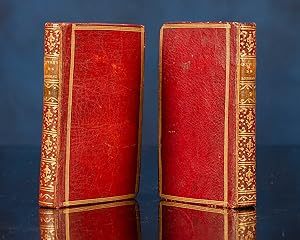
In a Contemporary Morocco Binding Attributed To Derôme Le Jeune ROUSSEAU, [Jean Baptiste]. [DEROME, Nicholas Denis aka Le Jeune, binder; attributed to]. ?uvres de Rousseau. Nouvelle édition. London: 1781. Two twelvemo volumes (4 5/8 x 2 13/16 inches; 118 x 72 mm.). [4], 252; [4], 276 pp. Engraved frontispiece portrait by Delvaux… in Volume I. Contents: Volume I, "Odes sacrées," "Odes, Liv. II-IV," and "Cantates allégoriques." Volume II, "Epitres, Liv. I-II," "Allégories, Liv. I-II," "Epigrammes, Liv. I-IV," and "Poésies diverses." Contemporary full red morocco attributed to Derôme Le Jeune, unsigned but with dentelles à l'oiseau, characteristic of Derôme, to volume two. Covers with gilt triple fillet border, smooth spines decoratively tooled in gilt in panels with two olive green morocco gilt lettering labels, board edges with single gilt fillet, gilt dentelles à l'oiseau, all edges gilt, bright blue endpapers. The absolute bare minimum of rubbing to extremities. A wonderful example. "Derôme was born on October 1, 1731, became a master binder on March 31, 1761, and was elected one of the Gardes en Charge of the Community of the Master Binders and Guilders of the City and University of Paris on May 10, 1773 at the same time as François Gaudreau, binder to the dauphine. He died around the year 1788 [i.e. 1790]. the designs used by Derôme on his bindings are extremely graceful, and rival those of Padeloup, to which they have a strong resemblance. It is be true that he purchased the material and stamps of this binder at the sale of his effects after his death, it explains to some extent the great similarity of the ornamentation employed by the two artists. Derôme executed many mosaic bindings, but his great renown has been gained by his dentelles, especially those in which he introduced a little bird with outstretched wings, and which are in consequence termed dentelles à l'oiseau" (Fletcher, W.I., Bookbinding in France). Marius Michel, in La Reliure Française, says that Derôme sought and found in the industries of his time the elements for new decoration, and crowned his efforts with the dentelles to which he has given his name, and which are distinguished from preceding ones by not being made up of the same tools in repetition, but in combination, thus affording more variety. "Jean-Baptiste Rousseau (April 6, 1671- March 17, 1741), was a French poet. He was born in Paris, the son of a shoemaker, and was well educated. As a young man, he gained favour with Boileau, who encouraged him to write. Rousseau began with the theatre, for which he had no aptitude. A one-act comedy, Le Café, failed in 1694, and he was not much happier with a more ambitious play, Le Flatteur (1696), or with the opera Venus et Adonis (1697). In 1700 he tried another comedy, Le Capricieux, which had the same fate. He then went with Tallard as an attaché to London, and, in days when literature still led to high position, seemed likely to achieve success. "His misfortunes began with a club squabble at the Café Laurent, which was much frequented by literary men, and where he indulged in lampoons on his companions. A shower of libellous and sometimes obscene verses was written by or attributed to him, and at last he was turned out of the café. At the same time his poems, as yet printed only singly or in manuscript, acquired him a great reputation, due to the dearth of genuine lyrical poetry between Jean Racine and André de Chénier. In 1701 he was made a member of the Académie des inscriptions; he was offered, though he had not accepted, profitable places in the revenue department; he had become a favourite of the libertine but influential côterie of the Temple; and in 1710 he presented himself as a candidate for the Académie française. "Verses more offensive than ever were handed round, and gossip maintained that Rousseau was their author. Legal proceedings of various kinds followed, and Rousseau ascribed the lampoon to Joseph Saunin. In 1712 Rousseau was prosecut.

Première partie de la Bibliothèque du vicomte E. de B.-B. reliée par Bradel-Derome Le Jeune ( Antoine Louis François & par son atelier). (Book auction sale catalogue - Catalogue de vente publique de livre).
2004 V 25 Paris Drouot - Choppin De Janvry - BRADEL - DEROME Le JEUNE :
Da: Antiquariaat Wim de Goeij, Kalmthout, ANTW, BelgioAntiquariaat Wim de Goeij
Contatta il venditoreVenditore con 5 stelleCondizione: Usato
EUR 54,00
EUR 34,80 spedizioneSpedito da Belgio a U.S.A.Quantità: 1 disponibili
2. Paris, Choppin de Janvry , Roch de Coligny, 2004, in-4°, 62 pp, 607 lots, sans illustrations (4 illustrations en couleur sur la couverture), agrafé, couverture originale.


