
Importo totale (1 articolo articoli):
Destinazione ordine:

dorondo (39 risultati)
Vai alla pagina principale dei risultati di ricerca
Filtri di ricerca
Tipo di articolo
- Tutti i tipi di prodotto
- Libri (39)
- Riviste e Giornali (Nessun altro risultato corrispondente a questo perfezionamento)
- Fumetti (Nessun altro risultato corrispondente a questo perfezionamento)
- Spartiti (Nessun altro risultato corrispondente a questo perfezionamento)
- Arte, Stampe e Poster (Nessun altro risultato corrispondente a questo perfezionamento)
- Fotografie (Nessun altro risultato corrispondente a questo perfezionamento)
- Mappe (Nessun altro risultato corrispondente a questo perfezionamento)
- Manoscritti e Collezionismo cartaceo (Nessun altro risultato corrispondente a questo perfezionamento)
Condizioni Maggiori informazioni
- Nuovo (28)
- Come nuovo, Ottimo o Quasi ottimo (4)
- Molto buono o Buono (6)
- Discreto o Mediocre (Nessun altro risultato corrispondente a questo perfezionamento)
- Come descritto (1)
Legatura
- Tutte
- Rilegato (39)
- Brossura (Nessun altro risultato corrispondente a questo perfezionamento)
Ulteriori caratteristiche
Lingua (1)
Spedizione gratuita
Paese del venditore
Valutazione venditore
-

Hardcover. Condizione: Fine. Condizione sovraccoperta: Fine. 1st Edition. Fine in a fine jacket - looks new with no wear or markings. Maps and text with sources and index.
-
Operation Crusader: Tank Warfare in the Desert, Tobruk 1941 (Die Wehrmacht im Kampf)
Libro 3 di 6: Die Wehrmacht im KampfDa: Solomon's Mine Books, Howard, PA, U.S.A.
Valutazione del venditore 5 su 5 stelle

hardcover. Condizione: New. *NEW* hardcover in DJ. Fresh from a distributor with no price tags and no remainder marks.
-

Riders of the Apocalypse: German Cavalry and Modern Warfare, 1870-1945
Da: Lexington Books Inc, Idaho Falls, ID, U.S.A.
Valutazione del venditore 5 su 5 stelle
hardcover. Condizione: Very Good. Condizione sovraccoperta: Very Good.
-
Riders of the Apocalypse: German Cavalry and Modern Warfare, 1870-1945
Lingua: Inglese
Editore: Naval Institute Press, U S. A., 2012
ISBN 10: 1612510868 ISBN 13: 9781612510866
Da: First Choice Books, Coeurd'Alene, ID, U.S.A.
Valutazione del venditore 5 su 5 stelle
Hardcover. Condizione: Fine. Condizione sovraccoperta: Fine. 312pp including bibliography and index Provides a comprehensive history of the german Cavalry.
-
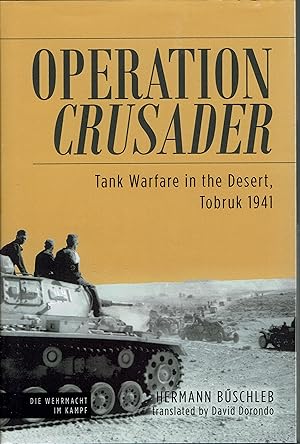
Operation Crusader: Tank Warfare in the Desert, Tobruk 1941
Libro 3 di 6: Die Wehrmacht im KampfDa: fourleafclover books, St. Louis, MO, U.S.A.
Valutazione del venditore 5 su 5 stelle
Hardcover. Condizione: As New. Condizione sovraccoperta: Fine. 89 pgs. Strategic Maps. Trans. from the German.
-

Operation Crusader: Tank Warfare in the Desert, Tobruk 1941 (Die Wehrmacht im Kampf)
Libro 3 di 6: Die Wehrmacht im KampfDa: The Anthropologists Closet, Clive, IA, U.S.A.
Valutazione del venditore 5 su 5 stelle
Hardcover. Condizione: New. Condizione sovraccoperta: New. New tightly bound hardcover in a new dust jacket. 8vo. (6.25 x 0.5 x 9 inches) Text is clean and free of marks or underlining. B&W photos and illustrations. Includes an index. 119 pp. Fast shipping in a secure book box mailer with tracking. First English translation of a German account of Operation Crusader. The port of Tobruk, Libya, was besieged by German and Italian forces in April 1941. Following an abortive attempt in June, the Allies tried to relieve the siege in late November, when the Eighth Army launched Operation Crusader, which aimed at destroying the Axis armored force then advancing. After a number of inconclusive engagements, the British 7th Armoured Division was defeated by the Afrika Korps at Sidi Rezegh. Erwin Rommel was then forced to withdraw his troops to the defensive line at Gazala, making the operation the first Allied victory over German land forces in World War II. This account of the tank warfare during Operation Crusader in front of Tobruk in the fall of 1941 examines the roles of commanders in the battles of Operation Crusader, in particular the part of Erwin Rommel, who achieved some defensive successes during the battle. As well as examining the part of commanders, it discusses the parameters of the battle: the terrain, weather, visibility, logistics, intelligence, and the forces involved. It then narrates the course of the battle, and the result of the battle.
-
Riders of the Apocalypse
Da: Gold Country Books, Sacramento, CA, U.S.A.
Valutazione del venditore 4 su 5 stelle

Hardcover. Condizione: New. Condizione sovraccoperta: New. New. Pristine. No markings. 8 pages of illustrations, 5 maps. // Shipped carefully packed in a sturdy box.
-
Riders of the Apocalypse German Cavalry & Modern Warfare, 1870-1945
Lingua: Inglese
Editore: Naval Institute Press, c.2012,, 2012
ISBN 10: 1612510868 ISBN 13: 9781612510866
Copia autografata
hardcover, Condizione: Good, Naval Institute Press, c.2012, 1st., 8vo., hardcover, 312pp., signed by author, VG-/VG- $.
-
Riders of the Apocalypse German Cavalry & Modern Warfare, 1870-1945
Lingua: Inglese
Editore: Naval Institute Press, c.2012,, 2012
ISBN 10: 1612510868 ISBN 13: 9781612510866
hardcover, Condizione: Good, Naval Institute Press, c.2012, 1st., 8vo., hardcover, 312pp., G $.
-
Riders of the Apocalypse: German Cavalry and Modern Warfare, 1870-1945
Da: Books From California, Simi Valley, CA, U.S.A.
Valutazione del venditore 5 su 5 stelle
Prima edizione
Hardcover. Condizione: Very Good. First Edition. First Edition / First Printing as identified with "1" in the full number line.
-

Operation Crusader (Hardcover)
Libro 3 di 6: Die Wehrmacht im KampfDa: Grand Eagle Retail, Bensenville, IL, U.S.A.
Valutazione del venditore 5 su 5 stelle
Hardcover. Condizione: new. Hardcover. First English translation of a Geman account of Operation Crusader. The port of Tobruk, Libya, was besieged by German and Italian forces in April 1941. Following an abortive attempt in June, the Allies tried to relieve the siege in late November, when the Eighth Army launched Operation Crusader, which aimed at destroying the Axis armoured force then advancing. After a number of inconclusive engagements, the British 7th Armoured Division was defeated by the Afrika Korps at Sidi Rezegh. Edwin Rommel was then forced to withdraw his troops to the defensive line at Gazala, making the operation the first Allied victory over German land forces in World War II. This account of the tank warfare during Operation Crusader in front of Tobruk in the fall of 1941 examines the roles of commanders in the battles of Operation Crusader, in particular the part of Edwin Rommel, who achieved some defensive successes during the battle. As well as examining the part of commanders, it discusses the parameters of the battle: the terrain, weather, visibility, logistics, intelligence, and the forces involved. It then narrates the course of the battle, and the result of the battle. 20 b/w maps First English translation of a Geman account of Operation Crusader. Shipping may be from multiple locations in the US or from the UK, depending on stock availability.
-

EUR 28,07
Spedizione gratuita
Spedito in U.S.A.Quantità: Più di 20 disponibili
Aggiungi al carrelloHardback. Condizione: New. The port of Tobruk, Libya, was besieged by German and Italian forces in April 1941. Following an abortive attempt in June, the Allies tried to relieve the siege in late November, when the Eighth Army launched Operation Crusader, which aimed at destroying the Axis armored force then advancing. After a number of inconclusive engagements, the British 7th Armoured Division was defeated by the Afrika Korps at Sidi Rezegh. Edwin Rommel was then forced to withdraw his troops to the defensive line at Gazala, making the operation the first Allied victory over German land forces in World War II. This account of the tank warfare during Operation Crusader in front of Tobruk in the fall of 1941 examines the roles of commanders in the battles of Operation Crusader, in particular the part of Erwin Rommel, who achieved some defensive successes during the battle. As well as examining the part of commanders, it discusses the parameters of the battle: the terrain, weather, visibility, logistics, intelligence, and the forces involved. It then narrates the course of the battle, and the result of the battle.
-

Bavaria and German Federalism: Reich to Republic, 1918-33, 1945-49
Libro 217 di 241: St Antony'sDa: St Philip's Books, P.B.F.A., B.A., Oxford, Regno Unito
Membro dell'associazione: PBFA
Valutazione del venditore 5 su 5 stelle
EUR 14,79
EUR 14,93 shipping
Spedito da Regno Unito a U.S.A.Quantità: 1 disponibili
Aggiungi al carrelloHardback. Condizione: Very Good. Condizione sovraccoperta: Very Good+. ~No ownership marks. ~Robust packaging. All UK orders with tracking, overseas tracking available on request. Size: xx, 165pp. With dustwrapper. Binding sound, text unmarked.
-

Operation Crusader
Libro 3 di 6: Die Wehrmacht im KampfDa: Rarewaves.com USA, London, LONDO, Regno Unito
Valutazione del venditore 5 su 5 stelle
EUR 33,82
Spedizione gratuita
Spedito da Regno Unito a U.S.A.Quantità: Più di 20 disponibili
Aggiungi al carrelloHardback. Condizione: New. The port of Tobruk, Libya, was besieged by German and Italian forces in April 1941. Following an abortive attempt in June, the Allies tried to relieve the siege in late November, when the Eighth Army launched Operation Crusader, which aimed at destroying the Axis armored force then advancing. After a number of inconclusive engagements, the British 7th Armoured Division was defeated by the Afrika Korps at Sidi Rezegh. Edwin Rommel was then forced to withdraw his troops to the defensive line at Gazala, making the operation the first Allied victory over German land forces in World War II. This account of the tank warfare during Operation Crusader in front of Tobruk in the fall of 1941 examines the roles of commanders in the battles of Operation Crusader, in particular the part of Erwin Rommel, who achieved some defensive successes during the battle. As well as examining the part of commanders, it discusses the parameters of the battle: the terrain, weather, visibility, logistics, intelligence, and the forces involved. It then narrates the course of the battle, and the result of the battle.
-
Bavaria and German Federalism: Reich to Republic, 1918-33, 1945-49
Libro 217 di 241: St Antony'sDa: Prior Books Ltd, Cheltenham, Regno Unito
Membro dell'associazione: ABA ILAB PBFA
Valutazione del venditore 5 su 5 stelle
Prima edizione
EUR 8,83
EUR 25,26 shipping
Spedito da Regno Unito a U.S.A.Quantità: 1 disponibili
Aggiungi al carrelloHardcover. Condizione: Very Good. Condizione sovraccoperta: Very Good. First Edition. A better than very good hardback copy in a better than very good dustjacket: firm, clean, square and tight with no underlining or splits.
-

EUR 40,72
Spedizione gratuita
Spedito in U.S.A.Quantità: Più di 20 disponibili
Aggiungi al carrelloHardback. Condizione: New. In late November 1942, Soviet forces surrounded General Friedrich Paulus' Sixth Army in a pocket at the Russian city of Stalingrad. In response, the Germans planned a relief operation, Operation Winter Thunderstorm, intended to break through the Soviet forces and open the pocket, releasing the encircled units. The 6th Panzer Division was the spearhead of the German relief force. The attack started on 12 December 1942 and was aborted on 23 December after heavy Soviet counterattacks. This failure sealed the fate of the German Sixth Army in Stalingrad. This account of the operation was first published in German in 1956, written by the well-respected military historian and retired German officer, Horst Scheibert, who was a tank commander in 6th Panzer Division during the attempt. Utilising many excerpts from war diaries, and telegrams sent during operations, it is a unique account of the entire operation from the situation in mid-November through the two German offensives, the Soviet counteroffensive and ongoing fighting until early January. This book includes 16 maps from the original edition and is the first English translation of this important German account.
-
Operation Crusader: Tank Warfare in the Desert, Tobruk 1941
Libro 3 di 6: Die Wehrmacht im KampfLingua: Inglese
Editore: Casemate Pub & Book Dist Llc, 2019
ISBN 10: 1612007236 ISBN 13: 9781612007236
Da: Revaluation Books, Exeter, Regno Unito
Valutazione del venditore 5 su 5 stelle
EUR 33,74
EUR 11,48 shipping
Spedito da Regno Unito a U.S.A.Quantità: 1 disponibili
Aggiungi al carrelloHardcover. Condizione: Brand New. 89 pages. 9.00x6.25x0.50 inches. In Stock.
-

On to Stalingrad
Da: Rarewaves.com USA, London, LONDO, Regno Unito
Valutazione del venditore 5 su 5 stelle
EUR 46,45
Spedizione gratuita
Spedito da Regno Unito a U.S.A.Quantità: Più di 20 disponibili
Aggiungi al carrelloHardback. Condizione: New. In late November 1942, Soviet forces surrounded General Friedrich Paulus' Sixth Army in a pocket at the Russian city of Stalingrad. In response, the Germans planned a relief operation, Operation Winter Thunderstorm, intended to break through the Soviet forces and open the pocket, releasing the encircled units. The 6th Panzer Division was the spearhead of the German relief force. The attack started on 12 December 1942 and was aborted on 23 December after heavy Soviet counterattacks. This failure sealed the fate of the German Sixth Army in Stalingrad. This account of the operation was first published in German in 1956, written by the well-respected military historian and retired German officer, Horst Scheibert, who was a tank commander in 6th Panzer Division during the attempt. Utilising many excerpts from war diaries, and telegrams sent during operations, it is a unique account of the entire operation from the situation in mid-November through the two German offensives, the Soviet counteroffensive and ongoing fighting until early January. This book includes 16 maps from the original edition and is the first English translation of this important German account.
-

On to Stalingrad: Operation Winter Thunderstorm and the Attempt to Relieve Sixth Army, December 1942
Lingua: Inglese
Editore: Casemate Pub & Book Dist Llc, 2022
ISBN 10: 1612008062 ISBN 13: 9781612008066
Da: Revaluation Books, Exeter, Regno Unito
Valutazione del venditore 5 su 5 stelle
EUR 39,36
EUR 11,48 shipping
Spedito da Regno Unito a U.S.A.Quantità: 1 disponibili
Aggiungi al carrelloHardcover. Condizione: Brand New. 164 pages. 9.00x6.00x1.00 inches. In Stock.
-
-

Riders of the Apocalypse: German Cavalry and Modern Warfare, 1870-1945
Da: Book Grocer, Tullamarine, VIC, Australia
Valutazione del venditore 5 su 5 stelle
EUR 34,32
EUR 25,58 shipping
Spedito da Australia a U.S.A.Quantità: 1 disponibili
Aggiungi al carrelloHardback. David R. Dorondo, Naval Institute Press. Despite the enduring popular image of the blitzkrieg of World War II, the German Army always depended on horses. It could not have waged war without them. While the Army's reliance on draft horses to pull artillery, supply wagons, and field kitchens is now generally acknowledged, D. R. Dorondo's Riders of the Apocalypse examines the history of the German cavalry, a combat arm that not only survived World War I but also rode to war again in 1939. Though concentrating on the period between 1939 and 1945, the book places that history firmly within the larger context of the mounted arm's development from the Franco-Prussian War of 1870 to the Third Reich's surrender. Driven by both internal and external constraints to retain mounted forces after 1918, the German Army effectively did nothing to reduce, much less eliminate, the preponderance of non-mechanized formations during its breakneck expansion under the Nazis after 1933. Instead, politicized command decisions, technical insufficiency, industrial bottlenecks, and, finally, wartime attrition meant that Army leaders were compelled to rely on a steadily growing number of combat horsemen throughout World War II. These horsemen were best represented by the 1st Cavalry Brigade (later Division) which saw combat in Poland, the Netherlands, France, Russia, and Hungary. Their service, however, came to be cruelly dishonored by the horsemen of the 8th Waffen-SS Cavalry Division, a unit whose troopers spent more time killing civilians than fighting enemy soldiers. Throughout the story of these formations, and drawing extensively on both primary and secondary sources, Dorondo shows how the cavalry's tradition carried on in a German and European world undergoing rapid military industrialization after the mid-nineteenth century. And though Riders of the Apocalypse focuses on the German element of this tradition, it also notes other countries' continuing (and, in the case of Russia, much more extensive) use of combat horsemen after 1900. However, precisely because the Nazi regime devoted so much effort to portray Germany's armed forces as fully modern and mechanized, the combat effectiveness of so many German horsemen on the battlefields of Europe until 1945 remains a story that deserves to be more widely known. Dorondo's work does much to tell that story.David R. Dorondo holds the degree of D.Phil. from the University of Oxford. He is professor of modern German and European military history at Western Carolina University. Hardback.
-
Operation Crusader (Hardcover)
Libro 3 di 6: Die Wehrmacht im KampfDa: CitiRetail, Stevenage, Regno Unito
Valutazione del venditore 5 su 5 stelle
EUR 27,78
EUR 42,49 shipping
Spedito da Regno Unito a U.S.A.Quantità: 1 disponibili
Aggiungi al carrelloHardcover. Condizione: new. Hardcover. First English translation of a Geman account of Operation Crusader. The port of Tobruk, Libya, was besieged by German and Italian forces in April 1941. Following an abortive attempt in June, the Allies tried to relieve the siege in late November, when the Eighth Army launched Operation Crusader, which aimed at destroying the Axis armoured force then advancing. After a number of inconclusive engagements, the British 7th Armoured Division was defeated by the Afrika Korps at Sidi Rezegh. Edwin Rommel was then forced to withdraw his troops to the defensive line at Gazala, making the operation the first Allied victory over German land forces in World War II. This account of the tank warfare during Operation Crusader in front of Tobruk in the fall of 1941 examines the roles of commanders in the battles of Operation Crusader, in particular the part of Edwin Rommel, who achieved some defensive successes during the battle. As well as examining the part of commanders, it discusses the parameters of the battle: the terrain, weather, visibility, logistics, intelligence, and the forces involved. It then narrates the course of the battle, and the result of the battle. 20 b/w maps First English translation of a Geman account of Operation Crusader. Shipping may be from our UK warehouse or from our Australian or US warehouses, depending on stock availability.
-

Operation Crusader
Libro 3 di 6: Die Wehrmacht im KampfDa: Rarewaves USA United, OSWEGO, IL, U.S.A.
Valutazione del venditore 5 su 5 stelle
Hardback. Condizione: New. The port of Tobruk, Libya, was besieged by German and Italian forces in April 1941. Following an abortive attempt in June, the Allies tried to relieve the siege in late November, when the Eighth Army launched Operation Crusader, which aimed at destroying the Axis armored force then advancing. After a number of inconclusive engagements, the British 7th Armoured Division was defeated by the Afrika Korps at Sidi Rezegh. Edwin Rommel was then forced to withdraw his troops to the defensive line at Gazala, making the operation the first Allied victory over German land forces in World War II. This account of the tank warfare during Operation Crusader in front of Tobruk in the fall of 1941 examines the roles of commanders in the battles of Operation Crusader, in particular the part of Erwin Rommel, who achieved some defensive successes during the battle. As well as examining the part of commanders, it discusses the parameters of the battle: the terrain, weather, visibility, logistics, intelligence, and the forces involved. It then narrates the course of the battle, and the result of the battle.
-

Operation Crusader (Hardcover)
Libro 3 di 6: Die Wehrmacht im KampfDa: AussieBookSeller, Truganina, VIC, Australia
Valutazione del venditore 5 su 5 stelle
EUR 47,81
EUR 31,54 shipping
Spedito da Australia a U.S.A.Quantità: 1 disponibili
Aggiungi al carrelloHardcover. Condizione: new. Hardcover. First English translation of a Geman account of Operation Crusader. The port of Tobruk, Libya, was besieged by German and Italian forces in April 1941. Following an abortive attempt in June, the Allies tried to relieve the siege in late November, when the Eighth Army launched Operation Crusader, which aimed at destroying the Axis armoured force then advancing. After a number of inconclusive engagements, the British 7th Armoured Division was defeated by the Afrika Korps at Sidi Rezegh. Edwin Rommel was then forced to withdraw his troops to the defensive line at Gazala, making the operation the first Allied victory over German land forces in World War II. This account of the tank warfare during Operation Crusader in front of Tobruk in the fall of 1941 examines the roles of commanders in the battles of Operation Crusader, in particular the part of Edwin Rommel, who achieved some defensive successes during the battle. As well as examining the part of commanders, it discusses the parameters of the battle: the terrain, weather, visibility, logistics, intelligence, and the forces involved. It then narrates the course of the battle, and the result of the battle. 20 b/w maps First English translation of a Geman account of Operation Crusader. Shipping may be from our Sydney, NSW warehouse or from our UK or US warehouse, depending on stock availability.
-

On to Stalingrad
Da: Rarewaves USA United, OSWEGO, IL, U.S.A.
Valutazione del venditore 5 su 5 stelle
Hardback. Condizione: New. In late November 1942, Soviet forces surrounded General Friedrich Paulus' Sixth Army in a pocket at the Russian city of Stalingrad. In response, the Germans planned a relief operation, Operation Winter Thunderstorm, intended to break through the Soviet forces and open the pocket, releasing the encircled units. The 6th Panzer Division was the spearhead of the German relief force. The attack started on 12 December 1942 and was aborted on 23 December after heavy Soviet counterattacks. This failure sealed the fate of the German Sixth Army in Stalingrad. This account of the operation was first published in German in 1956, written by the well-respected military historian and retired German officer, Horst Scheibert, who was a tank commander in 6th Panzer Division during the attempt. Utilising many excerpts from war diaries, and telegrams sent during operations, it is a unique account of the entire operation from the situation in mid-November through the two German offensives, the Soviet counteroffensive and ongoing fighting until early January. This book includes 16 maps from the original edition and is the first English translation of this important German account.
-
Bavaria and German Federalism: Reich to Republic, 1918-33, 1945-49
Libro 217 di 241: St Antony'sDa: BennettBooksLtd, San Diego, NV, U.S.A.
Valutazione del venditore 5 su 5 stelle
hardcover. Condizione: New. In shrink wrap. Looks like an interesting title!
-

Operation Crusader
Libro 3 di 6: Die Wehrmacht im KampfDa: Rarewaves.com UK, London, Regno Unito
Valutazione del venditore 5 su 5 stelle
EUR 30,93
EUR 74,64 shipping
Spedito da Regno Unito a U.S.A.Quantità: Più di 20 disponibili
Aggiungi al carrelloHardback. Condizione: New. The port of Tobruk, Libya, was besieged by German and Italian forces in April 1941. Following an abortive attempt in June, the Allies tried to relieve the siege in late November, when the Eighth Army launched Operation Crusader, which aimed at destroying the Axis armored force then advancing. After a number of inconclusive engagements, the British 7th Armoured Division was defeated by the Afrika Korps at Sidi Rezegh. Edwin Rommel was then forced to withdraw his troops to the defensive line at Gazala, making the operation the first Allied victory over German land forces in World War II. This account of the tank warfare during Operation Crusader in front of Tobruk in the fall of 1941 examines the roles of commanders in the battles of Operation Crusader, in particular the part of Erwin Rommel, who achieved some defensive successes during the battle. As well as examining the part of commanders, it discusses the parameters of the battle: the terrain, weather, visibility, logistics, intelligence, and the forces involved. It then narrates the course of the battle, and the result of the battle.
-

EUR 43,04
EUR 74,64 shipping
Spedito da Regno Unito a U.S.A.Quantità: Più di 20 disponibili
Aggiungi al carrelloHardback. Condizione: New. In late November 1942, Soviet forces surrounded General Friedrich Paulus' Sixth Army in a pocket at the Russian city of Stalingrad. In response, the Germans planned a relief operation, Operation Winter Thunderstorm, intended to break through the Soviet forces and open the pocket, releasing the encircled units. The 6th Panzer Division was the spearhead of the German relief force. The attack started on 12 December 1942 and was aborted on 23 December after heavy Soviet counterattacks. This failure sealed the fate of the German Sixth Army in Stalingrad. This account of the operation was first published in German in 1956, written by the well-respected military historian and retired German officer, Horst Scheibert, who was a tank commander in 6th Panzer Division during the attempt. Utilising many excerpts from war diaries, and telegrams sent during operations, it is a unique account of the entire operation from the situation in mid-November through the two German offensives, the Soviet counteroffensive and ongoing fighting until early January. This book includes 16 maps from the original edition and is the first English translation of this important German account.
-
Bavaria and German Federalism: Reich to Republic, 1918-33, 1945-49
Libro 217 di 241: St Antony'sDa: Lucky's Textbooks, Dallas, TX, U.S.A.
Valutazione del venditore 5 su 5 stelle
Condizione: New.
-
Bavaria and German Federalism: Reich to Republic, 1918-33, 1945-49
Libro 217 di 241: St Antony'sDa: Ria Christie Collections, Uxbridge, Regno Unito
Valutazione del venditore 5 su 5 stelle
EUR 158,84
EUR 13,76 shipping
Spedito da Regno Unito a U.S.A.Quantità: Più di 20 disponibili
Aggiungi al carrelloCondizione: New. In.

