
Edgerton harold e doc (1 risultati)
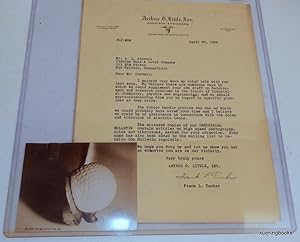
[archive] A small archive highlighting industrial consulting, including the early benefits of High Speed Photography - Arthur D. Little and Harold "Doc" Edgerton
[Arthur D. Little Inc.]; [Edgerton, Harold E. "Doc" ; Germeshausen, Kenneth J.]
Editore: Arthur D. Little, Inc, Cambridge, Massachusetts, 1933
- Prima edizione
Da: Kuenzig Books ( ABAA / ILAB ), Topsfield, MA, U.S.A.Kuenzig Books ( ABAA / ILAB )
Contatta il venditoreVenditore con 5 stelleCondizione: Usato - Molto buono
EUR 888,28
EUR 5,24 spedizioneSpedito in U.S.A.Quantità: 1 disponibili
Condizione: Very Good. First Edition. First Edition. A small archive from industrial consulting firm Arthur D. Little highlighting the uses of high speed photography and other solutions. The archive includes: 1) a 3 5/8 x 4 5/8 inch promotional photograph ((c) 1933 Arthur D Little Inc.) titled "Golf Ball at Instant of Impact" sh…owing a deformed golfball being hit by a golf club, captured by "stop motion" photography. Printed on the rear of the card is a description of the process, and it's application to industrial research, noting H. E. Edgerton and K. J. Germeshausen at MIT were the technical innovators. Surface finish crazing and a paper clip dent upper left. 2) Four Industrial Bulletins produced by Arthur D. Little, Inc. Each 11 x 8 1/4 inches and [4] pages. Jan 1933 and Mar 1933 are stamped "MARKED COPY" at top and highlight articles on vibration. Dec 1933 is also stamped "Marked Copy", this one highlighting an article "Seeing the Fourth Dimension" which is about how High Speed Photography is "now being employed in the plant and laboratory as a means for magnifying time" or seeing the unseen by reducing exposure times to as fine as a millionth of a second. The last, June 1934 contains an article about corrosion as well as on on glass - fibrous glass made by a small company Owens-Illinois Glass Company! All are folded for mailing, very good except for Dec 1933 which has a tear affecting the text (but nor readability) and browning. These bulletins were meant to "place before bankers, investors, and industrial executives early and authoritative information bearing upon the present status of industrial development or indicative of its probable trend." 3) A letter from Frank L.Tucker of Arthur D. Little, Inc.to Mr. A. L. Stowell of the Stanley Rule and Level Company in New Brittain Connecticut tying them together. Following up on a brief phone call, Tucker suggests Arthur D. Little could supplement Stanley Rule's own staff when solving development and research project problems and he solicits news of specific problems as they arise. He also suggests a facility visit to Arthur D. Little. The bulletins above appear related to issues Stanley Rule was having at the time. An early example of strobe photography's application in industrial consulting literature, this small archive highlights the potential for partnerships between industry (brokered by consulting firms like Arthur D. Little) and innovators like MIT and Harold "Doc" Edgerton. Edgerton would go on to found EG&G (which photographed early atomic bomb work), work in radar, sonar, and many other innovative areas. Arthur D. Little, founded in 1886, is the world's first management consultancy and remains in business today. Harold "Doc" Edgerton's name is synonymous with strobe photography. Doc began his graduate work at MIT in 1926 and through 1931 experimented with strobes and photography in his studies of synchronous motors. Shortly after becoming a Professor, Doc Edgerton and several of his students (including K. J. Germeshausen) began to consult with industrial concerns, using the new strobe photography to freeze machines in action and help debug industrial processes, and in at least one case debunk patent infringment cases. It was an important new tool in the industrial engineer's arsenal. Arthur D. Little, a local consulting firm, couldn't help but become aware of this new technology. They were in the business of offering analytical advice to those in industry and finance about notable trends, figures, and technologies and kept a close eye on top innovators at MIT just down the street. Today Edgerton's photography is highly collected as both technical innovation and wonderful artforms.
