

Importo totale (1 articolo articoli):
Destinazione ordine:

edited bhowmik (6 risultati)
Vai alla pagina principale dei risultati di ricerca
Filtri di ricerca
Tipo di articolo
- Tutti i tipi di prodotto
- Libri (6)
- Riviste e Giornali (Nessun altro risultato corrispondente a questo perfezionamento)
- Fumetti (Nessun altro risultato corrispondente a questo perfezionamento)
- Spartiti (Nessun altro risultato corrispondente a questo perfezionamento)
- Arte, Stampe e Poster (Nessun altro risultato corrispondente a questo perfezionamento)
- Fotografie (Nessun altro risultato corrispondente a questo perfezionamento)
- Mappe (Nessun altro risultato corrispondente a questo perfezionamento)
- Manoscritti e Collezionismo cartaceo (Nessun altro risultato corrispondente a questo perfezionamento)
Condizioni Maggiori informazioni
- Nuovo (4)
- Come nuovo, Ottimo o Quasi ottimo (Nessun altro risultato corrispondente a questo perfezionamento)
- Molto buono o Buono (1)
- Discreto o Mediocre (Nessun altro risultato corrispondente a questo perfezionamento)
- Come descritto (1)
Legatura
Ulteriori caratteristiche
- Prima ed. (2)
- Copia autograf. (Nessun altro risultato corrispondente a questo perfezionamento)
- Sovracoperta (Nessun altro risultato corrispondente a questo perfezionamento)
- Con foto (1)
- Non Print on Demand (6)
Lingua (2)
Spedizione gratuita
- Spedizione gratuita in U.S.A. (Nessun altro risultato corrispondente a questo perfezionamento)
Paese del venditore
Valutazione venditore
-
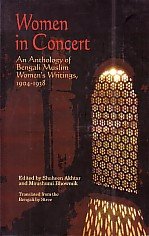
Women in Concert : An Anthology of Bengali Muslim Women\'s Writings, 1904-38
Da: Vedams eBooks (P) Ltd, New Delhi, India
Valutazione del venditore 4 su 5 stelle

EUR 23,94
Spedizione EUR 17,50
Spedito da India a U.S.A.Quantità: 1 disponibili
Aggiungi al carrelloThrowing light on the work and lives of unknown or forgotten Muslim women writers of pre-Independence Bengal when the state was not yet partitioned between India and East Pakistan todays Bangladesh in 1947 this anthology is like a rediscovery of their lives First published in Bengali as Zenana Mehfil Bangali Musalman Lekhikader Nirbachita Rachana 1904-38 it compiles for the first time eleven Bengali Muslim womens writings essays short stories poetry a novel and some correspondence each introduced and discussed separately The anthology also gives a glimpse of their lives that were not always confined within the household The writers include Akhtar Mahal Sayyada Khatun and M Fatema Khanum and other much more familiar names like Rokeya Sakhawat Hossain and Shamsundar Mahmud Among the immensely valuable interviews are those of Mohammed Nasiruddin who devoted his life to the cause of Bengali Muslim womens emancipation his daughter Nurjehan Begum the poet Sufia Kamal the writer Hameeda Khanam and Syed Mustafa Siraj the celebrated Bengali novelist who witnessed the social changes that were to alter the Bengali Muslim world 400 pp.
-

Developmental Issues of Tribes
Da: Vedams eBooks (P) Ltd, New Delhi, India
Valutazione del venditore 4 su 5 stelle
Prima edizione
EUR 27,93
Spedizione EUR 17,50
Spedito da India a U.S.A.Quantità: 1 disponibili
Aggiungi al carrelloHardcover. Condizione: New. 1st Edition. Contents: Part I: Issues of Development of Indigenous People in Peru, India, Ethiopia and Malaysia: 1. Peruvian Natives and Indigenous Communities and Access to the Titling of its Lands. 2. Oil Spills in the Peruvian Amazon. 3. The Right for Autonomy of Indigenous Peoples in the Peruvian Amazon: Between Recognition and Violation (Violation or Valuation). 4. Indigenous Languages in Danger of Extinction in a Globalized World in Peru. 5. The Cooking and Feeding Habit of Tribal People: An Advantage over Modern Civilization. 6. A Dire Situation of Tribes in Ethiopia. Part II: Socio-Economic Development of Indian Tribes: 7. Tribal Poverty in Odisha. 8. Socio-economic Development of PVTGs in India: Problems and Solutions. 9. Contextualizing Microfinance and Economic Growth: The Tribal Women Empowerment Imperative. 10. Sustainable Tribal Development: Problems, Prospects, Policies and Cases. 11. Role of Traditional Knowledge Digital Library (TKDL) in Protecting India's Traditional Knowledge. Part III: Indigenous People and their Existence: 12. Survival of Indigenous People: Environment Protection and Conservation. This edited book covers Peruvian tribes' land ownership, environment hazards from oil spills in Peruvian Amazon, their recognition and violation in Amazon, danger of indigenous languages in Peru, tribal poverty and tribal developmental problems and policies in India, tribal women empowerment in India, problems and solutions of PVTGs of India, environment-free traditional cooking and feeding habits of tribes and protection of traditional knowledge of tribal people and so on. The socio-economic development and dire situation of Ethiopian tribes were also described. How tribal people in this globe have been surviving against eviction in the process of conservation although they are contributing to forest environment and ecosystem, have been incorporated here. The book is useful to the researchers who are interested in studying tribal problems.
-

International Monetary System: Past, Present and Future
Da: Vedams eBooks (P) Ltd, New Delhi, India
Valutazione del venditore 4 su 5 stelle
Prima edizione
EUR 49,87
Spedizione EUR 17,50
Spedito da India a U.S.A.Quantità: 1 disponibili
Aggiungi al carrelloHardcover. Condizione: New. 1st Edition. Contents: Part- I: Economic Theories on International Monetary System: 1. The International Monetary System and the Global Financial Integration/Asim K. Karmakar and Sebak K. Jana. 2. Orthodox monetary theory: a critique from post-keynesianism and trans-financial economics/Dante A. Urbina. 3. Dollar hegemony/David fields. 4. Dollarization/David Fields and Matias Vernengo. 5. Quantitative easing and financial instability: from shadow banking system to the dealer of the last resort/Arturo Chian. 6. The IMF conditionality: theory and application in India/Mahendra Pal. 7. The international financial architecture: past, present and future/Somnath Karmakar. Part- II: Global Financial Crisis and its Impact: 8. Hegemonic currencies during the crisis: the dollar versus the Euro in a Cartalist perspective/David Fields and Matias Vernengo. 9. Financial crisis and impact on Indian economy/Ajoy Kumar Pandey. 10. Did Austrian economists predict the financial crisis?: critique of the Austrian business cycle theory/Dante A. Urbina. 11. Global financial crisis: causes, trends consequences and remedial policies/Sukanta Sarkar and Suman Kalyan Chaudhury. 12. Impact of global economic crisis on Indian economy/Suvranshu Pan. Part- III: Regionalism and Monetary Systems: 13. Re-examining the SDR's role in the new context of today's globalized world/Sumita Das and Amrita Saha. 14. Framework of monetary policy in the region under SAARC/Sourav Kumar Das and Kishor Naskar. 15. Does BRICS' new development bank matter? Tapan Purkait. 16. The TPP and the new international trade order/Carlos Aquino Rodriguez. Part- V : International Trade. 17. Futures market and inflation: an econometric investigation into metal and energy futures/Chinmaya Behera. 18. Foreign trade scenario of India and Bangladesh: an empirical study/Debjani Mitra. 19. India's export efficiency and economic growth during Pre-WTO and Post-WTO periods: an approach to DEA/Dipika Basu and Arun Kumar Nandi. 20. A detailed study of changing foreign trade pattern of India before pre-liberalisation era and impact of Foreign Exchange Reserve on India's foreign trade/Syed Shahid Mazhar and Anis ur Rehman.
-

Dasagrivaraksasavadhacaritam
Da: Vedams eBooks (P) Ltd, New Delhi, India
Valutazione del venditore 4 su 5 stelle
EUR 79,79
Spedizione EUR 17,50
Spedito da India a U.S.A.Quantità: 2 disponibili
Aggiungi al carrelloHardcover. Condizione: New. This unpublished Ramakatha has been found in the end of the Agneya Purana. On the request of king Ambarisa, sage Vasistha narrated the story to him. This book does not have Balakanda or Uttarakanda. The story begins with a curse to Narayana and Laksmi by Bhargava and goddess Earth respectively. As a result both of them were reincarnated in this world Rama and Sita. Unlike the original Ramayana, the author describes Ravana's genealogy and wanted to glorify him in the first few chapters. However after fifth chapter the story follows the original plot of Ramayana from the time sage Visvamitra requests king Dasaratha to allow Rama to leave with him to defeat raksasas who were disturbing them. This book ends with the description of Rama kingdom and his coronation. There is no mention of Lava, Kusa and other incidents which have been found in Valmiki's Ramayana.
-

Russian - Bengali Dictionary (IN RUSSIAN)
Lingua: Russo
Editore: Soviet Encyclopaedia Publishing House, Moscow, 1966
Da: Librairie Sheehy (Theologia Books), La Charite sur Loire, Francia
Valutazione del venditore 4 su 5 stelle
EUR 20,00
Spedizione EUR 36,00
Spedito da Francia a U.S.A.Quantità: 1 disponibili
Aggiungi al carrelloHardback. Condizione: Good. Good copy.755 pages. Approximately 24,000 words.
-

Application of Smart Technologies in Power System and Smart Grid: Select Proceedings of International Conference, CISTEE 2023
Da: Revaluation Books, Exeter, Regno Unito
Valutazione del venditore 5 su 5 stelle

EUR 261,97
Spedizione EUR 14,45
Spedito da Regno Unito a U.S.A.Quantità: 2 disponibili
Aggiungi al carrelloPaperback. Condizione: Brand New. 598 pages. 9.25x6.10x9.25 inches. In Stock.


