

Importo totale (1 articolo articoli):
Destinazione ordine:

edited imre bangha (3 risultati)
Vai alla pagina principale dei risultati di ricerca
Filtri di ricerca
Tipo di articolo
- Tutti i tipi di prodotto
- Libri (3)
- Riviste e Giornali (Nessun altro risultato corrispondente a questo perfezionamento)
- Fumetti (Nessun altro risultato corrispondente a questo perfezionamento)
- Spartiti (Nessun altro risultato corrispondente a questo perfezionamento)
- Arte, Stampe e Poster (Nessun altro risultato corrispondente a questo perfezionamento)
- Fotografie (Nessun altro risultato corrispondente a questo perfezionamento)
- Mappe (Nessun altro risultato corrispondente a questo perfezionamento)
- Manoscritti e Collezionismo cartaceo (Nessun altro risultato corrispondente a questo perfezionamento)
Condizioni Maggiori informazioni
- Nuovo (3)
- Come nuovo, Ottimo o Quasi ottimo (Nessun altro risultato corrispondente a questo perfezionamento)
- Molto buono o Buono (Nessun altro risultato corrispondente a questo perfezionamento)
- Discreto o Mediocre (Nessun altro risultato corrispondente a questo perfezionamento)
- Come descritto (Nessun altro risultato corrispondente a questo perfezionamento)
Legatura
- Tutte
- Rilegato (3)
- Brossura (Nessun altro risultato corrispondente a questo perfezionamento)
Ulteriori caratteristiche
- Prima ed. (3)
- Copia autograf. (Nessun altro risultato corrispondente a questo perfezionamento)
- Sovracoperta (2)
- Con foto (Nessun altro risultato corrispondente a questo perfezionamento)
- Non Print on Demand (3)
Lingua (1)
Prezzo
- Qualsiasi prezzo
- Inferiore a EUR 20 (Nessun altro risultato corrispondente a questo perfezionamento)
- EUR 20 a EUR 45
- Superiore a EUR 45 (Nessun altro risultato corrispondente a questo perfezionamento)
Spedizione gratuita
- Spedizione gratuita in U.S.A. (Nessun altro risultato corrispondente a questo perfezionamento)
Paese del venditore
Valutazione venditore
-

Rabindranath Tagore: One Hundred Years of Global Reception
Da: Vedams eBooks (P) Ltd, New Delhi, India
Valutazione del venditore 4 su 5 stelle

Prima edizione
EUR 32,22
Spedizione EUR 17,50
Spedito da India a U.S.A.Quantità: 1 disponibili
Aggiungi al carrelloHardcover. Condizione: New. Condizione sovraccoperta: New. 1st Edition. When Tagore won the Nobel Prize for Literature in 1913 for his own English translation of Gitanjali (Song Offerings), he became the first non-European to do so, achieving immediate fame.Translations in other languages of this and other works followed. Reams were written on his writings, and his personality. As aworld citizen, Tagore aimed at bringing the East and the West together for an inclusive humanism. His was assumed to be the Voice of India-indeed of Asia and the colonised world. The Nobel Prize gave him the authority to speak, and the intellectual elite of many countries listened. The editors of Rabindranath Tagore: One Hundred Years of Global Reception had asked Tagore experts worldwide to narrate how the Bengali author was received from 1913 until our time. Their thirty-five essays arranged by region or language group inform us about translations, the impact of Tagore s visits, and his subsequent standing in the world of letters. Tagore s reception while often enthusiastic was not always adulatory, occasionally undergoing dramatic metamorphoses, and diverse political and social milieus and cultural movements responded to him differently. This nuanced global reception is for the first time dealt with comprehensively and systematically in this volume presented as a work of reference. These essays remind us that Tagore s works keep being reprinted or retranslated for he continues to be relevant to modern readers.
-
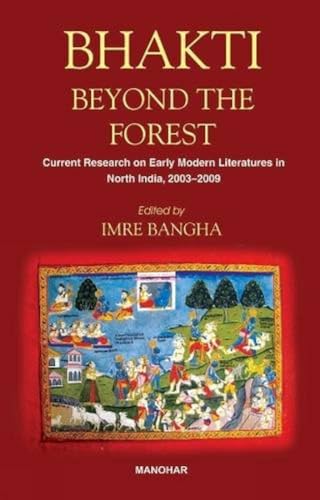
Bhakti Beyond the Forest: Current Research on Early Modern Religious Literatures in North India 2003-2009
Da: Vedams eBooks (P) Ltd, New Delhi, India
Valutazione del venditore 4 su 5 stelle
Prima edizione
EUR 36,51
Spedizione EUR 17,50
Spedito da India a U.S.A.Quantità: 1 disponibili
Aggiungi al carrelloHardcover. Condizione: New. Condizione sovraccoperta: New. 1st Edition. Contents: Preface. I. Constructing Bhakti Communities: 1. The four Sampradayas and other foursomes/John Stratton Hawley. 2. Thematic groupings of Bhakti poetry: the Dadupanth and Sarvangi literature/Dalpat Rajpurohit. 3. Nabhadas Bhaktamal and manuscript culture/James P. Hare. 4. Sainthood revisited: two printed versions of the lives of the eighty-four Vaishnavas by Gokulnath/Galina Rousseva Sokolova. 5. On and around the story of Candrahasa: the transmission of a tale and Bhakti/Yoshifumi Mizuno. II. Bakti and society: 6. Shiva and Parvati Assist Young couples in their marriage as referred to in Hindi devotional literature and folk songs/Teiji Sakata. 7. Devotion rewarded: the attitude towards wealth in the religious literature of medieval Gujarat/Francoise Mallison. III. Ideology: 8. Vaishnava sampradayas on the importance of ritual: a comparison of the two contemporaneous approaches by Vitthalanatha and Jiva Gosvami/Monika Horstmann and Anand Mishra. 9. Jayatrams jogpradipaka: between Hatha-yoga and Bhakti in the eighteenth century/Maya Burger. 10. From Sabda-brahman to sabad: the way from a transpersonal concept to personal experience/Florina Dobre-brat. 11. From ontology to aesthetics: a Bengal Vaishnava interpretation of the upanishadic passage so ham/Koyokazu Okita. IV. Forms: 12. Loving God through Sanskrit Grammar: Jiva Gosvami's use of Krishna's names in Harinamamrta-vyakarana/Rita Jeney. 13. God outside and God inside: north Indian Digambar Jain performance of Bhakti/John E. Cort.Appendix. Index. This book investigates from a diversity of perspectives how bhakti in general contributed to the formation of early modern literary culture in north India. The eighteen papers presented at the Tenth International Bhakti Conference: Early Modern literatures in North India at Sapientia-Hungarian University of Transylvania, in Miercurea Ciuc, Romania between 22-24 July 2009 address questions on how devotional literature was an important vehicle of community formation and how it dealt with the wider society. They also explore how ideology developed for a religious phenomenon with an emotional appeal, and what were the favoured linguistic literary or muscial forms of expression for bhakti. (jacket).
-

Tagore: Beyond His Language
Da: Vedams eBooks (P) Ltd, New Delhi, India
Valutazione del venditore 4 su 5 stelle
Prima edizione
EUR 36,51
Spedizione EUR 17,50
Spedito da India a U.S.A.Quantità: 1 disponibili
Aggiungi al carrelloHardcover. Condizione: New. 1st Edition. As a global figure, Tagore transcends the boundaries of language and reaches out to people distant both in time and space. His art took inspiration from contemporary Western trends and became a powerful means to connect with people beyond Bengal. Word, image, song, and text were his tools of communication, as also his extraordinary presence in a sartorial garb of his own design. A littérateur in many genres, the impact of his work was determined both by the material he presented, and by its simultaneously local and global contexts. Now, when his international reputation has spanned over more than a hundred years, it is important to revisit the sites of Tagore's eminence, and ask to what extent he was a 'living text' in the century that witnessed him as a global intellectual. Accordingly, this volume investigates how Tagore's writings and art are linked to the metalinguistic domains of the psychological, medical and mythical; how he was received in various cultures outside India; how his art was determined by individual circumstances and global aspirations; and how he acted as an inspiration to his contemporaries and subsequent generations including modern Indian writers and artists.
