Importo totale (1 articolo articoli):
Destinazione ordine:

einstein albert german physicist nobel (58 risultati)
Vai alla pagina principale dei risultati di ricerca
Filtri di ricerca
Tipo di articolo
- Tutti i tipi di prodotto
- Libri (Nessun altro risultato corrispondente a questo perfezionamento)
- Riviste e Giornali (Nessun altro risultato corrispondente a questo perfezionamento)
- Fumetti (Nessun altro risultato corrispondente a questo perfezionamento)
- Spartiti (Nessun altro risultato corrispondente a questo perfezionamento)
- Arte, Stampe e Poster (Nessun altro risultato corrispondente a questo perfezionamento)
- Fotografie (Nessun altro risultato corrispondente a questo perfezionamento)
- Mappe (Nessun altro risultato corrispondente a questo perfezionamento)
- Manoscritti e Collezionismo cartaceo (58)
Condizioni Maggiori informazioni
- Nuovo (Nessun altro risultato corrispondente a questo perfezionamento)
- Come nuovo, Ottimo o Quasi ottimo (Nessun altro risultato corrispondente a questo perfezionamento)
- Molto buono o Buono (Nessun altro risultato corrispondente a questo perfezionamento)
- Discreto o Mediocre (Nessun altro risultato corrispondente a questo perfezionamento)
- Come descritto (58)
Legatura
Ulteriori caratteristiche
- Prima ed. (Nessun altro risultato corrispondente a questo perfezionamento)
- Copia autograf. (4)
- Sovracoperta (2)
- Con foto (57)
- Non Print on Demand (58)
Lingua (1)
Spedizione gratuita
- Spedizione gratuita in U.S.A. (Nessun altro risultato corrispondente a questo perfezionamento)
Paese del venditore
Valutazione venditore
-

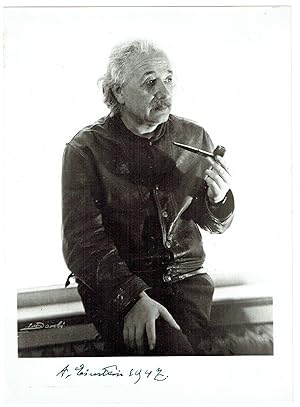
Photograph signed ("A. Einstein 1947").
Editore: No place, 1947., 1947
Da: Antiquariat INLIBRIS Gilhofer Nfg. GmbH, Vienna, A, Austria
Membro dell'associazione: ILAB PADA VDA VDAO
Valutazione del venditore 5 su 5 stelle

Manoscritto / Collezionismo cartaceo
EUR 35.000,00
Spedizione EUR 30,00
Spedito da Austria a U.S.A.Quantità: 1 disponibili
Aggiungi al carrello176 x 128 mm, annotated in pencil on verso: "Albert Einstein pl credit Lotte Jacobi 2299-2". A contemplative pose of Einstein in his famous leather jacket, holding his pipe, taken by Lotte Jacobi during the 1938 photo session she undertook with the theoretical physicist for Life magazine. - From the collection of Kalman Talansky (1924-2021).
-
Photograph signed ("A Einstein 1947").
Editore: n. p., 1947, 1947
Da: Kotte Autographs GmbH, Roßhaupten, Germania
Membro dell'associazione: ILAB PADA VDA
Valutazione del venditore 5 su 5 stelle
Manoscritto / Collezionismo cartaceo
EUR 35.000,00
Spedizione EUR 20,00
Spedito da Germania a U.S.A.Quantità: 1 disponibili
Aggiungi al carrello176 : 128 mm. Albert Einstein and his famous bomber jacket. A contemplative pose of Einstein holding his pipe taken by Lotte Jacobi during the 1938 photo session she undertook with the theoretical physicist for Life magazine. - Photograph by Lotte JACOBI (1896-1990), Princeton, 1938.Annotated in pencil on verso: "Albert Einstein pl. credit Lotte Jacobi 2299-2".
-
Typed letter signed A. Einstein".
Editore: Princeton, 30. I. 1940., 1940
Da: Kotte Autographs GmbH, Roßhaupten, Germania
Membro dell'associazione: ILAB PADA VDA
Valutazione del venditore 5 su 5 stelle
Manoscritto / Collezionismo cartaceo
EUR 14.500,00
Spedizione EUR 20,00
Spedito da Germania a U.S.A.Quantità: 1 disponibili
Aggiungi al carrello4to. 1 p. Blind embossed letterhead. To the young aspiring Romanian physicist Melanie Serbu (1909-1979), in German living now in Zurich, Switzerland."I believe that the concerns of colleague Wenzel are entirely justified. What I wrote to you was just an insight, casually expressed without knowledge of the relevant specialized literature. Of course, I also don't have the time to engage with this literature and can, therefore, take no responsibility for the matter. However, it would probably be best to choose the topic of the dissertation in line with a colleague there. This way, you can be sure that the work will be accepted if it is completed to his satisfaction, whereas otherwise, you might risk expending a lot of effort in vain."Ich glaube, dass die Bedenken des Kollegen Wenzel durchaus berechtigt sind. Was ich Ihnen schrieb, war nur ein apercu, leichthin ohne Kenntnisse der einschlägigen Spezal-Literatur geäussert. Ich habe natürlich auch nicht Zeit, mich mit dieser Literatur zu befassen und kann deshalb in der Sache keinerlei Verantwortung übernehmen. Es dürfte aber wohl das Beste sein, das Thema der Dissertation in Einklang mit einem dortigen Kollegen zu wählen. Dann sind Sie sicher, dass die Arbeit angenommen wird, wenn sie zu dessen Befriedigung vollendet wird, während Sie sonst riskieren würden, eine Fülle von Arbeit nutzlos aufzuwenden.
-

Typed letter signed with 8 autograph words inserted.
Editore: Princeton, NJ, 5 Aug. 1949., 1949
Da: Antiquariat INLIBRIS Gilhofer Nfg. GmbH, Vienna, A, Austria
Membro dell'associazione: ILAB PADA VDA VDAO
Valutazione del venditore 5 su 5 stelle
Manoscritto / Collezionismo cartaceo
EUR 22.000,00
Spedizione EUR 30,00
Spedito da Austria a U.S.A.Quantità: 1 disponibili
Aggiungi al carrello4to. 1 page. To the German-American mathematician Ernst Gabor Straus. Einstein refers to a work he has just written in which he resolves the equations of the gravitational field issues from Bianchi's identities; he also congratulates Straus on a beautiful mathematical discovery and invokes by comparison the proof of transcendence of numbers that the latter had simplified. - An assistant to Einstein from 1944 to 1948, Ernst Gabor Straus detected a computational error in one of Einstein's works and, in order to correct it, wrote a paper with him in 1946 entitled "A Generalization of the Relativistic Theory of Gravitation". In 1949, having left his position with Einstein at Princeton University, he published "Some Results in Einstein's Unified Field Theory". The two scientists remained in a working relationship afterwards. - On headed paper; perfectly preserved.
-
Typed letter signed ("A. Einstein").
Editore: Princeton, NJ, 2. II. 1940., 1940
Da: Antiquariat INLIBRIS Gilhofer Nfg. GmbH, Vienna, A, Austria
Membro dell'associazione: ILAB PADA VDA VDAO
Valutazione del venditore 5 su 5 stelle
Manoscritto / Collezionismo cartaceo
EUR 8.000,00
Spedizione EUR 30,00
Spedito da Austria a U.S.A.Quantità: 1 disponibili
Aggiungi al carrello4to. 1 p. Signature and one handwritten correction in green ink. In German. Framed, matted and glazed (46 x 62 cm) with a photographic portrait. To the Russian-French hydrodynamic engineer Wsevolode Grünberg in New York City, concerning a contested inheritance matter in which Einstein had reluctantly agreed to assist. From 1939, Einstein acted as a go-between for Grünberg and his friend János Plesch, an important Hungarian physician who had emigrated to England. "Concerning the inheritance matter", Einstein writes, "I regret having to report that we were not successful in getting my friend to England, as the War prevented it. Nor can I imagine that any hindrance remains to proceeding with the final settlement. I intend once more to encourage Mr. Plesch to put everything in order. As regards your inventions, I suggest that you send them for evaluation to my friend Professor Karman at the California Institute of Technology, who is a first-class expert and has influential connections to the realm of construction and practical implementation in the field. I enclose a letter to him [.]" (transl.). - Wsevolode Grünberg was the nephew of the Russian orthodontist and collector Josef Grünberg, a close friend of both Albert Einstein, who gave him the nickname "Bolshie", and János Plesch during their time in Berlin. It appears that Einstein and his second wife Elsa had become acquainted with Wsevolode Grünberg shortly before their friend's death in 1932. Travelling to America in 1939, Grünberg approached Einstein for an introduction to fellow engineers in the U.S. and help with his inheritance issue back in Europe. The two men met in June 1939 at the home of Irving Lehman in Port Chester, New York, and Einstein subsequently did what he could for Grünberg. In the early 1940s, Grünberg's important hydrofoil designs were used by the National Advisory Committee for Aeronautics (NACA) to build a seaplane model that was successfully tested at Langley, VA. Ironically, the classification of the project prevented the French citizen Grünberg from seeing the results of the tests until years after the war. Grünberg later became a U.S. citizen, changing his name to Waldemar A. Craig. - Traces of folds. On Einstein's embossed Princeton stationery.
-

Typed letter signed ('A. Einstein') to Hugo Bergmann
Editore: Princeton, 2 January 1950, 1950
Da: Kotte Autographs GmbH, Roßhaupten, Germania
Membro dell'associazione: ILAB PADA VDA
Valutazione del venditore 5 su 5 stelle
Manoscritto / Collezionismo cartaceo
EUR 9.500,00
Spedizione EUR 20,00
Spedito da Germania a U.S.A.Quantità: 1 disponibili
Aggiungi al carrello4to. One page, 279 x 216mm. Blind embossed letterhead. In German. 'The controversy about the foundations of the physics of probability'. Einstein is sending in a separate packet the volume printed for his 70th birthday (Albert Einstein: Philosopher-Scientist). 'I am sending it to you as I think that the controversy about the foundations of the physics of probability will perhaps interest you'. Once Bergmann has finished with the book, Einstein asks him to pass it to Rosa Dukas, sister of Einstein's assistant, Helen. Einstein has been discussing the problems of the Hebrew University with the recently-elected president, Selig Brodetzky, who has visited. Selig Brodetzky (1888-1954) was second president of the Hebrew University during a turbulent period, marked by the forced abandonment of the campus on Mount Scopus and disputes with the University Senate.
-
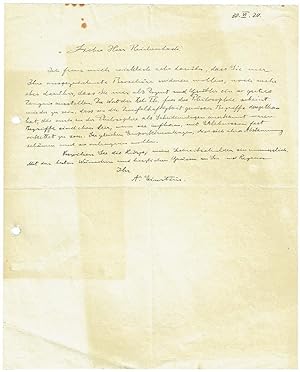
Autograph Letter Signed ("A. Einstein"), in German.
Editore: [Berlin], June 30, 1920, 1920
Da: Kotte Autographs GmbH, Roßhaupten, Germania
Membro dell'associazione: ILAB PADA VDA
Valutazione del venditore 5 su 5 stelle
Manoscritto / Collezionismo cartaceo
EUR 30.000,00
Spedizione EUR 20,00
Spedito da Germania a U.S.A.Quantità: 1 disponibili
Aggiungi al carrello4to. 1 page. Einstein on the value of relativity for philosophy. Einstein writes to Hans Reichenbach, the philosopher of science and an influential expositor of Relativity. In part (translation): "I am really very pleased that you want to dedicate your excellent brochure to me, but even more so that you give me such high marks as a lecturer and thinker. The value of the th.[eory] of rel.[ativity] for philosophy seems to me to be that it exposed the dubiousness of certain concepts that even in philosophy were recognized as small change. Concepts are simply empty when they stop being firmly linked to experiences. They resemble upstarts who are ashamed of their origins and want to disown them." The letter was published in the Collected Papers of Albert Einstein, vol 10, doc 66, pp 323-324 (CPAE Translation, vol 10, doc 66, p 201). Slightly uneven toning, a few spots in upper margin, two-hole punch at left margin, folding creases.
-
Three typed letters signed "A. Einstein".
Editore: Caputh near Potsdam, 25 June and 8 September 1932 (both with printed letterhead), and [De Haan], 16 May 1933, 1933
Da: Kotte Autographs GmbH, Roßhaupten, Germania
Membro dell'associazione: ILAB PADA VDA
Valutazione del venditore 5 su 5 stelle
Manoscritto / Collezionismo cartaceo
EUR 38.000,00
Spedizione EUR 20,00
Spedito da Germania a U.S.A.Quantità: 1 disponibili
Aggiungi al carrelloAltogether 3 pp. 4to. Approximately 28 x 22 cm. An extraordinary testimony to the intellectual friendship between Albert Einstein and the mathematician Ludwig Hopf during the decisive months immediately before and after Einstein's emigration from Germany. The letters reveal cosmological reflections, personal humour, and Einstein's early warnings concerning the rise of National Socialism and the fate of Jewish scholars.The correspondence is addressed to Ludwig Hopf (18841939), Einstein's former assistant, whom he had first met at the ETH Zürich in 1910 and with whom he maintained a lasting scientific and personal relationship since their years together in Aachen. The letters document Einstein's cosmological thinking, his demanding international lecture schedule, and his increasing concern for the future of intellectual life in Germany under the Nazi regime.In the letter of 25 June 1932, Einstein explains the transition from a static to an expanding cosmological model, dispensing in this "first approximation" with both the cosmological constant and spatial curvature: "Seitdem man aus den Beobachtungen der Rotverschiebungen der extragalaktischen Nebel weiß, dass die Materie expandiert kann man den Gleichungen schon ohne -Glied und ohne Krümmung genügen" ("Since observations of the redshifts of extragalactic nebulae have shown that matter is expanding the equations can already be satisfied without the -term and without curvature"). Consequently, "man über die Existenz einer Raumkrümmung vorläufig nichts aussagen kann" ("for the present nothing can be said about the existence of spatial curvature").Alongside these scientific reflections, Einstein offers characteristically dry personal humour: "Die guten Berichte über Ihre Kinder freuen mich sehr Mir gehts auch ähnlich mit meinem jüngsten Sohn, der in der Musik ziemlich modernistisch verseucht ist. Der Ältere hat mich sehr respektlos zum Grosspapa befördert" ("The good reports about your children delight me greatly It is similar with my youngest son, who is rather infected with musical modernism. The elder has most disrespectfully promoted me to grandfather"). He also complains of having no time left for "Vergnügungs-Eskapaden" ("pleasure escapades").In the letter of 8 September 1932, Einstein apologizes for failing to answer an invitation, attributing this to the restless pace of his life during the final year of the Weimar Republic: "Zur Entschuldigung kann nur das Nomadenleben dienen, das ich in den letzten Monaten geführt habe" ("The only excuse can be the nomadic life I have led in recent months"). He regrets being unable to undertake a proposed lecture series because of his overwhelming travel obligations shortly before leaving Germany permanently in 1933.Particularly remarkable is the letter of 16 May 1933, written shortly after Hitler's seizure of power and Einstein's definitive break with German institutions. Attempting to help Hopf who would only succeed in emigrating to Cambridge in 1939 before receiving an appointment at Trinity College Dublin Einstein proposes an alternative professional future through international public lectures: "Sie sollen populäre Vorlesungen in verschiedenen Ländern und Städten über Relativitätstheorie, die Prinzipien der Hydrodynamik (Theorie des Fliegens), sowie über die Wandlungen der Atomtheorie halten" ("You should give popular lectures in various countries and cities on relativity theory, the principles of hydrodynamics [the theory of flight], and the transformations of atomic theory"). Such work, Einstein remarks, would not only be more profitable than a professorship but would also provide "ein amüsantes Zigeunerleben" ("an amusing gypsy life"). He offers to use his own international reputation actively on Hopf's behalf: "Sobald Sie es nur wollen, empfehle ich Sie überall hin, dass man Sie einladen soll" ("As soon as you wish it, I shall recommend everywhere that you be invited").Against the background of rapidly radicalizing conditions in Germany, Einstein formulates a strikingly sharp assessment of developments there: "Ich habe Ihre lieben Landsleute immer richtig eingeschätzt es wird bald gegen die intellektuelle Schicht überhaupt losgehen" ("I have always judged your dear compatriots correctly it will soon turn against the intellectual class altogether"). He laments that "Die Hochschulen sind überall auf den Hund" ("The universities everywhere are going to ruin") and refers to his then-discussed but ultimately unrealized project of establishing a Jewish refugee university: "Meinen Plan einer jüdischen Flüchtlingsuniversität habe ich so gut wie aufgegeben, weil er wenig Gegenliebe findet" ("I have more or less abandoned my plan for a Jewish refugee university because it finds little support").The correspondence concludes with practical questions concerning Hopf's language skills "Wenn nicht, dann büffeln Sie tüchtig" ("If not, then study hard") combining political seriousness with personal encouragement in a manner entirely characteristic of Einstein.An exceptionally important and historically revealing group of letters, uniting cosmological theory, exile history, intellectual friendship, and prophetic political observation during one of the decisive turning points of the twentieth century.
-
Autograph letter signed "Dein Papa".
Editore: Caputh, 30 July [1929], 1929
Da: Kotte Autographs GmbH, Roßhaupten, Germania
Membro dell'associazione: ILAB PADA VDA
Valutazione del venditore 5 su 5 stelle
Manoscritto / Collezionismo cartaceo
EUR 10.000,00
Spedizione EUR 20,00
Spedito da Germania a U.S.A.Quantità: 1 disponibili
Aggiungi al carrello1 p. 4to. 28 x 22 cm. A deeply personal and affectionate letter to Einstein's younger son Eduard ("Tetel"), inviting him to Caputh in the hope of cheering him and strengthening his spirits. Combining paternal concern, philosophical reflection, and intimate glimpses into Einstein's private life, the letter is among the most human and emotionally revealing types of Einstein correspondence.Einstein writes that he will travel to Zurich on the 9th for "eine zionistische Sache" ("a Zionist matter") and proposes that Eduard accompany him back to Caputh, where he is living alone with Elsa in a small house by the lake: "Mein neues herrliches Schiff ist nun fertig und ich segle täglich. Es ist wunderbar für die Erholung" ("My splendid new boat is now finished and I sail every day. It is wonderful for recuperation"). Referring to the unusually cool weather, he suggests that the lakeside environment might benefit his son more than the mountains.The emotional core of the letter lies in Einstein's concern over Eduard's psychological condition and lack of vitality, which he senses between the lines of his son's recent letter: "Dein Brief bedrückt mich ein wenig, weil so wenig Unternehmungsgeist und Lebensfreude daraus spricht" ("Your letter depresses me somewhat because it shows so little enterprise and joy in life"). He stresses the moral and existential importance of meaningful work, invoking Arthur Schopenhauer as an example of a genius destroyed by the absence of practical occupation: "Selbst ein Genie wie Schopenhauer wurde zermürbt durch die Berufslosigkeit" ("Even a genius like Schopenhauer was worn down by the lack of a profession").Einstein continues with reflections of striking ethical clarity: "Man muss das Gefühl haben, dass man den anderen durch ehrliche Arbeit zurückgibt, was man empfängt. Sonst bleibt der moralische Katzenjammer nicht aus" ("One must feel that one gives back to others through honest work what one receives. Otherwise the moral hangover cannot fail to appear"). He concludes reassuringly that it will do Eduard good to spend more time in his company: "du wirst sehen" ("you will see").The letter was written during a transitional and physically fragile period in Einstein's life. Following a serious heart condition in 1928, he spent nearly a year recovering. In 1929 he built his celebrated summer house in Caputh near Potsdam, though at the time of the present letter he was still living in rented accommodation on Potsdamer Straße. The "new splendid boat" mentioned here was the sailing boat Tümmler, presented to Einstein by friends on the occasion of his fiftieth birthday in March 1929.Eduard Einstein (19101965), the second son of Albert Einstein and Mileva Mari , was highly gifted and musically talented. After excelling in his school examinations in 1929, he began medical studies with the intention of becoming a psychiatrist. Only a short time later, however, he developed schizophrenia, abandoned his studies, and spent much of his later life under psychiatric care at the Burghölzli clinic in Zurich.An exceptionally moving and psychologically revealing family letter, illuminating Einstein not as public icon or scientist, but as a deeply reflective and concerned father. From an important French private collection.
-

Autograph letter signed ("A. Einstein").
Editore: [Scharbeutz, after 26 July 1928]., 1928
Da: Antiquariat INLIBRIS Gilhofer Nfg. GmbH, Vienna, A, Austria
Membro dell'associazione: ILAB PADA VDA VDAO
Valutazione del venditore 5 su 5 stelle
Manoscritto / Collezionismo cartaceo
EUR 28.000,00
Spedizione EUR 30,00
Spedito da Austria a U.S.A.Quantità: 1 disponibili
Aggiungi al carrello4to (222 x 280 mm). 2 pp. In pencil on cream-coloured paper with traces of perforation at top edge. In German. With the original envelope, addressed in ink. To the Polish German mathematician Chaim Herman Müntz (1884-1956), setting out several equations in the body of the letter: "Ich danke Ihnen bestens für die Mitteilung der allgemeinen Integrationsmethode für die Näherungsgleichungen, die zu der zweiten Hamilton-Invariante (Dichte) [.] gehört. Das ganze Problem liegt aber wesentlich schwieriger, als ich gedacht hatte [.] Damit hängt es zusammen, dass mir eine physikalische Interpretation der Theorie bisher überhaupt nicht gelungen ist. Es ist aber dabei im Auge zu behalten, dass gemäss Bohrs Resultaten der Zusammenhang zwischen der Bewegung der Singularitäten und dem Wellenfelde überhaupt nicht so einfach ist, wie es nach Maxwell sein sollte [.]". The letter closes: "Wenn ich wieder zurück komme, wollen wir ausführlich über die Sache reden. Man kann natürlich die ganze Bemühung als utopisch erklären. Aber eine mathematisch so natürliche Theorie ist ernsthafter Beachtung wert, zumal bei der gegenwärtigen disperaten Lage der theoretischen Physik" - a remark that appears to be levelled at the new developments in quantum mechanics. - A dense scientific communication from Einstein's Berlin period, aligning with his intensive work on a unified field theory in 1928-29 and reflecting his reliance on other figureheads of contemporary physics and mathematics. Müntz, noted for the Müntz approximation theorem, worked with Einstein from 1927 and is thanked in Einstein's paper "On Unified Field Theory" (1929) for "laboriously precise calculation on the basis of Hamilton's principle", underscoring the present letter's context. - A fine association piece at the intersection of physics and higher mathematics, documenting Einstein's ongoing attempts to ground unification in a Hamiltonian variational framework. - Folded horizontally and vertically; envelope torn open somewhat roughly at the side. - From a Swedish private collection. - The Collected Papers of Albert Einstein (Princeton UP, 2021), vol. 16, p. 389f., no. 245 (edited from a photocopy).
-
Autograph manuscript of scientific calculations.
Editore: No place, [March 1950 - early April 1951]., 1951
Da: Antiquariat INLIBRIS Gilhofer Nfg. GmbH, Vienna, A, Austria
Membro dell'associazione: ILAB PADA VDA VDAO
Valutazione del venditore 5 su 5 stelle
Manoscritto / Collezionismo cartaceo
EUR 38.000,00
Spedizione EUR 30,00
Spedito da Austria a U.S.A.Quantità: 1 disponibili
Aggiungi al carrello4to (280 x 216 mm). 1½ pages. Dated (likely in the hand of Helen Dukas) in pencil at upper and lower right. The manuscript comprises approximately 31 lines of mathematical workings. Einstein devoted the last thirty years of his life to the quest to combine general relativity and Maxwell's theory of electromagnetism into a single physical and mathematical framework which would account for all of the then-known fundamental forces of nature - a "unified field theory". Although his early attempts in the 1920s focused on "distant parallelism", he later concentrated on an approach treating both the metric tensor and the affine connection as fundamental fields, often introducing an element of asymmetry (in variance to the theory of general relativity). Einstein often complained of the heavy mathematical burden imposed by this approach, as demonstrated in the present manuscript. - In mint condition. - Sotheby's, 30 May 1979, lot 49 (part).
-

Typed letter signed ("A. Einstein").
Editore: Princeton, New Jersey, 21. IV. 1942., 1942
Da: Antiquariat INLIBRIS Gilhofer Nfg. GmbH, Vienna, A, Austria
Membro dell'associazione: ILAB PADA VDA VDAO
Valutazione del venditore 5 su 5 stelle
Manoscritto / Collezionismo cartaceo
EUR 12.000,00
Spedizione EUR 30,00
Spedito da Austria a U.S.A.Quantità: 1 disponibili
Aggiungi al carrello4to. 1 page. In German. On blindstamped headed stationery. To the Hungarian-born physicist Cornelius Lanczos (1893-1974) at Purdue University, Lafyette, Indiana, about Lanczos's wave tensor, pointing out that it is indeed invariant in special-relativistic terms, but not the way in which it is constituted from individual waves of different frequencies; adding that his own research on complex space is not yet finished: "Nun noch eine Bemerkung über Ihren Wellen-Tensor: Es ist zwar richtig, dass dieser als Ganzes genommen spezial-relativistisch invariant ist, nicht aber die Art und Weise wie er aus Einzelwellen verschiedener Frequenz konstituiert ist [.] Meine Untersuchungen über den komplexen Raum sind noch nicht fertig". - Einstein further discusses his suffering from "bilious attacks", along with the challenges theoretical physicists face in finding defence work, and advises Lanczos to remain at Purdue University, as getting a job at the Institute for Advanced Study or elsewhere might prove difficult due to the lack of money there, compounded by xenophobia: "Ich glaube aber, dass Leute, die vorwiegend theoretisch gearbeitet haben, nicht so viel begehrt sind, besonders wenn noch die Xenophobie in Frage kommt". - Einstein's remarks about defence work are poignant: although the Einstein-Szilard letter to F. D. Roosevelt on 2 August 1939 effectively launched the Manhattan Project to construct an atomic bomb, he was himself denied clearance to work on it in July 1940, in part because of his pacifist views. In June 1943 he was, however, reported to be advising the Ordnance Bureau of the U.S. Navy on the theory of explosives. - Small tear to left margin.
-

Autograph letter signed ("A. Einstein").
Editore: Princeton, New Jersey, 4. XII. 1949., 1949
Da: Antiquariat INLIBRIS Gilhofer Nfg. GmbH, Vienna, A, Austria
Membro dell'associazione: ILAB PADA VDA VDAO
Valutazione del venditore 5 su 5 stelle
Manoscritto / Collezionismo cartaceo
EUR 28.000,00
Spedizione EUR 30,00
Spedito da Austria a U.S.A.Quantità: 1 disponibili
Aggiungi al carrello4to. 1 page. In German. To the Hungarian-born physicist Cornelius Lanczos (1893-1974) with thanks for sending him a copy of his book "The Variational Principles of Mechanics" (1949) and for his having dedicated it to him, pointing out that it has freed him for the time being from the burden of being a passionate non-reader. Einstein ironically adds that despite everything he has learned so far about the American people he hopes the work will gradually find general distribution in U.S. universities: "Sie wissen, dass ich ein leidenschaftlicher Nichtleser bin. Aber Ihr Buch wird mich für eine Zeit von diesem Laster befreien [.] Ich zweifle nicht, dass dies Buch allmählich eine allgemeine Verbreitung in den hiesigen Universitäten finden wird, trotz allem was ich von unseren neuen Landsleuten allmählich in Erfahrung gebracht habe". - Returning to their shared obsession with gravitational theory, Einstein provides three equations which he now feels certain constitute the "overdetermined system" which is "the only natural generalisation of the gravitational equations". The reasoning that has brought him to this conclusion appears as an appendix in "the new edition of my old relativity book", which he will send Lanczos as soon as he has a copy. - Very well preserved.
-
Typed letter signed ("A. Einstein").
Editore: Princeton, New Jersey, 14. II. 1955., 1955
Da: Antiquariat INLIBRIS Gilhofer Nfg. GmbH, Vienna, A, Austria
Membro dell'associazione: ILAB PADA VDA VDAO
Valutazione del venditore 5 su 5 stelle
Manoscritto / Collezionismo cartaceo
EUR 22.000,00
Spedizione EUR 30,00
Spedito da Austria a U.S.A.Quantità: 1 disponibili
Aggiungi al carrello4to. 1½ pp. In German. On blindstamped headed stationery. To the Hungarian-born physicist Cornelius Lanczos (1893-1974) on the intolerant and megalomaniac character of Erwin Schrödinger. Einstein considers him "intuitively extraordinarily gifted man" who suffers from so stormy a temperament that it makes him argue entirely contradictory opinions in short succession, so that one could quite frequently refute Schrödinger with Schrödinger: "Er ist ein intuitiv ausserordentlich begabter Mensch mit einem stürmischen Temperament und nicht frei von cäsarischen Anwandlungen. Das Temperament bringt ihn dazu, sich zu einer Zeit mit einer Auffassung A zu identifizieren und nach einiger Zeit mit der damit unverträglichen Auffassung B, sodass man meistens Schrödinger mit Schrödinger am schlagendsten widerlegen könnte". - Further, Einstein disapproves of Lanczos's intention to leave his position in Dublin, not least because finding a position in America where one can "immerse oneself in problems" is not at all easy; he urges his friend not to be too suspicious of others' attitudes towards him, even if strong nationalism is a well-known phenomenon among the Irish. - Lanczos had taken over Schrödinger's post at the School of Theoretical Physics at the Dublin Institute for Advanced Studies in 1952, and in spite of some early difficulties was to remain there for the rest of his life. Einstein himself would pass away only two months after the present letter. - Two small tears near lower left corner and left margin.
-

Autograph letter signed ("A. E.").
Editore: Princeton, New Jersey, 19. VI. 1943., 1943
Da: Antiquariat INLIBRIS Gilhofer Nfg. GmbH, Vienna, A, Austria
Membro dell'associazione: ILAB PADA VDA VDAO
Valutazione del venditore 5 su 5 stelle
Manoscritto / Collezionismo cartaceo
EUR 15.000,00
Spedizione EUR 30,00
Spedito da Austria a U.S.A.Quantità: 1 disponibili
Aggiungi al carrello4to. 1 page. In German. To the Hungarian-born physicist Cornelius Lanczos (1893-1974), approving of his philosophical lecture, with a snappy remark about the Austrian philosopher Otto Weininger (1880-1903). Einstein comments that positivists and pragmatists appear as "bearers of a world-feeling" in the same way that the Epicureans must have seemed to pious Jews and Christians, or the way "the female" appeared to the misogynic Weininger, pointing out that "unmusical engineering souls" obsessed with sense-data have lost their understanding for questions of philosophy: "Die Positivisten und Pragmatisten erscheinen da so ähnlich als Träger eines Weltgefühls wie die Epicuräer den frommen Juden und Christen erschienen, oder das Weibliche dem Weininger. Es ist aber etwas Wahres daran, nämlich, dass diese philosophischen Richtungen mit auf die Sens-data starrendem Blick, das Verständnis für das Wunder der Begreiflichkeit des nur so indirekt Gegebenen verloren haben, unmusikalische Ingenieur-Seelen". - Einstein concludes that Lanczos's reasoning seems quite "un-American" and wonders how the learned people in the United States reacted to such thoughts, considering it a kind of "psychological test": "Es würde mich interessieren zu erfahren, wie so was Unamerikanisches auf das hiesige gelehrte Volk wirkt. Haben Sie diesbezügliche Erfahrungen gesammelt? Es würde eine Art psychologischer 'test'". - Einstein's use of the word "un-American" in relation to Lanczos's philosophical exploration is prophetic, as Lanczos would indeed be suspected of "Un-American" leanings during the McCarthy-era. - Lower left corner slightly worn, otherwise very well preserved.
-

Typed letter signed ("A. Einstein").
Editore: Los Angeles, California, 9. VII. 1952., 1952
Da: Antiquariat INLIBRIS Gilhofer Nfg. GmbH, Vienna, A, Austria
Membro dell'associazione: ILAB PADA VDA VDAO
Valutazione del venditore 5 su 5 stelle
Manoscritto / Collezionismo cartaceo
EUR 14.500,00
Spedizione EUR 30,00
Spedito da Austria a U.S.A.Quantità: 1 disponibili
Aggiungi al carrello4to. 1 page. In German. Greek letter psi added by hand. On blindstamped headed stationery. To the Hungarian-born physicist Cornelius Lanczos (1893-1974) on the difficulties of finding one's way in life, discussing his ongoing dispute with Erwin Schrödinger and Max Born over the "Copenhagen Interpretation" of quantum mechanics. - Einstein is happy to hear that Lanczos is content in his new position in Dublin and no longer considers fleeing to Brazil, an idea Einstein found rather amusing. He compares the struggle of existence with living in the midst of a herd of buffalos, always under threat of being trampled: "Dies ist schon das Beste, was unsereinem erreichbar ist: man ist in eine Büffelherde geboren und muss froh sein, wenn man nicht vorzeitig zertrampelt wird. Die Idee einer Flucht nach Brasilien fand ich etwas drollig". - Turning to scientific matters, Einstein comments on Schrödinger's "desperate attempt" to dismiss the Born rule in favour of the wave function as a stand-alone description of the facts: "Schrödinger hat neuestens den verzw[e]ifelten Versuch unternommen, die Born'sche Interpretation zu verwerfen und die [psi] Funktion unmittelbar als die volls[t]ändige Beschreibung der realen Tatbestände zu proklamieren". - Lanczos had come under suspicion for possible communist affinities in McCarthyite America, and this appears to have caused his move to Ireland in 1952, where he took over Erwin Schrödinger's position at the School of Theoretical Physics at the Dublin Institute for Advanced Studies. Einstein's long-standing objection to the predominance of statistics in the Copenhagen Interpretation was famously summed up in his dictum 'God does not play dice'. The psi function represents the amplitude of the wave in Schrödinger's time wave equation.
-

Eigenh. Brief mit Unterschrift Albert".
Editore: O. O. , Sonntag, XII.54"
Da: Kotte Autographs GmbH, Roßhaupten, Germania
Membro dell'associazione: ILAB PADA VDA
Valutazione del venditore 5 su 5 stelle
Manoscritto / Collezionismo cartaceo
EUR 18.500,00
Spedizione EUR 20,00
Spedito da Germania a U.S.A.Quantità: 1 disponibili
Aggiungi al carrello4to. 1 p. Gelocht. An seinen Enkel Bernhard, nach dessen Hochzeit mit Aude Ascher. Lieber Hardi! | Der Bettelbrief hat mir sehr gefallen. Er zeigt, dass Dir der Sprung ins Joch recht gut gethan hat. Hoffentlich hast Du das Geld schon erhalten; wenns nicht reicht, will ich gerne noch weiter nachhelfen. Für die Kälte-Empfindlichkeit der Füsse Deiner Frau gibt es eine Art einfacher elektrischer Lampe [], die rotes und ultrarotes Licht in einem Bündel abgibt. Besonders für die Übergangsjahreszeit ist es nützlich []" - Hierzu die Zeichnung. Ich kann mir denken, dass Dir die soliden Schweizer Lehrmethoden besser gefallen als die oberflächlichen amerikanischen. Überhaupt ist in der Schweiz alles gesünder und ehrlicher - allerdings auch etwas kleinlich und phantasielos. Es imponiert mir, mit was für einer Energie Deine Frau sich auf ihren Beruf vorbereitet. Ihr ruhige und sichere Art wird auch auf Dich wirken. Ich bin ziemlich geschwächt von einer Anemia, so dass ich nicht einmal eine Treppe steigen kann. Aber der Kopf ist immer noch brauchbar und lebendig, sodass ich mich des Daseins freuen kann []"Lieber Hardi" to his grandson Bernhard Caesar Einstein]. Endearing personal letter to his grandson, with a pen drawing. Bernhard Caesar Einstein (1930-2008), son of Hans Albert, had married in 1954 Doris Aude Ascher (born in 1938): they had 5 children.Einstein picks up somewhat sarcastically on his ,beggar's letter' ('Bettelbrief') and the new ,marital yoke' ('der Sprung ins Joch'). He hopes he has received the money and if that is not enough he will help more if needed. With regards to his wife's cold feet ('die Kälte-Empfindlichkeit der Füsse Deiner Frau'), there is a sort of simple electrical lamp that projects a red light and ultra red light, useful during transitional seasons. He draws the lamp and concludes that it does not require very much electricityEinstein comments that Swiss teaching methods are likely better that American ones. In general, evreything is better and more honest in Switzerland but also a bit petty and lacking imagination ('Überhaupt ist in der Schweiz alles gesünder und ehrlicher allerdings auch etwas kleinlich und phantasielos.') He himself is weakened by anemia and cannot walk up stairs. But the head is still operable and alive in order to be grateful for existence ('Aber der Kopf ist immer noch brauchbar und lebendig, sodass ich mich des Daseins freuen kann.')For about two weeks, from January 2 to 13, Eisenhower spent his furlough in Washington, D.C., visiting his wife and attending a series of conferences. He then returned to London to plan for Overlordthe invasion of France at Normandy [Stephen E. Ambrose, Eisenhower: Soldier and President].
-

Typed letter signed A. Einstein".
Editore: Knollwood, Saranac Lake, 10. VIII. 1940., 1940
Da: Kotte Autographs GmbH, Roßhaupten, Germania
Membro dell'associazione: ILAB PADA VDA
Valutazione del venditore 5 su 5 stelle
Manoscritto / Collezionismo cartaceo
EUR 8.500,00
Spedizione EUR 20,00
Spedito da Germania a U.S.A.Quantità: 1 disponibili
Aggiungi al carrello4to. 1/2 p. Folded. Airmail paper. To the German-American musicologist Hans Rosenwald in Chicago. Einstein declined the request for an article, stating that due to his fame, [] jeder Auesserung von mir mehr Gewicht beigelegt wird als objektiv berechtigt und wünschbar ist []" - Rosenwald (1907-1988) was the editor of "Who is Who in Music," and the request was addressed to the physicist, who was also known as an excellent violinist. Rosenwald emigrated in 1936 and had been a lecturer in Chicago since 1938.
-
Typed letter signed. A. Einstein".
Editore: Princeton, 11. V. 1951., 1951
Da: Kotte Autographs GmbH, Roßhaupten, Germania
Membro dell'associazione: ILAB PADA VDA
Valutazione del venditore 5 su 5 stelle
Manoscritto / Collezionismo cartaceo
EUR 9.500,00
Spedizione EUR 20,00
Spedito da Germania a U.S.A.Quantità: 1 disponibili
Aggiungi al carrello4to. 1 p. Blind embossed stationery A. Einstein, [] Princeton". Important letter illustrating Einstein's care for his younger sister, Maya. To Dorothea Koenig in Nashville regarding the poor health condition of Einstein's sister, Maya: Ich weiss natürlich von Maja's alter Bekanntschaft mit Frau Glinz-Frey. Die Tatsache, dass diese keine Briefe mehr von meiner Schwester empfangen hat beruht auf deren schwerer Erkrankung (fortgeschrittene Arteriosklerose des Gehirns), welche ihr das Leben und Schreiben seit einiger Zeit unmöglich macht. Es ist sehr freundlich von Ihnen, Ihren Besuch anzubieten. Ein solcher würde sich jedoch nicht empfehlen, da meine Schwester im Sprechen ausserordentlich behindert ist und bei Gelegenheit eines Besuches sich ihres Zustandes schmerzlicher bewusst wird als sonst. Ich wage es deshalb gar nicht, von Ihrem Briefe etwas zu erwähnen. []" - In February 1939, Maja Einstein emigrated to the USA and moved in with her brother Albert in Princeton. Her husband was denied entry to the USA for health reasons, so he stayed with relatives in Geneva. Maja Einstein intended to return home after the end of World War II. In 1946, she suffered a stroke; she also developed arteriosclerosis and became bedridden, preventing her from returning to Europe. The couple maintained a correspondence by letter until Maja Einstein's death. She passed away on June 25, 1951, due to pneumonia following a fractured upper arm in Princeton.Albert Einstein reported after his sister's death: "In the last few years, I read to her every evening from the finest books of old and new literature.".
-

Typed letter signed ("A. Einstein").
Editore: Princeton, 6. X. 1938., 1938
Da: Antiquariat INLIBRIS Gilhofer Nfg. GmbH, Vienna, A, Austria
Membro dell'associazione: ILAB PADA VDA VDAO
Valutazione del venditore 5 su 5 stelle
Manoscritto / Collezionismo cartaceo
EUR 15.000,00
Spedizione EUR 30,00
Spedito da Austria a U.S.A.Quantità: 1 disponibili
Aggiungi al carrello4to (212 x 278 mm). ½ page. In German. To Edward Cushing, writing in support of the Austrian educator Eugenie Schwarzwald (1872-1940), founder of the "Schwarzwaldschule" for young women, after her assets were seized by the Nazis. In response to a prior letter from Mr. Cushing, Einstein writes: "I personally feel great respect and warm sympathy for Mrs. Schwarzwald. However, since I lead a rather isolated life, I have few personal acquaintances and no knowledge of people who could be approached [.] If you should learn about such people from your American friends, I should be very glad to write to them. Also, I should be able to make a modest contribution myself [.]" (transl.). - This letter relates to Mrs. Eugenie Schwarzwald, a progressive Austrian philanthropist who founded the innovative Schwarzwald school to educate Austrian girls. She was forced to leave Austria due to her Jewish ancestry; her assets were seized by the National Socialists, and the Schwarzwald schools were forcibly closed. Edward Cushing began the "Schwarzwald fund" to support her financially after the seizure of her assets, and in conjunction with the American journalist Dorothy Thompson, rallied for their intended emigration to America - likely referenced here. - Llight mailing folds impacting signature, two small spots of loss at the centrefolds. - From the collection of Kalman Talansky (1924-2021). - Cf. John M. Spalek et al., Deutschsprachige Exilliteratur seit 1933, p. 379.
-
Autograph letter signed.
Editore: Berlin, 22. III. 1929., 1929
Da: Kotte Autographs GmbH, Roßhaupten, Germania
Membro dell'associazione: ILAB PADA VDA
Valutazione del venditore 5 su 5 stelle
Manoscritto / Collezionismo cartaceo
EUR 19.500,00
Spedizione EUR 20,00
Spedito da Germania a U.S.A.Quantità: 1 disponibili
Aggiungi al carrello8vo. 1 1/2 pp. Double sheet. Printed letterhead Haberlandstr. 5 | Berlin W.". To Marie Barthelts in Winterhur : Ich erinnere mich noch ganz gut an unser Musizieren vor 29 Jahren. Seitdem hab ich viel heruntergefiedelt und auch sonst ein so merkwürdig arbeits- und ereignisreiches Leben geführt, dass das versprochene Kikeriki mir im Halse stecken geblieben ist. Es hätte Ende 1905 sein müssen. Ihr Briefchen war für mich vom schönsten, was bei diesem 50. Geburstag kam. Es wurde mir wieder alles von damals lebendig, die frohe, wenn auch harte Jugend, die guten Menschen, die fast alle aus dem Leben oder meinem Gesichtskreis weggegangen sind. Ich selbst bin ein grauhaariger, leidender Mensch geworden, aber der frohe Sinn und die Freude am Musizieren sind geblieben. Meine Eltern sind längst tot. Ich freue mich für Sie, dass Sie Ihre Mutter haben behalten dürfen. Seien Sie mit ihr bestens gegrüsst von Ihrem alten A. Einstein"Translation: I remember quite well our music-making from 29 years ago. Since then, I've fiddled away a lot and led such a strangely eventful life that the promised cock-a-doodle-doo has stuck in my throat. It must have been the end of 1905. Your little letter was the loveliest thing that came for me on this 50th birthday. It brought everything back to me from those days, the joyful, albeit tough youth, the good people, most of whom have passed away or left my circle. I myself have become a gray-haired, suffering person, but the joyful spirit and the pleasure in making music have remained. My parents have long been dead. I am happy for you that you have been able to keep your mother. Please give her my best regards. Yours sincerely, your old A. Einstein".
-
Autograph letter signed.
Editore: [Berlin], 27. II. 1924., 1924
Da: Kotte Autographs GmbH, Roßhaupten, Germania
Membro dell'associazione: ILAB PADA VDA
Valutazione del venditore 5 su 5 stelle
Manoscritto / Collezionismo cartaceo
EUR 28.000,00
Spedizione EUR 20,00
Spedito da Germania a U.S.A.Quantità: 1 disponibili
Aggiungi al carrelloFolio. 1 p. Folded. To Hermann Anschütz-Kaempfe: Der freundliche Brief von Ihrer Frau [Reta Stöve] und auch von Ihnen hat sehr wohlgethan und meiner Frau [Elsa Eisntein] das Vorurteil verscheucht, dass Sie ihr in irgend einer Weise übelwollen oder mich von ihr abzuziehen suchen. Man muss Frauen nehmen wie sie sind und ihnen das Leben so leicht als möglich machen wenn nicht aus purer Gutmütigkeit, halbaus Gutmütigkeit, so doch halb aus Klugheit. Dazu haben Sie mir in freundlicherWeise verholfen. Ich komme dann sehr gern wieder nach Kiel, nur muss ich anfangs Mai zum Philoesophenkongress nach Neapel. Das hat sich nichtvermeiden lassen, weil dort ein besonderer Tag der Rel[ativitäts]-Theorie gewidment ist. Mitte Mai kann ich aber gut nach Kiel kommen und freue mich schon darauf. Dass bei bewegter Kugelschale durch das Magnetfeld Drehmomente auf die Kugel übertragen werden, ist nicht ganz zu vermeiden, aber der dadurch erzeugte systematische Fehler kann nicht bedeutend sein, wohl nicht grösser als der durch Wasserreibung bedingte.Dagegen wird eben nichts zu machen sein. Wichtig ist, dass der Blasring schöngleichmässig ist, dass bei blosser Drehung um die Vertikale nichts derartigesauftritt. Ich arbeite fest, wurde aber von der physikalischen Muse an der Naseherumgeführt. Hoffentlich kommts besser []"Translated: "The kind letter from your wife [Reta Stöve] and also from you has been very comforting, dispelling any prejudice my wife [Elsa Einstein] may have had that you bear ill will towards her or seek to alienate me from her in any way. One must take women as they are and make life as easy for them as possible - if not out of pure good nature, then partly out of good nature and partly out of prudence. You have helped me in a friendly manner towards this end. I will be very happy to return to Kiel, but I must go to the Philosophy Congress in Naples at the beginning of May. This could not be avoided, as a special day dedicated to the Theory of Relativity will be observed there. However, I can come to Kiel in mid-May and look forward to it. The fact that torques are transferred to the ball due to the moving ball shell through the magnetic field cannot be completely avoided, but the systematic error thus generated cannot be significant, probably not greater than that caused by water friction. However, there will be nothing to be done about it. It is important that the bubble ring is evenly formed, so that nothing of the sort occurs with mere rotation around the vertical axis. I am working hard, but have been led astray by the muse of physics. Hopefully, it will improve [.]".
-

Typed letter signed.
Editore: Le-Coq-sur-Mer, 14 July 1933., 1933
Da: Antiquariat INLIBRIS Gilhofer Nfg. GmbH, Vienna, A, Austria
Membro dell'associazione: ILAB PADA VDA VDAO
Valutazione del venditore 5 su 5 stelle
Manoscritto / Collezionismo cartaceo
EUR 14.000,00
Spedizione EUR 30,00
Spedito da Austria a U.S.A.Quantità: 1 disponibili
Aggiungi al carrello4to. 1 page. In German. Writing to the Home Office in support of Lisa Einstein's initiative to remain in England: "Miss Einstein is the daughter of a distinguished man, one of the finest doctors in Stuttgart. She has studied medicine for two years and is forced by the measures against German Jews to give up her studies. She therefore wishes to begin training as a nurse. This career path, too, is closed to her in Germany by the new regulations. Guy's Hospital of London has declared itself willing to give her further training when she will have received permission to stay in England for the necessary period [.]" (translated). - Traces of folds; slight damage to edges and in the centrefold. Accompanied by a contemporary English translation.
-

Typed letter signed.
Editore: Pasadena, 21 Jan. 1931., 1931
Da: Antiquariat INLIBRIS Gilhofer Nfg. GmbH, Vienna, A, Austria
Membro dell'associazione: ILAB PADA VDA VDAO
Valutazione del venditore 5 su 5 stelle
Manoscritto / Collezionismo cartaceo
EUR 16.000,00
Spedizione EUR 30,00
Spedito da Austria a U.S.A.Quantità: 1 disponibili
Aggiungi al carrello4to. 1 page. Addressed to Mark Carter, Chairman of the ORT Organization, Los Angeles. The present letter was written in the course of Albert Einstein's second visit to the United States, while he was spending time at the California Institute of Technology (Caltech), Pasadena, where he met with physicists and astronomers to discuss topics related to his theory of relativity. At that time, Einstein was invited by Mark Carter, Chairman of ORT, Los Angeles, to attend a benefit event featuring a performance by actors belonging to the Habima Theatre. Einstein was a great admirer of Habima. Einstein wrote: "The efforts of ORT for the rehabilitation of Eastern European Jewry are of the highest importance for the Jewish people as a whole. A disease is definitely being healed here, which has brought distress to our people for centuries. I personally attended an unforgettable performance of 'The Dybbuk' at the Habima Theatre and I am convinced that the high level of this play will be enthusiastically received locally as well" (transl. from the German original). - The organization known as ORT ("Organization for Rehabilitation through Training") was established in Tsarist Russia in 1880 by Jewish philanthropists with the goal of providing professional training for members of struggling Jewish communities in Eastern Europe. The organization established a network of schools in the Pale of Settlement and in Russia, which, following the First World War, expanded to the West and opened branches throughout the world. In late October, 1930, the British branch of ORT held a luncheon attended by academics, philanthropists, and rabbis. In attendance were George Bernard Shaw, H.G. Wells, Lord Lionel Walter Rothschild, and Chief Rabbi of the United Kingdom Joseph Herman (Zvi) Hertz. These figures were joined by Albert Einstein, who took the opportunity to express his great regard for the ORT organization in a speech he delivered at the event. - Typed on the official stationery of the California Institute of Technology. Stains. Fold lines. Minor creases. Remnants of glued paper on verso.
-
Typed letter signed ("A. Einstein").
Editore: Princeton, 6 October 1938, 1938
Da: Kotte Autographs GmbH, Roßhaupten, Germania
Membro dell'associazione: ILAB PADA VDA
Valutazione del venditore 5 su 5 stelle
Manoscritto / Collezionismo cartaceo
EUR 15.000,00
Spedizione EUR 20,00
Spedito da Germania a U.S.A.Quantità: 1 disponibili
Aggiungi al carrello4to. 1 p. 212 : 278mm (light mailing folds impacting signature, two small spots of loss at the centerfolds). In German. Einstein supports Austrian educator Eugenie Schwarzwald, founder of the "Schwarzwald'sche school" for young women, after her assets were seized by the Nazis. In response to a prior letter from Mr. Cushing, Einstein writes: [] I personally feel great respect and warm sympathy for Mrs. Schwarzwald. However, since I lead a rather isolated life, I have few personal acquaintances and no knowledge of people who could be approached. If you should learn about such people from your American friends, I should be very glad to write to them. Also, I should be able to make a modest contribution myself []"This letter relates to Mrs. Eugenie Schwarzwald -- a progressive Austrian philanthropist who founded the innovative Schwarzwald school to educate Austrian girls. She was forced to leave Austria due to her Jewish ancestry, where her assets were seized by the Nazis and the Schwarzwald schools were forcibly closed. Edward Cushing began the "Schwarzwald fund" to financially support her after the seizure of her assets, and in conjunction with American journalist Dorothy Thompson, rallied for their intended emigration to America - likely referenced here. (see Deutschsprachige Exiliterature seit 1933, John M. Spalek et al., p. 379).
-
Typed postcard signed A. Einstein".
Editore: Berlin W., Haberlandstr. 5, 19. II. 1929., 1929
Da: Kotte Autographs GmbH, Roßhaupten, Germania
Membro dell'associazione: ILAB PADA VDA
Valutazione del venditore 5 su 5 stelle
Manoscritto / Collezionismo cartaceo
EUR 7.500,00
Spedizione EUR 20,00
Spedito da Germania a U.S.A.Quantità: 1 disponibili
Aggiungi al carrelloOblong-8vo. 1 p. To aspiring Romanian physicist Melanie Serbu (1909-1979), in German."I recommend starting with geometry (planimetry) for the time being. A textbook for algebra will follow. [.]"Ich rate Ihnen, einstweilen mit Geometrie (Planimetrie) anzufangen. Ein Lehrbuch für Algebra folgt. []".
-
Typed letter signed A. Einstein".
Editore: Berlin W., Haberlandstr. 5, z.zt. Caputh b. Potsdam, 19. VI. 1929., 1929
Da: Kotte Autographs GmbH, Roßhaupten, Germania
Membro dell'associazione: ILAB PADA VDA
Valutazione del venditore 5 su 5 stelle
Manoscritto / Collezionismo cartaceo
EUR 6.500,00
Spedizione EUR 20,00
Spedito da Germania a U.S.A.Quantità: 1 disponibili
Aggiungi al carrello4to. 1/2 p. Printed letterhead. Smaller tears to folds. To aspiring Romanian physicist Melanie Serbu (1909-1979), in German. Einstein probably included a letter of recommendation. "Enclosed is the requested letter, in which, of course, only as much is stated as I can justify."Anbei das gewünschte Schreiben, indem natürlich nur soviel steht, als ich verantworten kann.".
-
Typed letter signed A. Einstein".
Editore: Princeton, 8. IX. 1937., 1937
Da: Kotte Autographs GmbH, Roßhaupten, Germania
Membro dell'associazione: ILAB PADA VDA
Valutazione del venditore 5 su 5 stelle
Manoscritto / Collezionismo cartaceo
EUR 14.000,00
Spedizione EUR 20,00
Spedito da Germania a U.S.A.Quantità: 1 disponibili
Aggiungi al carrello4to. 3/4 p. Age toning and paper clip impression to the upper border. To the young aspiring Romanian physicist Melanie Serbu (1909-1979), in German."I thank you for your kind letters, from which I happily discern your cheerful disposition. By the way, it is not entirely clear from your communications whether you received and understood my letter on the unified treatment of the mechanics of the solid and liquid states. If this is not the case, I am happy to write to you about it again. It is undoubtedly an interesting area of work for a dissertation, even in the event that the relevant ideas are not fundamentally new."Ich danke Ihnen für Ihre freundlichen Briefchen, aus denen ich gerne Ihre frohe Gemütsverfassung erkenne. Es geht übrigens aus Ihren Mitteilungen nicht klar hervor, ob Sie meinen Brief über die einheitliche Behandlung der Mechanik des festen und flüssigen Zustandes erhalten und verstanden haben. Sollte es nicht der Fall sein, so will ich Ihnen gerne noch einmal darüber schreiben. Es ist zweifellos ein interessantes Arbeitsgebiet für eine Dissertation, selbst in dem Falle, dass die betreffenden Gedanken im Prinzip nicht neu wären. []".
-
Typed letter signed A. Einstein".
Editore: Princeton, 7. V. 1937., 1937
Da: Kotte Autographs GmbH, Roßhaupten, Germania
Membro dell'associazione: ILAB PADA VDA
Valutazione del venditore 5 su 5 stelle
Manoscritto / Collezionismo cartaceo
EUR 17.500,00
Spedizione EUR 20,00
Spedito da Germania a U.S.A.Quantità: 1 disponibili
Aggiungi al carrello4to. 1 3/4 pp. Blind embossed letterhead. Expected folds. Some age toning. To the young aspiring Romanian physicist Melanie Serbu (1909-1979), in German."[] I was very happy about . . . your successful exams. With regard to the marriage proposal from the . . . private lecturer you named, I cannot allow myself to judge. In and of itself, I believe that it is better for a woman to be married. If the man is not a Jew, marriage seems risky, especially under today's conditions as differences can easily emerge afterward, originally concealed by the desire for connection. Your idea of coming here doesn't seem to me to be advisable, especially since the mentality of the Prague area is probably much closer to you than the local people. It also has fewer difficulties from a financial point of view, and the prospect of finding a job here is not particularly good, even for real Americans. Even if you were here, you would get very little from me, because I don't teach and my time and energy is taken up to the last. I have indeed been somewhat ill in the last few months, but I am now completely recovered and able to work. Nonetheless, one is essentially finished as one approaches sixty. You can then depart with the joyful feeling that you have done your part and found fruitful paths. I am very happy that you are developing so well in Prague and that your tireless efforts have enabled you to overcome the really big obstacles presented by the unfamiliar environment and a disorderly and inadequate education. However, it would bring me particular joy if you were to truly find a like-minded companion. [.] P.S. If you have a scientific question that no one there can answer, I will be happy to provide you with an answer." Schon lange hätte ich Ihnen geschrieben, wenn ich nicht durch eine unvorstellbare Korrespondenz beständig gehetzt wäre. - Ich habe mich sehr über Ihre erfreuliche Nachricht betreffs Ihrer Geschwister und Ihres geglückten Examens gefreut. Bezüglich des Heiratsantrages von Seiten des von Ihnen genannten Privat-Dozenten kann ich mir kein Urteil erlauben. An und für sich glaube ich, dass es für eine Frau besser ist, wenn sie verheiratet ist. Wenn der Mann kein Jude ist, erscheint eine Verheiratung - besonders unter den heutigen Verhältnissen - riskant, da sich nachträglich leicht Gegensätze herausstellen, die ursprünglich durch den Wunsch nach Verbindung verdeckt werden.Ihre Idee, hierherzukommen, erscheint mir nicht empfehlenswert, zumal Ihnen die Mentalität der Prager Umgebung erheblich näher stehen dürfte als die hiesigen Menschen. Es hat auch vom finanziellen Standpunkt aus weniger Schwierigkeiten und die Aussicht, hier eine Stelle zu finden, ist selbst für waschechte Amerikaner nicht besonders günstig. Selbst wenn Sie hier wären, würden Sie von mir sehr wenig haben, weil ich ja nicht lehre und meine Zeit und Kraft bis aufs letzte in Anspruch genommen ist. - Ich war in den letzten Monaten tatsächlich einigermassen krank, bin aber wieder völlig hergestellt und arbeitsfähig. Immerhin ist man in der Hauptsache fertig, wenn man den Sechzig näherrückt. Man kann dann in dem frohen Gefühl abfahren, dass man das Seine getan und fruchtbare Wege gefunden hat.Ich freue mich sehr darüber, dass sie sich in Prag so schön entwickeln und durch Ihr unermüdliches Streben die wirklich grossen Hindernisse haben überwinden können, welche die fremde Umgebung und eine ungeordnete und mangelhafte Vorbildung Ihnen bereitet haben. Eine besondere Freude aber wäre es mir, wenn Sie wirklich einen gleichstrebenden Gefährten finden würden. [] P.S. Wenn Sie eine wissenschaftliche Frage haben, die Ihnen dort niemand beantworten kann, so werde ich mich freuen, Sie Ihnen zu beantworten.".
-
Typed letter signed A. Einstein".
Editore: Berlin W., Haberlandstr. 5, 9. X. 1928., 1928
Da: Kotte Autographs GmbH, Roßhaupten, Germania
Membro dell'associazione: ILAB PADA VDA
Valutazione del venditore 5 su 5 stelle
Manoscritto / Collezionismo cartaceo
EUR 28.000,00
Spedizione EUR 20,00
Spedito da Germania a U.S.A.Quantità: 1 disponibili
Aggiungi al carrello4to. 1 p. Printed letterhead. Folded. Some age toning. To aspiring Romanian physicist Melanie Serbu (1909-1979), in German. Perhaps impressed by her boldness, Einstein replied by recommending a book introducing his theory: Die Idee der Relativitätstheorie (1921) by Hans Thirring:You have evidently got hold of one of those popularizations of the theory of relativity which only superficially touches on the subject. . . . However, this cannot be understood without prior knowledge of physics. If you have such prior knowledge, I recommend reading a book on this subject that Prof. Thirring has published at the University of Vienna."Sie haben augenscheinlich eine von jenen Popularisierungen der Relativitäts-Theorie in die Hand bekommen, die nur ganz äusserlich den Gegenstand streift. Dies entnehme ich daraus, dass Sie glauben, die angeführte Stelle des Romans könnte mit der Theorie etwas zu schaffen haben. Diese aber lässt sich ohne physikalische Vorkenntnisse nicht verstehen. Für den Fall, dass Sie über solche Vorkenntnisse verfügen, empfehle ich Ihnen die Lektüre eines Buches, das Herr Prof. Thirring an der Universität Wien über diesen Gegenstand hat erscheinen lassen. []".