Importo totale (1 articolo articoli):
Destinazione ordine:

election 1840 (11 risultati)
Vai alla pagina principale dei risultati di ricerca
Filtri di ricerca
Tipo di articolo
- Tutti i tipi di prodotto
- Libri (11)
- Riviste e Giornali (Nessun altro risultato corrispondente a questo perfezionamento)
- Fumetti (Nessun altro risultato corrispondente a questo perfezionamento)
- Spartiti (Nessun altro risultato corrispondente a questo perfezionamento)
- Arte, Stampe e Poster (Nessun altro risultato corrispondente a questo perfezionamento)
- Fotografie (Nessun altro risultato corrispondente a questo perfezionamento)
- Mappe (Nessun altro risultato corrispondente a questo perfezionamento)
- Manoscritti e Collezionismo cartaceo (Nessun altro risultato corrispondente a questo perfezionamento)
Condizioni Maggiori informazioni
- Nuovo (Nessun altro risultato corrispondente a questo perfezionamento)
- Come nuovo, Ottimo o Quasi ottimo (1)
- Molto buono o Buono (Nessun altro risultato corrispondente a questo perfezionamento)
- Discreto o Mediocre (Nessun altro risultato corrispondente a questo perfezionamento)
- Come descritto (10)
Legatura
- Tutte
- Rilegato (Nessun altro risultato corrispondente a questo perfezionamento)
- Brossura (Nessun altro risultato corrispondente a questo perfezionamento)
Ulteriori caratteristiche
- Prima ed. (Nessun altro risultato corrispondente a questo perfezionamento)
- Copia autograf. (2)
- Sovracoperta (Nessun altro risultato corrispondente a questo perfezionamento)
- Con foto (8)
- Non Print on Demand (11)
Lingua (1)
Prezzo
- Qualsiasi prezzo
- Inferiore a EUR 20 (Nessun altro risultato corrispondente a questo perfezionamento)
- EUR 20 a EUR 45 (Nessun altro risultato corrispondente a questo perfezionamento)
- Superiore a EUR 45
Spedizione gratuita
- Spedizione gratuita in U.S.A. (Nessun altro risultato corrispondente a questo perfezionamento)
Paese del venditore
Valutazione venditore
-
Autographed Letter Signed about Martin Van Buren's chances in Ohio
Editore: Washington, 1840
Da: Argosy Book Store, ABAA, ILAB, New York, NY, U.S.A.
Membro dell'associazione: ABAA ILAB
Valutazione del venditore 5 su 5 stelle

Copia autografata
unbound. 2 pages (front and back), 10 x 8 inches, written by George Folts of Washington City to his brother James at Albany, New York, October 3rd, 1840, concerning their misguided notion that Martin Van Buren, the Democratic Party nominee for President, would win the State of Ohio in the Presidential election despite the fact that his Whig opponent William Henry Harrison resides there, in part: ".We have assurances from the best sources that Ohio will be ours in November.at all events from present appearances our chance seems much the best. All eyes are turned towards the Empire State, it is the battle ground if she will prove true to her best interests, and all will be well. Mr. Durham the bearer of this, formerly of Albany now a Clerk in this office leaves tomorrow. He is a clever fellow and a good Democrat." Note: George Folts received his Clerks job in Washington through the patronage system. Usual folds plus some pencil underlining; very good(-) condition. "We have assurances from the best sources that Ohio will be ours in November".
-
THE ROUGH-HEWER, DEVOTED TO THE SUPPORT OF THE DEMOCRATIC PRINCIPLES OF JEFFERSON
Editore: Thomas M. Burt., Albany, N.Y., 1840
Da: David M. Lesser, ABAA, Woodbridge, CT, U.S.A.
Membro dell'associazione: ABAA ESA ILAB SNEAB
Valutazione del venditore 5 su 5 stelle
Caption title, 8 pages [pages 249-256]. The 24 September 1840 issue. No. 32 of this short-lived periodical. Caption title, printed in three columns per page, [8] pages. Old folds, chips at upper margin, with a pinhole affecting two letters in the running title at page 250. Else Very Good. This Democratic periodical supports the Democratic Presidential ticket of Martin Van Buren and Richard Johnson. For State offices, the Rough-Hewer favors William Bouck for Governor, and Deniel Dickinson for Lieut. Governor. Presidential electors are listed by district. The Whig candidate, William Henry Harrison, is excoriated, as are Whig banking and other public policies. AI 40-5891 [5].
-

THE ROUGH-HEWER, DEVOTED TO THE SUPPORT OF THE DEMOCRATIC PRINCIPLES OF JEFFERSON
Editore: Albany, N.Y., 1840
Da: David M. Lesser, ABAA, Woodbridge, CT, U.S.A.
Membro dell'associazione: ABAA ESA ILAB SNEAB
Valutazione del venditore 5 su 5 stelle
Folio issue of this short-lived periodical: October 15, 1840. Caption title, printed in three columns per page, [8] pages. Untrimmed and uncut, widely margined, light fox and wear. A few tiny holes in the October issue, affecting a couple of letters. Good+. This Democratic periodical supports the Jackson-Van Buren credit and banking program, and blasts the Whig William Henry Harrison. Its motto: "New-York must be redeemed." The Rough-Hewer warns of "The great money conspiracy between the British Whigs in England and America. The British Press and the British Fund Mongers [are] electioneering for Harrison." AI 40-5891 [5].
-

ADDRESS TO THE DEMOCRACY OF THE STATE OF NEW- YORK
Editore: Albany, N.Y., 1840
Da: David M. Lesser, ABAA, Woodbridge, CT, U.S.A.
Membro dell'associazione: ABAA ESA ILAB SNEAB
Valutazione del venditore 5 su 5 stelle
pp [89]-96, large folded folio sheet printed in triple columns. Caption title [as issued], scattered light foxing, Very Good. An Extra, denominated No. 12, from the Rough-Hewer, a Democratic Party campaign publication published from February - December The Address supports the Democrats' presidential candidate, and New York's favorite son, Martin Van Buren, against the Whig candidate, William Henry Harrison. The Whigs, descendants of the aristocratic Federalists, are "constantly struggling to create [distinctions in society] by legislation for the special benefit of individuals and classes, thereby throwing into their hands a power and influence strong enough to control the suffrages of the people, or set them at defiance." Resolutions and discussion of the issues, all presented with great passion, ensue. FIRST EDITION. AI 40-5891 [5]. Lomazow 392. Not in Mott.
-

The New York Fraud. The Conspiracy of the Office Holders Unmasked
Editore: Published by a committee of the Boston Harrison Club, [Boston], 1840
Da: The Old Mill Bookshop, HACKETTSTOWN, NJ, U.S.A.
Valutazione del venditore 3 su 5 stelle

24pp. 8vo. 24pp. 8vo. A defence against allegations made by the Democratic Party in Oct. 1840 that James B. Glentworth, acting as an agent for the Whig Party, attempted to bring individuals from Philadelphia to fraudulently vote in New York during the 1838 and 1839 elections, with warnings by a pro-Harrison group over the 1840 election. Disbound. Tear to the upper outer corner of the title not affecting text.
-
PLAN OF A STANDING ARMY OF 200,000 MEN. SUBMITTED TO CONGRESS BY THE SECRETARY OF WAR, AND RECOMMENDED BY THE PRESIDENT OF THE UNITED STATES
Editore: Gideon, [Washington], 1840
Da: David M. Lesser, ABAA, Woodbridge, CT, U.S.A.
Membro dell'associazione: ABAA ESA ILAB SNEAB
Valutazione del venditore 5 su 5 stelle
Caption title [as issued], disbound. 16pp. Scattered foxing, pinhole knocks out one letter. Good+. A very scarce Whig campaign document, producing official messages and correspondence exposing the militaristic tendencies of the incumbent, Martin Van Buren. Joel Poinsett was Secretary of War at the time. Another issue is entitled, 'Plan of the Standing Army.' Not in AI, Sabin, Eberstadt, Decker. 624 NUC 0263455 [1].
-
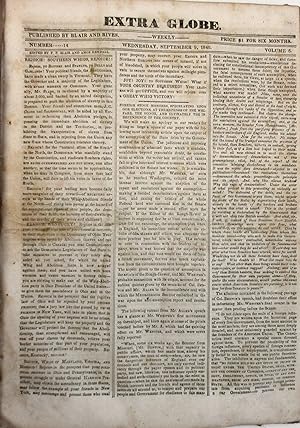
EXTRA GLOBE. WEEKLY
Editore: Blair & Rives, Washington, 1840
Da: David M. Lesser, ABAA, Woodbridge, CT, U.S.A.
Membro dell'associazione: ABAA ESA ILAB SNEAB
Valutazione del venditore 5 su 5 stelle
Folio, 8 3/4" x 12". 416pp. Nos. 1-27 of Volume VI; May 16, 1840 - October 26, 1840, plus No. 27, the final issue recording detailed election results, from January 1841. Boards detached, endpapers filled with local political tickets. Scattered foxing, light wear, Good+. A detailed contemporary report of the 1840 presidential campaign, from the perspective of this Democratic publication. It begins with the Democrats' National Convention in Baltimore, with the speeches, proceedings, and Address to the People. A campaign biography of Van Buren, the Democrats' candidate [and Blair & Rives's as well], is included, plus discussion of all the issues: slavery, abolition, internal improvements, tariff, banks, the Whigs' [repeatedly referred to as the 'Federal' Party, in order to drive home the Democrats' point that the Whigs were descended from the discredited Hartford Convention Federalists] muddled program and candidate, William Henry Harrison, "still shrouded in mystery.".
-
PROPOSITION TO EXTEND THE BRITISH FUNDING SYSTEM TO THE UNITED STATES. THE HARTFORD CONVENTION LEADER OF THE BRITISH WHIGS NEGOTIATING FOR THE SALE OF THE LAND AND LABOR OF THE COUNTRY TO BRITISH FUND-MONGERS. FREEMEN! WILL YOU CONSENT TO THE TRANSFER? THE MONEY POWER OF ENGLAND AND THE BRITISH WHIGS IN AMERICA- PROPOSITION TO MORTGAGE THE WHOLE COUNTRY TO THE BRITISH FUNDHOLDERS FOR THREE HUNDRED MILLIONS OF DOLLARS
Editore: Rough-Hewer Extra, [Albany], 1840
Da: David M. Lesser, ABAA, Woodbridge, CT, U.S.A.
Membro dell'associazione: ABAA ESA ILAB SNEAB
Valutazione del venditore 5 su 5 stelle
8pp, folio Extra of this short-lived New York Democratic periodical. Untrimmed and uncut, generously margined. A couple of short margin fold splits, light foxing. Good+ or so. A bombastic essay charging that the Whig Party is, like the wolf in sheep's clothing, in reality the old Hartford Convention Federalists, a bunch of Anglophiles in disguise. Their policies, and their conspiratorial "scheme" with England, are "dangerous to the purity of legislation, hostile to the genius of a free government, and directly at war with our constitution." Not in Sabin or American Imprints. OCLC 37969403 [3- NYHS, LCP, OH Hist. Soc.] [as of 5/12].
-
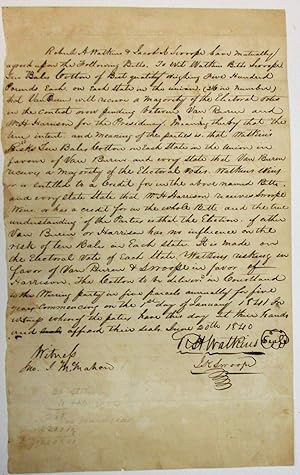
A SIGNED AND WITNESSED WAGER BETWEEN ROBERT H. WATKINS AND JACOB K. SWOOPE ON THE OUTCOME OF THE 1840 PRESIDENTIAL CONTEST BETWEEN INCUMBENT PRESIDENT MARTIN VAN BUREN AND WHIG CHALLENGER WILLIAM HENRY HARRISON
Editore: [Courtland, Lawrence Cty., Alabama, 1840
Da: David M. Lesser, ABAA, Woodbridge, CT, U.S.A.
Membro dell'associazione: ABAA ESA ILAB SNEAB
Valutazione del venditore 5 su 5 stelle
Single page, 7-3/4" x 12-3/4." Entirely in ink manuscript. Dated June 20, 1840, and signed at the end by Watkins and Swoope, with Jno. J. McMahon as witness. Inner edge is irregular. Closed tear [no loss] repaired expertly at blank bottom margin. Very Good. This documents records the terms of a wager on the outcome of the 1840 presidential election. "Watkins betts Swoope Ten Bales Cotton of Best quality weighing Five Hundred Pounds Each, on each State in the union (26 in number) that Van Buren will receive a majority of the Electoral votes in the contest now pending between Van Buren and Wm. H. Harrison for the Presidency." In case that's not entirely clear, "The true intent and meaning of the parties is that Watkins risks Ten Bales Cotton in each State in the Union in favour of Van Buren and every state that Van Buren receives a majority of the Electoral votes." The bet is made on the electoral vote of each State. Watkins risking in favor of Van Buren & Swoope in favor of Harrison. . . The cotton to be delivered in Courtland to the winning party in five parcels annually for five years commencing on the 1st day of January 1841." A calculation of States and bales can be seen at the bottom left corner in pencil. Robert H[erndon] Watkins [1782-1855] was a farmer in Courtland. Jacob K[uhn] Swoope [1800-1841] partnered with his two brothers in the successful Courtland mercantile firm of J & J Swoope in Courtland. John T. McMahon [c.1805-1857] was a Courtland commission merchant in the firm of Bierne & McMahon for many years. [Saunders, Col. James E.: EARLY SETTLERS OF ALABAMA WITH NOTES AND GENEALOGIES, New Orleans:1899, accessed online.].
-
1840 Campaign Broadside - Log Cabin Anecdotes; Illustrated Incidents In The Life Of Gen. William Henry Harrison
Editore: Published by J.P. Giffing at the office of the Harrison Almanac, New York, 1840
Da: The First Edition Rare Books, LLC, Cincinnati, OH, U.S.A.
Membro dell'associazione: ABAA ILAB IOBA MWABA
Valutazione del venditore 5 su 5 stelle
Wove Paper. Condizione: Near fine. Log Cabin Anecdotes, a campaign broadside promoting Whig Party presidential candidate William Henry Harrison, during the election of 1840. (illustratore). Campaign Broadside. Large campaign broadside on wove paper, measures 18" x 24", dry mounted on rigid card stock. Light toning along top edge, previously folded corner at top left, point of soiling along bottom edge, a near fine example. Printed in black and red, wood engraved illustrations, depicting twelve incidents from the life of Harrison. J.F. Trow, Printer. Includes a printed letter from Harrison's New York Committee of supporters, addressed to the Honorable Chas. Strong of Jefferson County, New York [1835]. A scarce broadside, there are five other known copies, including an example at the Library of Congress and four other distinguished institutions. Provenance: From the Camp Family Archive of Sackets Harbor, NY, with items relating to the first-generation settlers of Jefferson County, NY, from 1809-1866. The collection was amassed by Colonel Elisha Camp and his wife, Sophia Hale Camp, then held by the family for nine generations. Sold by Blanchard's Auction Service in 2021. The twelve incidents depicted in this broadside include: Harrison's Humanity in War; Harrison's Address to [Simon] Bolivar; Harrison's Treatment of an Old Fellow Soldier; Harrison Prefering [sic] Another Man's Son to His Own; Harrison's Care for His Soldiers; Delivering the Eagle; Harrison Charging in Battle, at the Thames; Harrison's Self-Denial; Harrison Giving Away His Only Blanket; Harrison Giving His Horse to a Methodist Minister; Harrison Saving the Life of a Negro; and The Council of Vincennes. William Henry Harrison (1773-1841) served as the governor of the Indiana Territory from 1801-1812. While governor, he negotiated numerous treaties with the native Americans in the area, greatly reducing their territory and stoking resentment against the United States. His antagonism culminated in the Battle of Tippecanoe in 1811 against the Shawnee Indians. This battle and the War of 1812 made Harrison a household name and propelled him to the White House in 1841.
-

Ohio And Pennsylvania Politicians Reflect On The State Of Pennsylvania Politics Just After The 1840 Election Of William Henry Harrison To The Presidency
Da: Stuart Lutz Historic Documents, Inc., South Orange, NJ, U.S.A.
Membro dell'associazione: ABAA ESA ILAB PADA
Valutazione del venditore 2 su 5 stelle

Copia autografata
(PRESIDENTIAL ELECTION OF 1840). ALS. 2pgs. November 18, 1840. Cincinnati, Ohio. An autograph letter signed J Burnet by Ohio lawyer and politician Jacob Burnet (1770-1853). It is addressed to James Dunlap of Pittsburg. Burnet replies to Dunlaps letter stating his concerns about Pennsylvania politics in light of the recent 1840 Presidential election, in which William Henry Harrison defeated Martin Van Buren. Harrison would die only a month into his Presidency. Mentioning a schism at one point, Burnet seems to anticipate the national divide that would eventually lead to the American Civil War, although this may have referred to economic issues rather than the question of slavery: Dear Sir I have received your letter of the 12th inst and read it with interest. The matter it containsthe view you have taken of the state of parties in Penna are highly interesting, and are certainly entitled to serious consideration. The mixture of parties, of which you speak, as having taken place in the late struggle, can not, as you observeThere is reason to fear, that when the cause whichthe union, the fruits of which we have just gathered, shall warn so often at, the repelling principlewill throw the parts from each other, as far as they win, before the conflict began, unless something can be done, to effect such a permanent combination, as you refer to. I confess I now have understood the theory of partyas they have existed in, and have agitated your state, or the principles on which they have been found, or by which they areI can however easilyschism, may be the result of such an injudicious course on the part of theyou are anxious to prevent. It would give mow me great pleasure to be instrumental in preventing the wit you depict so strikingly, were it in my power. I was known unequal to the task, because I have no claims to the confidence of the General, beyond those of his friends generally, not because in addition to this, I could not point him to the parties, or the persons, as to whom he ought to be on his guard. A frank communication from a confidential friend in Penna, who understands the whole subject, would receive the attention it deserves. An intelligent Pennacan communicate the specific information necessary to show him the danger and the mode of avoiding it. Advice or caution in a care like this, to have its proper influence, should come from the power of information. Your views on the subject of claims, founded on services, rendered in the late political contest, are precisely those I entertain, and express on all occasions, and I have reason to believe, the General looks on the subject though the same medium, and views it in the same light. If our motives have been patriotic, our labor has been done for the country, and success is our only legitimate reward. If they have been personal they are not praiseworthy, and ought not to be rewarded. I am confident that president elect views the matter in that light, and that he does not feel personal obligations to any body, on account of no part taken in the contest. If this be not so, I have very much misunderstood his character. Yours very respectfully J Burnet. The letter is in very good condition with a loss to the back page that does not affect any content. A reminder of the eternal contention and controversy in American political elections.