

Importo totale (1 articolo articoli):
Destinazione ordine:

election 1864 (20 risultati)
Vai alla pagina principale dei risultati di ricerca
Filtri di ricerca
Tipo di articolo
- Tutti i tipi di prodotto
- Libri (20)
- Riviste e Giornali (Nessun altro risultato corrispondente a questo perfezionamento)
- Fumetti (Nessun altro risultato corrispondente a questo perfezionamento)
- Spartiti (Nessun altro risultato corrispondente a questo perfezionamento)
- Arte, Stampe e Poster (Nessun altro risultato corrispondente a questo perfezionamento)
- Fotografie (Nessun altro risultato corrispondente a questo perfezionamento)
- Mappe (Nessun altro risultato corrispondente a questo perfezionamento)
- Manoscritti e Collezionismo cartaceo (Nessun altro risultato corrispondente a questo perfezionamento)
Condizioni Maggiori informazioni
- Nuovo (Nessun altro risultato corrispondente a questo perfezionamento)
- Come nuovo, Ottimo o Quasi ottimo (Nessun altro risultato corrispondente a questo perfezionamento)
- Molto buono o Buono (2)
- Discreto o Mediocre (Nessun altro risultato corrispondente a questo perfezionamento)
- Come descritto (18)
Legatura
- Tutte
- Rilegato (Nessun altro risultato corrispondente a questo perfezionamento)
- Brossura (2)
Ulteriori caratteristiche
- Prima ed. (6)
- Copia autograf. (Nessun altro risultato corrispondente a questo perfezionamento)
- Sovracoperta (Nessun altro risultato corrispondente a questo perfezionamento)
- Con foto (16)
- Non Print on Demand (20)
Lingua (1)
Prezzo
- Qualsiasi prezzo
- Inferiore a EUR 20 (Nessun altro risultato corrispondente a questo perfezionamento)
- EUR 20 a EUR 45
- Superiore a EUR 45
Spedizione gratuita
- Spedizione gratuita in U.S.A. (Nessun altro risultato corrispondente a questo perfezionamento)
Paese del venditore
Valutazione venditore
-

GEORGE H. PENDLETON, THE COPPERHEAD CANDIDATE FOR VICE-PRESIDENT. HIS HOSTILITY TO THE AMERICAN REPUBLIC ILLUSTRATED BY HIS RECORD AS A REPRESENTATIVE IN THE CONGRESS OF THE UNITED STATES FROM THE STATE OF OHIO.
Editore: Washington: Union Congressional Committee, 1864
Da: Steve Finer - Rare Books, Greenfield, MA, U.S.A.
Membro dell'associazione: SNEAB
Valutazione del venditore 3 su 5 stelle

Prima edizione
Soft cover. Condizione: Very Good. No Jacket. 1st Edition. 8vo, self wrps., 8pp. SABIN 59644. An unopened copy.
-
caption title: FACTS FOR THE PEOPLE. TO THE CITIZENS OF MASSACHUSETTS.
Editore: ([Boston: J. E. Farwell & Co., 1863])., 1863
Da: Steve Finer - Rare Books, Greenfield, MA, U.S.A.
Membro dell'associazione: SNEAB
Valutazione del venditore 3 su 5 stelle
Prima edizione
Soft cover. Condizione: Good. No Jacket. 1st Edition. 8vo, self wrps., 8pp. Paper age-browned some. Animadversions directed against the Republicans and against Charles Sumner, two forces calculating to pull the country apart, leaving President Lincoln as the obvious choice. A good+ copy.
-
A FEW PLAIN WORDS WITH THE RANK AND FILE OF THE UNION ARMIES. PUBLISHED BY THE UNION CONGRESSIONAL COMMITTEE
Editore: Towers for the Union Congressional Committee, [Washington, 1864
Da: David M. Lesser, ABAA, Woodbridge, CT, U.S.A.
Membro dell'associazione: ABAA ESA ILAB SNEAB
Valutazione del venditore 5 su 5 stelle

7, [1]pp. Loosened, caption title [as issued]. Light wear and soil, Good+. An appeal for the votes of the troops, "the working hands by which the nation's honor and manhood have been vindicated," in the upcoming presidential election. "Through four years of dread war, in bright and dark days, you have carried the Union in your hearts and on your bayonets." Opposing the Democrat-Copperhead platform as treasonous, this pamphlet exhorts, "If ever there was a time when Union bayonets were called on to think, it is now. The crisis of the war, when our armies have the rebellion in their grasp and are preparing to deal its death-blow, finds the country precipitated into the turmoil of a Presidential election." FIRST EDITION. Sabin 24237.
-

UNION CAMPAIGN DOCUMENTS. NO. 8. STIRRING APPEALS FROM HONORED VETERANS. DEMOCRATIC STATESMEN AND GENERALS TO THE LOYAL SONS OF THE UNION. VIEWS OF GENS. GRANT, SHERMAN, DIX, WOOL, BUTLER, EDWARD EVERETT, JOHN A. GRISWOLD, AND OTHERS
Editore: Weed, Parsons and Company, Albany, 1864
Da: David M. Lesser, ABAA, Woodbridge, CT, U.S.A.
Membro dell'associazione: ABAA ESA ILAB SNEAB
Valutazione del venditore 5 su 5 stelle
[81]-96 pages, [as issued]. Each page printed in two columns. Disbound and lightly foxed, Good+. Emphasizing Lincoln's support among all lovers of the Union, regardless of Party, this campaign pamphlet paints the Democrats as treasonous followers of the Copperhead Congressman Clement Vallandigham. "The Vallandigham platform is merely an attempt of the Richmond authorities to run the blockade of Northern ballot boxes, Montgomery Constitution in hand." Not in Sabin, Monaghan, or Bartlett. OCLC records eleven locations as of July 2015, under two accession numbers.
-
POLL BOOK AND TALLY SHEET OF NOBLE TOWNSHIP, RUSH COUNTY, INDIANA, FOR THE 1864 GUBERNATORIAL ELECTION BETWEEN JOSEPH MCDONALD AND OLIVER P. MORTON, AND THE OTHER STATE OFFICES AND JUDGESHIPS
Editore: [Indianapolis?, 1864
Da: David M. Lesser, ABAA, Woodbridge, CT, U.S.A.
Membro dell'associazione: ABAA ESA ILAB SNEAB
Valutazione del venditore 5 su 5 stelle
Folio, 8 ½" x 14". [16] pp, folded. Poll Book preprinted with introduction, columns and headings, names of candidates, etc. First [5] pages and final [4] pages completed in neat ink manuscript. The first page contains an introduction at the top half, followed by names of voters up through #279 on page [5]. At page [13] is the pre-printed certification filled in and signed by three officers, followed by a list of both preprinted and added names of those on the election ticket and the offices they seek, with number of votes received by each in manuscript. The final page contains the docketing information. Signed by Andrew Griffin, David McKee and John D. Dource, and filed on October 13, 1864. Quite clean. Very Good. [with] Tally Paper. 17" x 28". Preprinted with heading, columns, and names of candidates and offices they seek. Some additional candidates added in manuscript, with manuscript tallies and calculations. Old folds with a few short splits at corner folds, a few splits repaired with archival tape on verso, some soiling of verso. At the head of the document are the signatures of Andrew Griffin, David McKee and John D. Dource, judges; and Benjamin F. Reeve and J.R. Hunt, clerks. Tally sheet docketed on verso as filed October 13, 1864, by B.F. Tingley, Clerk. Very Good. During Indiana's 1864 gubernatorial election, Oliver P. Morton ran on the Union ticket against Democrat Joseph McDonald. Morton had been elected Lt. Governor under Gov. Henry Lane in 1860. Lane resigned two days after being confirmed in January, 1861, so that he could take a seat in the U.S. Senate; Morton succeeded to his office. Morton won the election by more than 20,000 votes. Names of the 279 who voted include: Lewis Smith, Bradford Z. Norris, John B. Reeve, Owen Reynolds, John W.N. Hunt, William Carney, Henry Long, Hiram Smith, Henry Armstrong, John Ryan, Thomas N. Smith, George W. Brown, David Johnson, Alexander FitzJarrell, William Quail, Francis M. Patterson, George Gray, Lorenso D. Richardson, Richard W. McKee. Benjamin F. Tingley [1823-1904] served as the Clerk of Rush County from 1864 to 1872, and he was a member of the local Freemason lodge where he held the position of treasurer for a time. Others who signed off on these documents as judges and clerks were primarily farmers by occupation.
-

Battle Cry of Freedom or, We'll Rally Round the Flag, Boys
Editore: [Philadelphia?], 1864
Da: James Cummins Bookseller, ABAA, New York, NY, U.S.A.
Membro dell'associazione: ABAA ILAB
Valutazione del venditore 4 su 5 stelle

Condizione: Old folds, some separations. 1p. handbill. Woodcut of a Lincoln & Johnson campaign flag. 8-1/2 x 6 inches. Scarce campaign handbill from the Election of 1864 with the lyrics to the popular Civil War song Battle Cry of Freedom, the patriotic song song written in 1862 by American composer George Frederick Root (18201895). 1p. handbill. Woodcut of a Lincoln & Johnson campaign flag. 8-1/2 x 6 inches.
-

NATIONAL UNION TICKET. FOR PRESIDENT, ABRAHAM LINCOLN, OF ILLINOIS. FOR VICE PRESIDENT, ANDREW JOHNSON, OF TENNESSEE. FOR ELECTORS, SAMUEL BRANNAN, OF SAN FRANCISCO. J.G. McCALLUM, OF EL DORADO. W.W. CRANE, OF ALAMEDA. CHARLES MACLAY, OF SANTA CLARA. J.W. OLIVER, OF SISKIYOU. FOR CONGRESS, THIRD DISTRICT, JOHN BIDWELL, OF BUTTE. SUPERVISOR FIRST DISTRICT, J.C. PRUED. FOR COUNTY TREASURER, HENRY MOLINEUX
Editore: Downieville CA?, 1864
Da: David M. Lesser, ABAA, Woodbridge, CT, U.S.A.
Membro dell'associazione: ABAA ESA ILAB SNEAB
Valutazione del venditore 5 su 5 stelle
Broadside ticket, 2-3/4" x 3-7/8." Small mounting remnants on blank verso. Very Good. "Sierra County Republican ticket for the election of 1864, in which the national Republican Party temporarily adopted the name National Union Party. Henry Molineux was treasurer of Sierra County, Calif. (of which Downieville is the seat); see N.Z.R. Molyneux, History, genealogical and biographical, of the Molyneux families (Syracuse, N.Y.: C.W. Bardeen, 1904), p. 99-102." [OCLC entry.] OCLC 78931206 [Brown, BYU] as of July 2024. The Lincoln Financial Foundation also owns a copy.
-
![Immagine del venditore per THE PRESIDENTIAL ELECTION. APPEAL OF THE NATIONAL UNION COMMITTEE TO THE PEOPLE OF THE UNITED STATES [caption title]. venduto da William Reese Company](https://pictures.abebooks.com/inventory/md/md32377262199.jpg)
THE PRESIDENTIAL ELECTION. APPEAL OF THE NATIONAL UNION COMMITTEE TO THE PEOPLE OF THE UNITED STATES [caption title].
Editore: [New York: National Union Executive Committee], Sept. 9, 1864., 1864
Da: William Reese Company, New York, NY, U.S.A.
Membro dell'associazione: ABAA ESA ILAB SNEAB
Valutazione del venditore 5 su 5 stelle
A scarce National Union Party circular from the 1864 presidential election, responding to the infamous Democratic Nation Convention in Chicago and asserting that "every rebel organ in the rebel States or in foreign lands,--every hater of Democratic Freedom and the Rights of Man, longs and labors for the overthrow of the Administration and the expulsion of Abraham Lincoln from the Presidential chair." The committee urges voters "not to arrest the blow which is just ready to descend upon the rebellion now tottering to its fall; not to give the rebels time to renew their strength for fresh conflicts; not to aid those who would aid them in overthrowing our Government, in destroying our Union, in plunging into a chaos of anarchy the great communities of which the Constitution makes one great and glorious nation, and in thus extinguishing, finally and forever, the hopes of all who have faith in Freedom and the Rights of Man." The missive is signed in type by Henry J. Raymond as Chairman and twenty other members of the National Union Committee. Whether thanks to their extensive literature output or merely a reflection of the existing public will, the National Union Party's aim was carried in 1864 by a historic margin, with Lincoln winning over 90% of the electoral vote. An uncommon fine piece of Civil War political ephemera. Light foxing and soiling to edges. Near fine.
-
![Immagine del venditore per THE REAL CHICAGO PLATFORM, AS EXPOUNDED BY THE DEMOCRATIC ORATORS AT CHICAGO [caption title]. venduto da William Reese Company](https://pictures.abebooks.com/inventory/md/md32320275795.jpg)
THE REAL CHICAGO PLATFORM, AS EXPOUNDED BY THE DEMOCRATIC ORATORS AT CHICAGO [caption title].
Editore: [New York: National Union Executive Committee, 1864]., 1864
Da: William Reese Company, New York, NY, U.S.A.
Membro dell'associazione: ABAA ESA ILAB SNEAB
Valutazione del venditore 5 su 5 stelle
A scarce anti-Copperhead broadside printed during the election of 1864, purporting to reveal "the real Chicago Platform" and providing excerpts from speeches given at the Democratic National Convention. The convention met in Chicago on August 29, 1864, where the Copperheads quickly established dominance over the outnumbered War Democrats and established peace with the South (at any cost) as the core of their platform. McClellan accepted the nomination alongside staunch Copperhead George Pendleton despite his open opposition to the peace platform; this seeming hypocrisy was mercilessly lampooned by the opposition, contributing to the abject failure of the joint War and Peace ticket. The present broadside presents statements made at the convention by "a number of distinguished Democratic orators" which they deem "sufficient to show the temper and purpose of all." Some choice excerpts include: "I love our Southern friends; they are a noble, a brave, and a chivalrous people [cheers]" (Representative James S. Rollins of Missouri); "Show me a War Democrat to-day, and I will show you a shoddy Abolitionist in disguise.He is a Judas, and should be cast out as an enemy to humanity and to God.Soon the net is to be drawn that will gather in its half million more to feed the insatiable thirst for blood of the Negro God" (J.A. McMaster, arrested for libel at the start of the war); "If Democrats catch Lincoln's b[lood]y satrap spies among them, they must cut their d[amne]d throats, that's all. [Applause]" (Captain William J. Kountz, known troublemaker and personal antagonist of General Grant, dishonorably discharged in 1863); and "We are one and all for peace, and with this magic word upon our banner we shall sweep over the course, and roll into oblivion the black, negro-loving, negro-hugging worshippers of old Abe Lincoln" (Isaiah Rynders, Tammany Hall tough and former Know-Nothing). The broadside was clearly printed with intention of wide dispersal among potential Lincoln supporters, with a noted price of "$1 per 100." The American Antiquarian Society reasonably suggests that this broadside was printed by the National Union Executive Committee of New York, based on typographically similar items in their collection. A representative document from one of the nation's most fraught elections. SABIN 68234. Old folds. Light tanning and staining. Small holes at two cross-folds, short closed tear to upper margin and left edge. About very good.
-
LINCOLN CAMPAIGN SONGSTER FOR THE USE OF CLUBS. CONTAINING ALL THE MOST POPULAR SONGS.
Editore: Philadelphia: Published by Mason & Co., 1864., 1864
Da: William Reese Company, New York, NY, U.S.A.
Membro dell'associazione: ABAA ESA ILAB SNEAB
Valutazione del venditore 5 su 5 stelle
Prima edizione
A pocket songster printed to support Lincoln's reelection campaign in 1864, featuring a rather youthful portrait of the president on the front wrapper and twelve spirited, pro-Union songs. The titles, largely military in theme, include such works as "Give us Noble Leaders," "The Veteran Volunteer," "Cast Your Votes for Abraham" ("For Lincoln or McClellan, you'll be called on to decide,/ The one to save the union, the other to divide"), and "We are Coming, Father Abraham, 600,000 More." The advertisements on the rear wrapper encourage readers to purchase a wide variety of Lincoln campaign badges, emblems, pins, and photographs from the publishers. Despite Lincoln's overwhelming electoral victory in 1864, the race was rather close in Pennsylvania where this was printed Lincoln took Philadelphia County by a scant few percent, and actually failed to secure a majority in neighboring Montgomery and Bucks counties. MONAGHAN 323. 16mo. Original pictorial wrappers. Wrappers soiled and stained. Largely clean internally. Advertisements on rear wrapper shaved slightly at outer edge, as issued. Good plus.
-
![Immagine del venditore per THE COST OF A REBEL PEACE. PLAIN WORDS FOR WORKING-MEN [caption title]. venduto da William Reese Company](https://pictures.abebooks.com/inventory/md/md32320289216.jpg)
THE COST OF A REBEL PEACE. PLAIN WORDS FOR WORKING-MEN [caption title].
Editore: New York: John A. Gray & Green, [1864]., 1864
Da: William Reese Company, New York, NY, U.S.A.
Membro dell'associazione: ABAA ESA ILAB SNEAB
Valutazione del venditore 5 su 5 stelle
Prima edizione
A rare Lincoln campaign broadside from the 1864 presidential election, addressed to the "working-man" of the North who was concerned with high wartime prices and taxes, and also making the argument that enslaved labor in the South only depresses the wages of workers in the North. This broadside was published by the Union Executive Congressional Committee, an arm of the 1864 Republican campaign based in New York which described itself in opposition to the "Peace and Disunity platform" adopted by the Copperhead Democrats, and the text addresses one of the opposition's key arguments. The authors begin, as the caption title suggests, in "plain words for working-men": "The war is costly; there is no doubt of that. Taxes are heavy and prices are high. And so some are crying: 'Let us stop the war! Let us have an armistice, and get cheap bread!' But think a moment how long have we had the best Government in the world without being taxed for it at all; and now that the rebels are trying to break down the Government, and to steal from us nearly half our territory, we ought to be willing to pay what it costs to hold our own." The Union employed a variety of strategies to fund the increasingly costly war with the Confederacy over the years, including implementing the first income tax in the United States. Though not blockaded like the South, the pecuniary effects of the war were nevertheless keenly felt by the people of the North, some of whom felt disproportionately burdened by far-away fighting. The authors of this broadside however assert that it is the "enemies of the Government who compel us to pay so dearly for its defence," the "aristocrats of the South, who look down upon working-men with contempt, who make their own laborers slaves, and call the free laborers of the North, 'mudsills,'" who are at fault. Their conclusion, then, is that "The surest way to bring down prices is to sustain the Government in crushing the rebellion." Otherwise, the broadside walks through imagined scenarios of armistice or peace with the Confederacy, as suggested by the Democratic platform. An armistice would not reduce prices, as "it would cost just as much to keep our armies standing idle, as it would to keep them at work," and lifting the blockade would only serve to strengthen the Confederacy and encourage it to reengage. A peace on terms favorable to the Confederacy would mean either maintaining a standing army along the new border with a hostile nation or, if reunion, the North shouldering the South's massive war debt themselves. No, they declare, "Our only hope of better days is in putting down the rebellion, and so gaining a Union peace. Reënforce Grant and Sherman Reëlect Abraham Lincoln and soon the rebellion will go down, and gold will go down, and prices will go down, and peace and plenty will come again to the home of the working-man." OCLC records six copies as of cataloging, located at the New-York Historical Society, American Antiquarian Society, Library Company of Philadelphia, Library of Congress, Harvard, and Williams College. A rare election broadside from the contentious 1864 election, appealing particularly to "the working man" and addressing the perennial issues of taxation and rising costs in wartime. OCLC 191231048, 1286072265. Left edge trimmed at an angle. Light foxing. Very good.
-
![Immagine del venditore per THE POLITICAL "SIAMESE TWINS" THE OFFSPRING OF CHICAGO MISCEGENATION [caption title]. venduto da William Reese Company](https://pictures.abebooks.com/inventory/md/md32320289215.jpg)
THE POLITICAL "SIAMESE TWINS" THE OFFSPRING OF CHICAGO MISCEGENATION [caption title].
Editore: New York: Currier & Ives, 1864., 1864
Da: William Reese Company, New York, NY, U.S.A.
Membro dell'associazione: ABAA ESA ILAB SNEAB
Valutazione del venditore 5 su 5 stelle
Prima edizione
A rare Currier and Ives political print from the 1864 presidential election, likening the unusual marriage of McClellan and his running mate, Copperhead leader George Pendleton, to the famous "Siamese twins," Chang and Eng Bunker. Chang and Eng first came to the United States in 1829, where their great popularity as a touring act gave birth to the phrase "Siamese twins" as a term for conjoined twins. After years of touring in Europe and America, the pair settled down in North Carolina for over a decade before returning to the stage in the 1860s. Their renewed popularity and enduring cultural relevance are both evidenced by this election-year cartoon. "In the center McClellan (left) is attached to the side of his running mate by 'The Party Tie.' McClellan says apologetically to the two Union soldiers at his left, 'It was not I that did it fellow Soldiers!! but with this unfortunate attachment I was politically born at Chicago!' The Democratic national convention took place in Chicago on August 29, 1864. The soldier with his arm in a sling responds angrily, 'Good bye little Mac' if thats your company! Uncle Abe gets my vote.' The soldier at far left says, 'I would vote for you General, if you were not tied to a "peace" Copperhead, who says that Treason and Rebellion ought to triumph!!' Pendleton addresses the two 'Copperheads' at his right: Clement Laird Vallandigham, author of the Democrats' peace plank, and Horatio Seymour, governor of New York and chairman of the Democratic national convention. Pendleton says, 'I dont care how many letters Mac writes, if it brings him votes; for every vote for him, count one for me!!' Vallandigham concurs, 'Yes Pen, that's the only reason that I support the ticket; if you are elected both Jeffand I will be triumphant!" Seymour (far right) replies, 'With Pendleton as Vice; Val.secretary of State; Wood [i.e., Fernando Wood, an organizer of the Peace Democrats] in the treasury, and I Govr. of New-York, we will have peace at any price the rebels ["our friends" in this copy] choose to ask for it'" Reilly. Interestingly, the copy described by Reilly differs slightly from the other recorded copies. In the Library of Congress copy, Seymour refers to "the rebels" directly; in our copy and most others, he instead refers to them as "our friends" in quotation marks, alluding to his famous (or infamous) "My Friends" speech delivered during the New York draft riots. OCLC records copies only at the University of Michigan and Peabody Essex Museum, though we locate additional copies at the Library of Congress, Library Company of Philadelphia, Princeton, and the Metropolitan Museum of Art. A rare and visually striking political cartoon, evocative of the fraught 1864 election and contemporary popular culture. REILLY 1864-19. PETERS, CURRIER & IVES 1671. CURRIER & IVES: CATALOGUE RAISONNÉ 5232. OCLC 191120100. Light foxing and soiling. Closed tear in right edge, into platemark but not touching illustration. Faint dampstain near center. Very good overall.
-
![Immagine del venditore per THE CHICAGO PLATFORM AND CANDIDATE [caption title]. venduto da William Reese Company](https://pictures.abebooks.com/inventory/md/md32320274815.jpg)
THE CHICAGO PLATFORM AND CANDIDATE [caption title].
Editore: New York: Published by Currier & Ives, 1864., 1864
Da: William Reese Company, New York, NY, U.S.A.
Membro dell'associazione: ABAA ESA ILAB SNEAB
Valutazione del venditore 5 su 5 stelle
A rare Currier and Ives print from the presidential election of 1864, satirizing the Democratic presidential candidate and former general, George B. McClellan, as an equivocating hypocrite. As Neely and Holzer explain, the presidential campaign of 1864 inspired a flurry of "separate-sheet display cartoons: thought-provoking, witty, but often cruel lampoons that struck hard at the most divisive political and personal issues of 1864. In these cartoons one can see illustrated vividly the raw toughness of the campaign as well as the skill of the artists who covered it." These prints, they note, could be "vicious: personal, mean-spirited, cruel, race-baiting, and divisive," and, in this context, McClellan, "[t]he military man now running on a peace platform made for one obvious target." The image here shows a two-faced McClellan at center, standing atop rickety planks - a literal representation of the Democratic party's Chicago peace platform - and holding a copy of his letter of acceptance. The planks are supported precariously at each corner on the shoulders of four figures: Confederate president Jefferson Davis; New York congressman and prominent Copperhead Fernando Wood; another Copperhead and the author of the Chicago platform, Clement Vallandigham; and "Jeffs friend," the devil. Standing on opposite sides of the image are representatives of each of the constituencies to whom the two-faced McClellan is pandering: a uniformed "Union Soldier" and a "Peace Democrat," caricatured here as a club-wielding simian Irishman. From the face addressing the Peace Democrat, McClellan says, "You see my friend I accept the nomination and of course stand on the platform," to which the Peace Democrat replies, "All right General! if yere in favor of resistin the draft, killing the Nagurs, and pace wid the Southerners, I'll knock any man on the head that'll vote aginye." From his other face, addressing the Union soldier, McClellan contradicts himself, saying, "If you don't like the Platform, I refer you to my letter of acceptance," a copy of which McClellan holds in his and which reads, "War! - preservation Union - could not look my gallant Comrades in the - face; ---" The soldier says, "Its no use General! you can't stand on that platform and come that blarney over me; I smell brimstone!" Below McClellan, the devil, speaking to Jefferson Davis, gives expression to the futility of the lost cause: "Well Jeff it's no use trying to hold up this rickety old platform, I guess I'll leave you to your fate!" Davis says in reply, "I'm in a pretty fix! Weldon road gone!! Atlanta taken!!! Mobile Forts surrendered!!!! Early licked!!!!! and now when my last hope is in keeping up this platform and getting Mac elected, you who led me into the scrape threaten to leave me!!!!!" Meanwhile, an exasperated Vallandingham exclaims, "Confound that letter! I've a good mind to bolt, and let the whole concern go to a smash!" Fernando tries to reassure his fellow Copperhead: "Hold on Val. don't you see it's only his little game to ring in the war men? if he is elected he is bound to carry out our policy and nothing else!" The image mocks the seeming hypocrisy of McClellan, a military man running on his war record, who has just accepted the nomination of a party whose platform calls for an end to the war, even as the candidate himself expresses his support for the war in his acceptance letter. Reilly notes that the cartoon was probably drawn by the prolific artist, Louis Maurer. This print is scarce. The Currier & Ives catalogue raisonné locates only the copies at the Chicago Historical Society and the Library of Congress. OCLC locates another two copies at the time of cataloguing, one at the Ohio History Center and another at the Clements Library. We find additional copies at the American Antiquarian Society, the Library Company of Philadelphia, and the Metropolitan Museum of Art. A rare and stinging political cartoon from the bitter, war-time election of 1864. REILLY, AMERICAN POLITICAL PRINTS 1864-20. WEITENKAMPF, p.143. PETERS, CURRIER & IVES 1621. GALE, CURRIER & IVES: A CATALOGUE RAISONNÉ 1126. NEELY & HOLZER, UNION IMAGE, pp.132, 134, 137, 144-45. Bryan F. Le Beau, Currier & Ives: America Imagined (Washington: Smithsonian Institution Press, 2001), pp.280-81. OCLC 818725064, 1292629697. Tanned with some scattered foxing. Small pinholes to top center and to top and bottom of left margin. Two small pieces of linen tape to top edge of verso; some soiling to verso and some discoloration from old tape, since removed, showing through to recto. Very good.
-
THE LINCOLN CATECHISM WHEREIN THE ECCENTRICITIES & BEAUTIES OF DESPOTISM ARE FULLY SET FORTH. A GUIDE TO THE PRESIDENTIAL ELECTION OF 1864.
Editore: New York: J.F. Feeks, [1864]., 1864
Da: William Reese Company, New York, NY, U.S.A.
Membro dell'associazione: ABAA ESA ILAB SNEAB
Valutazione del venditore 5 su 5 stelle
Prima edizione
Billed as "A Guide to the Presidential Election of 1864," this odious little pamphlet is filled with racist anti-Lincoln propaganda, aimed at the Copperhead audience in the midst of the war. It is presented in the form of a satirical catechism, alleged to be written by the Republicans: "What is the Constitution? A compact with hell - now obsolete. By whom hath the Constitution been made obsolete? By Abraham Africanus the First." The audience is made explicit with Lesson XVII, which asks "What is the meaning of the word 'Copperhead?' A man who believes in the Union as it was, the Constitution as it is, and who cannot be bribed with greenbacks, nor frightened by a bastile [sic]." The "Ten Commandments" are listed on page 12, with the first being "Thou shalt have no other God but the negro." J.F. Feeks was a viciously anti-Lincoln campaigner and printer, and many of his other publications are advertised on the wrappers of this pamphlet. In the leadup to the 1864 election, he printed a collection of offensive jokes and poems titled Lincolniana, a satirical pamphlet in the style of biblical verse foretelling the disasters of the "Reign of Abraham" ("as beautiful to look upon, as the skin of a sheep drawn over the skeleton of a gorilla"), a piece titled Abraham Africanus I: His Secret Life Revealed Under Mesmeric Influence, and many more, including a series of Democratic campaign songsters and song sheets, featuring such classic tunes as "Hey! Uncle Abe, are you Joking yet?" and "Little Mac (First in War, First in Peace, First in the Hearts of his Countrymen)." His election-year output also included an edition of the present pamphlet written in German, likely hoping to shake Lincoln's perceived support in the German-American community. An unusually nice copy of this pamphlet often found in tatters, and a stark reminder of the disunity within the Union as the fateful election of 1864 drew near. MONAGHAN 324. Original yellow pictorial wrappers. Light soiling and edge wear, small closed tear to top of front wrapper, slight chipping spine ends. Light creasing and very minor scattered foxing throughout. Later gift inscription in pencil along gutter of first page of text. A very good copy.
-

THE GRAVE OF THE UNION. OR MAJOR JACK DOWNING'S DREAM, DRAWN BY ZEKE
Editore: Bromley & Company, New York, 1864
Da: David M. Lesser, ABAA, Woodbridge, CT, U.S.A.
Membro dell'associazione: ABAA ESA ILAB SNEAB
Valutazione del venditore 5 su 5 stelle
19" x 24" lithograph broadside cartoon. Old tears repaired with tape on verso. Long horizontal tear at center has been reinforced by tape on verso. Light wrinkling and toning. The cartoon remains bold, solid, and intact. Good+. "The first in a series of four harsh anti-Lincoln satires published by Bromley & Co. in New York. An imaginary dream of Jack Downing (a comic Yankee character created in the 1830s by Seba Smith) has Lincoln and some of his supporters and cabinet members as a band of undertakers about to inter the Constitution. "In 1862, displeased by Attorney General Edward Bates's slowness in enforcing the Conspiracies Act, the President took matters into his own hands and issued a proclamation 'directing trial by court martial or military commissions of all persons who impeded the draft, discouraged enlistments or committed other disloyal acts.' Around thirty-eight thousand people were arrested, denied the right of habeas corpus, and held in jail until brought to trial. This heavy-handed act provides the fuel for the artist's attack here. "Secretary Stanton is shown driving a hearse 'War Democracy' drawn by four horses with the heads of War Democrats (left to right): John Cochrane, Benjamin F. Butler, Thomas Francis Meagher, and Daniel S. Dickinson. Secretary Stanton says, 'My jackasses had a load, but they pull'd it through bravely. Cochrane: 'I pull for the side that pays the best always.' Butler: 'A million of dollars from New-Orleans'. . . "At right journalist Horace Greeley and Massachusetts senator Charles Sumner bury a casket labeled 'Constitution. Three other caskets, 'Union,' 'Habeas Corpus,' and 'Free Speech Charge Express,' wait nearby. Greeley: 'I guess we'll bury it so deep that it will never get up again.' Sumner: 'Be still, you old fool. Let us first be sure that it is all under.' "A sober Lincoln watches with folded arms, asking, 'Chase will it stay down?" Beside him, treasury secretary Salmon P. Chase responds, '. . . It must stay down. Or we shall all go up!' . . . "Abolitionist clergyman Henry Ward Beecher presides over the ceremony with a black child in his arms, praying, 'Not thy will oh Lord! But mine be done.' Above them Secretary of War Edwin M. Stanton, who has the legs and tail of a demon and holds a dagger, flies off crying, 'If it were done, when 'tis done'." [Reilly] Reilly 1864-37. Weitenkampf 141. OCLC 647912979 [2- AAS, Clements], 299947771 [1- DLC] as of December 2024.
-

THE WAR CANDIDATE ON A PEACE PLATFORM
Editore: For Sale by the AMERICAN NEWS COMPANY, (Agents for the Publishers.) 121 Nassau St., New York, 1864
Da: David M. Lesser, ABAA, Woodbridge, CT, U.S.A.
Membro dell'associazione: ABAA ESA ILAB SNEAB
Valutazione del venditore 5 su 5 stelle
Oblong broadside, 8" x 9-3/8." Couple of light fox spots, not affecting illustration. Very Good. The broadside mocks the dissonance in the Democrats' 1864 presidential campaign. Candidate McClellan's acceptance speech supported a continued War Effort; but his Party's platform called for an end to the War. McClellan, sitting backward on a jackass, says, "I am happy to say that -- the record of my public life was kept in view". The jackass, however, facing the other direction, says, quoting from the Chicago Platform, "An immediate cessation of hostilities." Weitenkampf 145. Not in Reilly. OCLC 57744783 [2- Boston Ath., NYHS] as of June 2024. AAS also owns a copy,
-

A FREE PASS. ENTITLING THE HOLDER TO THE TENDER MERCIES OF THE CONSTITUTIONAL PURIFYING ASSOCIATION, WHO WILL GUARANTEE TO CLEANSE EVERY PARTICLE OF COPPERHEADISM FROM OUR NATURE- SO YOU WILL BE ABLE TO VOTE FOR AN HONEST MAN WITHOUT PREJUDICE. MEETING HOURS FROM 7 TO 11 P.M., EVERY DAY. FAITHFUL OFFICERS ALWAYS IN ATTENDANCE
Editore: [np, 1864
Da: David M. Lesser, ABAA, Woodbridge, CT, U.S.A.
Membro dell'associazione: ABAA ESA ILAB SNEAB
Valutazione del venditore 5 su 5 stelle
Broadside, 6.25" x 9", with two-thirds of the sheet consisting of a wood engraving entitled "The Purifying Process." Toned, with a few short blank edge chips. Good+. This scarce political broadside mocks the Copperheads, who opposed the Lincoln Administration and the Civil War. The broadside depicts humorous rituals imposed on the Copperheads, designed to purge Copperhead-ism from their natures. Weitenkampf and OCLC call this an 1864 broadside, with the Lincoln-McClellan election the subject of this piece. Weitenkampf, page 140. OCLC 14137917 [4- Lincoln Presidential Library, Brown, U IL, Princeton], 1360327631 [1- DLC], 1085916488 [1- AAS] as of May 2024.
-

PRESIDENT LINCOLN AND GENERAL GRANT ON PEACE AND WAR
Editore: For sale by all News Agents. Price, $1 per 100., [New York?], 1864
Da: David M. Lesser, ABAA, Woodbridge, CT, U.S.A.
Membro dell'associazione: ABAA ESA ILAB SNEAB
Valutazione del venditore 5 su 5 stelle
Broadside, 9 1/2" x 11 1/4". Printed in two columns. Light foxing, Old white tape remnants at upper margin of blank verso. Very Good. The broadside prints Judge Mills's report of his interview with President Lincoln, who strongly defends the use of black troops in the war effort. General Grant's letter to E.B. Washbourne [sic] reports, "The Rebels have now in their ranks their last man. The little boys and old men are guarding prisoners, guarding railroad bridges, and forming a good part of their garrisons for entrenched positions." Bayard Taylor's poem on the Democrats' presidential nominating convention, 'On the Chicago Surrender,' is also printed. "Judge Mills" was Joseph T. Mills of Wisconsin, an attorney and judge who had also been a State Assemblyman. Bartlett 2725. Sabin 41157. Weinstein, Against the Tide 141. Not in Monaghan.
-
![Immagine del venditore per LOYAL DEMOCRATS, READ! LETTER OE [sic] EZRA WHEELER. THE POLICY OF THE CHICAGO PLATFORM WOULD LEAD TO DISUNION venduto da David M. Lesser, ABAA](https://pictures.abebooks.com/inventory/md/md31593213457.jpg)
LOYAL DEMOCRATS, READ! LETTER OE [sic] EZRA WHEELER. THE POLICY OF THE CHICAGO PLATFORM WOULD LEAD TO DISUNION
Editore: [np. Milwaukee? Berlin WI?, 1864
Da: David M. Lesser, ABAA, Woodbridge, CT, U.S.A.
Membro dell'associazione: ABAA ESA ILAB SNEAB
Valutazione del venditore 5 su 5 stelle
Broadside, 6-1/8" x 11." Spotted, small chip to blank upper corner. Good+. Ezra Wheeler, Wisconsin Democrat, was serving his only term in Congress when he wrote this October 15 letter to his constituents in the Berlin Courant. He retired from Congress at the end of his term. Lincoln supporters reprinted the letter in this broadside, for the edification of voters in Wheeler's Fifth Wisconsin District. Wheeler "cannot support McClellan and Pendleton without being false to his Country, and false to the platform on which he was placed by the Democratic party of this district two years ago. . . As a loyal Union Democrat, he now advocates, and vote for, the re-election of Abraham Lincoln." Wheeler explains that a Democratic victory "would inevitably be the separation of the Northern and Southern States, and following that probably a division among the Northern States; and finally the destruction of our Government." We have not located a record of this broadside. Not located in Sabin, Bartlett, or on OCLC or the online sites of U WI Libraries, AAS, LCP, Newberry, Harvard, Yale as of January 2024.
-
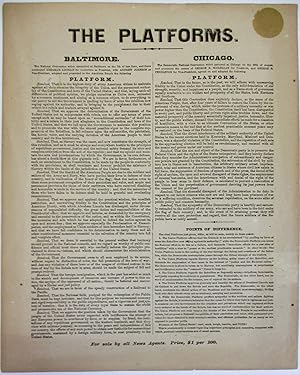
THE PLATFORMS
Editore: For sale by all News Agents. Price, $1 per 100, [New York], 1864
Da: David M. Lesser, ABAA, Woodbridge, CT, U.S.A.
Membro dell'associazione: ABAA ESA ILAB SNEAB
Valutazione del venditore 5 su 5 stelle
Broadside, 9" x 11 1/2". One margin spot [from removal of a gum label], light uniform toning. Very Good. Printed in two columns, separated by a rule. The Column on the left is headed "Baltimore Platform," for the National Union [Republican] Party; the right hand column is headed "Chicago Platform," for the Democrat-Copperhead Party. A Republican recitation of the Democrats' Platform and the Republicans' Platform in 1864, and an analysis of their 'Points of Difference.' "The Union platform looks to the ending of the war through the defeat and overthrow of the Rebellion, while the Democratic contemplates peace through the virtual triumph of the traitors." The broadside exhorts, "Freemen of the United States! read, mark, weigh, resolve, and VOTE! This is preeminently a contest regarding important principles and measures, compared with which, personal considerations are of small account." We conclude that this broadside was printed in New York, as the legend, "For sale by all News Agents. Price, $1 per 100," appears in similar broadside material with a New York imprint. Sabin 63348. Not in Bartlett.


