Importo totale (1 articolo articoli):
Destinazione ordine:

georges houten (12 risultati)
Vai alla pagina principale dei risultati di ricerca
Filtri di ricerca
Tipo di articolo
- Tutti i tipi di prodotto
- Libri (1)
- Riviste e Giornali (Nessun altro risultato corrispondente a questo perfezionamento)
- Fumetti (Nessun altro risultato corrispondente a questo perfezionamento)
- Spartiti (Nessun altro risultato corrispondente a questo perfezionamento)
- Arte, Stampe e Poster (11)
- Fotografie (Nessun altro risultato corrispondente a questo perfezionamento)
- Mappe (Nessun altro risultato corrispondente a questo perfezionamento)
- Manoscritti e Collezionismo cartaceo (Nessun altro risultato corrispondente a questo perfezionamento)
Condizioni Maggiori informazioni
- Nuovo (Nessun altro risultato corrispondente a questo perfezionamento)
- Come nuovo, Ottimo o Quasi ottimo (11)
- Molto buono o Buono (Nessun altro risultato corrispondente a questo perfezionamento)
- Discreto o Mediocre (Nessun altro risultato corrispondente a questo perfezionamento)
- Come descritto (1)
Legatura
- Tutte
- Rilegato (Nessun altro risultato corrispondente a questo perfezionamento)
- Brossura (2)
Ulteriori caratteristiche
- Prima ed. (2)
- Copia autograf. (Nessun altro risultato corrispondente a questo perfezionamento)
- Sovracoperta (Nessun altro risultato corrispondente a questo perfezionamento)
- Con foto (12)
- Non Print on Demand (12)
Lingua (1)
Prezzo
- Qualsiasi prezzo
- Inferiore a EUR 20 (Nessun altro risultato corrispondente a questo perfezionamento)
- EUR 20 a EUR 45 (Nessun altro risultato corrispondente a questo perfezionamento)
- Superiore a EUR 45
Spedizione gratuita
- Spedizione gratuita in U.S.A. (Nessun altro risultato corrispondente a questo perfezionamento)
Paese del venditore
Valutazione venditore
-
Lithographie extraite de l'ouvrage MOULIN ROUGE, publié en 1925 par Marcel Seheur. - grand orchestre du Moulin rouge (aquarellée à l'époque à la main).
Editore: Marcel Seheur, 1925
Da: Librairie L'amour qui bouquine, ALISE SAINTE REINE, Francia
Valutazione del venditore 5 su 5 stelle

Arte / Stampa / Poster
EUR 125,00
Spedizione EUR 13,50
Spedito da Francia a U.S.A.Quantità: 1 disponibili
Aggiungi al carrelloPas de couverture. Condizione: Très bon. Lithographie originale par Georges Van Houten (1888-1964) Signée dans la planche (monogramme) Feuille de 29 x 24 cm Papier vélin d'Arches Tirage à 500 exemplaires seulement. (copie du justificatif de tirage fournie). Lithographie extraite de l'ouvrage MOULIN ROUGE, publié en 1925 par Marcel Seheur. Monde la nuit parisienne des années 1920 : danseuses de cancan, musiciens de jazz, fête nocturne, orchestre, beaux messieurs, ambiance de cabaret, etc. Sujet de la lithographie vendue dans cette annonce : grand orchestre du Moulin rouge (aquarellée à l'époque à la main). Très bon état. Certaines lithographies peuvent avoir quelques traces d'humidité dans la marge, sans gravité et loin du sujet. Voir photos. A encadrer. Vous enchérissez sur ce que vous voyez. GEORGES VAN HOUTEN (Belgian / 1888-1964) The artist Georges van Houten was born in Antwerp, to Dutch parents. After studying under the Belgian post-Impressionist Jacob Smith, who mediated the influence of Vincent van Gogh and J.-F. Millet in van Houten's work, in 1905 van Houten went to Paris to study art. By 1910 Georges van Houten was a member of the Société des Artistes Indépendants, and exhibited five paintings in their Salon. Georges van Houten had his first solo exhibition at the Galerie Eugène Blot in Paris in 1913, and a second at the same venue the following year. At this exhibition his work caught the eye of the critic and connoisseur Théodore Duret, the great expert on the Impressionists, and he was commissioned to paint Duret's portrait. This portrait was completed the following year, but as van Houten spent the war years in the Belgian army, it was not exhibited until after the war, in the 1919 Salon d'Automne, where it was warmly received. That same year, Georges van Houten had an exhibition at the Galerie Sauvage. It seemed as if van Houten was set fair to become one of the great names of twentieth century art. But a seemingly trivial setback soured his attitude to the art world. In 1920, Georges van Houten was rejected in his application for membership of the Société du Salon d'Automne. Although all the foreign applicants were rejected that year, presumably as a result of reactionary post-war pressures, van Houten took it as a personal slight, attributing it to the malign influence of his contemporary rivals, particularly Matisse and Braque. He harboured a grudge about this incident to the end of his life. Georges van Houten did in fact exhibit a canvas, "Boulevard" at that year's Salon d'Automne, but subsequently he retreated to the Salon des Indépendants, where he exhibited regularly until 1932. The following year van Houten inherited a fortune, and although he continued to paint, stopped exhibiting or selling his work. What Georges van Houten prized above everything in art was fluidity of line, writing, "I would like one day to execute my line with a single stroke, as easily as I move my arm, to draw with no more effort than I write a letter." Our suite of lithographs by Georges van Houten depicting performers and customers in the louche atmosphere of the Moulin Rouge in the Roaring Twenties show how nearly he attained that dream. He described them to a friend as "illustrations de notre pauvre humanité d'après guerre", illustrations of our poor post-war humanity. After van Houten's death the Ashmolean Museum in Oxford held a retrospective exhibition, Georges van Houten 1888-1964, with a catalogue by Andrew Wilton (Ashmolean Museum, 1965). Georges van Houten left his art collection and some 300 of his own paintings to the Ashmolean; their collection includes at least two paintings closely related to the Moulin Rouge lithographs, "Moulin Rouge" (1922) and "Bar at the Moulin Rouge" (1924). The Moulin Rouge lithographs were published in 1925; an earlier portfolio, Arlequinades (1919) tackled another favourite Montmartre motif, the circus. In both, the influence of Toulouse-Lautrec overrides that of van Gogh, whose influence is more pronounced in van Houten's oil p.
-
Moulin Rouge -
Da: Le Livre à Venir, Chantelle, Francia
Valutazione del venditore 4 su 5 stelle

Prima edizione
EUR 120,00
Spedizione EUR 40,00
Spedito da Francia a U.S.A.Quantità: 1 disponibili
Aggiungi al carrelloParis, Marcel Seheur, 1925 - In-4, broché (24,5x29,5 cm), couverture rempliée illustrée en couleurs par Van Houten, 29 et 30 pages (texte de Henry-Jacques en français et en anglais). 40 lithographies de Van Houten en pleine page protégées par une serpente légendée dont 11 en couleurs. Edition originale limitée à 500 exemplaires sur vélin d'Arches. Rousseurs sur la couverture et les deux premières et dernières pages sinon bon état. Livres.
-
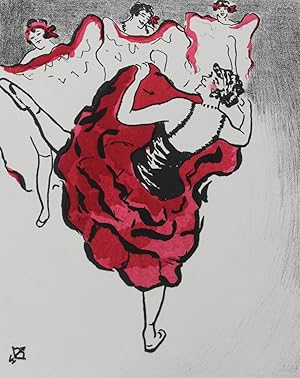
Lithographie originale danseuses de french cancan du Moulin rouge
Editore: Marcel Seheur, 1925
Da: Librairie L'amour qui bouquine, ALISE SAINTE REINE, Francia
Valutazione del venditore 5 su 5 stelle
Arte / Stampa / Poster
EUR 150,00
Spedizione EUR 13,50
Spedito da Francia a U.S.A.Quantità: 1 disponibili
Aggiungi al carrelloPas de couverture. Condizione: Très bon. Lithographie originale par Georges Van Houten (1888-1964) Signée dans la planche (monogramme) Feuille de 29 x 24 cm Papier vélin d'Arches Tirage à 500 exemplaires seulement. (copie du justificatif de tirage fournie). Lithographie extraite de l'ouvrage MOULIN ROUGE, publié en 1925 par Marcel Seheur. Monde la nuit parisienne des années 1920 : danseuses de cancan, musiciens de jazz, fête nocturne, orchestre, beaux messieurs, ambiance de cabaret, etc. Sujet de la lithographie vendue dans cette annonce : danseuses de french cancan du Moulin rouge (aquarellée à l'époque à la main). Très bon état. Certaines lithographies peuvent avoir quelques traces d'humidité dans la marge, sans gravité et loin du sujet. Voir photos. A encadrer. Vous enchérissez sur ce que vous voyez. GEORGES VAN HOUTEN (Belgian / 1888-1964) The artist Georges van Houten was born in Antwerp, to Dutch parents. After studying under the Belgian post-Impressionist Jacob Smith, who mediated the influence of Vincent van Gogh and J.-F. Millet in van Houten's work, in 1905 van Houten went to Paris to study art. By 1910 Georges van Houten was a member of the Société des Artistes Indépendants, and exhibited five paintings in their Salon. Georges van Houten had his first solo exhibition at the Galerie Eugène Blot in Paris in 1913, and a second at the same venue the following year. At this exhibition his work caught the eye of the critic and connoisseur Théodore Duret, the great expert on the Impressionists, and he was commissioned to paint Duret's portrait. This portrait was completed the following year, but as van Houten spent the war years in the Belgian army, it was not exhibited until after the war, in the 1919 Salon d'Automne, where it was warmly received. That same year, Georges van Houten had an exhibition at the Galerie Sauvage. It seemed as if van Houten was set fair to become one of the great names of twentieth century art. But a seemingly trivial setback soured his attitude to the art world. In 1920, Georges van Houten was rejected in his application for membership of the Société du Salon d'Automne. Although all the foreign applicants were rejected that year, presumably as a result of reactionary post-war pressures, van Houten took it as a personal slight, attributing it to the malign influence of his contemporary rivals, particularly Matisse and Braque. He harboured a grudge about this incident to the end of his life. Georges van Houten did in fact exhibit a canvas, "Boulevard" at that year's Salon d'Automne, but subsequently he retreated to the Salon des Indépendants, where he exhibited regularly until 1932. The following year van Houten inherited a fortune, and although he continued to paint, stopped exhibiting or selling his work. What Georges van Houten prized above everything in art was fluidity of line, writing, "I would like one day to execute my line with a single stroke, as easily as I move my arm, to draw with no more effort than I write a letter." Our suite of lithographs by Georges van Houten depicting performers and customers in the louche atmosphere of the Moulin Rouge in the Roaring Twenties show how nearly he attained that dream. He described them to a friend as "illustrations de notre pauvre humanité d'après guerre", illustrations of our poor post-war humanity. After van Houten's death the Ashmolean Museum in Oxford held a retrospective exhibition, Georges van Houten 1888-1964, with a catalogue by Andrew Wilton (Ashmolean Museum, 1965). Georges van Houten left his art collection and some 300 of his own paintings to the Ashmolean; their collection includes at least two paintings closely related to the Moulin Rouge lithographs, "Moulin Rouge" (1922) and "Bar at the Moulin Rouge" (1924). The Moulin Rouge lithographs were published in 1925; an earlier portfolio, Arlequinades (1919) tackled another favourite Montmartre motif, the circus. In both, the influence of Toulouse-Lautrec overrides that of van Gogh, whose influence is more pronounced in van Hou.
-
Lithographie extraite de l'ouvrage MOULIN ROUGE, publié en 1925 par Marcel Seheur. - Danseuse de french cancan (aquarellée à l'époque à la main).
Editore: Marcel Seheur, 1925
Da: Librairie L'amour qui bouquine, ALISE SAINTE REINE, Francia
Valutazione del venditore 5 su 5 stelle
Arte / Stampa / Poster
EUR 155,00
Spedizione EUR 13,50
Spedito da Francia a U.S.A.Quantità: 1 disponibili
Aggiungi al carrelloPas de couverture. Condizione: Très bon. Lithographie originale par Georges Van Houten (1888-1964) Signée dans la planche (monogramme) Feuille de 29 x 24 cm Papier vélin d'Arches Tirage à 500 exemplaires seulement. (copie du justificatif de tirage fournie). Lithographie extraite de l'ouvrage MOULIN ROUGE, publié en 1925 par Marcel Seheur. Monde la nuit parisienne des années 1920 : danseuses de cancan, musiciens de jazz, fête nocturne, orchestre, beaux messieurs, ambiance de cabaret, etc. Sujet de la lithographie vendue dans cette annonce : Danseuse de french cancan (aquarellée à l'époque à la main). Très bon état. Certaines lithographies peuvent avoir quelques traces d'humidité dans la marge, sans gravité et loin du sujet. Voir photos. A encadrer. Vous enchérissez sur ce que vous voyez. GEORGES VAN HOUTEN (Belgian / 1888-1964) The artist Georges van Houten was born in Antwerp, to Dutch parents. After studying under the Belgian post-Impressionist Jacob Smith, who mediated the influence of Vincent van Gogh and J.-F. Millet in van Houten's work, in 1905 van Houten went to Paris to study art. By 1910 Georges van Houten was a member of the Société des Artistes Indépendants, and exhibited five paintings in their Salon. Georges van Houten had his first solo exhibition at the Galerie Eugène Blot in Paris in 1913, and a second at the same venue the following year. At this exhibition his work caught the eye of the critic and connoisseur Théodore Duret, the great expert on the Impressionists, and he was commissioned to paint Duret's portrait. This portrait was completed the following year, but as van Houten spent the war years in the Belgian army, it was not exhibited until after the war, in the 1919 Salon d'Automne, where it was warmly received. That same year, Georges van Houten had an exhibition at the Galerie Sauvage. It seemed as if van Houten was set fair to become one of the great names of twentieth century art. But a seemingly trivial setback soured his attitude to the art world. In 1920, Georges van Houten was rejected in his application for membership of the Société du Salon d'Automne. Although all the foreign applicants were rejected that year, presumably as a result of reactionary post-war pressures, van Houten took it as a personal slight, attributing it to the malign influence of his contemporary rivals, particularly Matisse and Braque. He harboured a grudge about this incident to the end of his life. Georges van Houten did in fact exhibit a canvas, "Boulevard" at that year's Salon d'Automne, but subsequently he retreated to the Salon des Indépendants, where he exhibited regularly until 1932. The following year van Houten inherited a fortune, and although he continued to paint, stopped exhibiting or selling his work. What Georges van Houten prized above everything in art was fluidity of line, writing, "I would like one day to execute my line with a single stroke, as easily as I move my arm, to draw with no more effort than I write a letter." Our suite of lithographs by Georges van Houten depicting performers and customers in the louche atmosphere of the Moulin Rouge in the Roaring Twenties show how nearly he attained that dream. He described them to a friend as "illustrations de notre pauvre humanité d'après guerre", illustrations of our poor post-war humanity. After van Houten's death the Ashmolean Museum in Oxford held a retrospective exhibition, Georges van Houten 1888-1964, with a catalogue by Andrew Wilton (Ashmolean Museum, 1965). Georges van Houten left his art collection and some 300 of his own paintings to the Ashmolean; their collection includes at least two paintings closely related to the Moulin Rouge lithographs, "Moulin Rouge" (1922) and "Bar at the Moulin Rouge" (1924). The Moulin Rouge lithographs were published in 1925; an earlier portfolio, Arlequinades (1919) tackled another favourite Montmartre motif, the circus. In both, the influence of Toulouse-Lautrec overrides that of van Gogh, whose influence is more pronounced in van Houten's oil paintin.
-
Lithographie extraite de l'ouvrage MOULIN ROUGE, publié en 1925 par Marcel Seheur. - danseuses de french cancan (aquarellée à l'époque à la main).
Editore: Marcel Seheur, 1925
Da: Librairie L'amour qui bouquine, ALISE SAINTE REINE, Francia
Valutazione del venditore 5 su 5 stelle
Arte / Stampa / Poster
EUR 155,00
Spedizione EUR 13,50
Spedito da Francia a U.S.A.Quantità: 1 disponibili
Aggiungi al carrelloPas de couverture. Condizione: Très bon. Lithographie originale par Georges Van Houten (1888-1964) Signée dans la planche (monogramme) Feuille de 29 x 24 cm Papier vélin d'Arches Tirage à 500 exemplaires seulement. (copie du justificatif de tirage fournie). Lithographie extraite de l'ouvrage MOULIN ROUGE, publié en 1925 par Marcel Seheur. Monde la nuit parisienne des années 1920 : danseuses de cancan, musiciens de jazz, fête nocturne, orchestre, beaux messieurs, ambiance de cabaret, etc. Sujet de la lithographie vendue dans cette annonce : danseuses de french cancan (aquarellée à l'époque à la main). Très bon état. Certaines lithographies peuvent avoir quelques traces d'humidité dans la marge, sans gravité et loin du sujet. Voir photos. A encadrer. Vous enchérissez sur ce que vous voyez. GEORGES VAN HOUTEN (Belgian / 1888-1964) The artist Georges van Houten was born in Antwerp, to Dutch parents. After studying under the Belgian post-Impressionist Jacob Smith, who mediated the influence of Vincent van Gogh and J.-F. Millet in van Houten's work, in 1905 van Houten went to Paris to study art. By 1910 Georges van Houten was a member of the Société des Artistes Indépendants, and exhibited five paintings in their Salon. Georges van Houten had his first solo exhibition at the Galerie Eugène Blot in Paris in 1913, and a second at the same venue the following year. At this exhibition his work caught the eye of the critic and connoisseur Théodore Duret, the great expert on the Impressionists, and he was commissioned to paint Duret's portrait. This portrait was completed the following year, but as van Houten spent the war years in the Belgian army, it was not exhibited until after the war, in the 1919 Salon d'Automne, where it was warmly received. That same year, Georges van Houten had an exhibition at the Galerie Sauvage. It seemed as if van Houten was set fair to become one of the great names of twentieth century art. But a seemingly trivial setback soured his attitude to the art world. In 1920, Georges van Houten was rejected in his application for membership of the Société du Salon d'Automne. Although all the foreign applicants were rejected that year, presumably as a result of reactionary post-war pressures, van Houten took it as a personal slight, attributing it to the malign influence of his contemporary rivals, particularly Matisse and Braque. He harboured a grudge about this incident to the end of his life. Georges van Houten did in fact exhibit a canvas, "Boulevard" at that year's Salon d'Automne, but subsequently he retreated to the Salon des Indépendants, where he exhibited regularly until 1932. The following year van Houten inherited a fortune, and although he continued to paint, stopped exhibiting or selling his work. What Georges van Houten prized above everything in art was fluidity of line, writing, "I would like one day to execute my line with a single stroke, as easily as I move my arm, to draw with no more effort than I write a letter." Our suite of lithographs by Georges van Houten depicting performers and customers in the louche atmosphere of the Moulin Rouge in the Roaring Twenties show how nearly he attained that dream. He described them to a friend as "illustrations de notre pauvre humanité d'après guerre", illustrations of our poor post-war humanity. After van Houten's death the Ashmolean Museum in Oxford held a retrospective exhibition, Georges van Houten 1888-1964, with a catalogue by Andrew Wilton (Ashmolean Museum, 1965). Georges van Houten left his art collection and some 300 of his own paintings to the Ashmolean; their collection includes at least two paintings closely related to the Moulin Rouge lithographs, "Moulin Rouge" (1922) and "Bar at the Moulin Rouge" (1924). The Moulin Rouge lithographs were published in 1925; an earlier portfolio, Arlequinades (1919) tackled another favourite Montmartre motif, the circus. In both, the influence of Toulouse-Lautrec overrides that of van Gogh, whose influence is more pronounced in van Houten's oil painti.
-
Lithographie extraite de l'ouvrage MOULIN ROUGE, publié en 1925 par Marcel Seheur. - couple au bord de la piste de danse du Moulin rouge (tirage en bleu de la lithographie). - Couple homme et femme danseurs de french cancan (aquarellée à l'époque à la main).
Editore: Marcel Seheur, 1925
Da: Librairie L'amour qui bouquine, ALISE SAINTE REINE, Francia
Valutazione del venditore 5 su 5 stelle
Arte / Stampa / Poster
EUR 155,00
Spedizione EUR 13,50
Spedito da Francia a U.S.A.Quantità: 1 disponibili
Aggiungi al carrelloPas de couverture. Condizione: Très bon. Lithographie originale par Georges Van Houten (1888-1964) Signée dans la planche (monogramme) Feuille de 29 x 24 cm Papier vélin d'Arches Tirage à 500 exemplaires seulement. (copie du justificatif de tirage fournie). Lithographie extraite de l'ouvrage MOULIN ROUGE, publié en 1925 par Marcel Seheur. Monde la nuit parisienne des années 1920 : danseuses de cancan, musiciens de jazz, fête nocturne, orchestre, beaux messieurs, ambiance de cabaret, etc. Sujet de la lithographie vendue dans cette annonce : Couple homme et femme danseurs de french cancan (aquarellée à l'époque à la main). Très bon état. Certaines lithographies peuvent avoir quelques traces d'humidité dans la marge, sans gravité et loin du sujet. Voir photos. A encadrer. Vous enchérissez sur ce que vous voyez. GEORGES VAN HOUTEN (Belgian / 1888-1964) The artist Georges van Houten was born in Antwerp, to Dutch parents. After studying under the Belgian post-Impressionist Jacob Smith, who mediated the influence of Vincent van Gogh and J.-F. Millet in van Houten's work, in 1905 van Houten went to Paris to study art. By 1910 Georges van Houten was a member of the Société des Artistes Indépendants, and exhibited five paintings in their Salon. Georges van Houten had his first solo exhibition at the Galerie Eugène Blot in Paris in 1913, and a second at the same venue the following year. At this exhibition his work caught the eye of the critic and connoisseur Théodore Duret, the great expert on the Impressionists, and he was commissioned to paint Duret's portrait. This portrait was completed the following year, but as van Houten spent the war years in the Belgian army, it was not exhibited until after the war, in the 1919 Salon d'Automne, where it was warmly received. That same year, Georges van Houten had an exhibition at the Galerie Sauvage. It seemed as if van Houten was set fair to become one of the great names of twentieth century art. But a seemingly trivial setback soured his attitude to the art world. In 1920, Georges van Houten was rejected in his application for membership of the Société du Salon d'Automne. Although all the foreign applicants were rejected that year, presumably as a result of reactionary post-war pressures, van Houten took it as a personal slight, attributing it to the malign influence of his contemporary rivals, particularly Matisse and Braque. He harboured a grudge about this incident to the end of his life. Georges van Houten did in fact exhibit a canvas, "Boulevard" at that year's Salon d'Automne, but subsequently he retreated to the Salon des Indépendants, where he exhibited regularly until 1932. The following year van Houten inherited a fortune, and although he continued to paint, stopped exhibiting or selling his work. What Georges van Houten prized above everything in art was fluidity of line, writing, "I would like one day to execute my line with a single stroke, as easily as I move my arm, to draw with no more effort than I write a letter." Our suite of lithographs by Georges van Houten depicting performers and customers in the louche atmosphere of the Moulin Rouge in the Roaring Twenties show how nearly he attained that dream. He described them to a friend as "illustrations de notre pauvre humanité d'après guerre", illustrations of our poor post-war humanity. After van Houten's death the Ashmolean Museum in Oxford held a retrospective exhibition, Georges van Houten 1888-1964, with a catalogue by Andrew Wilton (Ashmolean Museum, 1965). Georges van Houten left his art collection and some 300 of his own paintings to the Ashmolean; their collection includes at least two paintings closely related to the Moulin Rouge lithographs, "Moulin Rouge" (1922) and "Bar at the Moulin Rouge" (1924). The Moulin Rouge lithographs were published in 1925; an earlier portfolio, Arlequinades (1919) tackled another favourite Montmartre motif, the circus. In both, the influence of Toulouse-Lautrec overrides that of van Gogh, whose influence is more pronounced in va.
-
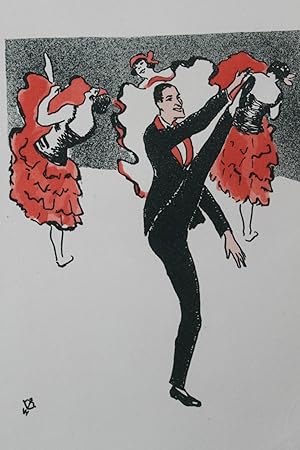
Lithographie extraite de l'ouvrage MOULIN ROUGE, publié en 1925 par Marcel Seheur. - danseurs de french cancan (aquarellée à l'époque à la main).
Editore: Marcel Seheur, 1925
Da: Librairie L'amour qui bouquine, ALISE SAINTE REINE, Francia
Valutazione del venditore 5 su 5 stelle
Arte / Stampa / Poster
EUR 155,00
Spedizione EUR 13,50
Spedito da Francia a U.S.A.Quantità: 1 disponibili
Aggiungi al carrelloPas de couverture. Condizione: Très bon. Lithographie originale par Georges Van Houten (1888-1964) Signée dans la planche (monogramme) Feuille de 29 x 24 cm Papier vélin d'Arches Tirage à 500 exemplaires seulement. (copie du justificatif de tirage fournie). Lithographie extraite de l'ouvrage MOULIN ROUGE, publié en 1925 par Marcel Seheur. Monde la nuit parisienne des années 1920 : danseuses de cancan, musiciens de jazz, fête nocturne, orchestre, beaux messieurs, ambiance de cabaret, etc. Sujet de la lithographie vendue dans cette annonce : danseurs de french cancan (aquarellée à l'époque à la main). Très bon état. Certaines lithographies peuvent avoir quelques traces d'humidité dans la marge, sans gravité et loin du sujet. Voir photos. A encadrer. Vous enchérissez sur ce que vous voyez. GEORGES VAN HOUTEN (Belgian / 1888-1964) The artist Georges van Houten was born in Antwerp, to Dutch parents. After studying under the Belgian post-Impressionist Jacob Smith, who mediated the influence of Vincent van Gogh and J.-F. Millet in van Houten's work, in 1905 van Houten went to Paris to study art. By 1910 Georges van Houten was a member of the Société des Artistes Indépendants, and exhibited five paintings in their Salon. Georges van Houten had his first solo exhibition at the Galerie Eugène Blot in Paris in 1913, and a second at the same venue the following year. At this exhibition his work caught the eye of the critic and connoisseur Théodore Duret, the great expert on the Impressionists, and he was commissioned to paint Duret's portrait. This portrait was completed the following year, but as van Houten spent the war years in the Belgian army, it was not exhibited until after the war, in the 1919 Salon d'Automne, where it was warmly received. That same year, Georges van Houten had an exhibition at the Galerie Sauvage. It seemed as if van Houten was set fair to become one of the great names of twentieth century art. But a seemingly trivial setback soured his attitude to the art world. In 1920, Georges van Houten was rejected in his application for membership of the Société du Salon d'Automne. Although all the foreign applicants were rejected that year, presumably as a result of reactionary post-war pressures, van Houten took it as a personal slight, attributing it to the malign influence of his contemporary rivals, particularly Matisse and Braque. He harboured a grudge about this incident to the end of his life. Georges van Houten did in fact exhibit a canvas, "Boulevard" at that year's Salon d'Automne, but subsequently he retreated to the Salon des Indépendants, where he exhibited regularly until 1932. The following year van Houten inherited a fortune, and although he continued to paint, stopped exhibiting or selling his work. What Georges van Houten prized above everything in art was fluidity of line, writing, "I would like one day to execute my line with a single stroke, as easily as I move my arm, to draw with no more effort than I write a letter." Our suite of lithographs by Georges van Houten depicting performers and customers in the louche atmosphere of the Moulin Rouge in the Roaring Twenties show how nearly he attained that dream. He described them to a friend as "illustrations de notre pauvre humanité d'après guerre", illustrations of our poor post-war humanity. After van Houten's death the Ashmolean Museum in Oxford held a retrospective exhibition, Georges van Houten 1888-1964, with a catalogue by Andrew Wilton (Ashmolean Museum, 1965). Georges van Houten left his art collection and some 300 of his own paintings to the Ashmolean; their collection includes at least two paintings closely related to the Moulin Rouge lithographs, "Moulin Rouge" (1922) and "Bar at the Moulin Rouge" (1924). The Moulin Rouge lithographs were published in 1925; an earlier portfolio, Arlequinades (1919) tackled another favourite Montmartre motif, the circus. In both, the influence of Toulouse-Lautrec overrides that of van Gogh, whose influence is more pronounced in van Houten's oil paintin.
-
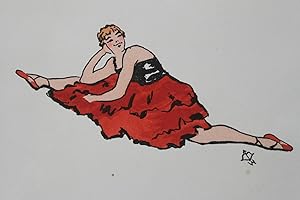
Lithographie extraite de l'ouvrage MOULIN ROUGE, publié en 1925 par Marcel Seheur. - danseuse de french cancan du Moulin rouge, le grand écart (aquarellée à l'époque à la main).
Editore: Marcel Seheur, 1925
Da: Librairie L'amour qui bouquine, ALISE SAINTE REINE, Francia
Valutazione del venditore 5 su 5 stelle
Arte / Stampa / Poster
EUR 155,00
Spedizione EUR 13,50
Spedito da Francia a U.S.A.Quantità: 1 disponibili
Aggiungi al carrelloPas de couverture. Condizione: Très bon. Lithographie originale par Georges Van Houten (1888-1964) Signée dans la planche (monogramme) Feuille de 29 x 24 cm Papier vélin d'Arches Tirage à 500 exemplaires seulement. (copie du justificatif de tirage fournie). Lithographie extraite de l'ouvrage MOULIN ROUGE, publié en 1925 par Marcel Seheur. Monde la nuit parisienne des années 1920 : danseuses de cancan, musiciens de jazz, fête nocturne, orchestre, beaux messieurs, ambiance de cabaret, etc. Sujet de la lithographie vendue dans cette annonce : danseuse de french cancan du Moulin rouge, le grand écart (aquarellée à l'époque à la main). Très bon état. Certaines lithographies peuvent avoir quelques traces d'humidité dans la marge, sans gravité et loin du sujet. Voir photos. A encadrer. Vous enchérissez sur ce que vous voyez. GEORGES VAN HOUTEN (Belgian / 1888-1964) The artist Georges van Houten was born in Antwerp, to Dutch parents. After studying under the Belgian post-Impressionist Jacob Smith, who mediated the influence of Vincent van Gogh and J.-F. Millet in van Houten's work, in 1905 van Houten went to Paris to study art. By 1910 Georges van Houten was a member of the Société des Artistes Indépendants, and exhibited five paintings in their Salon. Georges van Houten had his first solo exhibition at the Galerie Eugène Blot in Paris in 1913, and a second at the same venue the following year. At this exhibition his work caught the eye of the critic and connoisseur Théodore Duret, the great expert on the Impressionists, and he was commissioned to paint Duret's portrait. This portrait was completed the following year, but as van Houten spent the war years in the Belgian army, it was not exhibited until after the war, in the 1919 Salon d'Automne, where it was warmly received. That same year, Georges van Houten had an exhibition at the Galerie Sauvage. It seemed as if van Houten was set fair to become one of the great names of twentieth century art. But a seemingly trivial setback soured his attitude to the art world. In 1920, Georges van Houten was rejected in his application for membership of the Société du Salon d'Automne. Although all the foreign applicants were rejected that year, presumably as a result of reactionary post-war pressures, van Houten took it as a personal slight, attributing it to the malign influence of his contemporary rivals, particularly Matisse and Braque. He harboured a grudge about this incident to the end of his life. Georges van Houten did in fact exhibit a canvas, "Boulevard" at that year's Salon d'Automne, but subsequently he retreated to the Salon des Indépendants, where he exhibited regularly until 1932. The following year van Houten inherited a fortune, and although he continued to paint, stopped exhibiting or selling his work. What Georges van Houten prized above everything in art was fluidity of line, writing, "I would like one day to execute my line with a single stroke, as easily as I move my arm, to draw with no more effort than I write a letter." Our suite of lithographs by Georges van Houten depicting performers and customers in the louche atmosphere of the Moulin Rouge in the Roaring Twenties show how nearly he attained that dream. He described them to a friend as "illustrations de notre pauvre humanité d'après guerre", illustrations of our poor post-war humanity. After van Houten's death the Ashmolean Museum in Oxford held a retrospective exhibition, Georges van Houten 1888-1964, with a catalogue by Andrew Wilton (Ashmolean Museum, 1965). Georges van Houten left his art collection and some 300 of his own paintings to the Ashmolean; their collection includes at least two paintings closely related to the Moulin Rouge lithographs, "Moulin Rouge" (1922) and "Bar at the Moulin Rouge" (1924). The Moulin Rouge lithographs were published in 1925; an earlier portfolio, Arlequinades (1919) tackled another favourite Montmartre motif, the circus. In both, the influence of Toulouse-Lautrec overrides that of van Gogh, whose influence is more pronou.
-
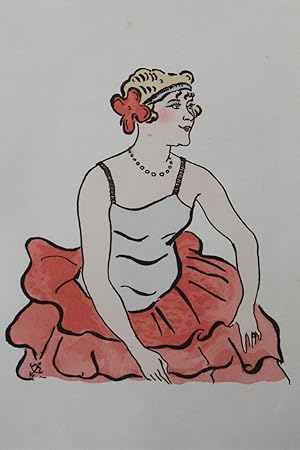
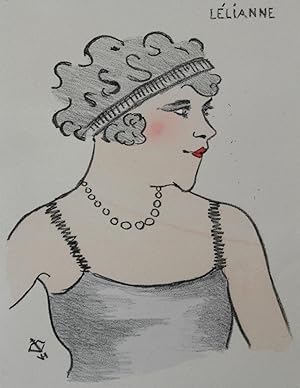
Lithographie extraite de l'ouvrage MOULIN ROUGE, publié en 1925 par Marcel Seheur. -Lélianne danseuse du Moulin rouge (aquarellée à l'époque à la main).
Editore: Marcel Seheur, 1925
Da: Librairie L'amour qui bouquine, ALISE SAINTE REINE, Francia
Valutazione del venditore 5 su 5 stelle
Arte / Stampa / Poster
EUR 155,00
Spedizione EUR 13,50
Spedito da Francia a U.S.A.Quantità: 1 disponibili
Aggiungi al carrelloPas de couverture. Condizione: Très bon. Lithographie originale par Georges Van Houten (1888-1964) Signée dans la planche (monogramme) Feuille de 29 x 24 cm Papier vélin d'Arches Tirage à 500 exemplaires seulement. (copie du justificatif de tirage fournie). Lithographie extraite de l'ouvrage MOULIN ROUGE, publié en 1925 par Marcel Seheur. Monde la nuit parisienne des années 1920 : danseuses de cancan, musiciens de jazz, fête nocturne, orchestre, beaux messieurs, ambiance de cabaret, etc. Sujet de la lithographie vendue dans cette annonce : Lélianne danseuse du Moulin rouge (aquarellée à l'époque à la main). Très bon état. Certaines lithographies peuvent avoir quelques traces d'humidité dans la marge, sans gravité et loin du sujet. Voir photos. A encadrer. Vous enchérissez sur ce que vous voyez. GEORGES VAN HOUTEN (Belgian / 1888-1964) The artist Georges van Houten was born in Antwerp, to Dutch parents. After studying under the Belgian post-Impressionist Jacob Smith, who mediated the influence of Vincent van Gogh and J.-F. Millet in van Houten's work, in 1905 van Houten went to Paris to study art. By 1910 Georges van Houten was a member of the Société des Artistes Indépendants, and exhibited five paintings in their Salon. Georges van Houten had his first solo exhibition at the Galerie Eugène Blot in Paris in 1913, and a second at the same venue the following year. At this exhibition his work caught the eye of the critic and connoisseur Théodore Duret, the great expert on the Impressionists, and he was commissioned to paint Duret's portrait. This portrait was completed the following year, but as van Houten spent the war years in the Belgian army, it was not exhibited until after the war, in the 1919 Salon d'Automne, where it was warmly received. That same year, Georges van Houten had an exhibition at the Galerie Sauvage. It seemed as if van Houten was set fair to become one of the great names of twentieth century art. But a seemingly trivial setback soured his attitude to the art world. In 1920, Georges van Houten was rejected in his application for membership of the Société du Salon d'Automne. Although all the foreign applicants were rejected that year, presumably as a result of reactionary post-war pressures, van Houten took it as a personal slight, attributing it to the malign influence of his contemporary rivals, particularly Matisse and Braque. He harboured a grudge about this incident to the end of his life. Georges van Houten did in fact exhibit a canvas, "Boulevard" at that year's Salon d'Automne, but subsequently he retreated to the Salon des Indépendants, where he exhibited regularly until 1932. The following year van Houten inherited a fortune, and although he continued to paint, stopped exhibiting or selling his work. What Georges van Houten prized above everything in art was fluidity of line, writing, "I would like one day to execute my line with a single stroke, as easily as I move my arm, to draw with no more effort than I write a letter." Our suite of lithographs by Georges van Houten depicting performers and customers in the louche atmosphere of the Moulin Rouge in the Roaring Twenties show how nearly he attained that dream. He described them to a friend as "illustrations de notre pauvre humanité d'après guerre", illustrations of our poor post-war humanity. After van Houten's death the Ashmolean Museum in Oxford held a retrospective exhibition, Georges van Houten 1888-1964, with a catalogue by Andrew Wilton (Ashmolean Museum, 1965). Georges van Houten left his art collection and some 300 of his own paintings to the Ashmolean; their collection includes at least two paintings closely related to the Moulin Rouge lithographs, "Moulin Rouge" (1922) and "Bar at the Moulin Rouge" (1924). The Moulin Rouge lithographs were published in 1925; an earlier portfolio, Arlequinades (1919) tackled another favourite Montmartre motif, the circus. In both, the influence of Toulouse-Lautrec overrides that of van Gogh, whose influence is more pronounced in van Houten's oil.
-
Lithographie extraite de l'ouvrage MOULIN ROUGE, publié en 1925 par Marcel Seheur.
Editore: danseuses de cancan du Moulin rouge (aquarellée à l'époque à la main)., 1925
Da: Librairie L'amour qui bouquine, ALISE SAINTE REINE, Francia
Valutazione del venditore 5 su 5 stelle
Arte / Stampa / Poster
EUR 155,00
Spedizione EUR 13,50
Spedito da Francia a U.S.A.Quantità: 1 disponibili
Aggiungi al carrelloPas de couverture. Condizione: Très bon. Lithographie originale par Georges Van Houten (1888-1964) Signée dans la planche (monogramme) Feuille de 29 x 24 cm Papier vélin d'Arches Tirage à 500 exemplaires seulement. (copie du justificatif de tirage fournie). Lithographie extraite de l'ouvrage MOULIN ROUGE, publié en 1925 par Marcel Seheur. Monde la nuit parisienne des années 1920 : danseuses de cancan, musiciens de jazz, fête nocturne, orchestre, beaux messieurs, ambiance de cabaret, etc. Sujet de la lithographie vendue dans cette annonce : danseuses de cancan du Moulin rouge (aquarellée à l'époque à la main). Très bon état. Certaines lithographies peuvent avoir quelques traces d'humidité dans la marge, sans gravité et loin du sujet. Voir photos. A encadrer. Vous enchérissez sur ce que vous voyez. GEORGES VAN HOUTEN (Belgian / 1888-1964) The artist Georges van Houten was born in Antwerp, to Dutch parents. After studying under the Belgian post-Impressionist Jacob Smith, who mediated the influence of Vincent van Gogh and J.-F. Millet in van Houten's work, in 1905 van Houten went to Paris to study art. By 1910 Georges van Houten was a member of the Société des Artistes Indépendants, and exhibited five paintings in their Salon. Georges van Houten had his first solo exhibition at the Galerie Eugène Blot in Paris in 1913, and a second at the same venue the following year. At this exhibition his work caught the eye of the critic and connoisseur Théodore Duret, the great expert on the Impressionists, and he was commissioned to paint Duret's portrait. This portrait was completed the following year, but as van Houten spent the war years in the Belgian army, it was not exhibited until after the war, in the 1919 Salon d'Automne, where it was warmly received. That same year, Georges van Houten had an exhibition at the Galerie Sauvage. It seemed as if van Houten was set fair to become one of the great names of twentieth century art. But a seemingly trivial setback soured his attitude to the art world. In 1920, Georges van Houten was rejected in his application for membership of the Société du Salon d'Automne. Although all the foreign applicants were rejected that year, presumably as a result of reactionary post-war pressures, van Houten took it as a personal slight, attributing it to the malign influence of his contemporary rivals, particularly Matisse and Braque. He harboured a grudge about this incident to the end of his life. Georges van Houten did in fact exhibit a canvas, "Boulevard" at that year's Salon d'Automne, but subsequently he retreated to the Salon des Indépendants, where he exhibited regularly until 1932. The following year van Houten inherited a fortune, and although he continued to paint, stopped exhibiting or selling his work. What Georges van Houten prized above everything in art was fluidity of line, writing, "I would like one day to execute my line with a single stroke, as easily as I move my arm, to draw with no more effort than I write a letter." Our suite of lithographs by Georges van Houten depicting performers and customers in the louche atmosphere of the Moulin Rouge in the Roaring Twenties show how nearly he attained that dream. He described them to a friend as "illustrations de notre pauvre humanité d'après guerre", illustrations of our poor post-war humanity. After van Houten's death the Ashmolean Museum in Oxford held a retrospective exhibition, Georges van Houten 1888-1964, with a catalogue by Andrew Wilton (Ashmolean Museum, 1965). Georges van Houten left his art collection and some 300 of his own paintings to the Ashmolean; their collection includes at least two paintings closely related to the Moulin Rouge lithographs, "Moulin Rouge" (1922) and "Bar at the Moulin Rouge" (1924). The Moulin Rouge lithographs were published in 1925; an earlier portfolio, Arlequinades (1919) tackled another favourite Montmartre motif, the circus. In both, the influence of Toulouse-Lautrec overrides that of van Gogh, whose influence is more pronounced in van Houten's o.
-
Lithographie au bar du MOULIN ROUGE
Editore: Marcel Seheur., 1925
Da: Librairie L'amour qui bouquine, ALISE SAINTE REINE, Francia
Valutazione del venditore 5 su 5 stelle
Arte / Stampa / Poster
EUR 155,00
Spedizione EUR 13,50
Spedito da Francia a U.S.A.Quantità: 1 disponibili
Aggiungi al carrelloPas de couverture. Condizione: Très bon. Lithographie originale par Georges Van Houten (1888-1964) Signée dans la planche (monogramme) Feuille de 29 x 24 cm Papier vélin d'Arches Tirage à 500 exemplaires seulement. (copie du justificatif de tirage fournie). Lithographie extraite de l'ouvrage MOULIN ROUGE, publié en 1925 par Marcel Seheur. Monde la nuit parisienne des années 1920 : danseuses de cancan, musiciens de jazz, fête nocturne, orchestre, beaux messieurs, ambiance de cabaret, etc. Sujet de la lithographie vendue dans cette annonce : au bar du Moulin rouge (aquarellée à l'époque à la main). Très bon état. Certaines lithographies peuvent avoir quelques traces d'humidité dans la marge, sans gravité et loin du sujet. Voir photos. A encadrer. Vous enchérissez sur ce que vous voyez. GEORGES VAN HOUTEN (Belgian / 1888-1964) The artist Georges van Houten was born in Antwerp, to Dutch parents. After studying under the Belgian post-Impressionist Jacob Smith, who mediated the influence of Vincent van Gogh and J.-F. Millet in van Houten's work, in 1905 van Houten went to Paris to study art. By 1910 Georges van Houten was a member of the Société des Artistes Indépendants, and exhibited five paintings in their Salon. Georges van Houten had his first solo exhibition at the Galerie Eugène Blot in Paris in 1913, and a second at the same venue the following year. At this exhibition his work caught the eye of the critic and connoisseur Théodore Duret, the great expert on the Impressionists, and he was commissioned to paint Duret's portrait. This portrait was completed the following year, but as van Houten spent the war years in the Belgian army, it was not exhibited until after the war, in the 1919 Salon d'Automne, where it was warmly received. That same year, Georges van Houten had an exhibition at the Galerie Sauvage. It seemed as if van Houten was set fair to become one of the great names of twentieth century art. But a seemingly trivial setback soured his attitude to the art world. In 1920, Georges van Houten was rejected in his application for membership of the Société du Salon d'Automne. Although all the foreign applicants were rejected that year, presumably as a result of reactionary post-war pressures, van Houten took it as a personal slight, attributing it to the malign influence of his contemporary rivals, particularly Matisse and Braque. He harboured a grudge about this incident to the end of his life. Georges van Houten did in fact exhibit a canvas, "Boulevard" at that year's Salon d'Automne, but subsequently he retreated to the Salon des Indépendants, where he exhibited regularly until 1932. The following year van Houten inherited a fortune, and although he continued to paint, stopped exhibiting or selling his work. What Georges van Houten prized above everything in art was fluidity of line, writing, "I would like one day to execute my line with a single stroke, as easily as I move my arm, to draw with no more effort than I write a letter." Our suite of lithographs by Georges van Houten depicting performers and customers in the louche atmosphere of the Moulin Rouge in the Roaring Twenties show how nearly he attained that dream. He described them to a friend as "illustrations de notre pauvre humanité d'après guerre", illustrations of our poor post-war humanity. After van Houten's death the Ashmolean Museum in Oxford held a retrospective exhibition, Georges van Houten 1888-1964, with a catalogue by Andrew Wilton (Ashmolean Museum, 1965). Georges van Houten left his art collection and some 300 of his own paintings to the Ashmolean; their collection includes at least two paintings closely related to the Moulin Rouge lithographs, "Moulin Rouge" (1922) and "Bar at the Moulin Rouge" (1924). The Moulin Rouge lithographs were published in 1925; an earlier portfolio, Arlequinades (1919) tackled another favourite Montmartre motif, the circus. In both, the influence of Toulouse-Lautrec overrides that of van Gogh, whose influence is more pronounced in van Houten's oil paintings.
-
Arlequinades. Album de douze dessins.
Data di pubblicazione: 1919
Da: SAS MARTINEZ D., PARIS, Francia
Membro dell'associazione: ILAB
Valutazione del venditore 4 su 5 stelle
Arte / Stampa / Poster Prima edizione
EUR 1.200,00
Spedizione EUR 23,20
Spedito da Francia a U.S.A.Quantità: 1 disponibili
Aggiungi al carrelloCouverture souple. Condizione: Bon. Edition originale. HOUTEN Georges van Anvers (Belgique) 1888 1964 Arlequinades. Album de douze dessins. Paris, Sauvage, s.d. (1919). Grand in-folio, en feuilles, sous couverture jaune à rabat illustrée de deux dessins en couleurs de Van Houten, intérieur illustré de motifs. Bel album complet comprenant 12 planches en couleurs. Il ouvre sur une courte préface du décorateur et critique d'art Marcel Genevrière (18851967). H500xL300mm chaque planche. Quelques courtes déchirures sur les bords de la couverture légèrement usagée et empoussiérée. Page de titre inégalement insolée. Les 12 planches en très bel état de conservation. Epreuves sur papier vélin crème. Toutes signées du monogramme et des initiales de l'artiste dans la composition. Exemplaire numéroté 70 d'un tirage à 275 (25 ex. sur Japon impérial et 250 ex. sur papier à grain numérotés de 1 à 250). Après avoir étudié la peinture en Belgique auprès du post-impressionniste belge Jacob Smith, Georges van Houken arrive à Paris en 1905. En 1910, il est membre de la Société des Artistes Indépendants et expose à leur salon. Lors de sa première exposition personnelle à la Galerie Eugène Blot en 1913, le critique d'art Théodore Duret, grand connaisseur des impressionnistes, le remarque et lui commande son portrait. Il passe la Première Guerre Mondiale dans l'armée belge et à son retour, il expose au Salon d'Automne et à la Galerie Sauvage en 1919. Après avoir exposé régulièrement au Salon des Indépendant jusqu'en 1932, il hérite d'une importante fortune et arrête d'exposer ses toiles. Notre belle et rare suite de lithographies de Georges van Houten représente, entre poésie et onirisme, divers personnages de la Commedia dell'arte.