
Grange william james (3 risultati)

Editore: Ronald Press 1937
Da: Polly's Books, Grand Rapids, MI, U.S.A.Polly's Books
Contatta il venditoreVenditore con 5 stelleCondizione: Usato - Buono
EUR 6,27
EUR 6,96 spedizioneSpedito in U.S.A.Quantità: 1 disponibili
Unknown Binding. Condizione: Used: Good. Hardcover. Revised Edition, 1940. 3rd Printing, 1946. A good copy with a tight and square binding. Text is clean but has mildly yellowed. Dark blue/green colored cloth boards are good but have lightly bumped corners. No dust jacket. Careful packaging and fast shipping. We recommend EXPEDI…TED MAIL for even faster delivery.
 Altre immagini
Editore: Charleston, South Carolina 1886
- Brossura
Da: James Cummins Bookseller, ABAA, New York, NY, U.S.A.James Cummins Bookseller, ABAA
Contatta il venditoreVenditore con 5 stelleCondizione: Usato
EUR 22.439,32
EUR 10,46 spedizioneSpedito in U.S.A.Quantità: 1 disponibili
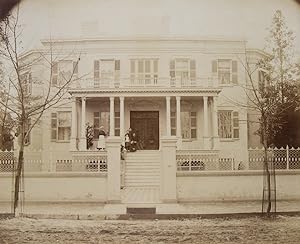
120 vintage albumen prints (4-3/4 x 8 inches, with one measuring 7-1/4 x 8-3/4 inches), mounted to stiff card album leaves, most captioned in ink in a contemporary hand, with an additional albumen print (4-3/4 x 8 inches) mounted on card (heavily worn with loss), stamped "Geo. L.G. Cook, photographer, 265 King Street, Charleston…, S.C.". Folio (12-1/4 x 10-1/4 inches). An album of 120 vintage albumen photographs showing the devastation to the city of Charleston, South Carolina, following the earthquake of August 31, 1886. Estimated to have reached a magnitude of between 6.6 and 7.3 on the Richter scale, the earthquake left 60 people dead and caused substantial property damage to nearly every structure in the city. Felt as far away as Chicago and Cuba, the Charleston earthquake remains the strongest recorded earthquakes on the east coast of the United States. The photographs collected in this album were taken by various Charleston photographers in the aftermath of the earthquake and document extensive property damage, soil liquefaction, sink holes and fissures, ruptured rail lines and overturned train cars, and the tent camps erected to house the newly homeless. "At least forty thousand people were 'tenting' in Charleston by September 3" (Williams & Hoffius, p. 53). A particular focus is placed on the damage sustained by the many Charleston churches and grand private residences. The photographers include George La Grange Cook (1849-1919), son of the prominent Civil War photographer George S. Cook (1819-1902). Cook's earthquake photographs were popular souvenir items, and he offered some 200 images in his series "Cook's Earthquake Views of Charleston and Vicinity." Other identified photographers include the Irish-born James A. Palmer (1825-1896), who specialized in views of southern blacks, and the English-born William E. Wilson (d. 1905), who specialized in documentary photography of Mobile and Savannah. Photographs of the destruction - along with vials of "earthquake sand" - were popular souvenirs among the waves of "disaster tourists" who began arriving shortly after the earthquake to view the ruined city. This album belonged to the English-born Francis W. Dawson (1841-1889), who in 1862 emigrated to the South to fight for the Confederacy. At the time of the earthquake, Dawson was co-owner and editor of the Charleston News and Courier (a photograph of the paper's damaged office is included in the album) and was the city's most prominent private citizen. Despite his earlier support for the Confederacy, Dawson used his influential position to urge racial tolerance and support for Reconstruction. Dawson was appointed a member of the Executive Relief Committee formed in the aftermath of the earthquake and was instrumental in spearheading and supporting the rebuilding of the city. His newspaper urged optimism and resilience in the face of mounting racial tension and the ever-present fear of another cataclysmic natural event. "Almost single-handedly, [Dawson] was attempting to prod his fellow citizens to buck up and rebuild their city" (ibid, p. 93) Produced between 1886 and the time of Dawson's sensational murder in 1889, the album may have been presented to Dawson as a tribute for his efforts in the rebuilding of the city. The first photograph in the album shows Dawson's home at 99 Bull Street, with Dawson and family sitting on their new front porch, rebuilt after its destruction during the earthquake. To the left of the family is Hélène Burdayron, the Swiss au pair who was at the center of a dispute that lead to Dawson's murder. Williams & Hoffius, Upheaval in Charleston (2011); Roxana Robinson, "The Strange Career of Frank Dawson," The New York Times, 20 March 2012 Contemporary black morocco gilt, titled in gilt on front cover ("The Charleston Earthquake / August 31st. 1886 / Francis W. Dawson). Spine perished but album intact, extremities worn, fading to some images, occasional foxing to mounts and images 120 vintage albumen pr.
Editore: Park Grange Sheffield Yorkshire; 20 April 1837
- Manoscritto
Da: Richard M. Ford Ltd, London, , Regno UnitoRichard M. Ford Ltd
Contatta il venditoreVenditore con 5 stelleCondizione: Usato
EUR 178,16
EUR 5,19 spedizioneSpedito da Regno Unito a U.S.A.Quantità: 1 disponibili
3pp., 4to. Bifolium. Good, on lightly-aged paper. Addressed, with broken seal in black wax, on verso of second leaf, to 'James Montgomery Esqr'. 80 lines of text. He has been twice that day to Montgomery's Sheffield mansion the Mount 'to enquire about you - the first time in vain, and the second nearly so. There they are much as… heretofore - but Miss Sarah meaning to write sermons you may have it before this.' Roberts declares: 'I think the present great Lions of the town are myself and mad dogs - perhaps you may think that they might be included under one head - yes - if that head was yours! I never before (though my study almost through life) saw so deeply into human nature. The surface is bad enough but, the bottom is horrible. [.] In motive how base! in power how contracted! in effort how weak! in knowledge how limited! in malignity how like a devil!the paradox of animals! the enigma of creation!' He describes how a bust of 'our dear departed friend' had 'liked to have done what he would not have liked to have done - killed poor Mary'. He writes out six lines of verse which he has 'adapted from one of your stanzas to our friends picture'. He gives a little local news before enquiring: 'What do you think the parson will say to me and my pamphlet - as both you and my dear friend Barnet are half parsons, perhaps there may be half of it that will suit you [.] I am just now very busy with two other good jobs, one to provide a club for old members whose Clubs have failed. In fine - I have so many irons in the fire at once that it requires attention to keep them all from burning their noses off.'.
