Importo totale (1 articolo articoli):
Destinazione ordine:

gwim james (4 risultati)
Vai alla pagina principale dei risultati di ricerca
Filtri di ricerca
Tipo di articolo
- Tutti i tipi di prodotto
- Libri (1)
- Riviste e Giornali (Nessun altro risultato corrispondente a questo perfezionamento)
- Fumetti (Nessun altro risultato corrispondente a questo perfezionamento)
- Spartiti (Nessun altro risultato corrispondente a questo perfezionamento)
- Arte, Stampe e Poster (3)
- Fotografie (Nessun altro risultato corrispondente a questo perfezionamento)
- Mappe (Nessun altro risultato corrispondente a questo perfezionamento)
- Manoscritti e Collezionismo cartaceo (Nessun altro risultato corrispondente a questo perfezionamento)
Condizioni Maggiori informazioni
- Nuovo (Nessun altro risultato corrispondente a questo perfezionamento)
- Come nuovo, Ottimo o Quasi ottimo (Nessun altro risultato corrispondente a questo perfezionamento)
- Molto buono o Buono (Nessun altro risultato corrispondente a questo perfezionamento)
- Discreto o Mediocre (Nessun altro risultato corrispondente a questo perfezionamento)
- Come descritto (4)
Legatura
- Tutte
- Rilegato (Nessun altro risultato corrispondente a questo perfezionamento)
- Brossura (Nessun altro risultato corrispondente a questo perfezionamento)
Ulteriori caratteristiche
- Prima ed. (Nessun altro risultato corrispondente a questo perfezionamento)
- Copia autograf. (Nessun altro risultato corrispondente a questo perfezionamento)
- Sovracoperta (Nessun altro risultato corrispondente a questo perfezionamento)
- Con foto (4)
- Non Print on Demand (4)
Lingua (1)
Prezzo
- Qualsiasi prezzo
- Inferiore a EUR 20 (Nessun altro risultato corrispondente a questo perfezionamento)
- EUR 20 a EUR 45 (Nessun altro risultato corrispondente a questo perfezionamento)
- Superiore a EUR 45
Spedizione gratuita
Paese del venditore
Valutazione venditore
-
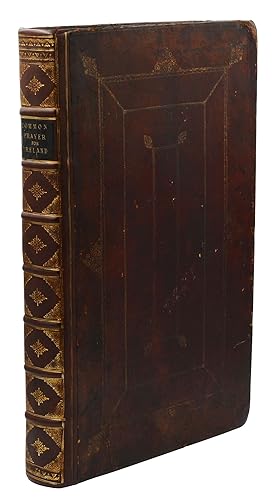
The Book of Common Prayer, and Administration of the Sacraments, and Other Rites and Ceremonies of the Church, According to the Use of the Church of Ireland; Psalter or Psalms of David, Pointed as They are to Be Sung or Said in Churches: and the Form or Manner of Making, Ordaining, and Consecrating of Bishops, Priests, and Deacons
Editore: Printed by and for George Grierson, at the Two Bibles in Essex-Street, Dublin, 1721
Da: Burnside Rare Books, ABAA, Portland, OR, U.S.A.
Membro dell'associazione: ABAA CBA ILAB
Valutazione del venditore 5 su 5 stelle

First thus. Folio measuring 17.5" x 11.5", over 2" thick. Contemporary calf over new leather spine in eight compartments, elaborately ruled in gilt, black title label lettered in gilt, all edges gilt. Text ruled in red with engraved headpieces. Very Good+, sturdily bound with wear to calf, dulling to gilt, a few ink stains to fore edge, corner crease to prelims, former owners' names written on front free endpaper (dating up to 1850); small ink number written on page facing table of contents and a single inked number in margin of another page, contents otherwise unmarked. Scarce in commerce, as later printings and editions of this work printed by Grierson have shown up at auction but none of the original 1721 edition have since 1932. Called "the finest" Book of Common Prayer that "had been printed in Dublin" by The Royal Society of Antiquaries of Ireland in 1920. One of the Irish artist James Gwim's greatest works was the frontispiece. Around 1755, he left Dublin for London where he worked for John Brooks as a designer of snuff-box lids at the Battersea Enamel Works, living in seclusion. An eccentric, he refused to leave his room for long periods of time, and was found dead in it after a brawl with a friend about his agoraphobia in 1769. The Book of Common Prayer was the first book printed in Ireland. Benton 275.
-
Antique Print-ANGELO-FENCING-MANUAL-PARADE-SECONDE-PLATE-18-Hall-Gwim-1763
Data di pubblicazione: 1763
Da: Pictura Prints, Art & Books, Overasselt, Paesi Bassi
Membro dell'associazione: ILAB NVVA
Valutazione del venditore 5 su 5 stelle
Arte / Stampa / Poster
EUR 225,00
Spedizione EUR 20,00
Spedito da Paesi Bassi a U.S.A.Quantità: 1 disponibili
Aggiungi al carrelloJames Gwim (illustratore). 'DE LA PARADE DE SECONDE SUR LE COUP DE SECONDE. PLATE 18. PUBLISHED ACCORDING TO ACT OF PARLIAMENT, FEB. 1763.'Two gentlemen demonstrating the parry in second position against a thrust in second. An elegant print from Angelo's renowned fencing manual "L'Ecole des Armes". Made by Charles Hall after James Gwim.Medium: Copperplate Engraving on hand-laid (verge) paper.Sheet size: 29.8 x 47.6 cm (11.73 x 18.74 inch). Image size: 25.4 x 37.5 cm. (10 x 14.76 inch).DOMENICO ANGELO, FENCING, L'ECOLE DES ARMES, 18TH CENTURY, COPPERPLATE ENGRAVING, HALL, LONDON, GENTLEMANLY ARTS | EXPO-434BACKGROUND INFORMATIONL'Ecole des Armes by Domenico Angelo. Published by R. & J. Dodsley, London, 1763. During the eighteenth-century, fencing was a popular sport among the English royalty and aristocracy, primarily learned on the Continent until the Italian fencing master Domenico Angelo Malevolti Tremamondo established his fencing school in London. A riding instructor by trade, Angelo was born in Leghorn, Italy in 1716 and briefly trained with the celebrated fencer Monsieur Teillagory in Paris. After arriving in England in 1755, he participated in and won several public fencing matches, quickly earning a reputation that helped him secure high-ranking clients such as the Duke of Devonshire and the Earl of Pembroke. He soon capitalized on his popularity by establishing Angelo's School of Arms, where he taught horsemanship as well as fencing to an affluent and fashionable clientele. Angelo also continued to teach privately and in 1758, instructed the Prince of Wales and the Duke of York. Over the years, his school became a venerable British institution, which was run by successive generations of the Angelo family until the early twentieth-century. In 1763, Angelo published L'Ecole d'Armes, a respected fencing handbook comprised of beautifully illustrated plates by renowned English artists like Chamber, Gwyn and Ryland depicting principal fencing positions, and esteemed by many as the ultimate authority on fencing.Reference: Lipperheide 2974.Biography engraver: Charles Hall (1720-1783) was a London-based artist, who initially trained as a letter engraver before taking up pictorial engraving. He is best-known for his portrait work and his engraved plates after Hans Holbein and Philip James de Loutherbourg, amongst others.Biography artist: James Gwim or Gwinn (c.1720-1769) was an Irish artist. Condition: very good, given age. Light soiling, foxing and creasing. General age-related toning and/or occasional minor defects from handling. Please study scan carefully.
-
Antique Print-ANGELO-FENCING-MANUAL-DESARMEMENT-PLATE-36-Hall-Gwim-1763
Data di pubblicazione: 1763
Da: Pictura Prints, Art & Books, Overasselt, Paesi Bassi
Membro dell'associazione: ILAB NVVA
Valutazione del venditore 5 su 5 stelle
Arte / Stampa / Poster
EUR 225,00
Spedizione EUR 20,00
Spedito da Paesi Bassi a U.S.A.Quantità: 1 disponibili
Aggiungi al carrelloJames Gwim (illustratore). 'DU DESARMEMENT SUR LE COUP DE TIERCE. PL. 36. PUBLISHED ACCORDING TO ACT OF PARLIAMENT, FEB. 1763.'Two gentlemen demonstrating the disarming technique in tierce. An elegant print from Angelo's renowned fencing manual "L'Ecole des Armes". Made by Charles Hall after James Gwim.Medium: Copperplate Engraving on hand-laid (verge) paper.Sheet size: 29.8 x 47.6 cm (11.73 x 18.74 inch). Image size: 25.4 x 37.5 cm. (10 x 14.76 inch).DOMENICO ANGELO, FENCING, L'ECOLE DES ARMES, 18TH CENTURY, COPPERPLATE ENGRAVING, HALL, LONDON, GENTLEMANLY ARTS | EXPO-434BACKGROUND INFORMATIONL'Ecole des Armes by Domenico Angelo. Published by R. & J. Dodsley, London, 1763. During the eighteenth-century, fencing was a popular sport among the English royalty and aristocracy, primarily learned on the Continent until the Italian fencing master Domenico Angelo Malevolti Tremamondo established his fencing school in London. A riding instructor by trade, Angelo was born in Leghorn, Italy in 1716 and briefly trained with the celebrated fencer Monsieur Teillagory in Paris. After arriving in England in 1755, he participated in and won several public fencing matches, quickly earning a reputation that helped him secure high-ranking clients such as the Duke of Devonshire and the Earl of Pembroke. He soon capitalized on his popularity by establishing Angelo's School of Arms, where he taught horsemanship as well as fencing to an affluent and fashionable clientele. Angelo also continued to teach privately and in 1758, instructed the Prince of Wales and the Duke of York. Over the years, his school became a venerable British institution, which was run by successive generations of the Angelo family until the early twentieth-century. In 1763, Angelo published L'Ecole d'Armes, a respected fencing handbook comprised of beautifully illustrated plates by renowned English artists like Chamber, Gwyn and Ryland depicting principal fencing positions, and esteemed by many as the ultimate authority on fencing.Reference: Lipperheide 2974.Biography engraver: Charles Hall (1720-1783) was a London-based artist, who initially trained as a letter engraver before taking up pictorial engraving. He is best-known for his portrait work and his engraved plates after Hans Holbein and Philip James de Loutherbourg, amongst others.Biography artist: James Gwim or Gwinn (c.1720-1769) was an Irish artist. Condition: very good, given age. Light soiling, foxing and creasing. General age-related toning and/or occasional minor defects from handling. Please study scan carefully.
-
Antique Print-ANGELO-FENCING-MANUAL-SALUT-POSITION-PLATE-13-Ryland-Gwim-1763
Data di pubblicazione: 1763
Da: Pictura Prints, Art & Books, Overasselt, Paesi Bassi
Membro dell'associazione: ILAB NVVA
Valutazione del venditore 5 su 5 stelle
Arte / Stampa / Poster
EUR 225,00
Spedizione EUR 20,00
Spedito da Paesi Bassi a U.S.A.Quantità: 1 disponibili
Aggiungi al carrelloJames Gwim (illustratore). 'QUATRIEME POSITION DU SALUT. PLATE 13. PUBLISHED ACCORDING TO ACT OF PARLIAMENT, FEB. 1763.'A gentleman fencer demonstrating the fourth position of the salute. An elegant print from Angelo's renowned fencing manual "L'Ecole des Armes".Made by William Wynne Ryland after James Gwim.Medium: Copperplate Engraving on hand-laid (verge) paper.Sheet size: 29.8 x 47.6 cm (11.73 x 18.74 inch). Image size: 25.4 x 37.5 cm. (10 x 14.76 inch).DOMENICO ANGELO, FENCING, L'ECOLE DES ARMES, 18TH CENTURY, COPPERPLATE ENGRAVING, RYLAND, LONDON, GENTLEMANLY ARTS | EXPO-434BACKGROUND INFORMATIONL'Ecole des Armes by Domenico Angelo. Published by R. & J. Dodsley, London, 1763. During the eighteenth-century, fencing was a popular sport among the English royalty and aristocracy, primarily learned on the Continent until the Italian fencing master Domenico Angelo Malevolti Tremamondo established his fencing school in London. A riding instructor by trade, Angelo was born in Leghorn, Italy in 1716 and briefly trained with the celebrated fencer Monsieur Teillagory in Paris. After arriving in England in 1755, he participated in and won several public fencing matches, quickly earning a reputation that helped him secure high-ranking clients such as the Duke of Devonshire and the Earl of Pembroke. He soon capitalized on his popularity by establishing Angelo's School of Arms, where he taught horsemanship as well as fencing to an affluent and fashionable clientele. Angelo also continued to teach privately and in 1758, instructed the Prince of Wales and the Duke of York. Over the years, his school became a venerable British institution, which was run by successive generations of the Angelo family until the early twentieth-century. In 1763, Angelo published L'Ecole d'Armes, a respected fencing handbook comprised of beautifully illustrated plates by renowned English artists like Chamber, Gwyn and Ryland depicting principal fencing positions, and esteemed by many as the ultimate authority on fencing.Reference: Lipperheide 2974.Biography engraver: William Wynne Ryland (1732/1738-1783) was an English engraver, who pioneered stipple engraving and was executed for forgery.Biography artist: James Gwim or Gwinn (c.1720-1769) was an Irish artist. Condition: very good, given age. Light soiling, foxing and creasing. General age-related toning and/or occasional minor defects from handling. Please study scan carefully.