Importo totale (1 articolo articoli):
Destinazione ordine:

ives frederic eugene henry hess (2 risultati)
Vai alla pagina principale dei risultati di ricerca
Filtri di ricerca
Tipo di articolo
- Tutti i tipi di prodotto
- Libri (2)
- Riviste e Giornali (Nessun altro risultato corrispondente a questo perfezionamento)
- Fumetti (Nessun altro risultato corrispondente a questo perfezionamento)
- Spartiti (Nessun altro risultato corrispondente a questo perfezionamento)
- Arte, Stampe e Poster (Nessun altro risultato corrispondente a questo perfezionamento)
- Fotografie (Nessun altro risultato corrispondente a questo perfezionamento)
- Mappe (Nessun altro risultato corrispondente a questo perfezionamento)
- Manoscritti e Collezionismo cartaceo (Nessun altro risultato corrispondente a questo perfezionamento)
Condizioni Maggiori informazioni
- Nuovo (Nessun altro risultato corrispondente a questo perfezionamento)
- Come nuovo, Ottimo o Quasi ottimo (Nessun altro risultato corrispondente a questo perfezionamento)
- Molto buono o Buono (1)
- Discreto o Mediocre (Nessun altro risultato corrispondente a questo perfezionamento)
- Come descritto (1)
Legatura
- Tutte
- Rilegato (Nessun altro risultato corrispondente a questo perfezionamento)
- Brossura (1)
Ulteriori caratteristiche
- Prima ed. (Nessun altro risultato corrispondente a questo perfezionamento)
- Copia autograf. (Nessun altro risultato corrispondente a questo perfezionamento)
- Sovracoperta (Nessun altro risultato corrispondente a questo perfezionamento)
- Con foto (2)
- Non Print on Demand (2)
Lingua (1)
Prezzo
- Qualsiasi prezzo
- Inferiore a EUR 20 (Nessun altro risultato corrispondente a questo perfezionamento)
- EUR 20 a EUR 45 (Nessun altro risultato corrispondente a questo perfezionamento)
- Superiore a EUR 45
Spedizione gratuita
- Spedizione gratuita in U.S.A. (Nessun altro risultato corrispondente a questo perfezionamento)
Paese del venditore
Valutazione venditore
-
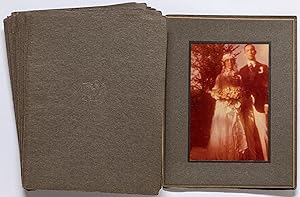
A Collection of Eight Early "Hicrome" Color Photographs, circa 1914-16
Editore: Hess-Ives Corporation, Philadelphia, 1914
Da: Between the Covers-Rare Books, Inc. ABAA, Gloucester City, NJ, U.S.A.
Membro dell'associazione: ABAA ESA ILAB IOBA
Valutazione del venditore 5 su 5 stelle

Softcover. Condizione: Very Good. A collection of eight rare "Hicrome" color photographs. Each print measures over 4" x 6", neatly mounted in a studio mat frame with tissue guard, laid down inside a thick paper portfolio (7" x 9") with a blind embossed pictorial device on the front cover. Most have a paper label on the back of the mount: "Hicrography: Hess-Ives Color Photograph / Hicrome: A color photograph", including a patent dated 1914; two prints have a separate paper ticket listing patents dating from 1903 - 1916. The collection consists of one image of a wedding couple taken outdoors, one large outdoor family portrait, three duplicate copies (in variant colors) of a woman in a drawing room, two duplicate copies of a young couple seated in front of a grove of trees with two open tents, and one copy of an older couple seated in front of the same woodland and tents. One duplicate print is partly damaged with a stain at the lower right corner, else very good or better overall with a few small tears and chips at the edges of the portfolio covers and tissue guards. Although Henry Hess's surname received top billing as President, the creative genius behind the landmark photography firm, Hess-Ives Corporation, was the inventor Frederic Eugene Ives. In the 1890s he developed a photochromoscope camera capable of producing color photographs from three sensitized plates. Exhibited at the Royal Photographic Society (RPS) in London, Ives was awarded a RPS fellowship as well as several scientific medals of achievement. In 1911 he partnered with the entrepreneur Henry Hess to form the Hess-Ives Corporation, which pioneered "hicrography," a unique dye imbibition color printing system. The dye imbibition process did not become commercially viable until the 1940s, when Kodak further developed the process under the "Dye Transfer" product trade name. A nice cache of well-preserved, scarce color prints taken before the First World War, each displaying a remarkable clarity of contrasting colors. Only one other Hicrome color photograph by Ives, a 1905 portrait of Mark Twain, has come up at auction in 2011.
-
A SMALL ARCHIVE OF CATALOGUES AND LETTERS OF AN EARLY PRACTITIONER
Editore: Hess-Ives Corporation, Philadelphia, 1917
Da: Andrew Cahan: Bookseller, Ltd., ABAA, Akron, OH, U.S.A.
Membro dell'associazione: ABAA ILAB
Valutazione del venditore 5 su 5 stelle
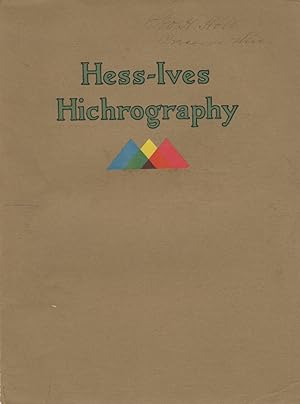
This collection, once owned by George H. Holt, contains the following: HESS-IVES HICHROGRAPHY. 8vo., 12 pp., illustrations from b&w photographs. String-tied decorative stiff wrappers. Faint dampstain; owner's name on the front wrapper, which is creased at the lower front corner. A three page price list is laid-in with holograph corrections. Very good. [with] HESS-IVES HICHROGRAPHY. Philadelphia: Hess-Ives Corporation, February 1916. 8vo., 31 pp., b&w and color illustrations. Decorative stiff wrappers. Previous owner's neat signature on the front wrapper. Faint dampstain and wrinkling. A near very good copy. [with] A folded typed two-page detailed instructions for exposing, developing and printing the "Hicrome" color prints. [with] A folded one-page typed letter signed and dated June 27, 1917, by F. E. Ives on Hess-Ives Corporation letterhead, addressed to Mr Holt, whose signature is on the printed catalogues. [with] Two folded, recto printed, single sheet advertisements, each picturing two of the four different Hicro cameras with prices. The catalogue dated December 1915, is the introductory catalogue for the ingenious camera that was capable of producing direct color photographs (Hichrography) from three negatives simultaneously exposed, as well as conventional b&w. The camera, available in 3 sizes (another was introduced three months later) is pictured and priced. This process was awarded the first United States patent in color photography. The laid-in price list also includes plate holders, film, paper and chemicals. The February 1916 catalogue is the second issued by the manufacturer, and increased the number of camera sizes to four. In his June 1917 letter to Mr. Holt, F.E. Ives states that he will be sending additional Hipacks, as well as his 5 x 7 camera for the Hiblock process (an adaptation of Ducos du Haron's tripack) along with holders which should be returned for processing. Ives' further writes that he is almost ready to demonstrate his "moving picture color process", on which he held three pending patents; tipped to the letter is a 2 1/4 frame sample.